


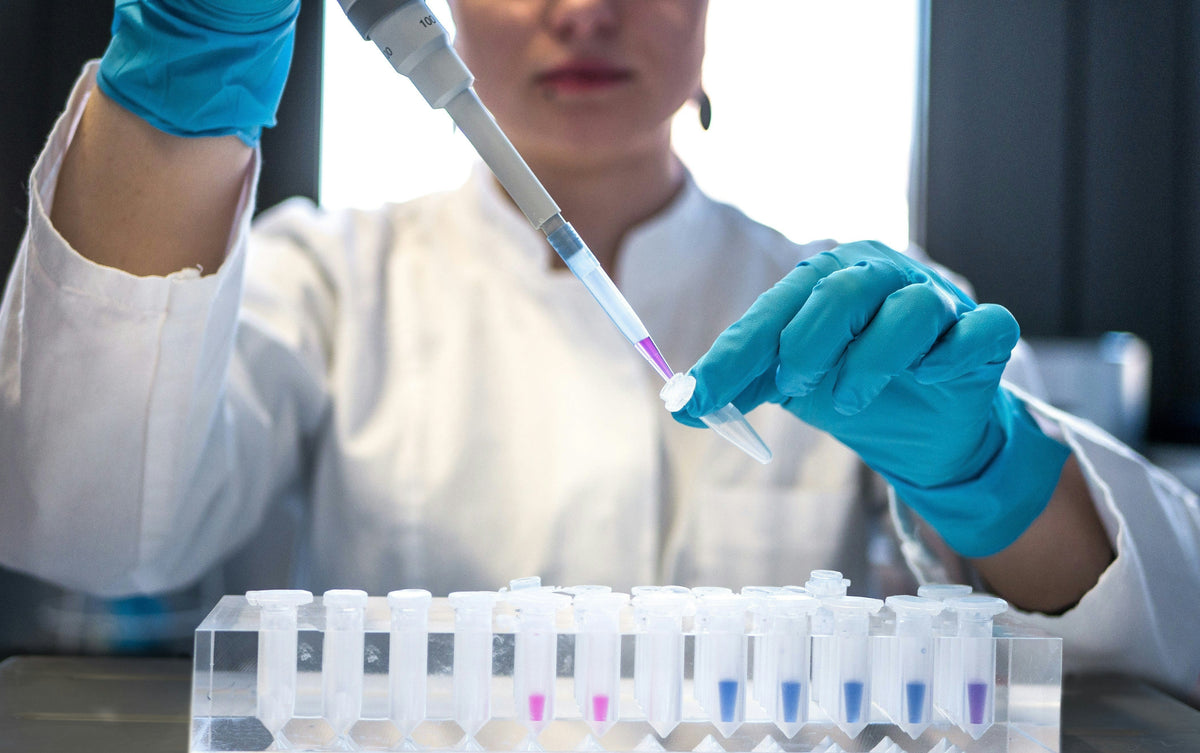
The short answer: no single laboratory test can tell you whether a mushroom extract is “good”. Different tests answer different questions. NMR can help assess a material's wider chemical fingerprint, while LC-MS can separate and investigate individual compounds within a complex extract. Used alongside conventional contaminant and specification testing, they can provide a much fuller picture of what the ingredient actually contains.
“Lab tested.”
You'll see those words everywhere.
On mushroom supplements.
Herbal extracts.
Protein powders.
Vitamins.
It's reassuring.
But by itself, it's almost meaningless.
Tested for what?
A laboratory might test a mushroom powder for heavy metals.
Useful.
That doesn't tell you whether it's actually the fungal species printed on the label.
Another test might measure beta-glucans.
Also useful.
That doesn't tell you whether characteristic compounds associated with that mushroom can be detected.
Another might confirm a chemical fingerprint.
Again useful.
But that doesn't replace microbiological or contaminant testing.
Different tests answer different questions.
That's why our approach to mushroom quality is increasingly based on layers of evidence, rather than one certificate or one impressive number.
If you're new to mushroom specifications, start with What Are Functional Mushrooms? A Guide to Lion’s Mane, Reishi, Chaga & Cordyceps.
What does “lab tested” actually mean?
Nothing specific until the test is named.
The phrase could refer to testing for:
- heavy metals
- microbiology
- pesticides
- moisture
- identity
- beta-glucans
- alpha-glucans
- individual chemical compounds
- broader chemical fingerprint
- batch consistency
All of those can be legitimate forms of analysis.
But they aren't interchangeable.
If a product says:
Lab tested for purity
we'd still want to ask:
Which laboratory?
Which sample?
Which tests?
Which methods?
What were the actual results?
That's one reason we'll also be writing How to Read a Mushroom Certificate of Analysis Without Being Fooled by the Paperwork.
There are different layers of mushroom testing
We find it useful to think of testing in several layers.
1. Safety and contaminants
This can include heavy metals, microbiological contamination and other unwanted substances.
These tests help answer:
Is there something in this material that shouldn't be there?
2. Specification testing
This may include moisture, beta-glucans, alpha-glucans and other defined compositional markers.
These tests help answer:
Does the ingredient meet its stated specification?
3. Identity and authenticity
This is a different question.
Is the material actually consistent with what it claims to be?
Depending on the ingredient and method, this can involve microscopy, DNA-based methods, spectroscopy or chemical fingerprinting.
4. Compound profiling
This asks:
Which individual molecules can actually be detected in the extract?
That's where techniques such as LC-MS become particularly useful.
One layer doesn't replace another.
A sophisticated mass spectrometer doesn't make heavy-metal testing unnecessary.
And a clean microbiology result doesn't prove species identity.
Why identity can become difficult after extraction
Imagine being handed an intact Lion’s Mane fruiting body.
Its appearance alone gives you useful information.
Now imagine that mushroom being dried, extracted, concentrated and turned into a fine brown powder.
Much of the obvious physical identity has disappeared.
You can't look at a capsule of powdered extract and recognise:
Hericium erinaceus
in the same way you can recognise the intact mushroom.
That means analytical techniques become increasingly useful once ingredients are heavily processed.
This isn't unique to mushrooms.
It's a common problem across botanical and food ingredients.
What is NMR?
NMR stands for Nuclear Magnetic Resonance.
The name sounds like something that should require safety goggles and a physics degree.
The basic principle is easier to understand.
Certain atomic nuclei respond in characteristic ways when placed in a strong magnetic field and exposed to radiofrequency energy.
Their response depends partly on the chemical environment surrounding them.
That produces a spectrum containing a large amount of information about the sample.
In complex natural materials, the overall spectrum can function like a chemical fingerprint.
What is an NMR fingerprint?
Imagine two musical chords.
They might contain some of the same individual notes.
But the complete pattern makes them distinguishable.
A chemical fingerprint works in a vaguely similar way.
Rather than looking only for one molecule, an untargeted NMR approach can examine a much broader pattern across the sample.
That pattern can then be compared with suitable reference materials and analysed statistically.
NMR-based metabolomics has been used in research to differentiate Ganoderma lucidum samples from different cultivation sources, demonstrating that spectral profiles can reveal differences that aren't obvious from physical appearance alone.
More broadly, NMR metabolomics has become an established area of food-authentication research.
Does NMR prove that a mushroom extract is authentic?
We wouldn't phrase it that strongly on its own.
NMR is a powerful analytical tool.
But interpretation depends on:
the sample,
the protocol,
the quality of reference material,
the database or spectral library,
the statistical model,
and the question being asked.
When an unknown sample's fingerprint is compared against well-characterised references, NMR can provide powerful evidence supporting identity and consistency.
But:
one test shouldn't be turned into a magical authenticity stamp.
That's true of analytical chemistry generally.
Why use a fingerprint rather than just test one compound?
Because natural products are complicated.
Suppose we identify one molecule that occurs in Reishi.
That may be useful.
But what if that molecule also occurs in another fungus?
Or what if someone simply adds an isolated compound to an otherwise poor ingredient?
Looking at a broader chemical pattern can provide information that a single marker can't.
This is one of the reasons metabolomic fingerprinting is increasingly interesting for food and natural-product authentication.
A recent review of Ganoderma quality control describes the value of combining taxonomic information with metabolomic techniques such as LC-MS and NMR rather than relying on one type of evidence alone.
What is LC-MS?
LC-MS stands for:
Liquid Chromatography Mass Spectrometry.
It's actually two analytical technologies working together.
Liquid chromatography
A mushroom extract contains many different compounds mixed together.
Liquid chromatography helps separate that mixture.
Different compounds travel through the chromatography system differently, so they emerge at different times.
This gives the analytical instrument a better chance of examining individual components rather than trying to understand the whole mixture at once.
Mass spectrometry
The separated compounds then enter the mass spectrometer.
Mass spectrometry analyses ions according to their mass-to-charge characteristics.
With sufficiently sophisticated instrumentation, the resulting data can help scientists investigate which compounds may be present.
What does ESI-QTOF mean?
You'll sometimes see the longer term:
LC-ESI-QTOF-MS
which looks specifically designed to make normal people stop reading.
Let's translate it.
LC = Liquid Chromatography
ESI = Electrospray Ionisation
QTOF = Quadrupole Time-of-Flight
MS = Mass Spectrometry
Electrospray ionisation helps transfer molecules from the liquid chromatography system into charged ions that the mass spectrometer can analyse.
The QTOF instrument can then measure ion masses with high accuracy and generate detailed mass-spectral information.
You do not need to remember any of that to buy a mushroom supplement.
The useful point is simply:
This type of analysis allows us to investigate individual compounds within a very complicated extract.
Has LC-MS actually been used to study mushrooms?
Extensively.
For example, researchers have used LC-MS/MS techniques to investigate hericenones in Lion’s Mane fruiting bodies.
HPLC-ESI-QTOF-MS/MS has been used to identify and quantify compounds including betulin, betulinic acid and inotodiol in Chaga preparations.
LC-MS-based metabolomics and related chromatographic approaches have also been used extensively to examine characteristic triterpenoids in Ganoderma species.
That's why this sort of analysis interests us.
It moves the conversation from:
These compounds are associated with this mushroom species.
towards:
Can we actually see evidence of them in the material being analysed?
Detection, identification and quantification aren't the same thing
This distinction matters enormously.
Detection
A signal consistent with a particular compound is observed.
Identification
There is sufficient analytical evidence to assign that signal to a particular compound, ideally with appropriate reference information or standards.
Quantification
The analysis determines how much of the compound is present, generally using validated methods, calibration and suitable standards.
Those stages shouldn't be blurred together.
Finding a mass-spectral feature that appears consistent with a molecule isn't automatically the same as accurately quantifying it.
This matters when supplement companies produce spectacular lists of compounds supposedly found in an extract.
Our preference is to be clear about what the analysis actually supports.
Why reference standards matter
If a laboratory wants to accurately quantify a particular molecule, it generally needs more than simply recognising an interesting signal.
Analytical standards can help establish:
retention behaviour,
spectral characteristics,
calibration curves,
and concentration.
Quality-control samples and blanks also help assess whether the analytical run is behaving as expected.
This is one reason compound-level testing can become considerably more involved than simply putting a powder into a machine and receiving a list of ingredients.
What compounds might be looked for in mushroom extracts?
The answer depends on the mushroom and fungal material.
For example, analytical work may investigate compounds associated with:
Lion’s Mane
Hericenones and related metabolites are particularly associated with fruiting-body material.
Cultured mycelium has a different profile, including erinacines.
This distinction is central to Lion’s Mane Mushroom: Benefits, Cognitive Support and How It Works.
Reishi
Reishi contains characteristic triterpenoids, including numerous ganoderic and lucidenic acids.
Chaga
Chemical analysis of Chaga has examined compounds including inotodiol, betulin and betulinic acid.
Cordyceps
Cordyceps materials can be examined for nucleosides and other characteristic metabolites, with the expected profile depending on the actual fungal material being used.
The point isn't that one compound defines a “good mushroom”.
It's that different mushrooms should have different chemical stories.
Why this matters for Lion’s Mane
Lion’s Mane provides a particularly good example.
A specification might say:
Lion’s Mane
fruiting body
15:1 extract
beta-glucans measured
That's already useful information.
But it still leaves another question:
Does the chemical profile support the claim that we're dealing with a Lion’s Mane fruiting-body extract?
If analysis detects compounds associated with that fungal material, that can add another piece to the evidence.
Conversely, if a fruiting-body-only product heavily markets a compound principally associated with cultured mycelium, we'd want much stronger evidence before repeating that claim.
That's why our revised Lion’s Mane approach distinguishes carefully between hericenones and erinacines.
Why beta-glucan testing isn't enough on its own
Beta-glucan data can be useful.
But Lion’s Mane and Reishi can both contain beta-glucans.
So if both products show a similar beta-glucan percentage, that doesn't tell us why one is Lion’s Mane and the other is Reishi.
That's where wider chemical profiling can add context.
Read Beta-Glucans vs Polysaccharides: What Do Mushroom Supplement Numbers Really Mean? for the full explanation.
Why extraction ratio isn't enough either
The same applies to extraction ratio.
Two powders can both say:
10:1 extract.
That doesn't mean they have the same chemical profile.
It doesn't even mean two extracts of the same mushroom are necessarily identical.
Starting material, extraction conditions, solvents and processing can all influence the final composition.
That's why What Does 10:1, 15:1 or 8:1 Mushroom Extract Actually Mean? is another important part of this guide.
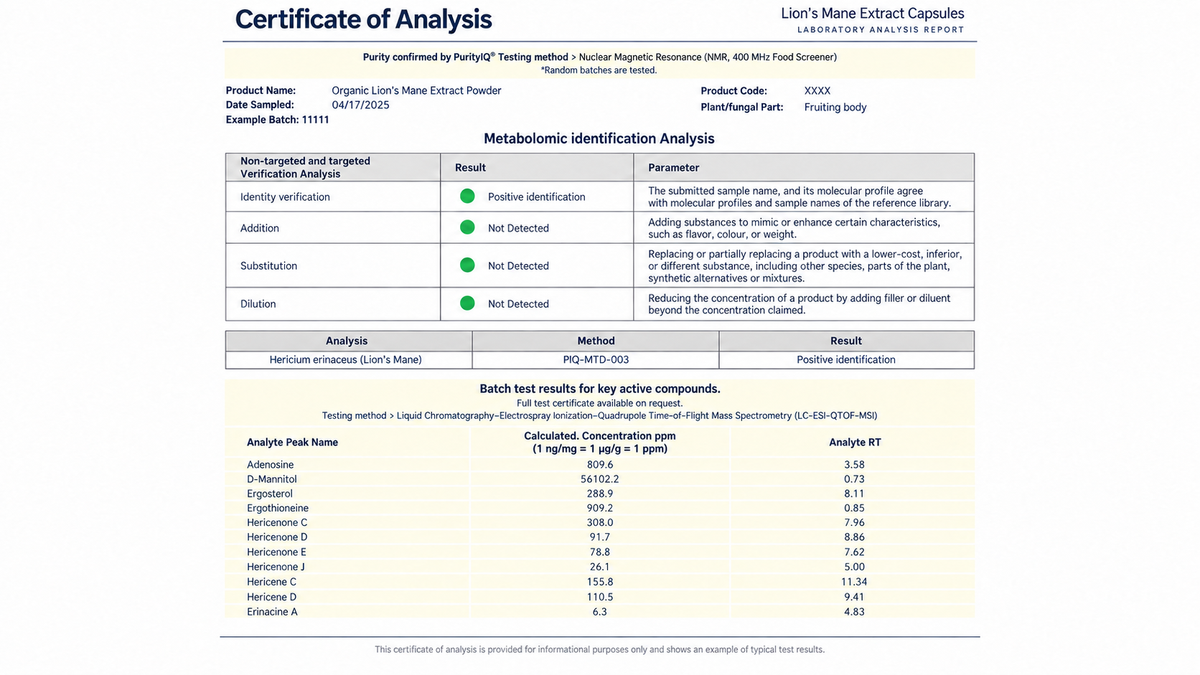
How does this fit with a Certificate of Analysis?
A Certificate of Analysis, or COA, is essentially a summary of analytical results against defined specifications.
It might show:
Specification: Beta-glucans minimum 30%
Result: 34.2%
Useful.
But the quality of a COA depends on the quality and relevance of the testing behind it.
Questions worth asking include:
Who performed the test?
Which method was used?
Was the sample from the relevant batch?
What date was it tested?
Does the result show an actual measurement or simply “Pass”?
Is identity included?
Are contaminants included?
Are the claimed characteristic compounds actually analysed?
We'll tackle all of this in How to Read a Mushroom Certificate of Analysis Without Being Fooled by the Paperwork.
How does One Life use this type of testing?
We don't have an NMR spectrometer or LC-QTOF mass spectrometer sitting behind the packing bench.
These are highly specialised laboratory instruments.
The analytical programme supporting the mushroom extracts we've selected includes advanced identity and compound-profile information alongside more conventional ingredient specifications.
For us, the important change is philosophical.
We're increasingly reluctant to rely on:
“It's 15:1.”
or:
“It's 30% beta-glucans.”
or:
“It's fruiting body.”
as the complete quality argument.
Instead, we want several pieces of information to agree.
Is the species right?
Is the fungal material right?
Does the extraction specification make sense?
Does the glucan testing make sense?
Does the broader chemical fingerprint make sense?
Can relevant compounds actually be detected?
That gives us a much more useful picture.
You can see the resulting products in our Functional Mushrooms collection.
Does advanced testing prove a mushroom supplement works?
No.
And this distinction is particularly important.
Analytical testing tells us about the material.
It can help investigate:
identity,
composition,
consistency,
and the presence or amount of particular chemical compounds.
It doesn't automatically establish a health outcome.
If LC-MS detects a compound that has been investigated in a scientific study, that doesn't mean the extract has been clinically proven to produce the result from that study.
Those are separate questions.
That's the same evidence distinction we apply throughout Lion’s Mane Mushroom: Benefits, Cognitive Support and How It Works.
Does NMR or LC-MS replace safety testing?
No.
A beautiful chemical fingerprint doesn't tell us everything about heavy-metal levels.
Compound profiling doesn't automatically answer microbiological questions.
Different tests have different jobs.
Our preferred approach is therefore not:
Find the fanciest instrument and ignore everything else.
It's:
Use the right analytical tool for the right question.
That's considerably less exciting as a slogan.
It's considerably better quality control.
Can laboratory testing detect adulteration?
Analytical techniques can help identify unusual or non-conforming composition.
NMR-based metabolomics has been used in food authentication because complex fingerprints can be compared across reference and unknown samples.
Chromatographic and mass-spectrometric methods can similarly reveal chemical patterns inconsistent with the expected material.
But again, we'd avoid claiming that any single test catches every possible form of adulteration.
Food authenticity is an analytical puzzle.
Different techniques provide different pieces.
Why we think this matters
The mushroom industry has become very good at talking about what should be inside a product.
Lion’s Mane should contain this.
Reishi should contain that.
Chaga contains these.
Cordyceps contains those.
That's useful background science.
But eventually we want to move from:
What should theoretically be there?
to:
What did the analysis actually find?
That's probably the single biggest change in how we're approaching mushroom quality.
And it leads to a phrase you'll see repeatedly throughout the One Life Mushroom Guide:
Don't just tell us what's supposed to be in the mushroom. Show us what's actually in the extract.
Continue Exploring
Beta-Glucans vs Polysaccharides: What Do Mushroom Supplement Numbers Really Mean?
Understand what one of the most common mushroom specification numbers actually measures.
What Does 10:1, 15:1 or 8:1 Mushroom Extract Actually Mean?
Why concentration ratios don't tell us what compounds actually survived extraction.
Fruiting Body vs Mycelium: It’s More Complicated Than “One Is Good and One Is Bad”
See why identifying the actual fungal material matters before we even begin analysing it.
Lion’s Mane Mushroom: Benefits, Cognitive Support and How It Works
See how analytical identity and research evidence need to be kept separate when discussing Lion’s Mane.
References
Wen H, Kang S, Song Y, et al. Differentiation of cultivation sources of Ganoderma lucidum by NMR-based metabolomics approach. Phytochemical Analysis. The study demonstrated the use of NMR spectra and multivariate analysis to distinguish Reishi samples from different cultivation sources.
A 2024 review describes the growing role of NMR metabolomics and chemical fingerprinting in food authentication while also noting the importance of validated workflows and reference data.
Recent work on Hericium erinaceus has used LC-MS/MS to investigate characteristic hericenones in Lion’s Mane fruiting bodies.
Chemical research on Inonotus obliquus has used HPLC-ESI-QTOF-MS/MS to investigate and quantify Chaga compounds including betulin, betulinic acid and inotodiol.
A recent review of Ganoderma systematics and metabolomics describes LC-MS and related profiling as useful complementary tools for chemical characterisation and quality control.
Written By
Written by Chris Simon, Founder of One Life Foods.
Chris has worked in the supplement industry since 2009 and is known for seeking out exceptional ingredients, products, and formulations. Read more about Chris and the story behind One Life Foods.

Share:
Hindu Kush Shilajit: History, Folklore and a Distinctive Mountain Resin
Reishi Mushroom: Fruiting Body, Extracts, Ganoderic Acids & What Quality Really Means