


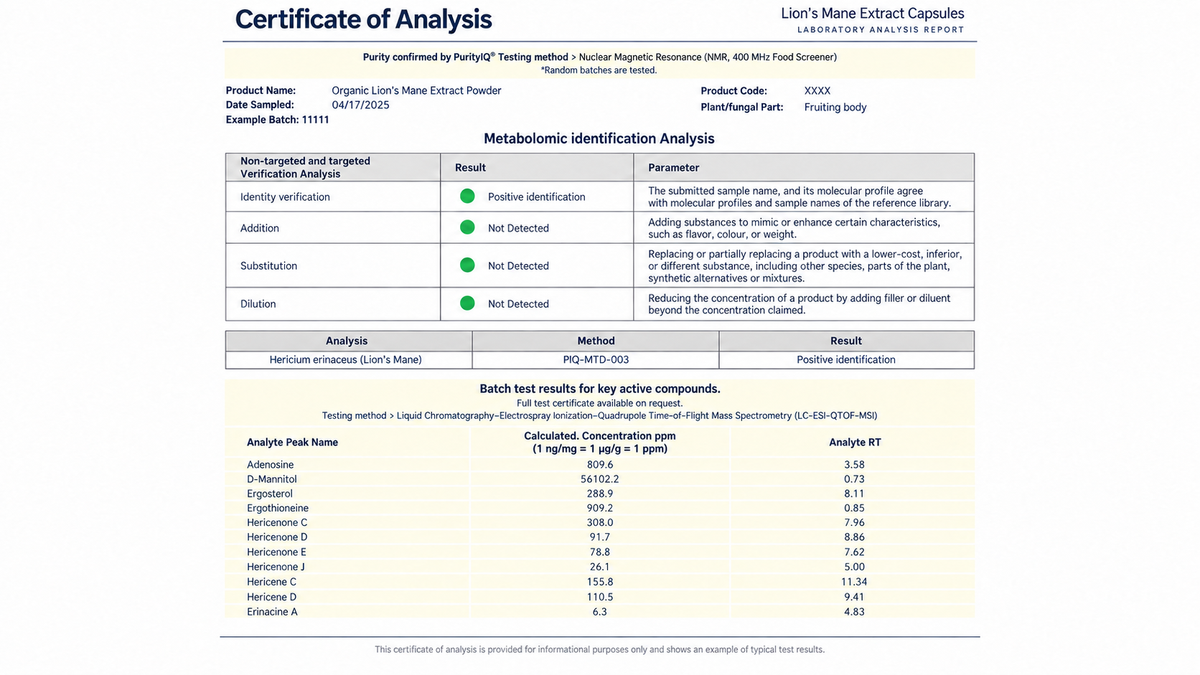
The short answer: a useful Certificate of Analysis should tell you what material was tested, which batch it came from, what was tested, how it was tested, what limits or specifications applied, and what the actual results were. A page full of ticks and the word “PASS” may look impressive, but it can still leave some very important questions unanswered.
We like Certificates of Analysis.
We just don't worship them.
A COA can be a genuinely useful piece of quality documentation.
It can help show whether an ingredient met specifications for things such as:
identity,
microbiology,
heavy metals,
moisture,
beta-glucans,
and other defined characteristics.
But there's a problem.
The phrase “Certificate of Analysis available” has itself become a marketing claim.
And a very official-looking PDF doesn't automatically mean a product has undergone comprehensive testing.
The question isn't:
Does this mushroom have a COA?
The better question is:
What does the COA actually tell us?
That's what we're going to unpack.
If you'd like to understand the analytical techniques themselves first, read How We Test Mushroom Extracts: NMR, LC-MS and What the Results Actually Tell Us.
What is a Certificate of Analysis?
A Certificate of Analysis, usually shortened to COA, is a document reporting analytical information about a particular material or product.
At its simplest, it normally compares:
a specification
with
a test result.
For example:
| Test | Specification | Result |
|---|---|---|
| Moisture | Maximum 8% | 5.4% |
| Beta-glucans | Minimum 25% | 31.2% |
| Lead | Maximum defined limit | Actual laboratory result |
| Microbiology | Defined limit | Actual result or pass/fail |
The exact format varies considerably.
Some COAs are detailed laboratory reports.
Others are supplier-issued summaries.
Some contain actual numerical results.
Others contain little more than:
PASS
PASS
PASS
The US FDA's dietary-supplement guidance provides a useful general definition of a COA as a document supplied for a component that records particular characteristics or attributes. It also emphasises the value of recording the test method, limits and actual results.
The specific US regulations don't apply to UK food supplements, but the principle is useful:
A COA should contain meaningful analytical information, not simply look scientific.
Is a COA the same thing as a product specification?
No.
This distinction is fundamental.
Specification
A specification tells you what the material is supposed to meet.
For example:
Beta-glucans: minimum 25%
Result
The result tells you what the analysed sample actually measured.
For example:
Beta-glucans: 31.4%
Those are not the same thing.
A document that shows:
Beta-glucans: ≥25%
but doesn't provide an actual measured result may simply be reproducing the product specification.
That's considerably less informative than:
Specification: ≥25%
Result: 31.4%
When we read a COA, we want to distinguish carefully between what was promised and what was measured.
The first thing we'd check: does the batch match?
This may be the least glamorous part of the whole process.
It's also one of the most important.
Look for:
batch number
or
lot number.
Then ask:
Does it relate to the ingredient or product you're actually buying?
A beautiful COA from three years ago may show that one historical batch passed testing.
It doesn't necessarily tell you anything about today's batch.
Likewise, a generic “typical analysis” isn't the same as batch-specific testing.
Ideally, there should be a clear trail connecting:
material
→ batch
→ sample
→ test report
→ finished product
That traceability matters.
Was the raw ingredient tested, or the finished product?
This distinction is easy to miss.
A supplement may contain an ingredient that has been extensively analysed without the finished capsule itself having undergone exactly the same tests.
For example, a raw mushroom extract might undergo:
identity testing,
compound profiling,
glucan analysis,
microbiology,
and heavy-metal testing.
That extract may then be supplied to a manufacturer and encapsulated into a finished supplement.
Those raw-material results are still useful.
But they shouldn't be described as:
“this finished capsule was LC-MS tested”
if the sample that actually went into the instrument was the raw extract before encapsulation.
The missing piece is traceability.
Can the business demonstrate that:
raw extract lot A
was used to manufacture:
finished capsule batch B?
If it can, the raw-material analysis provides meaningful evidence about the ingredient used in that finished batch.
But it still doesn't turn a raw-material COA into a finished-product COA.
That distinction is particularly important with advanced analytical work such as NMR and LC-MS, because those techniques may be used to characterise or profile the mushroom extract ingredient rather than the completed bottle of capsules.
For our own mushroom range, much of the supplier analytical documentation currently relates to the raw mushroom extracts used to make the capsules.
We think customers should be able to understand that distinction clearly rather than having raw-material testing presented as though every finished capsule batch underwent every test.
As the range develops, we also intend to add independent finished-product testing to provide another layer of verification.
Check the date too
A COA should normally include relevant dates.
Depending on the document, you may see:
manufacture date
sampling date
analysis date
release date
best-before or retest date
Not every document will contain all of these.
But there should be enough information to understand when the material was analysed and whether the document plausibly relates to the current batch.
A test report without a date isn't particularly useful evidence.
Who issued the COA?
This is another important distinction.
A COA might be issued by:
the ingredient manufacturer
the finished-product manufacturer
a distributor
or
an external laboratory.
Those aren't necessarily equivalent documents.
A manufacturer-issued COA may summarise results from its own quality system and external laboratories.
An independent laboratory report may contain the raw analytical result for a particular test.
Neither format is automatically better in every situation.
What matters is understanding:
Who performed the analysis?
and:
Who is simply reporting the result?
Does “third-party tested” automatically mean better?
Not necessarily.
Independent laboratory testing can add useful separation between the seller and the analysis.
But the words:
third-party tested
still don't answer:
tested for what?
A third-party laboratory could test only lead.
That doesn't tell you anything about beta-glucans.
Or species identity.
Or microbiology.
Or characteristic compounds.
The method and scope still matter.
So we'd rather see:
Tested by Laboratory X for lead using Method Y, result Z
than simply:
Independently lab tested.
What does ISO/IEC 17025 mean?
This is a laboratory accreditation standard worth recognising.
ISO/IEC 17025 sets requirements around the competence, impartiality and consistent operation of testing and calibration laboratories. In the UK, UKAS accredits laboratories against this standard.
Seeing an appropriately accredited laboratory is reassuring.
But there's a subtle point.
A laboratory being ISO/IEC 17025 accredited doesn't necessarily mean every test it offers sits within its accredited scope.
If a particular result matters to you, the deeper question is whether the specific analytical method or activity is covered by the laboratory's relevant accreditation scope.
You probably don't need to investigate that every time you buy a bottle of capsules.
But it's useful to know that:
accredited laboratory
and
accredited method within scope
aren't always identical claims.
Look for the test method
This is where a COA starts becoming much more informative.
Suppose it says:
Beta-glucans: 32%
Useful.
Now suppose it also gives the analytical method.
Much better.
Because the testing method influences what the number actually means.
We've discussed this in detail in Beta-Glucans vs Polysaccharides: What Do Mushroom Supplement Numbers Really Mean?.
An established analytical approach for mushrooms measures total glucans and alpha-glucans separately, with beta-glucans calculated from the difference.
More recent research has also shown why analytical methods sometimes need refinement as mushroom products become more complicated, particularly where starch-rich ingredients and other formulation components are involved.
So:
32% beta-glucans
is useful.
32% beta-glucans, measured using a clearly stated suitable method
is more useful.
Is “PASS” enough?
Sometimes.
But not always.
For a qualitative identity test, the meaningful outcome may genuinely be:
conforms
or
passes.
For absence/presence testing, a result might appropriately be expressed relative to a detection limit.
But for quantitative measurements, we generally prefer to see the actual result where practical.
For example:
Lead: PASS
tells us less than:
Lead: 0.08 mg/kg
Specification: maximum X mg/kg
Likewise:
Beta-glucans: PASS
is less informative than:
Beta-glucans: 32.1%
Specification: minimum 25%
The more quantitative the test, the more useful the actual number tends to be.
What should a mushroom COA test?
There isn't one universal panel that every mushroom ingredient must follow.
Different materials require different questions.
But the broad categories may include:
Identity
Is the ingredient consistent with the stated fungal material?
Microbiology
Are defined microorganisms or overall microbial levels within appropriate limits?
Heavy metals
What are the measured levels of relevant metals such as lead, cadmium, mercury and arsenic?
Pesticide residues
Where relevant to the material and sourcing.
Moisture
Useful for stability and ingredient specification.
Glucans
Beta-glucans and, where relevant, alpha-glucans.
Other species-relevant compounds
Depending on the mushroom and the claims being made about its composition.
No single panel proves everything.
The tests should make sense for the ingredient.
Heavy metals: don't just look for the word “tested”
Heavy-metal analysis is particularly important for naturally sourced materials.
A good report should make it clear:
which metals were tested
and preferably:
what the measured results were.
Simply writing:
Heavy metals: PASS
doesn't tell the reader whether that category refers to one metal, four metals or a wider panel.
It also doesn't show how close the measurement was to the applicable limit.
Again, actual data beats decorative paperwork.
Microbiology: what are we looking for?
Microbiological specifications can include measurements such as total aerobic microbial count and yeast/mould counts, alongside tests for particular organisms.
The exact panel depends on the product and applicable specifications.
What we want from a COA is clarity:
What was tested?
What was the limit?
What was the result?
A statement such as:
Microbiology compliant
may be accurate.
It just doesn't tell us very much on its own.
What about mushroom identity?
This becomes especially interesting once a mushroom has been powdered and extracted.
An intact Lion’s Mane fruiting body is visually distinctive.
A beige or brown extract powder isn't.
So analytical identity becomes increasingly important.
Depending on the material, identity work can involve:
DNA-based approaches,
microscopy,
chromatographic fingerprinting,
spectroscopy,
or metabolomic analysis.
There isn't one perfect method for every stage of production.
DNA methods can be extremely useful for biological authentication, but research on botanical authentication notes that processing can degrade or remove DNA and that DNA methods don't tell you the concentration of chemical metabolites in the resulting preparation. Chemical methods therefore provide complementary information.
That's why we favour multiple lines of evidence rather than one identity badge.
Why species name matters on the paperwork
“Lion’s Mane” is useful.
Hericium erinaceus is more precise.
“Reishi” is useful.
But Reishi terminology can encompass complicated taxonomic questions within Ganoderma.
“Cordyceps” is even broader.
A useful specification should identify the material as precisely as reasonably possible.
That may mean:
scientific species name
plus
fungal material used
such as:
fruiting body,
cultured mycelium,
or conk.
This is exactly why we've written Fruiting Body vs Mycelium: It’s More Complicated Than “One Is Good and One Is Bad”.
Does the COA tell you whether it's fruiting body or mycelium?
Sometimes.
But don't assume it does.
A COA may identify:
Hericium erinaceus
without necessarily specifying:
fruiting body
or
cultured mycelium.
Those are not interchangeable descriptions.
If the product is specifically marketed as fruiting body only, we'd expect the supporting product specification and quality documentation to substantiate that material description.
The same applies to:
Chaga conk
or
Cordyceps cultured mycelium.
What about carriers and excipients?
This is something a COA may not make obvious.
An extract can be supplied as a finished extract preparation containing a processing carrier or excipient.
That ingredient may appear on:
the product specification,
the technical data sheet,
or the finished label,
rather than being obvious from a headline COA.
This matters particularly when interpreting extraction ratios.
A capsule containing:
400 mg extract preparation
doesn't necessarily contain:
400 mg native extract
if part of the preparation consists of a carrier.
For the full explanation, read What Does 10:1, 15:1 or 8:1 Mushroom Extract Actually Mean?.
What if the COA says “polysaccharides”?
Ask what that means.
A broad polysaccharide result isn't necessarily equivalent to a beta-glucan result.
Starch is a polysaccharide too.
Research into commercial Reishi supplements has previously found starch-like materials in a substantial proportion of tested products, illustrating why broad carbohydrate measurements can sometimes be misleading.
That's why we're more interested in:
what was measured
than:
how big the percentage looks.
See Beta-Glucans vs Polysaccharides for the deeper explanation.
Should characteristic mushroom compounds appear on every COA?
Not necessarily.
This is important.
Advanced compound profiling isn't always part of a routine release COA.
A standard batch certificate may focus on agreed quality specifications, contaminants and compositional markers.
More detailed techniques such as NMR or LC-MS may sit within:
method-development work,
ingredient characterisation,
identity programmes,
periodic verification,
or separate analytical reports.
That doesn't make the COA incomplete.
It simply means you shouldn't expect one sheet of paper to contain every piece of evidence that exists about an ingredient.
This is why we talk about a quality dossier, not just a single document.
What's a quality dossier?
Not necessarily one literal folder with “QUALITY DOSSIER” written on the front.
It's our shorthand for the broader collection of information behind an ingredient.
That might include:
COAs,
specifications,
manufacturing information,
identity documentation,
analytical reports,
contaminant testing,
technical data,
and batch traceability.
A COA is one piece of that picture.
A useful piece.
Just not the whole picture.
Can a COA be fake?
Any document can potentially be falsified.
But that's not the most useful assumption to begin with.
More commonly, the issue is that a genuine document may simply be less informative than the marketing surrounding it suggests.
For example:
A historic COA may be presented as though it's current.
A specification may be mistaken for a test result.
A raw-material test may be presented in a way that makes customers assume the finished product itself was tested.
The raw-material result may be completely legitimate. The problem is the implication if the stage of testing isn’t made clear.
“Third-party tested” may refer to one narrow test.
So rather than trying to become forensic-document detectives, we'd ask whether the information forms a coherent, traceable story.
Does a supplier COA need verification?
In robust quality systems, supplier documentation isn't simply treated as infallible.
The FDA's supplement manufacturing guidance, while a US framework rather than UK law, illustrates the broader quality principle well: when manufacturers rely on supplier COAs, supplier reliability should be established and periodically reconfirmed.
That's sensible beyond regulation.
Trust is important.
Verification is better.
Verification doesn't necessarily mean repeating every supplier test on every finished batch.
It can include reviewing the manufacturer's quality system, checking batch documentation, maintaining raw-material-to-finished-product traceability and carrying out appropriate independent or periodic verification.
The important thing is being clear about which layer of the supply chain each piece of evidence relates to.
Our six-question COA test
If someone handed us a mushroom COA, we'd ask:
1. What exactly was tested?
2. Which batch does this relate to?
3. Who actually performed the analysis?
4. Which analytical method was used?
5. What was the specification, and what was the actual result?
6. What important questions does this document not answer?
That last question is often the most useful.
Because good quality control isn't about demanding every possible answer from one page.
It's about knowing which answers you still need.
The analytical documents behind our mushroom range
We don't think the word “tested” should be a black box.
While we work towards commissioning our own independent testing of the finished One Life products, we're publishing redacted copies of the supplier-issued analytical documentation we currently hold for the mushroom extracts used in our range.
You'll notice that parts of these documents have been removed. That's deliberate.
The redactions cover commercially sensitive information that could identify our supplier, such as company names and logos, registration numbers, product codes, contact details and other identifying information.
We haven't altered the analytical results, testing methods, species names or measured values shown in the documents.
It's also important to be clear about what these documents are.
They are supplier-issued documents, not tests commissioned by One Life Foods, and much of the analysis relates to the raw mushroom extract ingredients rather than the finished capsules. Some analytical work, such as NMR identity characterisation, is also carried out periodically rather than on every raw-material batch.
We're sharing them because we'd rather show you the evidence we currently have, with its limitations clearly explained, than simply put “lab tested” on a product page and leave it at that.
Our next step is to build on the supplier documentation with independent finished-product testing commissioned by One Life Foods. When we have those results, we'll publish them too.
Want to see the analytical documentation behind our mushroom range?
We publish redacted supplier-issued documentation for the extracts used in our Lion’s Mane, Reishi, Chaga and Cordyceps CS-4 products.
View Mushroom Testing & Analytical Documents
What we don't want a COA to become
We don't want this:
Here's a laboratory certificate, therefore this is unquestionably a premium mushroom.
A COA isn't a trophy.
It's evidence.
And evidence needs interpretation.
The same principle applies to:
extraction ratio
beta-glucan percentage
fruiting body
organic certification
NMR
LC-MS
Each can tell us something.
None tells us everything.
That's the philosophy we're applying across our Functional Mushrooms collection.
Continue Exploring
How We Test Mushroom Extracts: NMR, LC-MS and What the Results Actually Tell Us
Understand the analytical techniques that may sit behind the numbers on a laboratory report.
Beta-Glucans vs Polysaccharides: What Do Mushroom Supplement Numbers Really Mean?
Learn why the method behind a mushroom carbohydrate result matters.
What Does 10:1, 15:1 or 8:1 Mushroom Extract Actually Mean?
See why the extraction specification and finished extract preparation need to be distinguished.
How to Choose a Mushroom Supplement: 10 Things We’d Check Before Buying One
Put the paperwork into context with the rest of the product.
References
UKAS. ISO/IEC 17025: the importance of accreditation for laboratory testing and calibration. UKAS describes ISO/IEC 17025 as the international standard establishing requirements around laboratory competence, impartiality and consistent operation.
McCleary BV, Draga A. Measurement of β-Glucan in Mushrooms and Mycelial Products. Journal of AOAC International. 2016;99(2):364–373.
A review of DNA barcoding and metabarcoding in natural-product authentication highlights both the value of genetic identity methods and their limitations once ingredients have been heavily processed, supporting the use of complementary chemical techniques.
Research evaluating commercial Ganoderma lucidum supplements has demonstrated substantial variation between products and the presence of starch-like materials in many samples, reinforcing the need to understand what an analytical result actually measures.
Written By
Written by Chris Simon, Founder of One Life Foods.
Chris has worked in the supplement industry since 2009 and is known for seeking out exceptional ingredients, products, and formulations. Read more about Chris and the story behind One Life Foods.
Share:
Are Mushroom Supplements Safe? Side Effects, Interactions & Who Should Be Cautious