


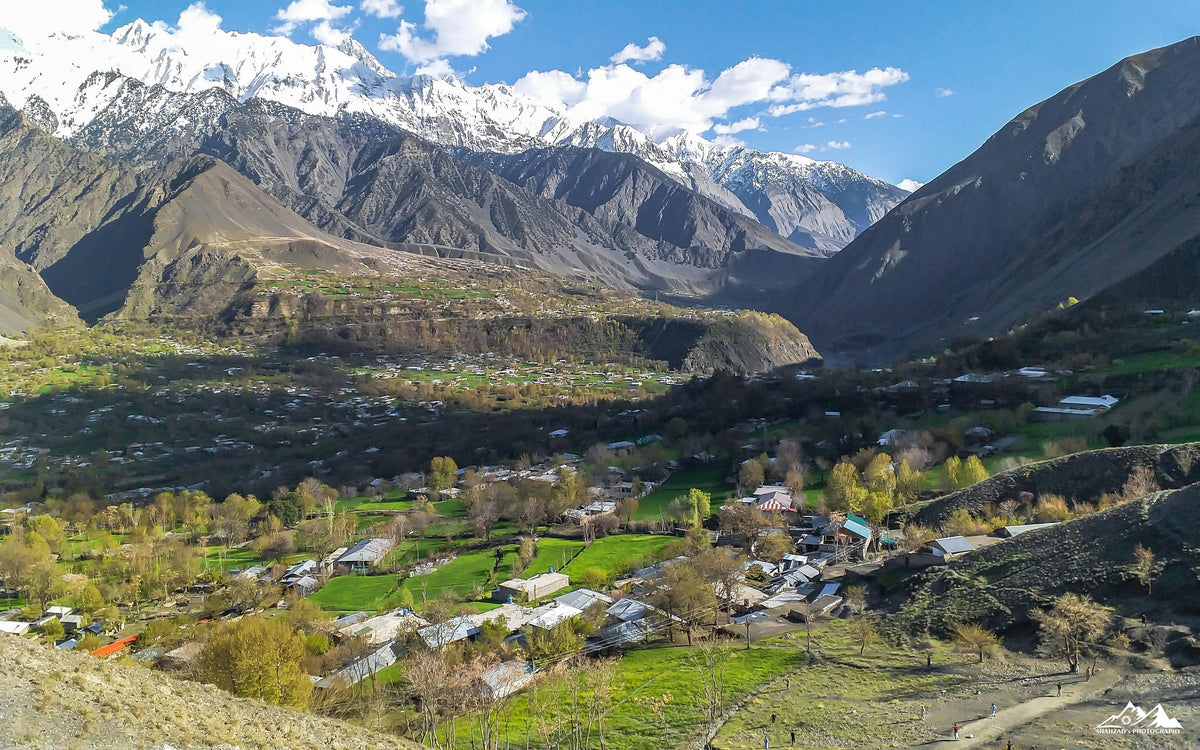
Stretching across Afghanistan and into northern Pakistan, the Hindu Kush has spent thousands of years sitting between different worlds. Routes through its valleys and passes connected South Asia with Afghanistan, Persia and Central Asia, carrying people, goods, languages and medical traditions in both directions.
That gives Hindu Kush Shilajit a rather different background from the Shilajit associated with Kashmir.
Kashmiri Shilajit sits naturally within the Ayurvedic tradition. Further north, across parts of Central Asia and Siberia, similar mountain substances became better known as Mumiyo or Mumiya.
The Hindu Kush lies somewhere between those worlds.
The resin itself can be different too. Our Hindu Kush Shilajit has a noticeably stronger aroma than some of the other regional Shilajits we work with. It's earthy and mineral, but there's also a sharper, more sulphurous edge to it.
That smell is worth looking at because regional differences in Shilajit are real. They're also easy to overinterpret.
Where Does Hindu Kush Shilajit Come From?
The Hindu Kush runs mainly through Afghanistan and northern Pakistan. At its eastern end it reaches Chitral, where Tirich Mir rises to around 7,700 metres and forms the highest point in the range.
It's rugged, geologically complicated country.
The Hindu Kush contains metamorphic rocks including schist, marble and gneiss, alongside granite and other intrusive rocks. The wider region also has an unusually long history of mining and mineral extraction.
Lapis lazuli is probably the best-known example.
Badakhshan, to the north of the Hindu Kush, has supplied lapis lazuli since prehistoric times. The stone travelled huge distances through the ancient world and has been found at archaeological sites thousands of miles from where it was mined. Historical accounts of the wider Hindu Kush region also mention silver, garnet, ruby, rock crystal and other minerals.
Shilajit fits naturally into this sort of landscape. Scientific literature identifies the Hindu Kush alongside the Himalayas, Karakoram, Pamirs and Altai as one of the mountainous regions where Shilajit occurs.
If you're new to the substance itself, our guide to what Shilajit is, how it's thought to form and what it contains gives the broader background. What Is Shilajit? Composition, Origin and Traditional Use
The geology doesn't make Hindu Kush Shilajit automatically better than material from another mountain range. It does help explain why Shilajit from different regions isn't expected to be identical.
Geology, vegetation, microbial activity, water and processing can all affect the finished material. That's one reason Shilajit from different origins can vary in mineral profile, aroma, taste, colour and texture.
A Mountain Range That Connected South Asia and Central Asia
Look at the Hindu Kush on a map and it seems like an obvious barrier.
Historically, it was also a route through.
Mountain passes connected Afghanistan and the Indian subcontinent with Bactria, Badakhshan and Central Asia. Chitral, at the eastern end of the range, sat particularly close to the meeting point of several cultures and language groups.
Trade moved through these routes for centuries, along with religious ideas, medical knowledge and natural materials.
It's tempting to take that fact one step further and claim that Shilajit itself was carried along particular caravan routes. We haven't found enough evidence to say that with confidence.
It's certainly possible, but possible isn't the same as documented.
What we do know is that the Hindu Kush sat between regions with several different traditions of using medicinal mineral substances. That becomes particularly interesting when you look at the different names attached to Shilajit and related materials.
Shilajit, Salajeet, Momiai and Mumiyo
In the UK and wider West, most people now know the substance as Shilajit.
Across Pakistan and Urdu-speaking communities, Salajeet and Shilajeet are also familiar names.
Move towards Persia and Central Asia and you start to encounter terms such as Momiai, Mumiya and Mumiyo.
The terminology isn't always neat.
Historical physicians weren't analysing these materials using chromatography or modern spectroscopy. Natural substances were classified according to where they came from, what they looked like, how they behaved and how they were used.
Persian and Arabic medical literature, for example, describes mūmiyāʾ, a medicinal mineral pitch or bituminous material. Persian sources became particularly well known, and the substance eventually acquired a reputation much further west.
There are clear parallels with the wider Shilajit and Mumiyo traditions, but it would be risky to assume that every historical reference describes exactly the same material you'd find in a jar of Shilajit today.
That's one of the more interesting things about the Hindu Kush.
Geographically, it sits close to where these different naming traditions and medical cultures overlap.
Is Hindu Kush Shilajit Part of Ayurvedic Medicine?
Shilajit has a well-established place in Ayurveda, where it's often referred to as Shilajatu or Silajatu. Classical Ayurvedic texts discuss its origin, different types, purification and traditional uses.
The Hindu Kush itself, though, shouldn't simply be treated as an extension of the Ayurvedic world.
Its position between South Asia, Afghanistan, Persia and Central Asia exposed the region to several medical traditions.
To the south and east, there's the South Asian Shilajit or Salajeet tradition.
Further west, Persian medicine had its own history of medicinal mineral pitches.
Further north, related mountain substances came to be known as Mumiyo.
The Hindu Kush lies between them.
There doesn't seem to be one ancient source that gives us a single, complete “Hindu Kush Shilajit tradition”. Given how culturally and linguistically diverse the region has always been, we'd be suspicious of any account that claimed there was.
For the more clearly documented Ayurvedic side of the story, our article on Kashmiri Shilajit, Shodhana and traditional purification goes into much more detail. Kashmiri Shilajit: Tradition, Purification and the Myth of Raw
How Was Shilajit Traditionally Used?
Historical uses depended on the tradition you're looking at.
In Ayurveda, Shilajit became particularly associated with rasayana, a broad category concerned with restoration, vitality and healthy ageing.
Persian and related medical traditions used substances described as Momiai or medicinal mineral pitch for a range of purposes. Historical sources often mention injuries, wounds and fractures.
Those records are interesting because they tell us how highly these substances were regarded. They don't tell us that every traditional use has since been clinically proven.
That distinction matters.
Centuries of reputation have gradually become mixed with modern supplement marketing, and Shilajit now attracts claims that go far beyond the evidence.
Traditional use is part of the history. It shouldn't be used as a shortcut around modern research.
We've looked at that wider problem separately in our guide to common Shilajit myths and what the evidence actually supports. Shilajit Myths: What's True and What Isn't
Why Does Hindu Kush Shilajit Smell More Sulphurous?
This is one of the first things we notice about our Hindu Kush Shilajit.
Compared with some of the other regional resins we handle, the aroma is stronger. There's the usual earthy and mineral character, but there's also a sharper note that comes across as distinctly sulphurous.
It's not subtle.
Natural Shilajit doesn't have to smell pleasant, and different origins don't necessarily smell the same. Our broader guide to Shilajit composition notes that regional materials can differ in aroma as well as mineral profile, colour, taste and texture.
The difficult part is explaining exactly why.
It'd be easy to say that the Hindu Kush resin smells more sulphurous because it contains more sulphur, or because of a particular feature of the local geology.
We don't have enough evidence to make that connection.
Smell is more complicated than an elemental mineral result.
Research examining volatile compounds in Shilajit from different countries has identified mixtures of hydrocarbons, aromatic compounds, phenolic compounds, oxygen-containing compounds and other volatile substances. The relative amounts can vary between samples.
Those differences are likely to contribute to why one Shilajit might smell mild and earthy while another smells smoky, sharp or sulphurous.
Shilajit can contain sulphur among its elemental constituents, but finding sulphur in a mineral analysis doesn't prove that it's responsible for the smell you're noticing.
So we'd rather stick to what we can actually observe.
Our Hindu Kush Shilajit has a stronger, more sulphurous aroma than many of the other Shilajits we work with.
We don't need a more dramatic explanation than that.
Does the Smell of Shilajit Tell You Where It Comes From?
Not reliably.
Regional differences are real, but smell isn't a geographic fingerprint on its own.
Shilajit from different areas can vary because of local geology, biological source material, microbial activity, water movement, climate and purification. Even two batches associated with the same wider mountain system don't have to be chemically identical.
A sulphurous smell can therefore be a characteristic of a particular source or batch without being proof that it came from the Hindu Kush.
The same caution applies to many of the authenticity tests that circulate online.
Burning Shilajit, freezing it, stretching it between your fingers or seeing how it dissolves may tell you something about its physical behaviour. None of those tests can establish its full composition, contaminant levels or geographic origin.
We've covered these in detail in Informal Shilajit Tests vs Laboratory Reports. Why Most Shilajit Authenticity Tests Don't Mean Much
Hindu Kush Shilajit Folklore
Shilajit almost invites folklore.
It appears in mountains, comes out of rock, has a strange smell and changes texture with temperature. For most of its history, nobody had the analytical tools needed to explain exactly what it was.
It's hardly surprising that stories grew around it.
Across Asia, Shilajit is sometimes described using phrases such as “blood of the mountain” or “sweat of the mountain”. There are also familiar stories about people discovering it after watching animals consume dark substances from mountain rock.
The difficulty is working out where some of those stories actually came from.
A general Shilajit legend can easily become an “ancient Himalayan legend”, “ancient Persian legend” or “Hindu Kush legend” after being repeated by enough websites.
We haven't found strong enough historical evidence to describe those stories specifically as Hindu Kush folklore.
So we won't.
There's already enough real history in this region without borrowing a legend from somewhere else.
Shilajit and the Mineral History of the Hindu Kush
One part of the Hindu Kush story that deserves more attention is the region's relationship with minerals.
People around these mountains have been extracting valuable materials from rock for thousands of years.
Lapis lazuli from Badakhshan is the obvious example. It travelled across the ancient world and became prized for jewellery, decorative objects and, later, pigments.
Other parts of the region became associated with gemstones, precious metals and crystalline minerals.
That doesn't mean ancient communities thought about Shilajit as a “mineral supplement” in the modern sense. That would be projecting today's language backwards.
It does give us some useful context, though.
A dark, unusual substance appearing naturally from mountain rock was emerging in a region where people already knew that mountains contained materials worth finding, trading and using.
You don't need a mystical origin story to understand why someone might have paid attention to it.
What Makes Hindu Kush Shilajit Different?
The clearest difference is where it comes from.
Hindu Kush Shilajit comes from a different mountain system, geological setting and cultural region from Shilajit sourced in Kashmir, the Karakoram or the Altai.
Its historical setting is different too. Rather than fitting neatly within one tradition, the Hindu Kush sits between South Asian, Afghan, Persian and Central Asian worlds.
Then there are the physical differences.
In our experience, Hindu Kush Shilajit has a particularly strong aroma, with a pungent mineral character and a noticeable sulphurous note. Some other regional Shilajits are softer, earthier or more resinous.
Regional differences in composition are also plausible and measurable. Shilajit isn't a standardised material produced to one natural recipe. Local geology and environmental conditions can influence the mineral and organic matrix.
None of that means one origin must be better.
If you're comparing different sources, our guide to Altai, Mongolian, Kashmiri and Hunza Shilajit explains why measured differences are more useful than trying to crown one mountain range as the universal winner. Which Shilajit Is Best? Comparing Regional Origins
Does Hindu Kush Origin Mean Better Shilajit?
No mountain name is a quality guarantee.
“Himalayan”, “Kashmiri”, “Altai”, “Hunza” and “Hindu Kush” can all tell you something useful about origin. They can't tell you whether the material has been purified properly, stored correctly or tested for relevant contaminants.
This is where Shilajit marketing can get backwards.
The mountain range becomes the headline while the finished product gets remarkably little attention.
We think it makes more sense to ask where the material came from, how it was processed and what the testing actually shows.
Our article on whether Himalayan Shilajit really is better looks more closely at why geography matters without treating it as proof of quality. Is Himalayan Shilajit Really the Best?
Purification matters for the same reason. Shilajit collected from a natural rock environment can contain unwanted material, so “raw” shouldn't automatically be read as “better”. You can read more about that in our guide to raw versus purified Shilajit. Is Raw Shilajit Better? The Purification Paradox
A Different Side of the Shilajit Story
Hindu Kush Shilajit doesn't need a grand origin myth.
Its actual setting gives us plenty to work with.
It comes from a mountain range that has connected Afghanistan, northern Pakistan, Central Asia, Persia and the Indian subcontinent for centuries. It sits between traditions that used names including Shilajit, Salajeet, Momiai and Mumiyo. The surrounding region has one of Asia's oldest histories of mineral extraction and trade.
Then there's the resin itself.
Our Hindu Kush Shilajit has a noticeably stronger sensory character than many of the other regional resins we handle, particularly its pungent, mineral and more sulphurous aroma.
That doesn't make it automatically purer, stronger or better.
It does make it distinctive.
And when you're dealing with a natural material that can genuinely change from one mountain region to another, those differences are more interesting than trying to make every origin tell the same story.
Explore More About Shilajit
-
The Complete Shilajit Guide — our evidence-based knowledge centre covering composition, benefits, safety, testing, sourcing and regional origins.
-
What Is Shilajit? — how Shilajit forms, what it contains and why composition varies between mountain regions.
-
Which Shilajit Is Best? — a comparison of regional Shilajits and their measured differences.
-
Kashmiri Shilajit: Tradition, Purification and the Myth of Raw — the Ayurvedic side of the Shilajit story and the importance traditionally placed on purification.
-
Is Raw Shilajit Better? — why minimal processing and purity aren't necessarily the same thing.
-
How We Test Our Shilajit — the laboratories, methods and published testing behind our Shilajit range.
Written By
Written by Chris Simon, Founder of One Life Foods.
Chris has worked in the supplement industry since 2009 and is known for seeking out exceptional ingredients, products, and formulations. Read more about Chris and the story behind One Life Foods.

Share:
Hot Water vs Dual Extraction: Does Alcohol Make a Better Mushroom Extract?
How We Test Mushroom Extracts: NMR, LC-MS and What the Results Actually Tell Us