


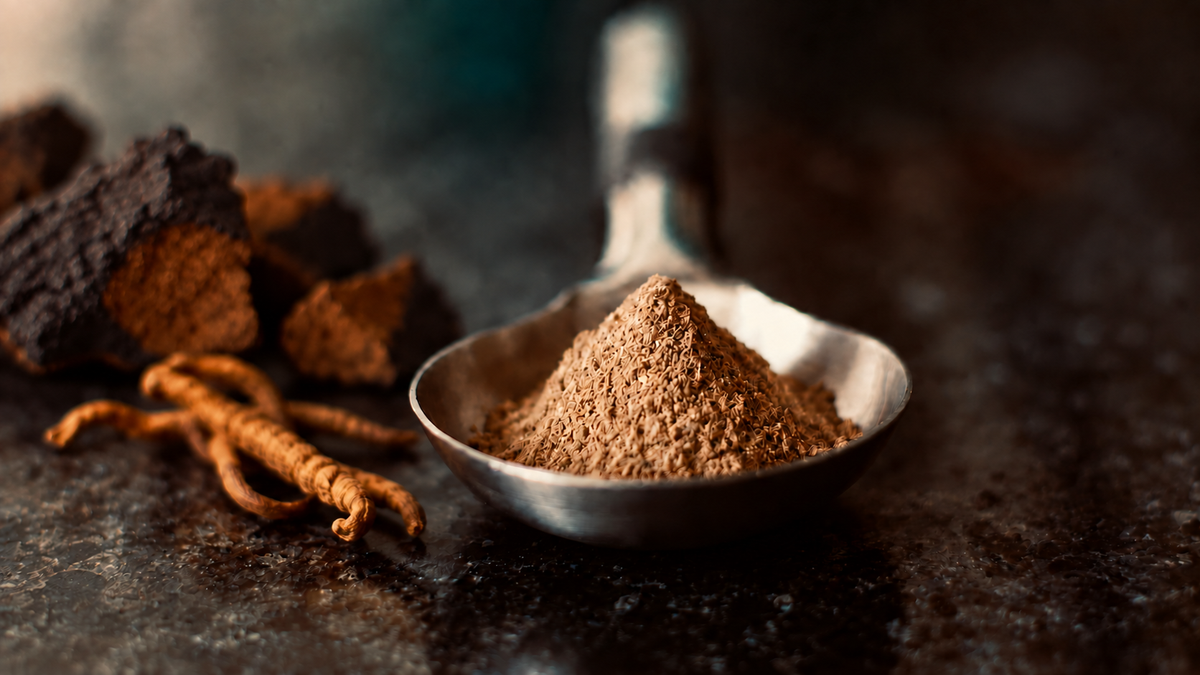
The short answer: an extraction ratio describes the relationship between the amount of starting material used and the amount of extract produced. A 10:1 ratio generally means around 10 parts of starting dry material were required to produce one part of native extract. It does not mean the product is ten times stronger, ten times more effective or contains ten times as much of every mushroom compound.
The numbers look reassuringly scientific.
8:1
10:1
15:1
20:1
And the assumption is almost irresistible:
If 10:1 is good, 20:1 must be twice as good.
Unfortunately, mushroom extraction doesn't work like the volume control on a stereo.
An extraction ratio can be useful information.
We use extraction ratios ourselves.
But we've become increasingly cautious about treating them as a universal measure of quality.
Because the ratio tells us something about what went into the extraction process.
It doesn't necessarily tell us enough about what came out.
If you're new to the difference between a basic powder and an extracted preparation, read Powdered Herbs vs Herbal Extracts: Why That £9.99 “Super Supplement” Might Just Be a Fancy Pot of Dust first.
What does a 10:1 mushroom extract mean?
In a conventional dry extract ratio, 10:1 means approximately ten units by weight of starting material were used to produce one unit of native extract.
For example:
10 kg starting material
produces approximately:
1 kg native extract.
Likewise:
8:1 means approximately 8 kg of starting material to 1 kg of extract.
15:1 means approximately 15 kg to 1 kg.
The concept is widely used across botanical and fungal extracts. Technical literature on drug-to-extract ratios defines the genuine or native extract ratio as the mass of starting material used relative to the mass of extract itself, excluding added excipients.
That sounds simple.
There's just one important catch.
You need to know what exactly the manufacturer is calling the starting material and what exactly they're calling the extract.
Why does the basis of the ratio matter?
Because a big ratio can be created in very different ways depending on how it's calculated.
The useful version compares dry starting fungal material with the genuine or native extract produced from it.
But when looking at any extract specification, we'd want to know:
Was the starting weight fresh or dry?
Does the stated ratio refer to the native extract?
Does it refer to a finished extract preparation containing a carrier?
Was the ratio calculated before or after other ingredients were added?
Without knowing the basis, comparing one brand's 10:1 with another brand's 10:1 can be much less meaningful than it appears.
Does 10:1 mean the extract is ten times stronger?
No.
This is probably the single most important point in the article.
10:1 describes a manufacturing relationship.
It isn't a universal potency scale.
Suppose ten kilograms of mushroom material are processed to produce one kilogram of extract.
That tells us how much starting material was involved.
It doesn't tell us that every naturally occurring compound became ten times more concentrated.
Extraction is selective.
Some constituents dissolve readily in the extraction medium.
Some dissolve less readily.
Some remain in the discarded solid material.
Some may change during processing.
Different solvents can also produce different chemical profiles from the same starting material.
So:
10:1 doesn't mean 10 times stronger.
15:1 doesn't mean 15 times more effective.
20:1 doesn't mean twice as good as 10:1.
Those conclusions require information that the ratio simply doesn't provide.
Why does material disappear during extraction?
Because extraction isn't just shrinking a mushroom.
Imagine preparing a very strong cup of tea.
You start with leaves.
Water removes some of the soluble material from those leaves.
You then discard the used leaves.
What remains in the liquid isn't a miniature version of the original leaf containing every component in the same proportions.
It's the material that moved into the extraction liquid under those particular conditions.
A mushroom extraction is much more controlled and technically sophisticated, but the underlying principle is similar.
Material is being selected and separated.
That's why a higher extraction ratio can sometimes mean that a greater proportion of the original starting mass didn't end up in the finished native extract.
Whether that's desirable depends on what was extracted and what the intended finished specification is.
Is 15:1 better than 8:1?
Not on the ratio alone.
If two otherwise identical extracts used the same species, same fungal material, same raw-material quality, same solvent system and same analytical standards, ratio might give you useful additional information about concentration.
But real products aren't usually identical in every other respect.
One might use fruiting body.
Another might use cultured mycelium.
One might use hot water.
Another might use a different extraction system.
One might contain a carrier.
Another might not.
One might provide batch-specific compound analysis.
Another might simply print “15:1” on the bottle.
So if you ask:
Is 15:1 better than 8:1?
our answer is:
Not enough information.
And we think that's a much better answer than automatically choosing the bigger number.
Can a 1:1 product still be an extract?
Yes.
This is another point that often gets lost.
A 1:1 extract isn't necessarily the same thing as plain powdered mushroom.
If a manufacturer uses one unit of starting material to produce one unit of genuine extracted material, the resulting preparation can still legitimately have undergone an extraction process.
What matters is how the material was processed and what the stated ratio actually refers to.
So:
1:1 mushroom powder
and
1:1 mushroom extract
shouldn't automatically be treated as the same thing.
“Extract” describes processing.
“Ratio” describes the relationship between defined input and output.
Those are separate pieces of information.
What about blended mushroom extracts?
Blended extracts add another complication. Mushroom ingredients might combine a 1:1 preparation with a more concentrated extract. The finished ratio may therefore describe the overall blend rather than one single extraction step. That’s another reason not to interpret an extract ratio as a simple potency score.
For example, a manufacturer might combine a relatively low-ratio preparation with a more concentrated water or dual extract. The two fractions may have been produced differently and may contribute different characteristics to the finished ingredient.
What matters is understanding what the finished extract actually contains and how it was made, rather than judging it from the ratio printed on the specification alone.
Then continue into your existing section along the lines of:
Does a higher extract ratio mean a stronger mushroom supplement?
That sequencing is ideal because it becomes:
What does the ratio mean? → How is it calculated? → What if the extract is a blend? → Does a bigger ratio actually mean better?
What is a native extract?
This is a useful term when you're trying to understand ratio claims.
A native, sometimes called genuine, extract is the material produced by extraction before additional carriers or excipients are incorporated.
In standard extract-ratio terminology, the ratio is ideally expressed relative to this native extract rather than the weight of everything in the final commercial powder.
That matters because dry extracts can sometimes require processing aids or carriers to improve properties such as drying, stability or flow.
Those ingredients aren't automatically a sign of poor quality.
But they need to be distinguished from the mushroom extract itself.
What happens if a mushroom extract contains a carrier?
Suppose a manufacturer produces a genuine mushroom extract and then adds a carrier during the drying or finishing process.
The resulting powder is an extract preparation, not simply 100% native extract.
That makes the arithmetic more important.
Imagine, purely as an example:
A powder is described as a 10:1 extract preparation.
A capsule contains 400 mg of preparation.
If part of that 400 mg is a carrier, you can't necessarily multiply the full 400 mg by ten and claim the capsule contains the equivalent of 4,000 mg of dried mushroom.
First you need to know whether the stated 10:1 applies to:
the entire finished preparation,
or only to the native extract portion.
This is why we think transparent specifications matter more than impressive-looking arithmetic.
Does 400 mg of a 10:1 extract equal 4,000 mg of mushroom?
Only in a very specific sense, and only if the underlying ratio supports the calculation.
If 400 mg is genuinely 400 mg of a dry native 10:1 extract based on dried starting material, then it can be described mathematically as having used approximately 4,000 mg of starting material to produce that amount of extract.
But that does not mean there are physically 4,000 mg of mushroom sitting inside a 400 mg capsule.
And it doesn't mean the capsule is:
ten times more potent,
ten times more effective,
or
equivalent in every chemical respect to eating 4 g of dried mushroom.
A better phrase is:
starting-material equivalent, where that equivalence is properly substantiated.
Even then, we'd rather know what is actually measured in the finished extract.
Why can two 10:1 extracts be completely different?
Because the ratio doesn't describe the entire extraction process.
Two manufacturers could both start with ten kilograms of the same mushroom species and produce one kilogram of extract.
But they might use different:
fungal material,
cultivation methods,
temperatures,
extraction times,
solvents,
filtration processes,
drying methods,
or carriers.
Research into fungal extraction demonstrates that variables such as temperature and extraction conditions can materially affect the compounds recovered from mushroom material.
So 10:1 vs 10:1 isn't necessarily an apples-to-apples comparison.
Sometimes it's barely the same fruit bowl.
Does the extraction solvent matter?
Yes.
Different compounds have different solubilities.
Water can extract certain classes of compounds effectively.
Alcohol can be used for others.
Some mushroom products use a combination, commonly described as dual extraction.
That doesn't mean dual extraction is automatically better either.
A method should make sense for:
the species,
the material,
the compounds of interest,
and the desired finished extract.
The real question isn't simply:
Was alcohol involved?
It's:
What did the process actually produce?
We'll explore this separately in Hot Water vs Dual Extraction: Does Alcohol Automatically Make a Better Mushroom Extract?.
Can you compare extraction ratios between different mushrooms?
Not very usefully on their own.
Lion’s Mane and Reishi are different fungi.
Chaga conk is a very different starting material again.
Cordyceps CS-4 is different again.
They have different physical structures and chemical compositions.
So saying:
This Lion’s Mane is 15:1 but that Reishi is 8:1, therefore the Lion’s Mane is stronger
doesn't make much sense.
It's a little like comparing concentrated coffee with concentrated tomato stock because both carry a concentration number.
The ratio only makes sense in the context of the material being extracted.
Does a higher ratio mean more beta-glucans?
Not necessarily.
Beta-glucans can be measured.
So if beta-glucan content is the information you want, we'd rather see the actual analytical result than attempt to infer it from an extraction ratio.
A 15:1 label doesn't tell you:
15% beta-glucans
or:
15 times the beta-glucans.
Those are entirely different measurements.
And beta-glucans themselves aren't the complete quality story either.
We'll cover that in Beta-Glucans vs Polysaccharides: What Do Mushroom Supplement Numbers Really Mean?.
What about species-specific compounds?
This is where our approach to mushroom extracts has changed most.
If we're assessing Reishi, we're interested in more than its extraction ratio.
We're also interested in whether the finished material has the chemical characteristics expected of Reishi.
The same applies to Lion’s Mane, Chaga and Cordyceps.
Depending on the species, analytical work can look for groups of compounds such as:
Lion’s Mane: hericenones and related metabolites
Reishi: ganoderic and lucidenic acids
Chaga: compounds such as inotodiol and betulin-related constituents
Cordyceps: nucleosides and other characteristic metabolites
This isn't about claiming that detecting one compound proves a particular health effect.
It gives us another way to investigate whether the finished extract resembles the material it claims to be.
That's why extraction ratio increasingly sits alongside, rather than above, analytical testing in how we assess mushrooms.
What does “standardised extract” mean?
A standardised extract is different from a ratio claim.
An extraction ratio tells you something about starting material versus extract yield.
Standardisation refers to the finished extract being produced or adjusted to meet a defined level of a particular constituent or group of constituents.
These answer different questions.
For example:
10:1
asks:
How much starting material was used relative to extract?
while:
30% of a defined measured constituent
asks:
How much of this measured constituent is present in the finished material?
Neither number necessarily tells you everything.
But they aren't interchangeable.
Technical literature on extract ratios makes the same distinction between input-side extraction relationships and compositional standardisation of the resulting material.
Is a standardised extract automatically better?
Not necessarily.
It depends on what it has been standardised to and why.
A useful marker might help demonstrate consistency.
A poorly chosen marker might tell us relatively little about the wider material.
And a mushroom can contain hundreds of different constituents.
So once again, we're reluctant to crown a single number as the universal winner.
What should you look at alongside the extraction ratio?
For us, the useful questions are:
-
What species is being used?
The scientific identity should be clear. -
What fungal material is being extracted?
Fruiting body, cultured mycelium, Chaga conk or something else? See Fruiting Body vs Mycelium: It’s More Complicated Than “One Is Good and One Is Bad”. -
What does the ratio actually refer to?
Dry starting material to native extract? Something else? -
How was it extracted?
Water, dual extraction or another method? -
Are carriers present?
And if so, is the ratio based on the native extract or finished preparation? -
What's actually measured in the finished material?
Beta-glucans, other specification markers or characteristic metabolites? -
Has identity been verified?
A concentration number can't compensate for the wrong starting material. -
Is there batch-level testing?
Specifications tell us what should be there. Analysis can help show what actually is there.
That's the sort of information we increasingly want to provide throughout our Functional Mushrooms collection.
Why we still use extraction ratios
After everything we've just said, you might reasonably ask:
Why put an extraction ratio on a product at all?
Because it is useful information.
The problem isn't the ratio.
It's asking the ratio to tell us something it can't.
We want to know the extraction ratio.
We just also want to know:
what was extracted,
how it was extracted,
what finished powder resulted,
and what the analysis says about it.
In other words:
keep the ratio. Lose the mythology around it.
The extraction-ratio trap in mushroom marketing
A product described as:
20:1 ULTRA CONCENTRATED
sounds more impressive than:
8:1 extract.
That's marketing doing what marketing does.
But unless we're told more, we still don't know:
What starting material was used?
Was it properly identified?
Which compounds were recovered?
Were any carriers added?
What's the beta-glucan profile?
Are characteristic compounds present?
Was the finished material independently analysed?
A bigger number can be a useful specification.
It isn't a substitute for those questions.
The bottom line
Extraction ratios matter.
They just don't mean what mushroom marketing sometimes encourages us to think they mean.
10:1 isn't ten times stronger.
15:1 isn't automatically better than 8:1.
20:1 doesn't win simply because twenty is the biggest number on the page.
The ratio tells us about the relationship between starting material and extract.
That's valuable.
But it doesn't tell us:
what compounds survived,
what was removed,
what else is in the preparation,
whether the fungal material was correctly identified,
or whether the finished extract has the chemical profile we'd expect.
That's why our view of mushroom quality increasingly comes back to the same principle:
Don't rely on the number that's easiest to print on the front of the bottle.
Look at the whole extract.
And, wherever possible:
measure what's actually there.
Continue Exploring
Fruiting Body vs Mycelium: It’s More Complicated Than “One Is Good and One Is Bad”
Why the material going into an extract matters just as much as the concentration number.
Powdered Herbs vs Herbal Extracts: Why That £9.99 “Super Supplement” Might Just Be a Fancy Pot of Dust
Our broader guide to the difference between powdered ingredients and extracted preparations.
Beta-Glucans vs Polysaccharides: What Do Mushroom Supplement Numbers Really Mean?
The next headline numbers worth understanding on mushroom specifications.
How We Test Mushroom Extracts: NMR, LC-MS and What the Results Actually Tell Us
How deeper analytical testing can move us beyond assumptions based on ratios alone.
Written By
Written by Chris Simon, Founder of One Life Foods.
Chris has worked in the supplement industry since 2009 and is known for seeking out exceptional ingredients, products, and formulations. Read more about Chris and the story behind One Life Foods.

Share:
Why We Moved From Our Four Mushroom Blend to Individual Mushrooms
Cordyceps CS-4 Explained: Mycelium, Cultivation, Extraction & Identity