


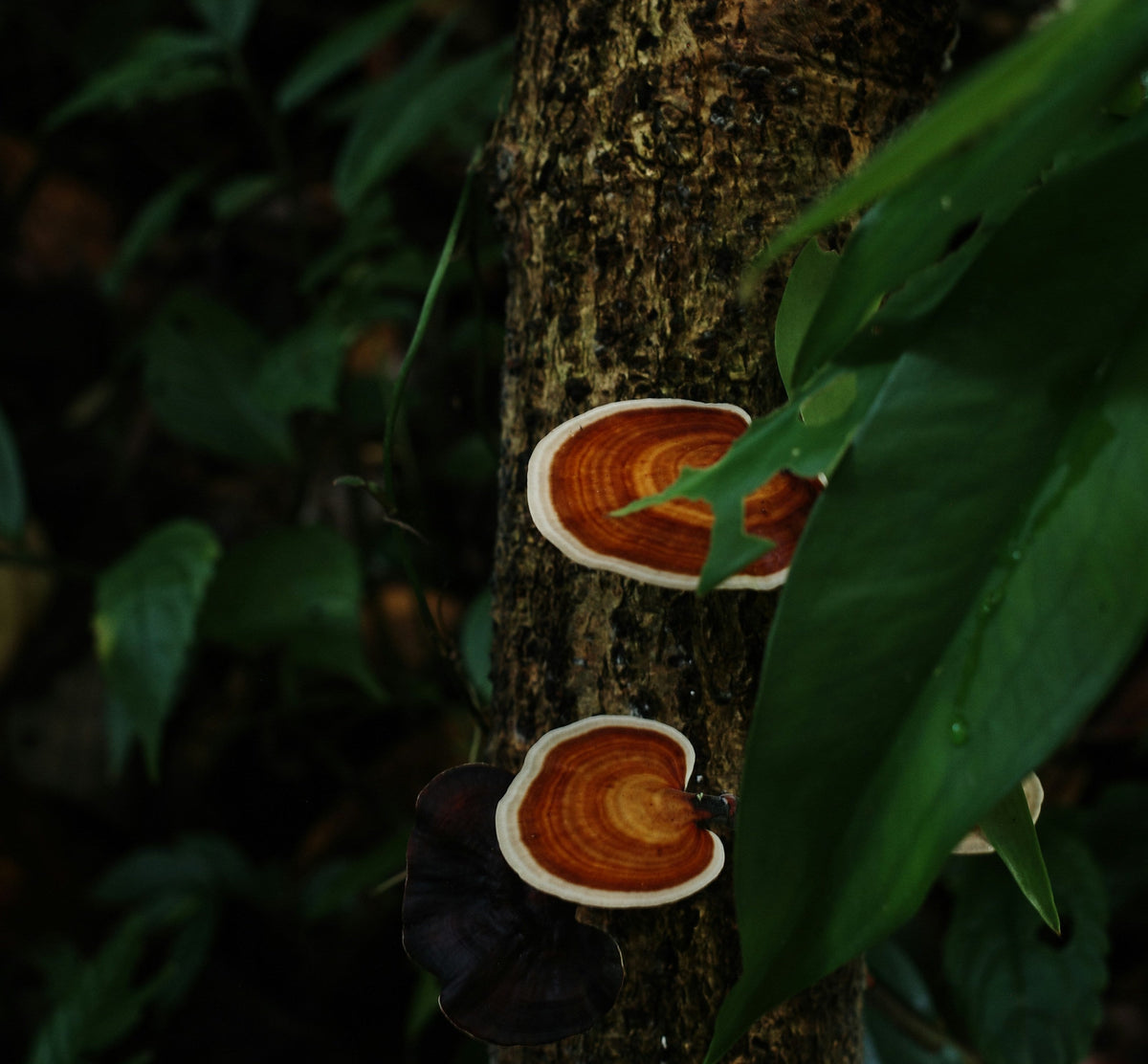
The short answer: Reishi is the common name given to fungi within the genus Ganoderma. A good Reishi supplement can’t be judged by one number alone. Species identity, fungal material, extraction method, beta-glucans, characteristic triterpenoids such as ganoderic acids, and analytical testing all help build a more useful picture of what’s actually in the extract.
Reishi is one of the most recognisable names in functional mushrooms.
It’s also one of the easiest to oversimplify.
You’ll see phrases such as:
100% fruiting body
30% beta-glucans
15:1 extract
dual extracted
high triterpenes
premium Reishi
Every one of those might tell you something.
None tells you everything.
And Reishi has another complication that rarely makes it onto the front of the bottle:
Even the name of the fungus isn’t as straightforward as it first appears.
So let’s start there.
If you’re new to mushroom terminology generally, read What Are Functional Mushrooms? A Guide to Lion’s Mane, Reishi, Chaga & Cordyceps first.
What is Reishi?
Reishi is a common name used for lacquered, woody fungi belonging to the genus Ganoderma.
In Japan, the term Reishi is widely used.
In China, you’ll often encounter Lingzhi.
Unlike the soft culinary mushrooms you might fry for breakfast, Reishi fruiting bodies are tough, woody and distinctly bitter.
They often develop the glossy, reddish-brown surface that makes them immediately recognisable.
They’ve been used historically in East Asian traditions for centuries, which is one reason modern researchers have taken such an interest in their chemistry.
But historical use and modern product claims are different things.
Traditional use can tell us why a fungus became culturally important.
It doesn’t automatically establish what a modern capsule will do.
Is Reishi really Ganoderma lucidum?
This is where things get interesting.
For decades, the name Ganoderma lucidum was applied very broadly to shiny Reishi-like fungi.
Modern molecular work has shown that what was historically grouped under that name actually includes several distinct species.
One particularly important species is Ganoderma lingzhi, which is native to East Asia and is strongly associated with traditional Lingzhi/Reishi cultivation.
A study examining commercially sold Reishi products found that most products labelled Ganoderma lucidum actually contained Ganoderma lingzhi. The researchers argued that historical naming practices had contributed significantly to the confusion.
That doesn’t mean every product labelled G. lucidum is necessarily deceptive.
Much of the confusion developed because fungal taxonomy itself changed.
But it does demonstrate why species identity matters.
“Reishi” is useful as a consumer name.
It shouldn’t be the end of the identification process.
For our own Reishi capsules, the current product specification uses Ganoderma lucidum, so that is the botanical name we use on the product page and label.
We recognise the modern taxonomic distinction between G. lucidum and G. lingzhi, which is why we think it’s better to explain the naming issue openly rather than pretend Reishi taxonomy is perfectly straightforward.
Does the species make a chemical difference?
Potentially, yes.
Research comparing G. lucidum sensu stricto with G. lingzhi found measurable differences in their triterpenic-acid profiles.
That’s important because Reishi is often marketed partly around its triterpenoids.
So if two fungi can both be sold historically under the Reishi or G. lucidum umbrella yet have different chemical profiles, accurate identification becomes more than academic housekeeping.
It becomes part of understanding the ingredient.
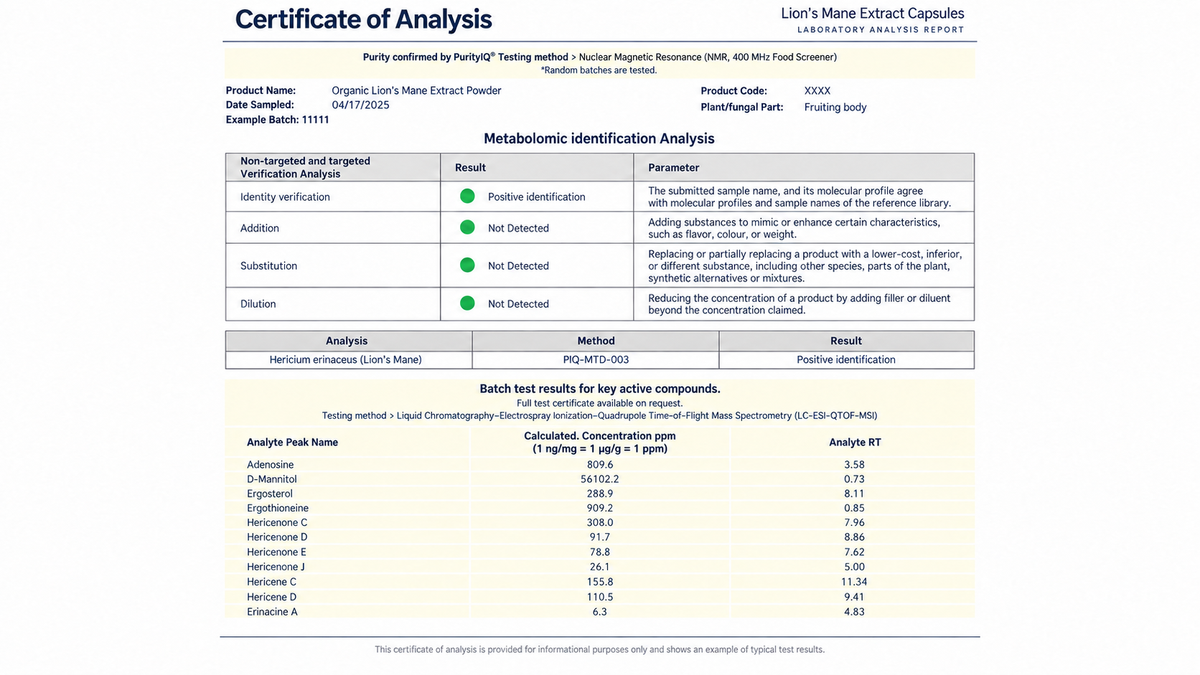
This is one reason we’re increasingly interested in identity testing and chemical profiling, rather than simply accepting the common name printed on a specification.
See How We Test Mushroom Extracts: NMR, LC-MS and What the Results Actually Tell Us.
Which part of Reishi is used in supplements?
Reishi products can be made from different fungal materials, including:
the fruiting body,
cultured mycelium,
spores,
or combinations of these.
For our own Reishi product, we’ve chosen fruiting-body extract.
That matters because fruiting body and mycelium aren’t simply two names for the same raw material.
They’re different fungal structures and can have different chemical profiles.
But we wouldn’t turn that into the blanket rule that mycelium is always inferior.
As we explain in Fruiting Body vs Mycelium: It’s More Complicated Than “One Is Good and One Is Bad”, the real questions are what material is being used, how it was grown and how the finished ingredient was verified.
What does Reishi fruiting body contain?
Reishi is chemically complicated.
Research has identified numerous classes of compounds, including:
- polysaccharides, including beta-glucans
- triterpenoids
- ganoderic acids
- lucidenic acids
- sterols such as ergosterol
- nucleosides including adenosine
- proteins and amino acids
- numerous other secondary metabolites
Reviews of Ganoderma chemistry have catalogued hundreds of secondary metabolites across the genus.
That immediately tells us something useful.
A Reishi extract isn’t one compound.
And a single percentage can’t describe its entire chemistry.
What are ganoderic acids?
Ganoderic acids are a large family of lanostane-type triterpenoids associated particularly with Ganoderma species.
You may see individual examples referred to as:
ganoderic acid A,
ganoderic acid B,
ganoderic acid C,
ganoderic acid D,
and numerous others.
Scientists have identified many different ganoderic acids and related triterpenoids from Ganoderma.
They’re particularly interesting to us from a quality-characterisation perspective.
Why?
Because beta-glucans occur across many fungi.
Ganoderic-acid profiles give us another layer of information that is much more closely associated with Ganoderma chemistry.
That doesn’t mean:
ganoderic acid detected = proven health effect.
It means:
ganoderic acid detected = useful chemical information about the extract.
Those are very different statements.
What are lucidenic acids?
Lucidenic acids are another family of Ganoderma-associated triterpenoids.
They’ve received much less scientific attention than ganoderic acids, but several different lucidenic acids have been identified in Reishi materials.
A 2023 review described them as one of the major groups of triterpenoids found within Ganoderma, while also emphasising that research into them remains comparatively preliminary.
Again, for us their presence is interesting principally because it helps build a more detailed picture of the extract.
What about beta-glucans?
Reishi contains fungal beta-glucans, and beta-glucan percentage has become one of the most widely used mushroom quality specifications.
That’s useful.
But it’s not enough on its own.
A Reishi extract and a Lion’s Mane extract might both contain substantial beta-glucans.
That doesn’t make them chemically equivalent.
Likewise, a large total polysaccharide percentage isn’t necessarily the same thing as a measured beta-glucan result.
We unpack the distinction in Beta-Glucans vs Polysaccharides: What Do Mushroom Supplement Numbers Really Mean?.
Our broader principle is simple:
Measure beta-glucans where useful, but don’t pretend they’re the entire Reishi story.
Are ganoderic acids the “active ingredient” in Reishi?
We’d avoid putting it that way.
Natural materials rarely behave like pharmaceutical products with one clearly defined active ingredient.
Reishi contains numerous chemical classes.
Ganoderic acids are certainly among the most studied Reishi triterpenoids, but calling them the active ingredient suggests a level of simplicity that the underlying chemistry doesn’t support.
A better description is:
characteristic compounds of interest.
They can help with chemical characterisation and quality assessment.
Research into isolated ganoderic acids is a separate question from what consuming a particular Reishi food supplement may do.
What does the research into Reishi actually say?
There’s a substantial amount of published research into Ganoderma, but much of it is:
laboratory research,
cell studies,
animal research,
or research involving isolated constituents.
There have also been human clinical trials.
That means it wouldn’t be accurate to say:
There’s no research on Reishi.
But it would be equally inaccurate to jump from interesting laboratory findings to:
Reishi has been clinically proven to deliver all the benefits claimed online.
A 2025 systematic review and meta-analysis examined 17 randomised trials involving 971 participants. It found some differences in certain measured outcomes, but not others, and rated the overall certainty of evidence as very low.
That is precisely the sort of nuance we want to preserve.
Research exists.
Some findings are interesting.
The evidence isn’t strong enough to treat every Reishi supplement as clinically proven.
Why can’t we simply apply Reishi studies to any Reishi capsule?
Because different studies use different preparations.
One might investigate:
a hot-water extract,
an ethanol extract,
an isolated beta-glucan,
a spore product,
a particular cultivated strain,
or a preparation standardised to specific constituents.
That isn’t automatically equivalent to every commercial Reishi product.
This is the same distinction we make in our Lion’s Mane article.
Research on an ingredient category isn’t automatically evidence for every product carrying that ingredient name.
Is dual-extracted Reishi automatically better?
No.
This is one of the most repeated rules in mushroom marketing.
The argument normally goes like this:
Water extracts polysaccharides.
Alcohol extracts triterpenes.
Therefore:
dual extraction must always produce the superior Reishi extract.
There’s some chemical logic behind the first two statements.
But the final conclusion is too simplistic.
Extraction depends on temperature, time, particle size, solvent proportions and many other variables.
Research has demonstrated that triterpenoids, including ganoderic acids, can be isolated from aqueous Ganoderma lucidum extracts. One study of a standardised hot-water extract reported measurable ganoderic acid A alongside polysaccharides and adenosine.
That doesn’t mean water is always better.
Nor does it mean alcohol is unnecessary.
It means the finished analysis matters more than the slogan.
Doesn't alcohol extract more triterpenes?
Alcohol-rich extraction systems can be highly effective for Reishi triterpenoids.
Research optimising G. lucidum extraction found that ethanol concentration was an important variable in maximising triterpenoid recovery.
So alcohol can absolutely have a useful role.
What we reject is the idea that simply seeing the words:
dual extract
automatically tells you more about the final chemical composition than actually measuring that composition.
Our preference is:
Ask what the extraction produced.
Not simply:
Ask how many solvents were involved.
How is our Reishi extract actually made?
Our Reishi extract is deliberately formulated from two different fruiting-body preparations:
50% 1:1 extract powder
and
50% 15:1 dual extract powder.
The 1:1 portion is steam-treated and re-dried, while the concentrated 15:1 portion is extracted using hot water and alcohol.
Together, they form a finished Reishi preparation with an overall stated extract ratio of 8:1.
We chose this approach because we don’t believe the best Reishi product is necessarily the one with the biggest extraction ratio printed on the label.
Instead, we want a well-characterised fruiting-body extract that combines two differently prepared fractions and gives us a meaningful analytical profile in the finished ingredient.
That’s exactly what we look for.
The current supporting analysis reports:
32.33% beta-glucans
35.32% polysaccharides
3.27% triterpenes
alongside identified Ganoderma compounds including ganoderic acids A, B, C1, C2 and C6, as well as lucidenic acid D.
Those numbers don’t turn Reishi into a single-score competition.
But they give us considerably more useful information than simply saying:
“15:1 dual extract”
and assuming that must mean better.
Our approach is different.
Start with Reishi fruiting body. Use appropriate extraction. Then look at what the resulting ingredient actually contains.
That’s why we chose this formulation.
What does a 15:1 Reishi extract mean?
It describes an extraction ratio.
It doesn’t mean:
15 times stronger,
15 times more effective,
or 15 times more ganoderic acids.
Extraction ratios describe the relationship between starting material and extract yield.
They don’t tell you exactly which compounds are present in the final powder.
And, as our own Reishi illustrates, a finished preparation can also combine extracts with different ratios, so the number needs to be understood in the context of how the ingredient was actually formulated.
That’s why we’ve written a separate guide:
What Does 10:1, 15:1 or 8:1 Mushroom Extract Actually Mean?
A Reishi extract ratio can be useful.
It just shouldn’t become a substitute for compositional analysis.
Can two Reishi extracts with the same ratio be very different?
Absolutely.
Imagine two products both labelled:
15:1 Reishi Extract
One could begin with well-characterised mature fruiting-body material and use a carefully controlled extraction process.
Another could use different starting material, extraction conditions or manufacturing controls.
Both may technically carry the same headline ratio.
Their resulting chemical profiles could still differ considerably.
Published research demonstrates that cultivation conditions and substrate can alter Reishi triterpenoid profiles.
Again:
the number tells us something.
It doesn’t tell us everything.
Why does the bitter taste of Reishi matter?
Reishi is characteristically bitter, and triterpenoids contribute to that bitterness.
That can be useful sensory information.
But we wouldn’t use bitterness as a laboratory test.
A dark, bitter powder may look and taste exactly like what somebody expects Reishi extract to taste like while still having an unremarkable analytical profile.
Taste is observation.
Chemical analysis is evidence.
The two shouldn’t be confused.
How can Reishi identity be tested?
There are several possible approaches.
Genetic testing can be useful for distinguishing Ganoderma species where suitable DNA remains available.
Chemical fingerprinting can help assess whether the overall metabolomic profile fits appropriate reference material.
LC-MS and related chromatographic methods can investigate individual compounds such as ganoderic acids.
NMR can provide broader spectral information.
No single technique is perfect for every question.
This is why our approach is becoming increasingly multi-layered.
Read How We Test Mushroom Extracts: NMR, LC-MS and What the Results Actually Tell Us.
What would we look for in a good Reishi product?
We’d want to understand:
Species: What Ganoderma is actually being used?
Material: Fruiting body, mycelium, spores or something else?
Extraction: Powder or extract? How was it processed?
Ratio: What does the extraction ratio actually refer to?
Glucans: Are beta-glucans measured appropriately?
Triterpenoids: Is there useful evidence about characteristic Reishi chemistry?
Carriers: Is anything else present in the extract preparation?
Identity: Has the fungal material been meaningfully verified?
Safety: What contaminant and microbiological testing exists?
Batch traceability: Does the analytical evidence relate to the ingredient being sold?
That broader framework is explained in How to Choose a Mushroom Supplement: 10 Things We’d Check Before Buying One.
How our Reishi fits into the One Life range
We’ve chosen to offer Reishi as an individual fruiting-body extract, rather than burying it inside a large multi-mushroom formula.
Each capsule contains 400 mg of the finished Reishi extract preparation.
That preparation combines:
50% 1:1 fruiting-body extract
with
50% 15:1 dual fruiting-body extract
and carries an overall stated extract ratio of 8:1.
The 1:1 portion is steam-treated and re-dried, while the concentrated 15:1 fraction uses hot water and alcohol during extraction.
The analytical information supporting the product relates primarily to the raw extract ingredients, rather than implying that every finished capsule batch has itself undergone every analytical technique discussed in this article.
We think that distinction matters.
It lets us explain what the ingredient actually is, how it was prepared and what the supporting analysis relates to, rather than reducing everything to a single number on the front of a bottle.
For the current extraction specification and ingredient details, see Reishi Extract Capsules.
The extraction method matters.
The fungal material matters.
The analytical profile matters.
And no one of those should be reduced to a single marketing badge.
The bottom line
Reishi is one of the most studied functional mushrooms.
It’s also one of the most complicated to assess properly.
Even the name Ganoderma lucidum has been used historically in ways that modern taxonomy has challenged.
Then we have:
fruiting body versus mycelium,
beta-glucans versus total polysaccharides,
water extraction versus alcohol extraction,
extraction ratios,
ganoderic acids,
lucidenic acids,
and increasingly sophisticated analytical testing.
It would be much easier to say:
Buy the highest percentage.
Or:
Buy the biggest ratio.
Or:
Dual extraction always wins.
But we don’t think any of those rules survives close examination.
Our approach is simpler in a different way:
Understand the material. Understand the extraction. Then look at what the analysis actually shows.
Continue Exploring
Reishi Extract Capsules
Explore the specification and ingredient details of our individual Reishi fruiting-body extract.
Fruiting Body vs Mycelium: It’s More Complicated Than “One Is Good and One Is Bad”
Understand why the fungal material itself matters.
Beta-Glucans vs Polysaccharides: What Do Mushroom Supplement Numbers Really Mean?
See why headline carbohydrate percentages need context.
What Does 10:1, 15:1 or 8:1 Mushroom Extract Actually Mean?
Understand what extraction ratios tell you, and what they don’t.
How We Test Mushroom Extracts: NMR, LC-MS and What the Results Actually Tell Us
Go deeper into chemical fingerprinting and compound analysis.
How to Choose a Mushroom Supplement: 10 Things We’d Check Before Buying One
Bring all the quality measures together.
References
Research into commercial Reishi products has highlighted both the complicated taxonomy of Ganoderma and the distinction between G. lucidum and G. lingzhi.
A comprehensive review of Reishi chemistry discusses polysaccharides, triterpenoids, sterols, nucleosides and other constituents while noting the limitations of much of the clinical evidence.
A 2025 systematic review and meta-analysis evaluated 17 randomised controlled trials and rated the certainty of evidence across assessed outcomes as very low.
Published chemical work has also identified ganoderic and lucidenic acids in aqueous Ganoderma lucidum preparations.
Written By
Written by Chris Simon, Founder of One Life Foods.
Chris has worked in the supplement industry since 2009 and is known for seeking out exceptional ingredients, products, and formulations. Read more about Chris and the story behind One Life Foods.

Share:
How We Test Mushroom Extracts: NMR, LC-MS and What the Results Actually Tell Us
Can You Take Lion’s Mane, Reishi, Chaga & Cordyceps Together?