


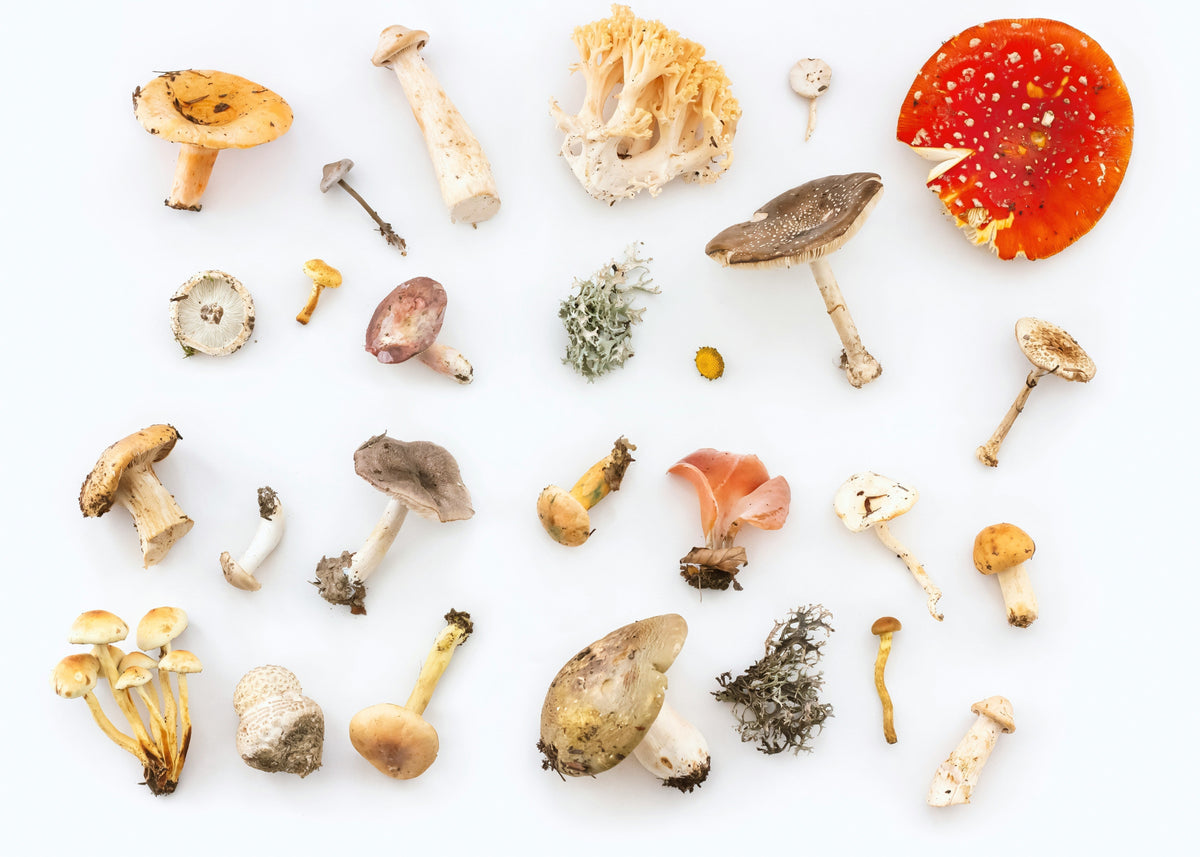
Lion’s Mane. Reishi. Chaga. Cordyceps.
They’ve gone from relatively specialist ingredients to appearing in capsules, coffees, powders, drinks and increasingly elaborate mushroom blends.
More choice should be a good thing.
The problem is that the language surrounding mushrooms has become almost as complicated as the fungi themselves.
Fruiting body. Mycelium. 15:1 extract. Dual extracted. Beta-glucans. Polysaccharides. Bioactive compounds. Full spectrum.
These terms are often presented as shorthand for quality, but rarely explained properly.
And perhaps the biggest mistake is treating Lion’s Mane, Reishi, Chaga and Cordyceps as though they’re essentially four versions of the same ingredient.
They aren’t.
This guide is our attempt to make the mushroom supplement world a little easier to understand.
We sell mushroom products ourselves, so we’re obviously interested in the category. But as we’ve spent more time researching mushrooms, talking to people who work with fungi, looking at extraction methods and examining analytical data, we’ve become less interested in simple marketing rules.
We’d rather ask better questions.
What exactly is the material?
Which part of the fungus has been used?
How was it processed?
What does the testing actually tell us?
And perhaps most importantly:
Does what’s in the finished extract match the story being told on the label?
If you’d like to see the mushroom products we currently offer, you can Explore our Functional Mushrooms collection.
What is a functional mushroom?
“Functional mushroom” is a modern umbrella term rather than a formal scientific classification.
It’s generally used to describe mushrooms and other fungal materials that are used for more than ordinary culinary purposes and which have attracted interest because of their history, composition and the naturally occurring compounds they contain.
It’s a convenient category.
But convenience can hide some enormous differences.
Lion’s Mane produces an unmistakable white fruiting body.
Reishi produces a tough, woody fruiting body.
Chaga is generally collected as a hard, dark conk growing on trees.
Cordyceps CS-4 products use cultured fungal mycelium rather than the sort of mushroom fruiting body most of us picture.
So before we’ve even reached extraction or testing, we’re already dealing with four very different materials.
Meet the four
Lion’s Mane
Hericium erinaceus
Lion’s Mane is probably the most recognisable of the four once you’ve seen it.
Rather than producing the familiar cap and stem, it develops cascading white spines that give it its name.
It has a long history of culinary and traditional use in East Asia and has become one of the most heavily discussed mushrooms in the modern supplement market.
That popularity has also created a very wide range of products, from simple mushroom powders to concentrated extracts and mycelial preparations.
For us, the important questions are what material has actually been used, how it has been extracted and what analytical information is available about the finished ingredient.
Our own Lion’s Mane Fruiting Body Extract Capsules are an example of the approach we increasingly favour: clearly identified fungal material alongside extraction and analytical verification.
Reishi
Ganoderma lucidum
Reishi looks and behaves very differently.
Its mature fruiting body is firm, woody and often has a distinctive glossy surface.
It isn’t generally approached like a normal culinary mushroom. Its traditional preparation has typically involved processes such as prolonged heating or extraction.
Modern Reishi extracts can contain a complex mixture of polysaccharides, sterols, triterpenes and other fungal metabolites.
Again, the name “Reishi” on the front of the bottle only tells you part of the story.
You can explore our Reishi Extract Capsules if you’d like to see how we’ve approached Reishi as a standalone product.
Chaga
Inonotus obliquus
Chaga is different again.
The material most people recognise as Chaga isn’t a conventional mushroom cap. It’s the dense, dark conk that develops on trees, particularly birch in colder northern regions.
We’ve worked with Chaga in its dried form for some time, which gives us an interesting comparison within our own range.
Our Wild Harvested Chaga is dried Chaga intended for traditional hot-water preparation.
A manufactured Chaga Extract Capsule is another format entirely.
They’re both Chaga, but they aren’t the same preparation and shouldn’t be assumed to be directly interchangeable.
We’ll explore that distinction in more detail in our forthcoming guide to dried Chaga versus Chaga extract.
Cordyceps CS-4
Cordyceps has perhaps the most unusual story of the four.
The name Cordyceps covers a complicated group of fungi, and the material used in modern supplements can vary considerably.
Cordyceps CS-4 is particularly interesting because the supplement material is cultured fungal mycelium.
That immediately creates a problem with one of the mushroom industry’s favourite rules:
“Fruiting body is always good. Mycelium is always bad.”
Reality is more complicated.
And that’s a theme you’ll find throughout this guide.
You can explore our Cordyceps CS-4 Extract Capsules to see the material and extraction approach we’ve selected for our own range.
Fruiting body vs mycelium
This is one of the most common debates in mushroom supplements.
A fruiting body is the reproductive structure we’d ordinarily recognise as the mushroom.
Mycelium is the network of fungal tissue from which fruiting bodies can develop.
You’ll often see brands suggesting that any product containing mycelium must automatically be inferior.
We don’t think that’s a particularly intelligent way to assess a product.
The more useful question is:
What exactly is the mycelium grown on?
There’s an important difference between controlled fungal culture and a material consisting of mycelium grown extensively through cereal grain, with the remaining grain substrate then becoming part of the finished powder.
In the latter case, you’re not simply dealing with fungal material. There can also be a significant amount of starch and substrate.
But that doesn’t mean mycelium itself is inherently poor.
Some fungal compounds can differ between fruiting body and mycelial tissue, and some products, including Cordyceps CS-4, deliberately use cultured mycelium.
So rather than following a blanket rule, we’d suggest asking:
Which fungal material has been used, why was it selected, how was it grown and how has it been verified?
We’ll explore this much more deeply in Fruiting Body vs Mycelium: It’s More Complicated Than “One Is Good and One Is Bad”.
Mushroom powder vs mushroom extract
Another distinction that matters enormously is whether you’re buying mushroom powder or mushroom extract.
A basic mushroom powder can be as simple as:
Grow or harvest the mushroom material.
Dry it.
Mill it into powder.
An extract adds another stage.
The fungal material is processed using a solvent, commonly hot water and sometimes water followed by alcohol, to draw soluble constituents out of the starting material.
The resulting liquid can then be concentrated and dried back into a powder.
This is why:
500 mg mushroom powder
isn’t necessarily equivalent to:
500 mg mushroom extract.
They’re different preparations.
But that doesn’t mean the word “extract” automatically guarantees quality either.
Poor starting material can still produce a poor extract.
Inappropriate extraction can produce a poor extract.
Poor storage can affect an ingredient.
And a very impressive number printed beside the word “extract” doesn’t necessarily tell you what’s actually present in the finished powder.
We go further into this in Herbal Powders vs Herbal Extracts.
What does 10:1, 15:1 or 8:1 mean?
Extraction ratios are common on mushroom labels.
A 10:1 ratio is generally intended to mean that around ten parts of starting material were used to produce one part of finished extract.
At first glance, that makes comparison easy.
20:1 sounds better than 10:1.
15:1 sounds better than 5:1.
Unfortunately, it’s not that straightforward.
An extraction ratio tells you about the relationship between starting material and finished extract.
It doesn’t tell you whether the starting material was high quality, whether the correct fungal material was used, whether extraction was appropriate, what compounds were recovered, whether important compounds survived processing or whether carriers are present.
A carefully produced lower-ratio extract can therefore be more interesting than a poorly made higher-ratio one.
So when you see 15:1, we’d treat it as one piece of information.
Not a quality score.
For a fuller explanation, see What Does 10:1, 15:1 or 8:1 Mushroom Extract Actually Mean?.
Does a higher extraction ratio mean a stronger mushroom?
Not necessarily.
This is one of the assumptions we’ve become increasingly cautious about.
Imagine concentrating something that wasn’t particularly good to begin with.
You’ve still concentrated it.
That doesn’t automatically make the finished material exceptional.
The extraction method also matters.
Temperature.
Time.
Solvent.
Starting material.
Moisture.
Processing.
All can affect what ends up in the final powder.
That’s why we’ve become increasingly interested in looking beyond the number on the front of the specification sheet.
Hot-water extraction vs dual extraction
Mushroom extracts are commonly described as either hot-water extracts or dual extracts.
Hot-water extraction
Hot water is widely used because many fungal components are water soluble.
It also has a long history in traditional mushroom preparation.
Dual extraction
Dual extraction generally uses both water and alcohol at different stages.
The reasoning is straightforward.
Different compounds have different solubilities, so using more than one solvent can broaden the range of compounds recovered.
But there’s another overly simple rule in the mushroom industry:
Dual extracted equals automatically superior.
Again, we don’t think that’s necessarily true.
A poorly executed dual extraction doesn’t become a premium extract simply because alcohol appears somewhere in the process.
Likewise, a carefully controlled hot-water extraction can produce a chemically interesting finished ingredient.
The process matters.
But the finished extract matters more.
Our preference is increasingly:
Don’t just tell us how it was extracted. Show us what survived the extraction.
That’s the subject of Hot Water vs Dual Extracted Mushrooms: What Actually Matters?.
What are beta-glucans?
Beta-glucans are one of the most familiar specification markers used in mushroom products.
They’re a type of polysaccharide found in fungi and other natural materials.
This is where another common source of confusion appears.
All beta-glucans are polysaccharides.
But:
Not all polysaccharides are beta-glucans.
So a product advertising a large “polysaccharide” percentage isn’t necessarily communicating the same thing as one providing a properly measured beta-glucan figure.
There’s another complication too.
Starch is also a carbohydrate material, and products containing significant cereal substrate can make simplistic carbohydrate numbers harder to interpret.
Testing methodology therefore matters.
Does a high beta-glucan percentage prove quality?
It can be useful information.
But no, we don’t think it proves overall quality by itself.
Two different mushroom species could both have impressive beta-glucan specifications while containing completely different profiles of other naturally occurring compounds.
That raises an obvious question.
If Lion’s Mane and Reishi can both contain beta-glucans, what actually makes Lion’s Mane Lion’s Mane and Reishi Reishi?
Part of the answer lies in the wider chemical profile.
That’s where mushroom analysis becomes much more interesting.
We’ll unpack the terminology in Beta-Glucans vs Polysaccharides: What Do Mushroom Supplement Numbers Really Mean?.
Beyond beta-glucans
Different fungi contain complex mixtures of compounds.
Some are shared across many fungal species.
Others are much more characteristic of particular mushrooms.
You’ll commonly see discussions around groups such as:
Lion’s Mane: hericenones and related compounds
Reishi: ganoderic acids and other triterpenes
Chaga: inotodiol and betulin-related compounds
Cordyceps: compounds including adenosine and cordycepin
That doesn’t mean the presence of one molecule proves that taking a particular supplement will produce a particular health outcome.
Those are two very different questions.
What compound profiling can help with is something more fundamental:
Does the chemistry of the extract support the identity and quality story being told about it?
That’s important.
Because a scientific paper describing compounds found in a mushroom species doesn’t automatically prove that meaningful quantities of those compounds exist in every supplement carrying that mushroom’s name.
What does “lab tested” actually mean?
Almost every supplement company now says its products are tested.
That’s good.
But the next question should always be:
Tested for what?
Testing might include microbiological contamination, heavy metals, pesticides, moisture, fungal identity, beta-glucans, other specification markers, characteristic compounds and batch-to-batch consistency.
A product can pass one category of testing without telling you much about another.
For example, passing a heavy-metal specification is important.
But it doesn’t tell you whether the mushroom species has been correctly identified.
And confirming identity doesn’t automatically tell you how much of a particular compound is present.
Different analytical questions need different analytical tools.
What is NMR?
NMR stands for Nuclear Magnetic Resonance.
Despite the intimidating name, the basic idea is fairly understandable.
A sample can produce a detailed chemical fingerprint.
That fingerprint can then be analysed and compared with reference material to help assess identity and consistency.
In mushroom testing, techniques of this kind can add another layer beyond simply relying on what a powder is supposed to contain.
It’s essentially another way of asking:
Does this material chemically resemble what we expect it to be?
What is LC-MS?
LC-MS stands for Liquid Chromatography Mass Spectrometry.
In simplified terms, liquid chromatography separates components within a complicated sample.
Mass spectrometry then helps identify compounds according to their molecular characteristics.
More advanced forms of the technique can provide extremely detailed information about a complex extract.
Again, it isn’t a magic “good mushroom” machine.
It can’t turn weak evidence into a health claim.
What it can do is help us move beyond:
This compound should theoretically be present.
towards:
Can we actually detect it in this material?
That’s a much more useful conversation.
We’ll explore both methods in How We Test Mushroom Extracts: NMR, LC-MS and What the Results Actually Tell Us.
Why mushroom products can look similar but be very different
Two bottles can both say:
Lion’s Mane Extract
Both might say:
15:1
Both might carry impressive beta-glucan numbers.
Both might look almost identical on the shelf.
But the underlying products could still differ because of cultivation, fungal material, maturity, storage, extraction, processing, carrier use, compound profile and analytical verification.
This is why we’ve become less interested in choosing one headline number and calling it the definition of quality.
Mushrooms are more complicated than that.
There’s no single magic quality marker
If there’s one idea we want this Mushroom Guide to communicate, it’s probably this:
There isn’t one number or phrase that proves a mushroom supplement is good.
Not 15:1.
Not 30% beta-glucans.
Not “fruiting body”.
Not “dual extracted”.
Not “organic”.
Not “lab tested”.
All of those things can be useful information.
None tells you everything.
We think the better approach is to build up a picture.
What species is it?
Which fungal material has been used?
Powder or extract?
What extraction process was used?
Are carriers present?
What do the specifications say?
Has identity been assessed?
Has the finished extract undergone deeper analysis?
Does the evidence support the story on the label?
That’s how we’re increasingly approaching our own Functional Mushrooms collection.
Why we’re now offering the mushrooms individually
For a long time, we offered Lion’s Mane, Reishi, Chaga and Cordyceps together in our Four Mushroom Blend.
It was straightforward.
One product.
Four mushrooms.
Fixed proportions.
But our thinking has evolved.
Our individual mushroom capsules contain 400 mg of the chosen mushroom extract preparation per capsule, compared with 100 mg of each individual mushroom in a capsule of our previous Four Mushroom Blend.
That gives you much more freedom to choose which mushrooms you want to explore and how they fit into your routine.
We’ve written about that decision in detail in Why We Moved From Our Four Mushroom Blend to Individual Mushrooms.
And if you’re interested in different ways to approach more than one, see How to Choose and Combine Lion’s Mane, Reishi, Chaga & Cordyceps.
The bottom line
The more we’ve learned about mushrooms, the less interested we’ve become in easy answers.
Lion’s Mane isn’t Reishi.
Reishi isn’t Chaga.
Chaga isn’t Cordyceps.
Fruiting body isn’t automatically superior simply because it’s fruiting body.
Mycelium isn’t automatically inferior simply because it’s mycelium.
A 20:1 extract isn’t necessarily better than a 10:1.
And a high beta-glucan percentage doesn’t tell you everything about the finished extract.
That’s exactly why we’re creating this Mushroom Guide.
We’ll be looking much more closely at individual mushrooms, extraction, fungal biology, analytical testing, traditional preparation and the increasingly confusing language used by the supplement industry.
We’re still learning too.
And the more we learn about fungi, the more interesting the subject becomes.
Continue Exploring
Why We Moved From Our Four Mushroom Blend to Individual Mushrooms
Why our approach has moved from one fixed four-mushroom formula towards individual extracts.
How to Choose and Combine Lion’s Mane, Reishi, Chaga & Cordyceps
A practical guide to taking one mushroom or building a more flexible combination.
Written By
Written by Chris Simon, Founder of One Life Foods.
Chris has worked in the supplement industry since 2009 and is known for seeking out exceptional ingredients, products, and formulations. Read more about Chris and the story behind One Life Foods.

Share:
Human Shilajit Studies: What the Research Actually Shows
How to Choose a Mushroom Supplement: 10 Things We’d Check Before Buying One