


The short answer: fruiting body and mycelium are different fungal structures, and neither is automatically the best choice for every mushroom product. The more useful questions are what species is being used, what fungal material is present, how it was grown, whether growth substrate remains, how it was processed and what the finished ingredient has actually been tested for.
Spend five minutes shopping for mushroom supplements and you'll probably encounter one of the industry's favourite rules:
Fruiting body good.
Mycelium bad.
It's wonderfully simple.
Unfortunately, fungi aren't.
Lion’s Mane alone gives us reasons to question the rule. Its fruiting body and mycelium contain different chemical profiles.
Cordyceps CS-4 complicates it further because the commercial material is deliberately produced as cultured mycelium.
And then there's Chaga, where the familiar black material isn't actually the conventional fruiting body at all.
So rather than deciding that one part of every fungus is universally superior, we think it's more useful to understand what the terms actually mean.
If you're new to the subject, What Are Functional Mushrooms? A Guide to Lion’s Mane, Reishi, Chaga & Cordyceps is a good place to start.
What is a mushroom fruiting body?
The fruiting body is the reproductive structure produced by certain fungi.
It's the part most people picture when they hear the word mushroom.
Think:
a cap,
a stem,
gills,
pores,
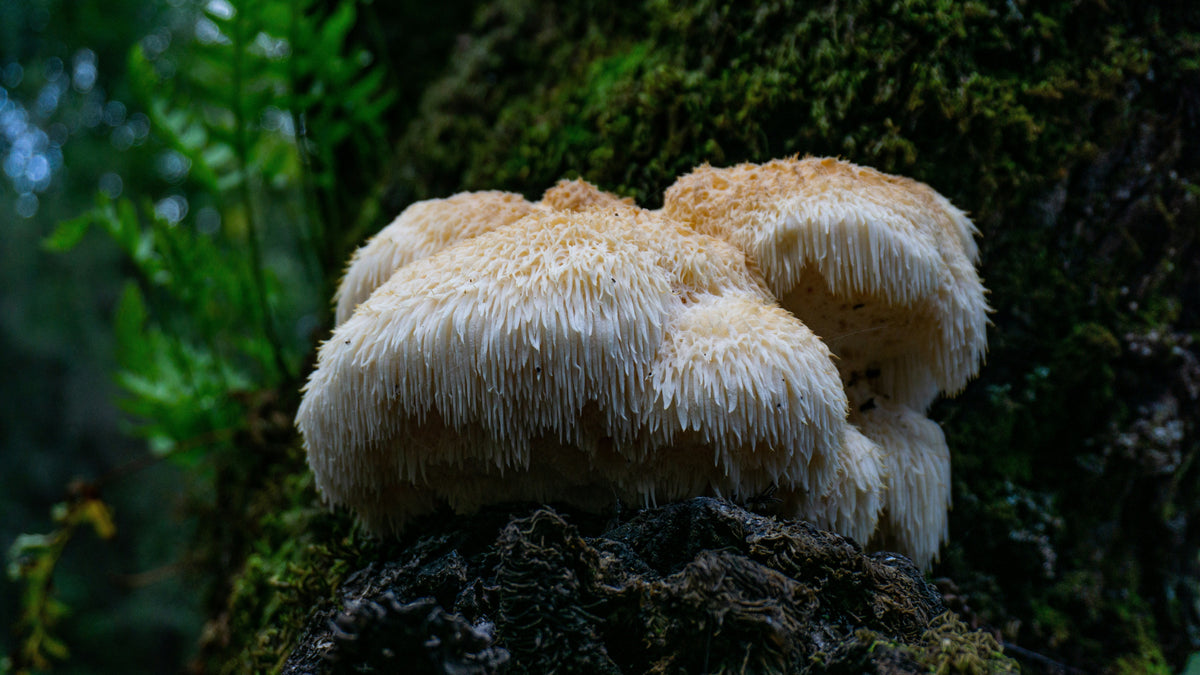
or, in the case of Lion’s Mane, long cascading spines.
Its biological role is connected with reproduction and the production or dispersal of spores.
Not every fungal fruiting body looks remotely like the familiar supermarket mushroom, but the principle is the same.
When a Lion’s Mane supplement says “fruiting body”, for example, it's referring to the distinctive white reproductive structure of Hericium erinaceus.
Our Lion’s Mane Fruiting Body Extract Capsules use this material.
What is mycelium?
Mycelium is the network of fungal filaments, known as hyphae, through which a fungus grows and interacts with its environment.
It's sometimes described as the “roots of the mushroom”.
That's a convenient visual analogy, but it isn't biologically accurate.
Fungi aren't plants and mycelium isn't a root system.
The mycelium is actually a major part of the fungal organism itself.
Depending on the species and growing conditions, it can spread through soil, wood, organic material or a controlled culture medium.
Under suitable conditions, some fungi then produce fruiting bodies from this mycelial network.
So is mycelium just waste material?
No.
And this is where we think mushroom marketing has sometimes become too simplistic.
Mycelium is living fungal tissue.
It contains fungal cell-wall components and produces its own metabolites.
Research on Ganoderma lucidum, or Reishi, for example, has characterised beta-glucans produced in submerged mycelial cultivation.
Lion’s Mane gives us an even clearer example because its fruiting body and cultured mycelium are associated with different groups of secondary metabolites.
Hericenones have been identified from the fruiting bodies of Hericium erinaceus, while erinacines have historically been identified principally from its mycelia.
That doesn't mean a mycelium product is automatically good.
It means mycelium itself shouldn't be confused with the separate question of how that mycelium was cultivated and what else is in the finished ingredient.
Why does mycelium have such a bad reputation in mushroom supplements?
A lot of the argument actually centres on myceliated grain, not pure mycelium.
These aren't the same thing.
One way to cultivate mycelium is on a solid substrate such as:
rice,
oats,
sorghum,
or another cereal grain.
The fungal mycelium grows through that substrate.
If the whole material is then dried and milled together, the finished ingredient can contain both fungal biomass and substantial amounts of remaining grain-derived material.
That matters because a consumer seeing the word “mushroom” may reasonably assume they're buying predominantly fungal material.
Recent analytical research comparing Chaga materials illustrates the distinction well.
Researchers compared authentic Chaga conk, pure Inonotus obliquus mycelium, cereal substrates and grain-fermented materials. The fermented-grain products contained much higher levels of alpha-glucans and detectable starch compared with authentic Chaga conk, while the pure liquid-cultured mycelium didn't show the same starch result.
That's important.
The problem isn't simply:
mycelium.
The problem may be:
what else came with it.
What is liquid-cultured mycelium?
Mycelium can also be cultivated through submerged or liquid fermentation.
Instead of growing the fungus through a solid cereal block, the fungal culture grows within a controlled liquid medium.
This can produce mycelial biomass that is very different from dried myceliated grain.
Submerged cultivation is well established in fungal biotechnology and has been studied extensively for the production of fungal biomass and polysaccharides.
Again, that doesn't mean every liquid-fermented product is automatically excellent.
Species identity still matters.
Culture conditions matter.
Processing matters.
Extraction matters.
And the composition of the finished ingredient matters.
But it shows why reducing the whole subject to “mycelium bad” isn't particularly helpful.
Fruiting body vs mycelium in Lion’s Mane
Lion’s Mane is probably the best mushroom for understanding why this distinction matters.
The fruiting body and mycelium belong to the same species:
Hericium erinaceus.
But they're chemically different fungal tissues.
Lion’s Mane fruiting body
The fruiting body is associated with compounds including hericenones and hericenes.
Recent analytical work continues to identify hericenones from Hericium erinaceus fruiting bodies.
Lion’s Mane mycelium
Cultured Lion’s Mane mycelium is particularly associated with a group of compounds called erinacines.
Reviews of Lion’s Mane chemistry distinguish erinacines found in mycelium from hericenones associated with fruiting bodies.
This has a very practical consequence when reading research.
A study using erinacine-enriched cultured Lion’s Mane mycelium isn't automatically evidence for a completely different fruiting-body extract.
And vice versa.
We discuss this problem in much more depth in Lion’s Mane Mushroom: Benefits, Cognitive Support and How It Works.
Does Lion’s Mane fruiting body contain erinacines?
This is something we'd be cautious about assuming.
Erinacines are primarily associated with cultured mycelium, while hericenones are principally associated with fruiting-body material.
That doesn't mean a particular analytical method could never detect a trace compound outside the tissue in which it's usually concentrated.
It means that if a fruiting-body-only Lion’s Mane product specifically markets erinacines, we'd want to see analytical evidence from that actual ingredient or batch rather than assuming their presence from the species name alone.
That's a good example of a principle you'll see repeatedly throughout our Mushroom Guide:
Don't just tell us what's supposed to be there. Show us what's actually in the material.
What about Reishi?
Reishi, Ganoderma lucidum, is commonly sold as fruiting-body material.
Its tough, woody fruiting body contains beta-glucans, sterols and an extensive group of triterpenoids that includes ganoderic acids.
But Reishi mycelium is also genuine fungal material and has itself been studied chemically.
For example, researchers have characterised branched beta-glucans in submerged Ganoderma lucidum mycelial cultivation.
So again:
Fruiting body and mycelium are different.
That doesn't automatically mean:
one is real and the other isn't.
For our own Reishi product, we've chosen fruiting-body material because that's the preparation and specification we want to offer.
You can explore our Reishi Extract Capsules for the product details.
Chaga completely breaks the fruiting-body rule
Chaga is where the terminology gets particularly interesting.
The black, charcoal-like growth most people call Chaga is the sterile conk produced by Inonotus obliquus, usually on birch.
It's not the conventional reproductive fruiting body of the fungus.
Research into Chaga ecology describes the familiar conk as a sterile fungal growth, while the actual fertile fruiting structure appears separately and is comparatively short-lived.
So imagine applying the rule:
Only fruiting bodies count as good mushroom material.
We'd immediately have a problem.
The Chaga people have collected and prepared traditionally isn't the ordinary fruiting body.
Different Chaga materials can also be chemically different. Research comparing cultivated I. obliquus mycelium with sterile Chaga conk found distinct polysaccharide structures and profiles between them.
That's why our Chaga products describe the actual material as conk, rather than trying to squeeze Chaga into terminology that doesn't accurately describe it.
You can explore our Wild Harvested Chaga or Chaga Extract Capsules to see the two different preparations.
What about Cordyceps CS-4?
Cordyceps gives us another reason not to insist on fruiting body as a universal standard.
Wild Ophiocordyceps sinensis has an extraordinary life cycle involving insect hosts in high-altitude regions of Asia.
Modern fermented Cordyceps materials were developed partly because naturally occurring material is scarce and difficult to produce at scale.
Cordyceps CS-4 is a good example of why “mycelium is poor quality” doesn’t work as a universal rule.
CS-4 is deliberately produced from submerged liquid-fermented fungal mycelium. It isn’t a fruiting body, and it isn’t simply mycelium grown through a cereal grain substrate and ground up with that substrate.
In other words, the use of mycelium here isn’t a shortcut or an accidental substitute for fruiting body. It is the fungal material CS-4 is specifically designed around.
The taxonomic story is complicated too. Material historically described as Paecilomyces hepiali Cs-4 is now placed by modern taxonomy under Samsoniella hepiali. The current NCBI taxonomy lists Samsoniella hepiali as the accepted name and includes Paecilomyces sp. Cs-4 among its associated names.
You don't need to become a fungal taxonomist to buy a supplement.
But the example matters because it demonstrates something fundamental:
For Cordyceps CS-4, cultured mycelium isn't an accidental substitute for a fruiting body. It's the material the product is based on.
You can explore our Cordyceps CS-4 Extract Capsules for the specification of the product in our range.
Is fruiting body usually preferable to myceliated grain?
This is a more useful comparison.
If we're comparing a clearly identified mushroom fruiting body with a product consisting largely of fungal growth and undeclared cereal substrate, we'd want to understand exactly how much fungal material is actually present in the latter.
Research on commercial and experimental mushroom materials shows why alpha-glucan, beta-glucan and starch testing can help reveal differences between fungal material and grain-derived substrate.
But that still isn't a reason to turn fruiting body into a universal badge of quality.
A fruiting body can be:
poorly identified,
poorly grown,
poorly stored,
poorly extracted,
or poorly characterised.
Putting “100% fruiting body” on the front of the bottle doesn't answer those questions.
Is fruiting body the same as whole mushroom?
Not necessarily.
“Whole mushroom” can be surprisingly vague terminology.
Depending on the product, it might refer to:
the fruiting body,
fruiting body plus other fungal structures,
a whole cultivated biomass,
or simply unextracted fungal material.
We'd rather brands use precise language.
If it's fruiting body, say fruiting body.
If it's cultured mycelium, say cultured mycelium.
If it's mycelium grown on grain and the grain remains, say so.
If it's Chaga conk, call it conk.
Specific language makes comparison easier.
What matters more than fruiting body vs mycelium?
We'd look at the whole product rather than one marketing phrase.
That means asking:
-
What species is being used?
Is the scientific identity clear? -
What fungal material is present?
Fruiting body, cultured mycelium, sterile conk, myceliated grain or something else? -
How was it cultivated or sourced?
Wild harvested, fruiting-body cultivation, solid substrate or liquid fermentation? -
Is growth substrate present in the finished ingredient?
If grain or another carrier remains, is it disclosed? -
Is it powder or extract?
Those are different preparations. See Powdered Herbs vs Herbal Extracts: Why That £9.99 “Super Supplement” Might Just Be a Fancy Pot of Dust. -
How has the finished material been tested?
Identity, glucans, contaminants, characteristic compounds and batch consistency can all answer different questions.
This is also why we'll be publishing How We Test Mushroom Extracts: NMR, LC-MS and What the Results Actually Tell Us.
Why “fruiting body only” became such powerful marketing
Because it's easy to understand.
Consumers don't want to complete a mycology degree before buying a bottle of capsules.
So the industry created shorthand.
Fruiting body only became associated with premium.
Mycelium became associated with cheap.
That shorthand was partly driven by legitimate concerns about products containing large amounts of cereal substrate.
But somewhere along the way, two different statements became confused:
Some myceliated-grain products can contain substantial non-fungal substrate.
and:
All mycelium is inferior.
The first is a product-composition question.
The second is an oversimplification.
We think customers deserve the distinction.
What about beta-glucans?
Beta-glucan testing can add useful information when comparing fungal materials, but once again it isn't a perfect one-number solution.
Different fungal tissues can contain different polysaccharide profiles.
Grain substrates can introduce their own carbohydrates.
And different mushroom species naturally vary.
That's why measuring beta-glucans, alpha-glucans and, where relevant, starch can sometimes tell us more than simply reading “polysaccharides” on a specification sheet.
We'll explore that in Beta-Glucans vs Polysaccharides: What Do Mushroom Supplement Numbers Really Mean?.
The bottom line
Fruiting body vs mycelium is a useful question.
It just isn't the only question.
For Lion’s Mane, the distinction tells us something about the compounds we might expect to find.
For Cordyceps CS-4, cultured mycelium is fundamental to the product itself.
For Chaga, the material traditionally collected isn't even the conventional fruiting body.
And when the concern is actually mycelium grown on cereal grain, we should say exactly that rather than treating all fungal mycelium as the same material.
So our approach is:
Don't choose a mushroom supplement because one fashionable phrase appears on the label.
Ask what it is.
Ask how it was grown.
Ask what else is present.
Ask how it was processed.
And ask what the analysis can actually verify.
That's the approach we're applying across our Functional Mushrooms collection.
Continue Exploring
Lion’s Mane Mushroom: Benefits, Cognitive Support and How It Works
See why fruiting body and mycelium need to be distinguished when interpreting Lion’s Mane research.
What Does 10:1, 15:1 or 8:1 Mushroom Extract Actually Mean?
Why a bigger extraction ratio doesn't automatically mean a better mushroom extract.
Beta-Glucans vs Polysaccharides: What Do Mushroom Supplement Numbers Really Mean?
Learn what some of the most common mushroom specification numbers actually measure.
What Are Functional Mushrooms?
Go back to the fundamentals of mushroom material, extraction and testing.
Written By
Written by Chris Simon, Founder of One Life Foods.
Chris has worked in the supplement industry since 2009 and is known for seeking out exceptional ingredients, products, and formulations. Read more about Chris and the story behind One Life Foods.

Share:
How to Choose a Mushroom Supplement: 10 Things We’d Check Before Buying One
Why We Moved From Our Four Mushroom Blend to Individual Mushrooms