


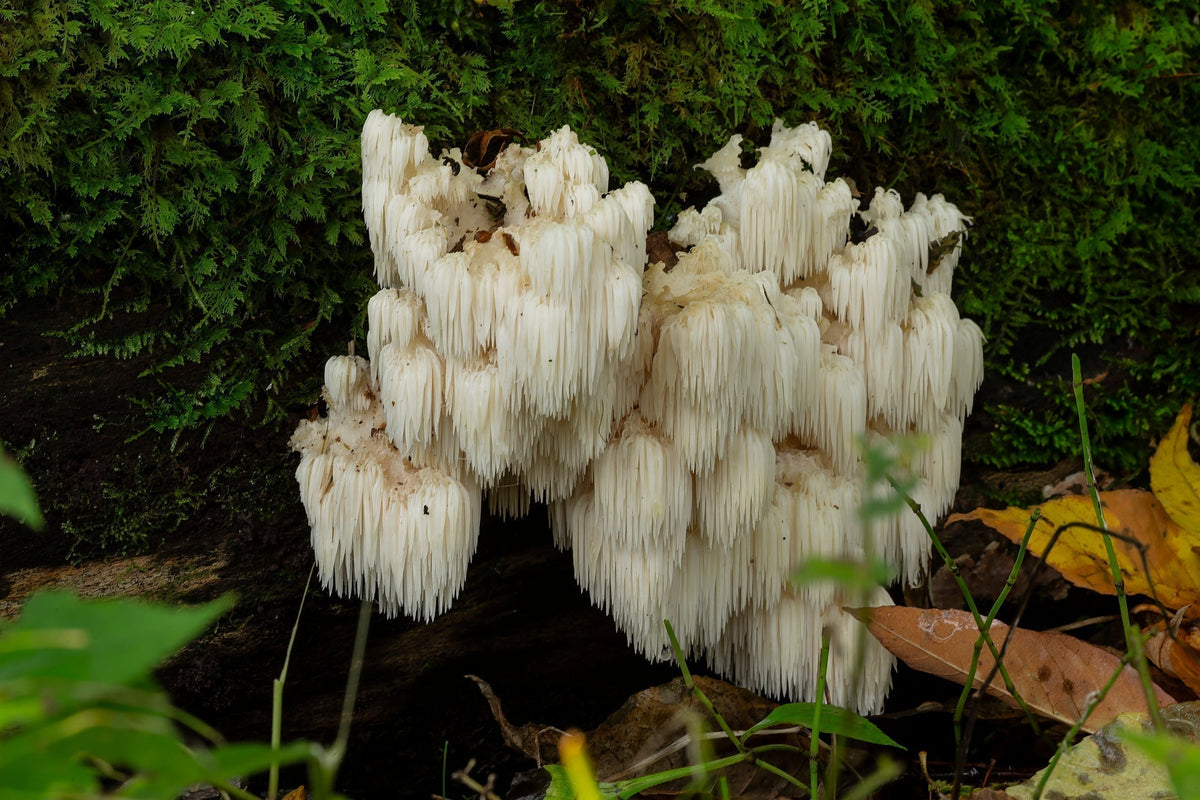
Lion’s Mane is not exactly subtle.
With its long white spines and shaggy appearance, it looks less like a conventional mushroom and more like something a wizard might keep on a shelf for emergencies.
Its scientific name is Hericium erinaceus, and it has a history of culinary and traditional use in East Asia.
Today, it’s one of the most talked-about mushrooms in the supplement world.
Much of that attention centres on the brain.
Focus. Memory. Cognition. Mood. Nerve growth factor. Neuroplasticity.
You'll see all of those terms associated with Lion’s Mane online.
But there's an important difference between saying researchers have investigated Lion’s Mane in relation to these areas and saying Lion’s Mane has been proven to provide those benefits.
Those aren't the same thing.
And once we started looking more closely at the research, we found the real story considerably more interesting than the marketing version.
If you're new to mushroom terminology generally, you may want to start with What Are Functional Mushrooms? A Guide to Lion’s Mane, Reishi, Chaga & Cordyceps.
Research Doesn't Equal Product Claim
Throughout this article we discuss published scientific research into Hericium erinaceus and compounds isolated from it. Different studies have used different preparations, including fruiting-body powder, fruiting-body extracts and cultured mycelium. Findings from one preparation shouldn't automatically be applied to another, and research on Lion’s Mane doesn't establish that our own product will produce the same outcome.
What is Lion’s Mane mushroom?
Lion’s Mane is the common name for Hericium erinaceus, an edible fungus in the Hericiaceae family.
Rather than producing a conventional cap and stem, the fruiting body develops cascading white spines.
It grows naturally on hardwood trees and has a long culinary history, particularly in parts of Asia.
Modern Lion’s Mane products come in several quite different forms:
- fresh or dried mushroom
- ground fruiting-body powder
- fruiting-body extracts
- cultured mycelium
- mycelial extracts
- combinations of fungal materials
- tinctures and liquid preparations
That distinction matters.
A study using three grams of powdered fruiting body isn't necessarily telling us what to expect from a smaller amount of a concentrated extract.
Likewise, research on erinacine-enriched cultured mycelium isn't automatically applicable to a fruiting-body product.
Lion’s Mane is the species. The preparation is another question entirely.
Why has Lion’s Mane attracted so much interest?
One reason is its unusual chemistry.
Lion’s Mane contains a range of naturally occurring constituents, including polysaccharides, beta-glucans, sterols and numerous secondary metabolites.
Two names come up particularly frequently:
hericenones
and
erinacines
These compounds have attracted laboratory research because some have been investigated in connection with biological pathways involving nerve growth factor, usually abbreviated to NGF.
NGF is a naturally occurring protein involved in the development, maintenance and survival of certain nerve cells.
That mechanistic research is one of the reasons scientists became interested in studying Lion’s Mane in areas such as cognition.
But this is also where marketing can run several steps ahead of the evidence.
A compound doing something interesting in a laboratory model doesn't mean swallowing a capsule will automatically produce the same result in a person.
That's why the human research matters.
Hericenones vs erinacines: what's the difference?
Although they often appear together in Lion’s Mane marketing, hericenones and erinacines aren't interchangeable.
Hericenones
Hericenones are secondary metabolites associated principally with the fruiting body of Hericium erinaceus.
Researchers have identified a number of different hericenones, and some have been investigated in laboratory models involving NGF-related activity.
Modern analytical studies continue to identify hericenones within Lion’s Mane fruiting bodies.
Erinacines
Erinacines are different compounds and are associated primarily with cultured Lion’s Mane mycelium.
Recent research comparing fungal tissue has found erinacine production to be substantially greater in mycelium than fruiting-body tissue.
That distinction matters enormously when reading research.
A trial using erinacine A-enriched cultured mycelium shouldn't be casually cited as proof of what a fruiting-body extract does.
They're both Lion’s Mane.
They aren't the same preparation.
This is one of the subjects we'll explore further in Fruiting Body vs Mycelium: It’s More Complicated Than “One Is Good and One Is Bad”.
So what are the potential benefits of Lion’s Mane?
This is probably the question that brought you here.
The most accurate answer is:
Lion’s Mane has been investigated in human studies measuring aspects of cognition, cognitive decline, mood, stress and other neurological outcomes, but the clinical evidence is still relatively small and results aren't uniformly positive.
That's less exciting than “Lion’s Mane boosts your brain”.
It's also much more useful.
A 2024 review looking at mushrooms and neurocognitive health found that intervention results were mixed and concluded that further human studies with larger samples and appropriate cognitive testing are needed.
Let's look at some of the studies people are actually referring to.
What does the human research say about Lion’s Mane and cognition?
2009: adults with mild cognitive impairment
One of the best-known Lion’s Mane studies involved 30 Japanese adults aged 50 to 80 with mild cognitive impairment.
Participants were randomised to Lion’s Mane or placebo.
The intervention group took tablets containing 96% dried Lion’s Mane powder, providing approximately 3 g per day, for 16 weeks.
Scores on the study's cognitive scale were significantly higher in the Lion’s Mane group than the placebo group at weeks 8, 12 and 16. Four weeks after supplementation stopped, scores had fallen again.
That's interesting.
But look carefully at what it tells us.
It was:
- a small study
- in older adults with diagnosed mild cognitive impairment
- using approximately 3 g per day
- using dried mushroom powder
- over 16 weeks
It doesn't automatically tell us what happens in a healthy 30-year-old taking a different Lion’s Mane extract.
2019: healthy adults over 50
Another randomised, double-blind, placebo-controlled study investigated 31 healthy adults over the age of 50.
Participants in the Lion’s Mane group consumed four supplements daily, each containing 0.8 g of powdered fruiting body, giving 3.2 g per day for 12 weeks.
Three cognitive tests were used.
A statistically significant difference between groups was observed in the MMSE score at the end of the trial, while the other cognitive tests didn't show significant between-group differences.
Again, that's interesting.
But “one measure improved while others didn't” is a much more accurate summary than simply saying:
Lion’s Mane improves cognition.
What about Lion’s Mane in younger, healthy adults?
This is particularly relevant because a large part of the modern Lion’s Mane market is aimed at younger people interested in productivity, studying and mental performance.
The evidence here is much thinner.
2023 pilot study
A randomised, double-blind, placebo-controlled pilot trial studied 41 healthy adults aged 18 to 45 taking 1.8 g of Lion’s Mane daily.
Researchers measured a number of aspects of cognition and mood.
Following a single dose, participants in the Lion’s Mane group completed one Stroop task more quickly.
After 28 days there was also a trend towards reduced subjective stress that narrowly missed the conventional threshold for statistical significance.
But the study also produced null and some limited negative findings, and the researchers themselves emphasised the small sample and need for larger studies.
That's exactly the sort of nuance that's lost when a study becomes an Instagram graphic saying:
“Lion’s Mane proven to boost focus.”
2025 acute fruiting-body extract study
A more recent study tested a single 3 g dose of a 10:1 Lion’s Mane fruiting-body extract in 18 healthy adults aged 18 to 35.
Researchers assessed executive function, working memory, attention, processing speed, psychomotor performance and mood.
The headline finding?
There was no significant overall improvement in composite cognitive performance or mood compared with placebo.
One individual psychomotor task did improve, but the authors concluded that any acute effects may be task-specific and that further chronic research is needed.
We think results like this are just as important to discuss as positive ones.
If we're interested in what Lion’s Mane actually does, null results are evidence too.
Does Lion’s Mane improve focus?
At present, we wouldn't make that claim.
Researchers have measured attention, reaction time, executive function and other cognitive outcomes in human Lion’s Mane studies.
Some individual tests have produced positive findings.
Others haven't.
The number of controlled human trials remains relatively small, the products differ considerably, and sample sizes have generally been modest.
So if the question is:
Has Lion’s Mane been studied in relation to focus and cognitive performance?
Yes.
If the question is:
Has it been established that any Lion’s Mane supplement will make a healthy person more focused?
No.
That's an important difference.
What does the research say about Lion’s Mane and memory?
Memory-related outcomes have appeared in several human studies, but again the results depend on the population, preparation and test used.
The 2009 trial in people with mild cognitive impairment found differences on its overall cognitive-function scale during the supplementation period.
The 2019 trial used several cognitive measures but only found a significant between-group result on one of them.
In younger healthy adults, controlled evidence is currently much less convincing.
That's why we think “Lion’s Mane has been investigated in cognitive research” is a much more defensible statement than “Lion’s Mane supports memory”.
What about mood and stress?
Mood is another area in which Lion’s Mane has attracted human research.
A small 2010 study randomised 30 women to Lion’s Mane-containing cookies or placebo cookies for four weeks.
Researchers measured depression, sleep, menopausal symptoms and a broader collection of self-reported complaints.
Some scores changed within the Lion’s Mane group and some individual measures differed from placebo, while others didn't.
The 2023 young-adult pilot trial also measured mood and perceived stress. It found a trend towards lower subjective stress after 28 days, but this narrowly missed conventional statistical significance.
So mood and stress are legitimate areas of investigation.
They aren't established reasons for us to market a Lion’s Mane supplement as reducing stress, anxiety or depression.
That distinction is particularly important because treatment claims relating to conditions such as depression would move well beyond what is permitted for a food supplement.
What about Lion’s Mane and neurological conditions?
Lion’s Mane has also been investigated in preclinical models and small human studies involving neurological disease and cognitive impairment.
For example, one placebo-controlled study investigated erinacine A-enriched Lion’s Mane mycelium in people with mild Alzheimer's disease for 49 weeks.
That is scientifically interesting.
It is not a reason to describe an ordinary Lion’s Mane food supplement as preventing, treating or slowing Alzheimer's disease.
Foods and food supplements can't claim or imply that they prevent, treat or cure disease.
It also illustrates our earlier point about preparation.
Erinacine-enriched mycelium and a fruiting-body extract are chemically different materials.
You can't simply transfer results from one to the other because they share the words “Lion’s Mane”.
What about nerve growth factor?
NGF is probably the biological mechanism most frequently associated with Lion’s Mane.
Certain isolated compounds from Hericium erinaceus have been investigated in laboratory and animal work for their interactions with NGF-related pathways.
That's genuinely interesting science.
But mechanistic evidence needs to stay in its lane.
A useful evidence ladder looks something like this:
Compound identified
↓
Laboratory mechanism investigated
↓
Animal research
↓
Controlled human trial
↓
Replication in larger studies
↓
Evidence applicable to a defined product and population
The mushroom supplement world has a habit of jumping from the first or second step directly to:
Therefore this capsule supports your brain.
We don't think that's a responsible interpretation.
Fruiting body vs mycelium matters when discussing the science
Lion’s Mane is one of the best examples of why the fruiting-body-versus-mycelium argument deserves more nuance.
Fruiting bodies contain characteristic compounds including hericenones.
Cultured mycelium is associated particularly with erinacines.
Recent work has shown marked differences in erinacine production according to fungal tissue and even the substrate used to culture the mycelium.
So neither of these statements is particularly useful:
All Lion’s Mane is basically the same.
or
Fruiting body is always good and mycelium is always bad.
The better questions are:
Which material was used?
How was it grown?
Was growth substrate carried into the finished ingredient?
How was it extracted?
And what does the analytical data actually show?
Read Fruiting Body vs Mycelium: It’s More Complicated Than “One Is Good and One Is Bad” for the deeper version.
Lion’s Mane powder vs extract
Another common mistake is comparing Lion’s Mane products solely by milligrams.
A powder may simply be mushroom material that has been dried and milled.
An extract undergoes additional processing in which soluble constituents are extracted from the original material before the resulting preparation is concentrated and dried.
These aren't directly equivalent preparations.
This matters when reading research too.
The well-known 2009 study used around 3 g of dried powder per day.
The 2025 acute study used 3 g of a 10:1 fruiting-body extract.
Those numbers may look similar.
The preparations aren't.
This is why trying to derive the “correct Lion’s Mane dose” by grabbing a milligram number from one study can be misleading.
For more on this distinction, see Powdered Herbs vs Herbal Extracts: What’s the Difference?
Does the extraction ratio matter?
Yes.
But perhaps not in the way mushroom marketing often suggests.
A ratio such as 8:1, 10:1 or 15:1 describes the relationship between the amount of starting material and finished extract according to the extraction specification.
It doesn't automatically tell you:
- how good the starting material was
- which compounds were extracted
- what was lost during processing
- whether carriers are present
- the chemical profile of the finished powder
So we'd never treat:
15:1
as automatically meaning:
three times better than 5:1.
Extraction ratio is a specification.
Not a universal potency score.
We'll explore this separately in What Does 10:1, 15:1 or 8:1 Mushroom Extract Actually Mean?.
What about beta-glucans?
Beta-glucans are polysaccharides found in fungal cell walls and are commonly measured in mushroom ingredients.
They're useful information.
But they're not unique to Lion’s Mane.
Reishi, Chaga and numerous other fungi can contain beta-glucans too.
That means a beta-glucan figure can't tell the complete story of what makes one Lion’s Mane extract chemically different from another mushroom extract.
There's also an important distinction between beta-glucans and the much broader term polysaccharides.
Not all polysaccharides are beta-glucans.
And where cereal substrate or starch is present, a vague total-polysaccharide number can become particularly difficult to interpret.
That's why we'll be looking at this separately in Beta-Glucans vs Polysaccharides: What Do Mushroom Supplement Numbers Really Mean?.
Why we're interested in compound-level testing
This is one of the biggest changes in how we think about mushroom supplements.
A product can look impressive on paper:
Lion’s Mane
fruiting body
high extraction ratio
beta-glucans measured
All useful.
But we still want to ask:
Does the finished material actually contain the chemical markers we'd expect to find?
Techniques such as NMR can help assess a sample's broader chemical fingerprint.
Chromatography and mass-spectrometry techniques can go further by separating and investigating individual compounds within a complex extract.
Research methods have also been developed specifically to measure Lion’s Mane constituents such as hericenones, hericenes, erinacines and ergosterol in raw materials and finished products.
That's why our philosophy is increasingly:
Don't just tell us what's supposed to be in the mushroom. Show us what's actually in the extract.
For a deeper explanation, read How We Test Mushroom Extracts: NMR, LC-MS and What the Results Actually Tell Us.
How long does Lion’s Mane take to work?
There isn't an established universal answer.
And we'd be suspicious of anyone giving you an exact one.
Human studies have investigated everything from a single dose through to interventions lasting four, twelve, sixteen and even more weeks, using very different Lion’s Mane preparations and populations.
Results have also been mixed.
So statements such as:
“You'll feel Lion’s Mane after two weeks”
aren't supported by a universal body of evidence.
If you're taking a supplement, follow its labelled directions rather than trying to reproduce a research protocol involving a different material.
When is the best time to take Lion’s Mane?
There isn't good clinical evidence establishing a universally superior time of day for Lion’s Mane.
You'll often see morning use recommended online because Lion’s Mane is marketed around focus and productivity.
That's marketing convention rather than a demonstrated rule.
The more practical answer is to follow the product directions and use it at a time that works consistently within your routine.
No complicated mushroom sundial required.
Can you take Lion’s Mane with Reishi, Chaga or Cordyceps?
Keeping the mushrooms individual gives you that option.
But we don't label combinations according to implied outcomes such as:
Lion’s Mane + Cordyceps = focus and energy
or
Lion’s Mane + Reishi = calm focus
Those descriptions turn a combination into an implied health claim.
Instead, we've developed a straightforward framework based on choosing one mushroom, pairing two or making one an “anchor” within your routine.
You can read that here:
Can You Take Lion’s Mane, Reishi, Chaga & Cordyceps Together?
How should you choose a Lion’s Mane supplement?
We'd look beyond the front of the bottle.
1. Check the species
Look for Hericium erinaceus rather than an unspecified “mushroom complex”.
2. Ask which fungal material is used
Fruiting body?
Cultured mycelium?
Mycelium grown on cereal substrate?
A mixture?
These are meaningful differences.
3. Find out whether it's powder or extract
A dried powder and an extracted preparation aren't directly equivalent.
4. Understand the extraction method
Hot water?
Dual extraction?
Another process?
Don't assume one term automatically proves superiority.
5. Treat extraction ratio as one specification
A larger number doesn't automatically mean a better product.
6. Look beyond “polysaccharides”
Where possible, understand what was actually measured and by which method.
7. Ask about carriers and substrate
Carriers aren't automatically unacceptable.
Undeclared ones are a different matter.
8. Look for identity verification
How does the company know the mushroom material is what it claims to be?
9. Look at compound analysis where available
If characteristic compounds are heavily featured in the marketing, has anyone actually tested the ingredient for them?
10. Be suspicious of certainty
“Best mushroom.”
“Maximum potency.”
“Clinically proven brain booster.”
Fungal chemistry rarely fits neatly into slogans.
If you want the broader buying framework, see How to Choose a Mushroom Supplement: 10 Things We’d Check Before Buying One.
What makes our approach to Lion’s Mane different?
Our interest isn't simply in putting a big extraction ratio on the front of a bottle.
We're interested in the starting material, extraction process and analytical profile of the finished ingredient.
Our Lion’s Mane uses fruiting-body material in an extracted preparation.
More importantly, we're moving towards a philosophy where conventional specifications are considered alongside deeper verification rather than being treated as the whole quality story.
If you'd like the technical product information, you can view our Lion’s Mane Fruiting Body Extract Capsules.
We've deliberately placed that link here, rather than alongside the human research above.
The research describes the products actually tested in those studies.
Our product should be judged on its own specification and analysis, not by borrowing results from a different Lion’s Mane preparation.
Is Lion’s Mane safe?
Lion’s Mane has been consumed as food and has generally been well tolerated in the relatively small human studies conducted so far.
That doesn't mean adverse reactions are impossible.
Mushroom allergies and individual sensitivities can occur, and the overall clinical evidence base is still limited. A US National Institutes of Health review notes that Lion’s Mane hasn't been linked to clinically apparent liver injury and that reported adverse effects in available trials have generally been mild.
If you're pregnant or breastfeeding, have a medical condition, have a mushroom allergy, are preparing for surgery or take medication, seek appropriate professional advice before using food supplements.
And always follow the product's stated recommended intake.
So does Lion’s Mane “work”?
That depends on what you mean by “work”.
If the question is:
Does Lion’s Mane contain chemically interesting compounds that are being actively researched?
Yes.
Have controlled human studies investigated cognition and mood?
Yes.
Have some studies reported positive findings?
Yes.
Have other tests and studies produced null or mixed findings?
Also yes.
Do we yet have enough evidence to say every Lion’s Mane supplement improves focus, memory, mood or brain health?
No.
And crucially:
Research on one Lion’s Mane preparation doesn't prove another product will produce the same result.
That may sound less spectacular than some of the claims you'll see online.
We think it's considerably more interesting.
Final thoughts: interesting enough without the hype
Lion’s Mane deserves attention.
Just perhaps not for exactly the reasons the internet sometimes gives it.
It has an unusual chemical profile.
Its fruiting body and mycelium contain different groups of compounds.
Researchers have investigated it in laboratory, animal and human studies.
Some human findings are encouraging.
Others are neutral.
Most trials are small.
And the preparations used differ considerably.
That's not disappointing science.
That's science in progress.
We'd rather show you that than turn preliminary findings into promises.
So when we talk about Lion’s Mane, our questions aren't simply:
What benefits can we put on the label?
They're:
What did the researchers actually test?
What material did they use?
How much?
For how long?
What did they measure?
What worked?
What didn't?
And is the product we're selling actually comparable with the material in the research?
Those are harder questions.
They're also the questions that make the Mushroom Guide worth writing.
Continue Exploring
What Are Functional Mushrooms?
Start with the fundamentals, including fruiting bodies, mycelium, extraction ratios, beta-glucans and analytical testing.
Fruiting Body vs Mycelium: It’s More Complicated Than “One Is Good and One Is Bad”
Why the most common mushroom quality rule needs considerably more nuance.
Powdered Herbs vs Herbal Extracts: What’s the Difference?
Understand why milligrams alone don't make two Lion’s Mane preparations equivalent.
Can You Take Lion’s Mane, Reishi, Chaga & Cordyceps Together?
Our practical guide to ONE, PAIR and ANCHOR approaches.
The Mushroom Guide
Explore the complete One Life library on mushrooms, extracts, testing, research and quality.
Lion’s Mane Fruiting Body Extract Capsules
View the specification and product information for our Lion’s Mane extract.
References
- Mori K, Inatomi S, Ouchi K, Azumi Y, Tuchida T. Improving effects of the mushroom Yamabushitake, Hericium erinaceus, on mild cognitive impairment: a double-blind placebo-controlled clinical trial. Phytotherapy Research. 2009;23(3):367-372. The trial included 30 adults with mild cognitive impairment and used approximately 3 g/day of dried Lion’s Mane material for 16 weeks.
- Nagano M, Shimizu K, Kondo R, et al. Reduction of depression and anxiety by 4 weeks Hericium erinaceus intake. Biomedical Research. 2010;31(4):231-237.
- Saitsu Y, Nishide A, Kikushima K, Shimizu K, Ohnuki K. Improvement of cognitive functions by oral intake of Hericium erinaceus. Biomedical Research. 2019;40(4):125-131.
- Docherty S, Doughty FL, Smith EF. The Acute and Chronic Effects of Lion’s Mane Mushroom Supplementation on Cognitive Function, Stress and Mood in Young Adults: A Double-Blind, Parallel Groups, Pilot Study. Nutrients. 2023;15(22):4842.
- Docherty S, et al. Acute effects of a standardised extract of Hericium erinaceus on cognition and mood in healthy younger adults: a double-blind randomised placebo-controlled study. Frontiers in Nutrition. 2025.
- Friedman M. Chemistry, Nutrition, and Health-Promoting Properties of Hericium erinaceus Mushroom Fruiting Bodies and Mycelia and Their Bioactive Compounds. Journal of Agricultural and Food Chemistry. 2015;63.
- Wang J, Wu J, Yamaguchi R, et al. Uncovering Hericenones from the Fruiting Bodies of Hericium erinaceus through Interdisciplinary Collaboration. Journal of Natural Products. 2025;88(1):80-85.
- Recent tissue-comparison research has further examined the influence of fungal tissue and culture substrate on erinacine production in H. erinaceus.

Share:
Shilajit for women
Supporting Your Immune System During Winter: The Science Behind Staying Well