


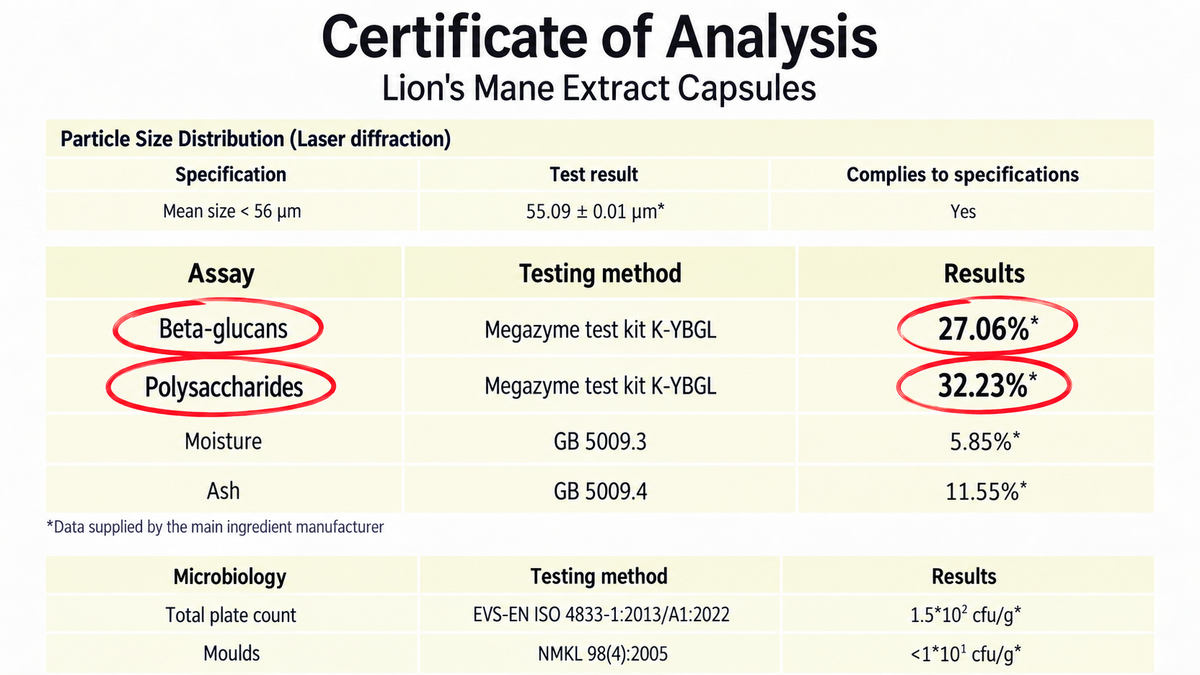
The short answer: beta-glucans are a type of polysaccharide, but not all polysaccharides are beta-glucans. A high “polysaccharide” percentage can therefore include carbohydrates other than the fungal beta-glucans you may think you're buying. Beta-glucan testing is more specific, but even that number should be interpreted alongside the fungal material, extraction method and wider analytical profile.
Mushroom labels love percentages.
30% beta-glucans.
40% polysaccharides.
High in mushroom polysaccharides.
The numbers look scientific.
And because 40 is bigger than 30, the temptation is to conclude that the first product must contain more of whatever makes mushrooms interesting.
Unfortunately, that's not how the terminology works.
A product claiming 40% polysaccharides isn't necessarily showing you something more impressive than one declaring 30% beta-glucans.
They aren't measuring the same thing.
To understand why, we need to start with carbohydrates.
If you're new to mushroom quality terminology generally, start with What Are Functional Mushrooms? A Guide to Lion’s Mane, Reishi, Chaga & Cordyceps.
What is a polysaccharide?
A polysaccharide is a large carbohydrate molecule made from many smaller sugar units joined together.
That's a very broad chemical category.
Polysaccharides occur throughout nature.
Plants contain them.
Fungi contain them.
Cereals contain them.
Starch is a polysaccharide.
Cellulose is a polysaccharide.
Different glucans are polysaccharides too.
So when a mushroom product simply says:
“30% polysaccharides”
the immediate question should be:
Which polysaccharides?
Because the total number alone doesn't tell you.
What is a glucan?
A glucan is a polysaccharide built primarily from glucose units.
Those glucose units can be joined together in different ways.
That produces different structural forms, including:
alpha-glucans
and
beta-glucans.
The distinction isn't marketing terminology. It describes differences in the chemical bonds linking the glucose molecules together.
Those structural differences matter when analysing fungal materials.
What are beta-glucans?
Beta-glucans are glucans containing glucose molecules connected through beta-type linkages.
Mushroom beta-glucans commonly include structures involving beta-(1→3) backbones with beta-(1→6) branching, although fungal glucan structures can be considerably more complicated than a single formula.
Beta-glucans aren't exclusive to mushrooms.
They're also found in yeast and cereals, among other sources.
And beta-glucans from different sources aren't necessarily structurally identical.
That's why simply seeing the words “contains beta-glucans” doesn't tell you everything about an ingredient.
But within mushroom specifications, beta-glucan percentage can be a useful piece of compositional information.
So are beta-glucans and polysaccharides the same thing?
No.
The easiest way to remember it is:
Beta-glucans are polysaccharides.
But:
Polysaccharides include much more than beta-glucans.
Imagine saying:
All Labradors are dogs, but not all dogs are Labradors.
Same principle.
A total-polysaccharide result may potentially include beta-glucans, alpha-glucans and other carbohydrate polymers.
That means a large total-polysaccharide number doesn't automatically tell you how much fungal beta-glucan is actually present.
Why did mushroom brands historically use “polysaccharides”?
Partly because they were relatively easy to measure as a broad category.
But broad measurements create an obvious problem.
If you're trying to judge the fungal composition of a mushroom product, a method that counts many different carbohydrates together can produce an impressive number without telling you which carbohydrates you're actually looking at.
That's particularly relevant when mushroom ingredients are produced using cereal substrates or when carbohydrate-based carriers are present.
This is one reason the industry has increasingly moved towards more specific beta-glucan analysis rather than relying solely on total polysaccharide claims.
What are alpha-glucans?
Alpha-glucans are another group of glucose-based polysaccharides.
Starch is a major example.
That makes alpha-glucan testing particularly interesting when assessing mushroom products made using cereal grain.
If mycelium is grown through rice, oats or another grain and that substrate remains in the final dried ingredient, the grain can contribute significant starch.
But there is an important point to make here.
Alpha-glucan does not automatically mean “filler” or “grain”.
Fungal materials can naturally contain certain alpha-linked carbohydrates too, and modern analytical work has highlighted additional complications such as naturally occurring trehalose (a sugar) and formulation ingredients.
So we'd treat an unusually high alpha-glucan result as something to investigate, not as automatic proof of adulteration.
This is closely connected with Fruiting Body vs Mycelium: It’s More Complicated Than “One Is Good and One Is Bad".
What does starch have to do with mushroom supplements?
Quite a lot when cereal substrate remains in the ingredient.
Imagine mycelium grown through a block of rice.
As the fungus grows, it uses some of that substrate.
But if the entire material is eventually dried and milled, remaining rice doesn't magically disappear.
The finished powder can therefore contain:
fungal biomass
plus
remaining cereal material.
That cereal contributes starch.
This is why knowing whether a product is:
fruiting body,
pure cultured mycelium,
or
mycelium together with growth substrate
can matter when interpreting glucan results.
A 2026 update to analytical methods for mushroom beta-glucans specifically discusses the challenges introduced by starch-rich fungal products and modern supplement formulations.
Does a high polysaccharide percentage prove a good mushroom supplement?
No.
Not by itself.
Suppose Product A says:
50% polysaccharides
while Product B says:
30% beta-glucans.
You can't simply conclude Product A has the better mushroom specification because 50 is larger than 30.
Product A's broader figure could include several types of carbohydrate.
Product B is reporting something more specific.
That's why we'd rather know exactly what was measured than simply choose the biggest percentage printed on the label.
Is a high beta-glucan percentage better?
It can provide useful information.
But we're wary of turning beta-glucan percentage into another universal quality score.
Lion’s Mane can contain beta-glucans.
Reishi can contain beta-glucans.
Other fungi can contain beta-glucans.
Yet those mushrooms are chemically different.
So imagine two extracts both testing at:
30% beta-glucans.
Does that mean they're essentially the same quality?
No.
It tells us something about one part of their composition.
It doesn't tell us everything else that's present.
How are mushroom beta-glucans actually measured?
This is where things become more technical.
One established approach measures:
total glucans
and then separately measures:
alpha-glucans.
Beta-glucan is then calculated from the difference.
In simplified form:
total glucans minus alpha-glucans = calculated beta-glucans
A widely referenced analytical method developed for mushroom and mycelial products uses acid hydrolysis to determine total glucan and enzymatic treatment to determine alpha-glucan.
That sounds straightforward.
But analytical chemistry rarely stays straightforward for long.
Why does the testing method matter?
Because different methods don't necessarily produce identical results.
The chemistry of fungal glucans is complex.
Different acids, enzymes, sample matrices and analytical conditions can affect what is broken down and measured.
Even the established beta-glucan methodology has continued to evolve.
A 2026 paper examined refinements intended to improve measurement in modern products containing ingredients such as resistant starches, trehalose and sweeteners that can complicate the older workflow.
This doesn't mean beta-glucan testing is unreliable.
It means:
you need to know how the number was obtained.
A percentage without a method is less informative than it first appears.
Can two laboratories get different beta-glucan results?
Potentially, yes.
Different methods or modifications to methods can produce different results, particularly with complicated samples.
Earlier analytical work found, for example, that different hydrolysis approaches could produce significantly different beta-glucan measurements in certain mushrooms, including Ganoderma lucidum.
That's one reason we wouldn't obsess over tiny percentage differences between two products unless we knew they had been analysed on a genuinely comparable basis.
31% versus 33% may look like a meaningful product difference.
Without understanding the methods and uncertainty involved, it may not be.
Does extraction change beta-glucan content?
It can change the composition of the finished material.
An extract isn't simply a smaller version of the original mushroom.
Extraction transfers selected soluble material from the starting fungal material into the extracted preparation.
Depending on the extraction process, some constituents may become concentrated relative to others.
This is why powder, starting material and finished extract shouldn't automatically be compared gram for gram.
For the broader explanation, see Powdered Herbs vs Herbal Extracts: Why That £9.99 “Super Supplement” Might Just Be a Fancy Pot of Dust.
Does a higher extraction ratio mean more beta-glucans?
No.
This is an important distinction.
A 15:1 extraction ratio and a 30% beta-glucan specification are answering different questions.
The extraction ratio concerns starting material and extract yield.
The beta-glucan result concerns the measured composition of the finished sample.
You can't reliably derive one from the other.
So a 20:1 extract doesn't automatically contain more beta-glucans than a 10:1 extract.
If you want to understand the ratio itself, read What Does 10:1, 15:1 or 8:1 Mushroom Extract Actually Mean?.
Are beta-glucans the “active ingredient” in mushrooms?
We wouldn't reduce mushroom chemistry to that.
Beta-glucans are important and measurable fungal constituents.
But mushrooms aren't single-compound ingredients.
They can also contain:
sterols,
nucleosides,
triterpenoids,
phenolic compounds,
proteins,
amino acids,
secondary metabolites,
and many other molecules.
The profile varies by species, fungal tissue, cultivation and extraction.
That's particularly obvious when comparing mushrooms such as Lion’s Mane and Reishi.
Both may contain beta-glucans.
But Lion’s Mane is associated with compounds such as hericenones, while Reishi contains characteristic triterpenoids including ganoderic acids.
The beta-glucan figure therefore tells us something.
It doesn't tell us everything that makes the mushroom that mushroom.
Why species-specific compounds interest us
Suppose two extracts both meet a respectable beta-glucan specification.
We still want to know:
Does the Lion’s Mane look chemically like Lion’s Mane?
Does the Reishi contain the chemical features we'd expect from Reishi?
Does the Chaga contain characteristic Chaga compounds?
That's where more detailed analytical techniques become useful.
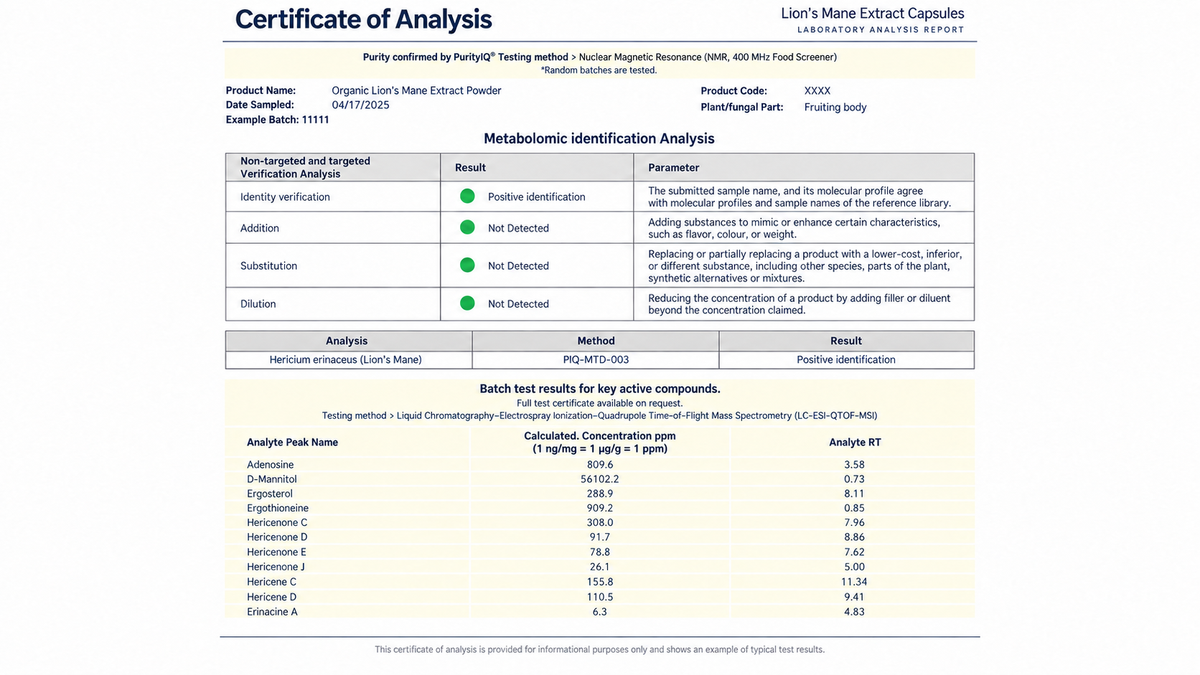
Mass-spectrometry-based profiling has been used in scientific research to identify characteristic compounds in mushroom materials, while metabolomic approaches can help distinguish fungal samples and assess quality.
This is why we've become increasingly interested in combining conventional specifications with deeper analysis.
Read How We Test Mushroom Extracts: NMR, LC-MS and What the Results Actually Tell Us next.
What should you look for on a mushroom specification?
We'd prefer to see several pieces of information rather than one impressive number.
Species
What fungus is it actually supposed to be?
Fungal material
Fruiting body?
Cultured mycelium?
Chaga conk?
Myceliated grain?
Extraction
Is it powder or extract?
How was it processed?
Glucan information
Is beta-glucan actually measured?
Are alpha-glucans reported where relevant?
What analytical method was used?
Other composition data
Are there species-characteristic compounds or other useful markers?
Identity
Is there evidence that the material genuinely matches the stated fungal ingredient?
Safety and contaminants
Has it been tested for the things you wouldn't want in the product as well as the things you do?
That's the wider picture we want to build across our Functional Mushrooms collection.
Why we don't chase one magic percentage
The supplement industry likes easy comparison.
People want to know:
Which bottle has the best number?
We understand why.
The difficulty is that fungal ingredients aren't smartphones where one processor speed neatly beats another.
A high beta-glucan percentage can be useful.
So can a meaningful extraction ratio.
So can fruiting-body information.
So can species-specific chemistry.
So can NMR identity testing.
None of them deserves to become the sole definition of quality.
Our view is increasingly:
Use several pieces of evidence together.
That's considerably harder to fit on the front of a bottle.
It's also much more informative.
Continue Exploring
What Does 10:1, 15:1 or 8:1 Mushroom Extract Actually Mean?
See why extraction ratio and beta-glucan percentage are two completely different specifications.
Fruiting Body vs Mycelium: It’s More Complicated Than “One Is Good and One Is Bad”
Understand how fungal material and cereal substrate can affect mushroom composition.
How We Test Mushroom Extracts: NMR, LC-MS and What the Results Actually Tell Us
See how analytical testing can take us beyond headline percentages.
What Are Functional Mushrooms?
Go back to the fundamentals of mushroom extracts, fungal material and quality.
References
McCleary BV, Draga A. Measurement of β-Glucan in Mushrooms and Mycelial Products. Journal of AOAC International. 2016;99(2):364-373.
A recent 2026 Journal of AOAC International paper further examined and refined enzymatic beta-glucan measurement for mushrooms, yeast, algae and increasingly complex supplement formulations.
A broader review of mushroom glucans discusses their structures and the different analytical techniques used to determine glucan content.
Written By
Written by Chris Simon, Founder of One Life Foods.
Chris has worked in the supplement industry since 2009 and is known for seeking out exceptional ingredients, products, and formulations. Read more about Chris and the story behind One Life Foods.
Share:
Cordyceps CS-4 Explained: Mycelium, Cultivation, Extraction & Identity
Hot Water vs Dual Extraction: Does Alcohol Make a Better Mushroom Extract?