


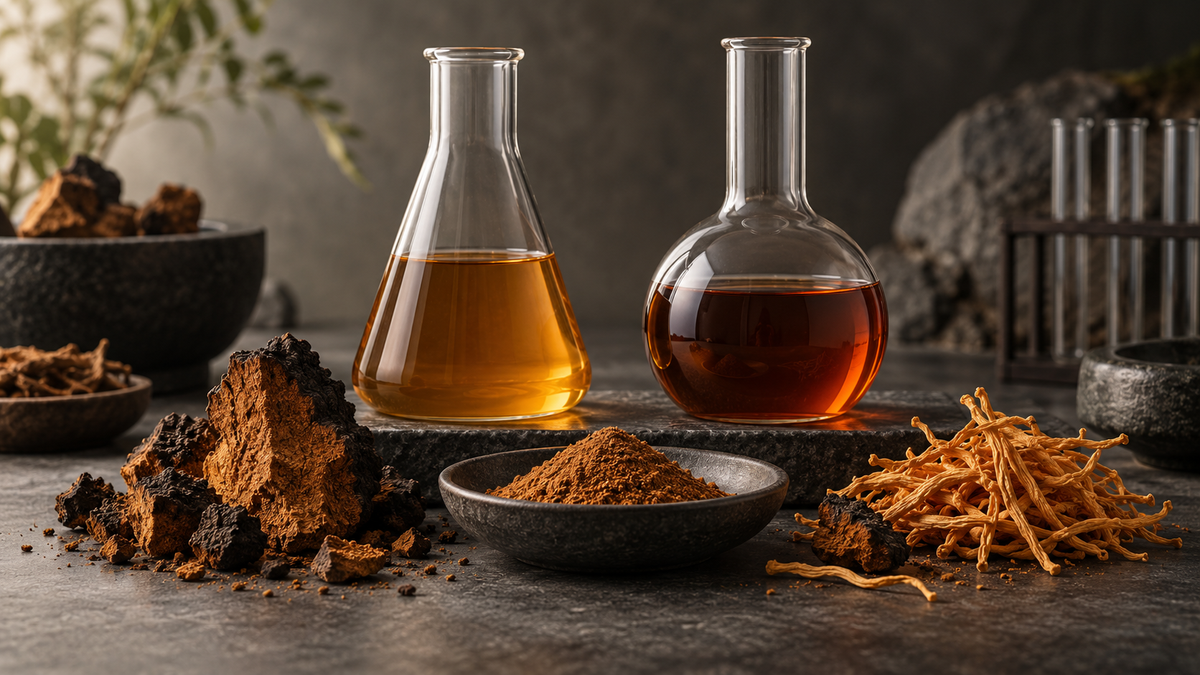
The short answer: no. “Hot-water extracted” and “dual extracted” describe manufacturing processes, not quality grades. Alcohol can improve the recovery of certain less water-soluble compounds, while hot water is widely used for fungal polysaccharides and other water-soluble constituents. But extraction time, temperature, solvent concentration, starting material and the chemistry of the finished extract all matter. A dual extract isn’t automatically better, and a hot-water extract isn’t automatically incomplete.
There’s a very tidy rule circulating around the mushroom industry:
Water extracts the polysaccharides.
Alcohol extracts the triterpenes.
Therefore:
dual extraction must be better.
It sounds logical.
It’s also incomplete.
Different mushroom compounds do have different solubilities, and alcohol can be extremely useful in extraction.
But mushrooms aren't divided into two perfectly separate chemical compartments where water gets half and ethanol gets the other half.
Nor does seeing the words:
DUAL EXTRACTED
tell you whether the extraction was actually carried out well.
So what does hot-water extraction do?
What does alcohol add?
And how should you decide whether one mushroom extract is genuinely better than another?
If you're unfamiliar with extracts generally, it’s worth reading What Does 10:1, 15:1 or 8:1 Mushroom Extract Actually Mean? alongside this guide.
What is mushroom extraction?
Extraction is essentially a separation process.
You begin with fungal material such as:
fruiting body,
cultured mycelium,
or Chaga conk.
That material contains many different chemical constituents held within a complex biological structure.
A solvent is then used to transfer some of those constituents from the mushroom material into a liquid.
The liquid can subsequently be:
filtered,
concentrated,
and dried
to produce an extract powder.
The important word there is some.
Extraction is selective.
Different solvents, temperatures and processing conditions favour different components.
So an extract isn't simply a mushroom made smaller.
It’s a preparation whose composition has been influenced by the extraction process.
What is hot-water mushroom extraction?
Hot-water extraction uses heated water as the extraction solvent.
It’s one of the most established methods for processing mushroom materials.
Water is particularly relevant to mushroom polysaccharides, including fungal glucans.
Research reviews describe hot-water extraction as one of the most commonly used conventional methods for obtaining mushroom polysaccharides, although the result is strongly affected by temperature, extraction time and the ratio of water to starting material.
In simplified form, the process may look like:
dried mushroom material
→ hot water
→ extraction
→ filtration
→ concentration
→ drying
→ extract powder
The real manufacturing process can, of course, be considerably more sophisticated.
Does hot water only extract beta-glucans?
No.
This is one of the most important misconceptions to clear up.
Hot water is particularly useful for many water-soluble fungal constituents, including polysaccharides.
But a hot-water extract isn't necessarily a bag containing nothing but beta-glucans.
Other molecules can also move into the aqueous extract.
The exact result depends on:
the species,
fungal material,
particle size,
temperature,
time,
water-to-material ratio,
pressure,
and subsequent processing.
That’s one reason we prefer looking at the finished composition rather than assuming it from the name of the solvent.
Why are beta-glucans associated with hot-water extraction?
Because many mushroom polysaccharides are extracted effectively using aqueous systems.
Hot-water extraction has long been used in scientific research and industrial processing of fungal polysaccharides. Reviews of Ganoderma, for example, describe hot water as one of the principal conventional approaches used for extracting polysaccharide fractions including beta-glucans.
But even here, the details matter.
The extraction yield can change with:
temperature,
time,
water volume,
particle size,
and pretreatment.
So:
hot water extracted
doesn't give you one standardised chemical result.
It tells you which principal solvent was used.
Can hot-water extraction damage compounds?
Potentially, if the process is poorly controlled.
Heat is useful because it can improve solubility and speed extraction.
But higher temperature and longer processing aren’t automatically better.
Reviews of mushroom polysaccharide extraction note that prolonged high-temperature processing can alter polysaccharide structure and affect heat-sensitive constituents.
The manufacturer therefore has to balance:
efficient extraction
with
preserving the characteristics of the material being extracted.
This is another reason why “hot water” isn't enough information to judge quality.
Two hot-water extracts can be produced under very different conditions.
What is alcohol extraction?
Alcohol extraction generally uses ethanol, or an ethanol-water mixture, to extract constituents with different solubility characteristics.
In mushroom processing, alcohol is often discussed in relation to compounds such as:
triterpenoids,
sterols,
and other less water-soluble constituents.
Reishi provides the classic example.
Its characteristic triterpenoid chemistry includes numerous ganoderic and lucidenic acids.
Research examining Ganoderma lucidum extraction has shown that ethanol concentration can significantly affect triterpenoid recovery. In one optimisation study, ethanol-rich extraction systems produced substantial triterpenoid fractions from Reishi fruiting bodies.
So alcohol absolutely has a legitimate role.
The mistake is turning:
alcohol can improve extraction of certain compounds
into:
anything without alcohol must be inferior.
What is dual extraction?
In mushroom supplements, dual extraction usually means that both water and alcohol have been used during processing.
The aim is typically to recover a broader range of chemical constituents than might be targeted using one solvent alone.
A simplified model might be:
mushroom material
→ water extraction
plus
alcohol extraction
→ combine appropriate fractions
→ concentrate
→ dry
But that diagram hides a lot.
Dual extraction isn't one universally standardised manufacturing method.
Different manufacturers can vary:
the order of extraction,
ethanol concentration,
temperature,
time,
number of extraction cycles,
ratio of solvents,
concentration method,
and how the fractions are recombined.
Two bottles can therefore both say:
DUAL EXTRACT
while containing quite different finished extracts.
Does dual extraction mean water first and alcohol second?
Not necessarily.
A manufacturer might:
extract sequentially,
use aqueous ethanol,
carry out separate extractions and combine them,
or use a process designed around the chemistry of a particular mushroom.
Even academic research uses many different extraction systems.
For example, work on Ganoderma lucidum has used aqueous ethanol alongside ultrasound to recover both polysaccharide and triterpenoid fractions.
So the phrase dual extraction gives you the broad principle.
It doesn't give you the recipe.
Why is Reishi so often dual extracted?
Because Reishi contains chemically different groups of constituents.
Its polysaccharides provide one obvious reason to use an aqueous extraction stage.
Its triterpenoids provide an obvious reason to consider an alcohol-containing extraction system.
That gives dual extraction a plausible rationale.
But there’s a twist.
Water-extracted Reishi can still contain triterpenoids
The common claim is sometimes presented as:
If Reishi hasn't been alcohol extracted, there will be no ganoderic acids.
Published chemistry doesn't support such an absolute statement.
Researchers have isolated numerous triterpenoids from a water extract of Ganoderma lucidum, including ganoderic acids A, B, C1, C6 and others, alongside several lucidenic acids.
Another study chemically standardised a hot aqueous Reishi fruiting-body extract and measured:
25.1% total polysaccharides
alongside
0.45% ganoderic acid A
and
0.069% adenosine.
That doesn't show hot water is superior to ethanol.
It shows something more useful:
solubility isn't always an all-or-nothing question.
But doesn't alcohol extract more Reishi triterpenoids?
It can.
And this is where we need to avoid swinging too far in the opposite direction.
Research optimising Reishi extraction has found that ethanol-rich systems can increase recovery of triterpenoids and phenolic compounds. One study found its optimum conditions involved substantial ethanol concentrations, with the most effective ultrasound-assisted method using an ethanol-rich solvent system.
Other research has similarly used high-concentration ethanol specifically to prepare Reishi triterpenoid fractions.
So a fair summary is:
Alcohol can be very useful for Reishi triterpenoids.
But:
the absence of alcohol doesn't prove the absence of every triterpenoid.
Those two statements can both be true.
Why does extraction temperature matter?
Because extraction is chemistry, not just soaking.
Increasing temperature can:
increase molecular movement,
change solubility,
improve penetration into fungal material,
and alter extraction rate.
But excessive heat can also change some constituents.
The same applies to duration.
An extraction lasting ten minutes isn't automatically worse than one lasting six hours.
Nor is the six-hour extraction automatically superior.
It depends on:
what is being extracted,
from what starting material,
under which conditions.
That's why we resist attempts to rank extracts using one manufacturing fact.
Why does ethanol concentration matter?
Because “alcohol extracted” doesn't tell you how much alcohol was used.
An extraction using:
20% ethanol
isn't chemically identical to one using:
90% ethanol.
Changing the water-to-ethanol balance changes the solvent environment.
That can significantly alter what dissolves into it.
The Reishi extraction literature demonstrates this particularly clearly, with triterpenoid recovery changing according to ethanol percentage and other processing variables.
So when you see:
dual extracted
you still don't know:
how much ethanol,
for how long,
at what temperature,
or what the resulting extract contained.
Does alcohol extraction remove the beta-glucans?
Not necessarily, but this depends heavily on the process.
A dual extraction may deliberately preserve or recombine fractions obtained through different stages.
In research settings, ethanol can also be used during polysaccharide purification and precipitation rather than simply as the primary extraction solvent.
In other words, seeing ethanol somewhere in a manufacturing process doesn't automatically tell you which compounds were retained or removed.
What matters is the composition of the finished material.
Are hot-water and dual extracts directly comparable by milligrams?
Not necessarily.
Suppose Product A contains:
500 mg hot-water extract
and Product B contains:
500 mg dual extract.
It’s tempting to treat the milligram figure as an equal comparison.
But their composition may differ.
Likewise:
400 mg of an extract preparation
may not always mean:
400 mg native mushroom extract
if a processing carrier forms part of that preparation.
This is why mushroom labels need to be read as a collection of information rather than isolated numbers.
See How to Choose a Mushroom Supplement: 10 Things We’d Check Before Buying One.
Does dual extraction make an extract “full spectrum”?
We wouldn't use that logic.
“Full spectrum” is not a standardised analytical definition for mushroom supplements.
Using two solvents doesn't prove that:
every important compound was extracted,
every original mushroom constituent remains,
or the finished powder perfectly represents the complete starting material.
Extraction is selective by definition.
A dual extraction may broaden the range of extracted constituents.
That is a more defensible description than:
everything is there.
This is also why we generally prefer specific descriptions such as:
hot-water extract
dual extract
fruiting-body extract
or
cultured-mycelium extract
rather than vague umbrella language.
Is dual extraction always better for Chaga?
Again, not automatically.
Chaga has a very different chemistry from Reishi.
Its composition depends partly on:
the Chaga conk,
the host tree,
which part of the conk is used,
and the extraction process.
Some Chaga constituents are more water soluble than others.
More lipophilic compounds may benefit from extraction environments different from those used primarily for polysaccharides.
But saying:
dual extraction therefore wins
would still skip the important question:
What did the process actually recover?
When we update our main Chaga guide, we'll explore that distinction in more detail.
For the moment, the useful principle is:
choose an extraction method for the material and chemistry, not because one phrase sounds more premium.
What about Lion’s Mane?
Lion’s Mane creates another useful example.
Its fruiting body contains polysaccharides alongside characteristic secondary metabolites such as hericenones.
Different extraction systems can therefore produce different chemical profiles.
That means a hot-water Lion’s Mane extract and an alcohol-rich Lion’s Mane extract shouldn't automatically be treated as interchangeable preparations.
Nor should research using one preparation automatically be applied to the other.
This distinction is important in Lion’s Mane Mushroom: Benefits, Cognitive Support and How It Works.
What about Cordyceps CS-4?
Cordyceps CS-4 is different again.
It’s based on cultured mycelium rather than Reishi-style fruiting body.
Its chemical profile includes water-soluble constituents such as polysaccharides and nucleosides.
Our broader Cordyceps guide explains why the material, cultivation method and extract specification need to be considered together:
Cordyceps CS-4 Explained: Mycelium, Cultivation, Extraction & Identity.
This illustrates the bigger point.
There shouldn't be one universal extraction rule for every mushroom.
Why would an extract combine a 1:1 extract with a concentrated extract?
Not every mushroom ingredient is made from a single extraction fraction.
A mushroom extract can also be formulated by combining a 1:1 preparation with a more concentrated water or dual extract.
At first glance, that can look strange. Why dilute a concentrated extract with a 1:1 material?
Because the two preparations may be intended to do different things.
A 1:1 extract can be produced with the aim of retaining a relatively broad representation of the original mushroom material, rather than concentrating only the compounds most readily recovered by a particular solvent system.
A higher-ratio extract, meanwhile, uses more starting material relative to the amount of finished extract and may be designed to concentrate particular soluble constituents.
With mushrooms such as Reishi and Chaga, a manufacturer may therefore combine:
a broader 1:1 extract
with
a more concentrated water or dual extract
to create a finished ingredient with characteristics from both preparations.
That does not mean the blend is automatically better.
It also doesn’t mean a 1:1 extract is “weak” or a concentrated extract is inherently “stronger”.
They are different preparations.
The useful questions remain:
What starting material was used?
How were the two fractions produced?
Why were they combined?
And what does analysis of the finished blend actually show?
This is also a good example of why extraction ratios need context. A finished product made from two extract fractions may carry an overall extract ratio that has been calculated from the composition of the blend rather than representing one single extraction process.
See What Does 10:1, 15:1 or 8:1 Mushroom Extract Actually Mean? for a deeper explanation of extraction ratios.
Why doesn't one extraction method suit every mushroom?
Because:
Lion’s Mane isn't Reishi.
Reishi isn't Chaga.
Chaga isn't Cordyceps CS-4.
They involve different fungal materials and different chemical profiles.
It therefore makes little sense to insist that one identical extraction process must be optimal across the entire category.
A better question is:
Was the extraction method appropriate for this particular material and what does the resulting analysis show?
What should we look at after extraction?
This is where the Mushroom Guide keeps returning to the same idea.
Once you know how an extract was made, ask what evidence exists about the finished ingredient.
That might include:
Beta-glucans
Useful for understanding part of the fungal carbohydrate composition.
Read Beta-Glucans vs Polysaccharides: What Do Mushroom Supplement Numbers Really Mean?.
Species-relevant compounds
For example, characteristic Reishi triterpenoids can provide another layer of compositional information.
Identity
Does the chemical or biological evidence support the fungal material being claimed?
Extraction ratio
Useful manufacturing information, provided it is properly defined.
Carrier disclosure
Is the finished material native extract alone, or an extract preparation containing another ingredient?
Batch testing
Does the evidence actually relate to the material being sold?
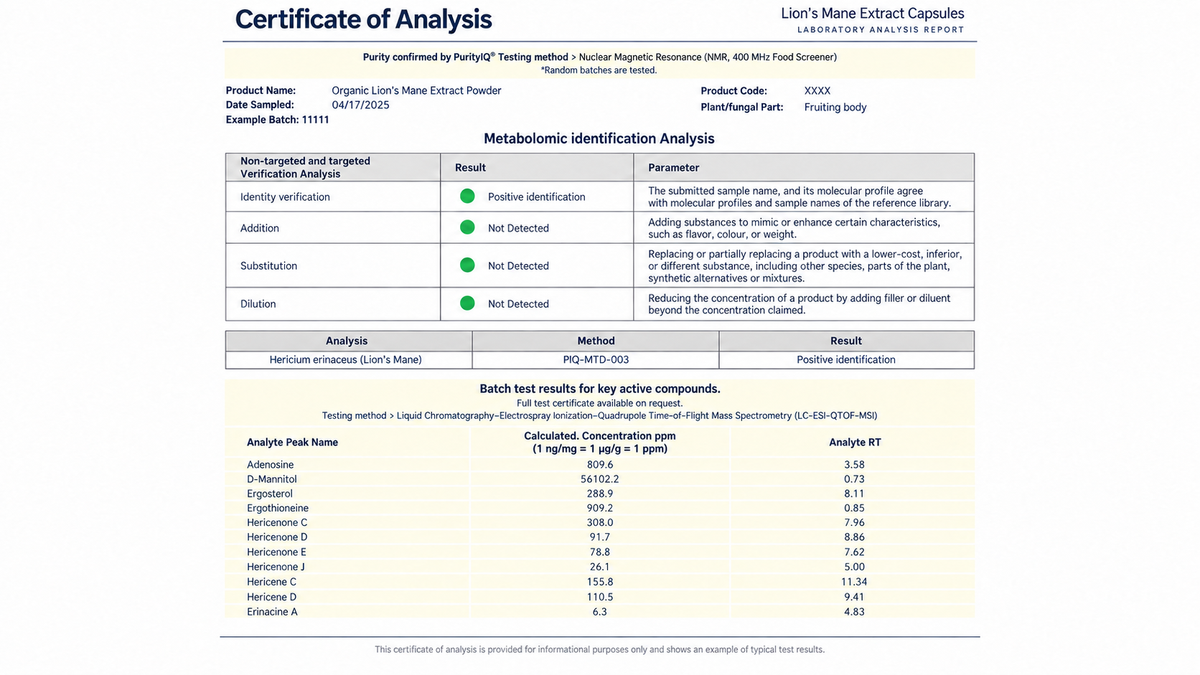
All of this is why we've written How to Read a Mushroom Certificate of Analysis Without Being Fooled by the Paperwork.
Can LC-MS tell us whether an extraction worked?
It can tell us something much more useful than the solvent name alone.
LC-MS can help investigate individual compounds in an extract.
That means instead of reasoning:
Alcohol should extract this compound.
we can sometimes ask:
Was the compound actually detected?
And potentially:
How much was measured?
That's a major difference.
Likewise, NMR and other analytical approaches can provide information about identity and broader chemical composition.
Read How We Test Mushroom Extracts: NMR, LC-MS and What the Results Actually Tell Us.
Does detecting more compounds automatically mean a better supplement?
No.
That's another trap.
A longer chemical list isn't automatically a quality score.
Some compounds may be present at trace levels.
Different analytical methods detect different things.
And simply detecting a molecule doesn't prove that consuming the product produces a particular physiological outcome.
Analytical testing tells us about:
the material.
Clinical research asks different questions.
We need both areas to remain separate.
Is a more concentrated extract automatically better?
No.
A 15:1 extraction ratio doesn't automatically beat an 8:1.
A dual extract doesn't automatically beat hot water.
30% beta-glucans doesn't automatically beat 25%.
And an extract with a very long compound list doesn't automatically beat one with fewer measured constituents.
Each piece of information answers a different question.
The mistake is using one of them as a universal score.
So how do you choose between hot-water and dual extracts?
We'd ask five things:
1. What mushroom or fungal material is being extracted?
Reishi fruiting body and Cordyceps cultured mycelium aren't chemically identical materials.
2. Why was that extraction process chosen?
Was the process designed around the chemistry of the ingredient?
3. What are the actual specifications?
Beta-glucans, extraction ratio and other relevant compositional information can provide useful context.
4. What does the analytical testing show?
Where appropriate, can expected mushroom-specific compounds actually be identified?
5. Is the manufacturer transparent?
Does it explain exactly what was used, rather than simply relying on terms such as “premium”, “potent” or “full spectrum”?
Those questions tell us considerably more than:
Does it say dual extracted?
How we think about extraction at One Life
Our view has changed as we've learned more about mushroom ingredients.
We don't believe:
hot water is basic
and
dual extraction is premium.
Nor do we believe the opposite.
Instead, we look at extraction as one part of a bigger chain:
starting material
→ identity
→ cultivation or sourcing
→ extraction
→ finished composition
→ verification
That approach is less convenient than ranking products using a single badge.
But we think it’s much more useful.
You can see the individual products and their respective specifications in our Functional Mushrooms Collection.
The bottom line
Water and alcohol have different solvent properties.
That matters.
Hot water is widely used to recover fungal polysaccharides and other water-soluble constituents.
Alcohol-containing systems can be useful for less water-soluble molecules, including many Reishi triterpenoids.
So dual extraction can make perfect technical sense.
What doesn't make sense is treating the words dual extracted as automatic proof of quality.
A carefully produced hot-water extract can have a meaningful and measurable chemical profile.
A poorly executed dual extract doesn't become exceptional just because two solvents were involved.
The better question isn't:
How many solvents did they use?
It’s:
What material did they start with, how was it extracted, and what can they actually show you about the finished extract?
That is the standard we'd rather use.
Continue Exploring
What Does 10:1, 15:1 or 8:1 Mushroom Extract Actually Mean?
See why concentration ratios aren't the same thing as potency or chemical quality.
Reishi Mushroom: Fruiting Body, Extracts, Ganoderic Acids & What Quality Really Means
Explore why Reishi is the classic example of the hot-water versus alcohol-extraction debate.
Beta-Glucans vs Polysaccharides: What Do Mushroom Supplement Numbers Really Mean?
Understand the carbohydrate measurements commonly associated with mushroom extracts.
How We Test Mushroom Extracts: NMR, LC-MS and What the Results Actually Tell Us
See how analysis can move the conversation beyond assumptions about the extraction process.
How to Choose a Mushroom Supplement: 10 Things We’d Check Before Buying One
Bring extraction, identity, fungal material and testing together.
References
Research reviews describe hot-water extraction as one of the conventional methods most widely used for mushroom polysaccharides and note that extraction temperature, time and other process variables influence the resulting material.
Che XQ, Li SP, Zhao J. Ganoderma triterpenoids from aqueous extract of Ganoderma lucidum. Researchers isolated a range of triterpenoids, including multiple ganoderic and lucidenic acids, from an aqueous Reishi extract.
A chemically characterised aqueous Ganoderma lucidum fruiting-body extract contained total polysaccharides alongside measurable ganoderic acid A and adenosine, illustrating why water extraction should not automatically be described as triterpene-free.
Heleno SA et al. Extraction of triterpenoids and phenolic compounds from Ganoderma lucidum: optimization study using the response surface methodology. Food & Function. The study demonstrated that ethanol concentration, temperature and extraction technique materially influenced recovery of Reishi triterpenoids.
Research using aqueous ethanol with ultrasonic-assisted extraction further demonstrates how solvent concentration and other processing conditions can be adjusted to recover both polysaccharide and triterpenoid fractions from Ganoderma lucidum.
Written By
Written by Chris Simon, Founder of One Life Foods.
Chris has worked in the supplement industry since 2009 and is known for seeking out exceptional ingredients, products, and formulations. Read more about Chris and the story behind One Life Foods.

Share:
Beta-Glucans vs Polysaccharides: What Do Mushroom Supplement Numbers Really Mean?
Hindu Kush Shilajit: History, Folklore and a Distinctive Mountain Resin