


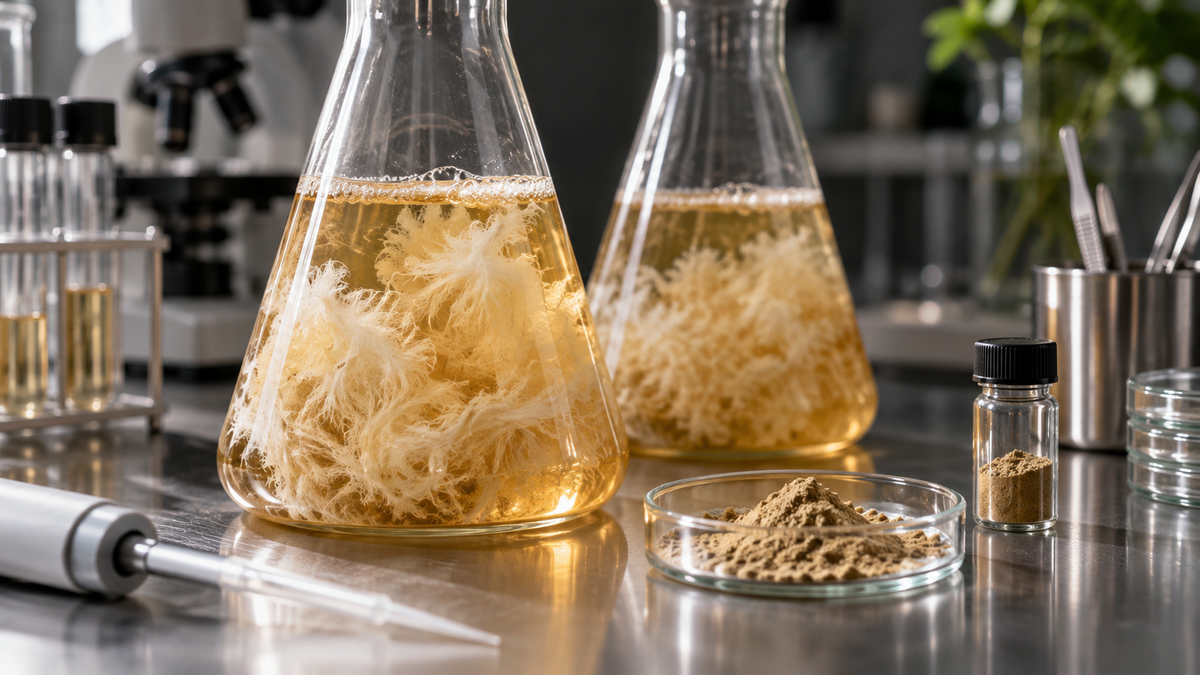
The short answer: Cordyceps CS-4 is a cultivated fungal mycelium produced through fermentation. It was historically associated with Cordyceps sinensis and described as Paecilomyces hepiali, while modern taxonomy places that fungus under Samsoniella hepiali. It isn’t wild Ophiocordyceps sinensis, and it isn’t a fruiting-body product. That doesn’t make it an inferior substitute. It makes it a different, deliberately cultivated fungal material that needs to be judged on its own specification.
Cordyceps may be the most confusing name in the entire functional mushroom category.
Lion’s Mane looks like Lion’s Mane.
Reishi generally looks recognisably like Reishi.
Chaga is unusual, but at least you can point to the black conk growing on a birch tree.
Cordyceps gives us:
wild caterpillar fungi,
cultured mycelium,
fruiting-body products,
different fungal species,
historical scientific names,
modern scientific names,
CS-4,
and Cordyceps militaris.
Then all of them end up being sold under the word:
Cordyceps.
So before asking whether a Cordyceps supplement is good, we first need to ask:
Which Cordyceps are we actually talking about?
What is wild Ophiocordyceps sinensis and why is it so expensive?
The famous wild Chinese caterpillar fungus is now known scientifically as:
Ophiocordyceps sinensis
It was historically called:
Cordyceps sinensis
And it is very different from the cultivated Cordyceps ingredients found in most modern supplements.
Wild O. sinensis has an extraordinary natural life cycle.
The fungus infects the underground larvae of ghost moths living in high-altitude alpine regions of the Tibetan Plateau and surrounding Himalayas. The fungal mycelium colonises the insect, eventually killing and mummifying it. A reproductive fungal structure then grows from the caterpillar and emerges above the soil.
The traditionally collected material therefore isn't simply a mushroom.
It's a fungus-insect complex, consisting of the fungal structure together with the remains of its caterpillar host.
That distinction alone makes it very different from fermented CS-4 mycelium.
Why is wild O. sinensis so scarce?
Wild O. sinensis occurs within a relatively restricted high-altitude habitat, generally thousands of metres above sea level across parts of the Tibetan Plateau and neighbouring Himalayan regions.
It can't simply be grown in agricultural fields like an ordinary mushroom crop.
Its natural production depends on a complicated relationship between the fungus, particular insect hosts, the alpine environment and the seasonal life cycle of both organisms.
At the same time, demand for the wild material has been enormous.
Researchers have documented declining natural resources associated with heavy harvesting pressure, habitat degradation and environmental change. The species is classified as Vulnerable on the IUCN Red List and has been under state protection in China for decades.
Put simply:
there's a limited wild supply competing with an unusually large market.
And that has produced some extraordinary prices.
How much does wild Cordyceps actually cost?
There isn't one fixed price for wild O. sinensis.
Specimens are graded according to factors such as size, appearance, maturity and geographic origin, so published prices vary enormously.
Older scientific reviews reported international prices of around US$20,000 to US$40,000 per kilogram (£15,000 to £30,000 per kg), with wild Cordyceps earning the nickname “soft gold”.
Field research in Shanghai reported average-quality material selling for around US$50,000 per kilogram (£37,000/kg) in 2018.
More recent research gives an even better indication of just how wide the range can be. Market observations from Tibet in 2023 reported approximately:
US$22,600 per kilogram (approx £17,000/kg) for lower-quality material,
and around:
US$117,800 per kilogram (approx £87,000/kg) for high-quality specimens from a particularly prized region.
The same research notes that premium material has previously been advertised at approximately US$145,000 per kilogram (approx £107,000/kg).
Those figures shouldn't be interpreted as a universal retail price.
Origin, grade, specimen size, where in the supply chain the sale takes place and market demand all make an enormous difference.
But they illustrate an important point:
genuine wild Ophiocordyceps sinensis can be worth tens of thousands of pounds per kilogram, and exceptional material has been advertised at more than £100,000 per kilogram.
So when an inexpensive supplement casually implies that its capsule contains significant quantities of genuine wild caterpillar fungus, that's a claim worth examining carefully.
Is wild Ophiocordyceps sinensis illegal?
Not simply because it is Ophiocordyceps sinensis.
You may see claims online that wild Cordyceps is internationally banned or CITES-listed. That's not currently accurate.
There are no fungi listed in the CITES Appendices, including O. sinensis.
That doesn't mean wild harvesting is a free-for-all.
The species is regarded as vulnerable, and harvesting and trade are controlled in several of the countries where it naturally occurs. China has afforded the species state protection, while other Himalayan countries use combinations of harvesting rules, permits, quotas, royalties and local restrictions.
So the more accurate distinction is:
wild O. sinensis isn't subject to a blanket worldwide ban, but its harvest and trade can be tightly regulated, and material taken or exported outside those rules may be illegal.
Food law creates another layer of regulation because whether a particular Cordyceps ingredient can be marketed as a food or supplement depends on the jurisdiction, the species and the form in which it is being sold.
This is another reason the word “Cordyceps” on the front of a supplement doesn't tell us enough.
Why not simply put wild O. sinensis into supplements?
Scarcity and price are obvious practical reasons.
If genuine wild material can trade for tens of thousands of pounds per kilogram, putting meaningful quantities into an inexpensive daily capsule becomes economically difficult.
There are also questions around:
responsible harvesting,
supply consistency,
traceability,
natural variation,
contaminants,
and pressure on a vulnerable wild resource.
Wild O. sinensis also contains the insect host itself, making it fundamentally different from a cultivated fungal mycelium ingredient.
These limitations are a major reason researchers and manufacturers began developing cultivated Cordyceps-related fungal materials.
That brings us to CS-4.
So what is Cordyceps CS-4?
CS-4 is a cultivated mycelial fermentation product.
It was developed from fungal material associated with wild Chinese Cordyceps and has been commercially produced through controlled fermentation rather than harvesting wild caterpillar-fungus complexes.
This distinction is essential:
CS-4 is not powdered wild Ophiocordyceps sinensis.
It’s also not simply a cultivated fruiting body.
It’s a deliberately produced mycelial material.
Human research into CS-4 has described it as a standardised fermentation product derived from a mycelial strain historically called Paecilomyces hepiali.
What is Paecilomyces hepiali?
For many years, the fungus associated with CS-4 was described as:
Paecilomyces hepiali
This is the name you'll still encounter in a large amount of published literature.
But fungal taxonomy doesn't stand still.
Modern multigene phylogenetic work moved Paecilomyces hepiali into a different genus.
The currently accepted name is:
Samsoniella hepiali
NCBI lists Paecilomyces hepiali as the basionym and specifically includes Paecilomyces sp. Cs-4 among the names associated with Samsoniella hepiali.
So if you see:
Cordyceps CS-4
Paecilomyces hepiali
and
Samsoniella hepiali
in different places, they aren't necessarily referring to three unrelated ingredients.
They're part of a complicated taxonomic history.
Why doesn't the front of every bottle say Samsoniella hepiali?
Because consumer terminology and scientific taxonomy don't always evolve at the same speed.
“Cordyceps CS-4” is a recognised commercial description with decades of historical use.
Many published studies also use older terms such as:
Cordyceps sinensis,
Paecilomyces hepiali,
or simply CS-4.
Modern taxonomy gives us more precise language, but abandoning the familiar commercial term entirely could create just as much confusion.
We think the sensible approach is transparency:
Cordyceps CS-4 cultured mycelium
with the modern fungal identity explained where appropriate.
Is Cordyceps CS-4 a fruiting body?
No.
And it shouldn’t pretend to be.
This is exactly why we don’t agree with the simplistic rule:
Fruiting body is always good. Mycelium is always bad.
CS-4 exists specifically as a cultured mycelial material.
Calling it fruiting body would be inaccurate.
Calling it inferior purely because it's mycelium would ignore why the ingredient exists in the first place.
For the wider explanation, read Fruiting Body vs Mycelium: It’s More Complicated Than “One Is Good and One Is Bad”.
Is CS-4 the same as mycelium grown on grain?
Not necessarily.
This distinction matters.
Mycelium can be grown in different ways.
One approach involves growing fungal material through a solid cereal substrate such as rice.
If that whole material is dried and ground together, substantial grain can remain in the finished product.
Another method uses submerged or liquid fermentation.
The fungus grows within a controlled liquid culture environment.
Scientific reviews of Cordyceps production describe submerged fermentation as an established way of producing fungal mycelial biomass and polysaccharides.
Our CS-4 ingredient is based on liquid-fermented mycelium, not simply mycelium grown through a block of cereal grain and milled together with it.
That’s an important distinction.
Does liquid fermentation automatically mean a better Cordyceps product?
No.
That would just replace one simplistic rule with another.
Liquid fermentation gives manufacturers substantial control over variables such as:
nutrient medium,
temperature,
pH,
oxygen,
fermentation time,
and fungal growth conditions.
But quality still depends on the strain, manufacturing process, harvest, extraction and finished analytical profile.
So we'd never argue:
liquid fermentation = automatically premium.
We'd say:
Tell us how it was cultivated, then show us what the finished material contains.
What compounds are found in CS-4?
Cultured CS-4 and related P. hepiali materials have been analysed for compounds including:
adenosine,
other nucleosides,
mannitol,
polysaccharides,
sterols,
and, in some preparations, cordycepin.
A published CS-4 human trial characterised its preparation as containing adenosine, mannitol, polysaccharides and other constituents.
Separate analytical research on P. hepiali mycelial extract has identified nucleosides including adenosine, uridine and cordycepin, illustrating that these cultured materials can have measurable small-molecule profiles.
But there’s an important lesson here:
Different cultured preparations can contain very different concentrations.
So the fact that cordycepin has been found in one P. hepiali preparation doesn’t mean every CS-4 extract automatically contains the same amount.
Again, test the actual material.
What is adenosine?
Adenosine is a naturally occurring nucleoside found throughout biology.
It has also been identified and measured in Cordyceps materials and is commonly used as one of several compositional markers.
Its presence can therefore contribute useful information about the extract.
But we'd be careful about converting:
contains adenosine
into:
therefore produces a particular health effect.
Composition and clinical effect are different questions.
What is cordycepin?
Cordycepin is:
3'-deoxyadenosine
It’s a nucleoside analogue that has become strongly associated with Cordyceps marketing.
It has been studied extensively in laboratory research.
However, its concentration varies dramatically between fungal species and preparations.
Cordycepin is especially associated with Cordyceps militaris, which is one reason it's important not to assume that research or composition data from C. militaris automatically applies to CS-4.
Some P. hepiali mycelial extracts have been shown analytically to contain cordycepin, but the level depends on strain and culture conditions.
So we wouldn't choose a CS-4 product simply because the word “Cordyceps” makes us expect a particular cordycepin concentration.
We'd want the analysis.
Is Cordyceps CS-4 the same as Cordyceps militaris?
No.
This is one of the most important distinctions in the article.
Cordyceps militaris is a separate fungus.
It can be cultivated to produce orange fruiting bodies and is widely used in modern Cordyceps products.
CS-4 is a fermented mycelial preparation associated historically with Cordyceps sinensis and the fungus now placed as Samsoniella hepiali.
So:
CS-4 research isn't automatically C. militaris research.
And:
C. militaris research isn't automatically CS-4 research.
Whenever you see a dramatic study headline about “Cordyceps”, the first question should be:
Which species or preparation did they actually use?
Has Cordyceps CS-4 been studied in humans?
Yes.
That’s worth acknowledging.
A double-blind, placebo-controlled pilot study enrolled 20 healthy adults aged 50 to 75 and investigated CS-4 over 12 weeks.
Participants assigned to CS-4 received 333 mg three times daily.
The study reported changes in metabolic and ventilatory thresholds but no change in VO2 max. Only 15 of the original 20 participants completed the study.
What does that tell us?
It tells us that CS-4 itself has been investigated in humans.
What it doesn't justify is turning a small pilot study into a blanket promise that:
Cordyceps boosts energy or improves athletic performance.
The study was small, involved an older population and measured specific exercise endpoints.
That distinction matters.
Why mention research if we can't make a health claim?
Because “no authorised health claim” and “no scientific research exists” aren't the same thing.
We can explain:
what researchers studied,
which preparation they used,
how many people took part,
which outcomes were measured,
what they found,
and what the limitations were.
That is much more useful than either extreme:
This mushroom definitely does X.
or:
We aren't allowed to make a claim, therefore science has nothing to say.
Our aim is to help people understand the evidence rather than turn research papers into slogans.
Is CS-4 an extract or fermented mycelium?
It can be both.
This is another terminology issue.
The starting fungal material can be:
cultured mycelium
and that mycelium can subsequently undergo:
extraction.
So a product described as:
Cordyceps CS-4 mycelium extract
isn't contradictory.
“Mycelium” tells you what fungal material was used.
“Extract” tells you what happened to it afterwards.
Our Cordyceps product uses a hot-water extract preparation derived from liquid-fermented CS-4 mycelium.
What does 6:1 mean for Cordyceps?
Our current Cordyceps specification uses a 6:1 extract.
In general terms, an extraction ratio describes the relationship between starting material and the resulting native extract.
It does not mean:
six times stronger,
six times more effective,
or six times more Cordycepin.
To understand why, read What Does 10:1, 15:1 or 8:1 Mushroom Extract Actually Mean?.
The same rule applies whether the label says:
6:1,
8:1,
10:1,
or 20:1.
A ratio is manufacturing information.
It isn't a universal potency score.
Does the Cordyceps extract contain a carrier?
Our current CS-4 extract preparation includes maize starch as a processing carrier.
The amount can vary between batches, but the specification limits it to less than 20% of the finished extract preparation, and it may be closer to 10%.
That means a 400 mg capsule contains more than 320 mg of Cordyceps-derived extract material.
The starch is used during manufacture of the extract rather than simply being mixed into the finished powder afterwards.
That distinction doesn’t make the carrier irrelevant. It simply explains what it is doing there, which is why we describe the capsule accurately as containing 400 mg of Cordyceps CS-4 extract preparation.
We think that’s worth stating plainly.
Carriers aren't automatically evidence of a poor extract.
They can have legitimate technical functions during manufacturing and drying.
But they should be disclosed.
This is also why we wouldn’t describe this particular product as:
“no fillers”
or
“100% pure Cordyceps extract powder”
if those phrases could imply that the finished extract preparation contains nothing else.
Transparency is much better than trying to win a label-language contest.
Is maize starch the same as mycelium grown on grain?
No.
This distinction is easy to miss.
Mycelium grown on grain means the fungus has been cultivated through a cereal substrate and some of that growth substrate may remain in the resulting biomass.
A processing carrier added to an extracted preparation is a different manufacturing situation.
Both should be disclosed where relevant.
But they're not the same thing.
This matters because phrases like:
grain free
no starch
no fillers
can become misleading if they're used without understanding where the carbohydrate material actually came from.
What about beta-glucans and polysaccharides in Cordyceps?
Cordyceps mycelial materials contain polysaccharides, and these have been extensively investigated scientifically.
But again, we'd distinguish:
total polysaccharides
from:
specifically measured beta-glucans.
Those numbers aren't interchangeable.
For the broader explanation, see Beta-Glucans vs Polysaccharides: What Do Mushroom Supplement Numbers Really Mean?.
We also wouldn't use a large polysaccharide percentage as proof that the product is superior.
It's one compositional measure.
Not a complete quality score.
How should CS-4 identity be verified?
The taxonomy gives us an obvious reason to take identity seriously.
A good CS-4 specification should make clear:
what fungal material is present,
what organism or strain identity is being used,
how it was cultivated,
and how the finished material has been characterised.
Analytical techniques might include:
spectroscopic fingerprinting,
chromatography,
mass spectrometry,
or other appropriate identity methods.
The modern taxonomic connection between Paecilomyces hepiali and Samsoniella hepiali is supported by multigene phylogenetic research.
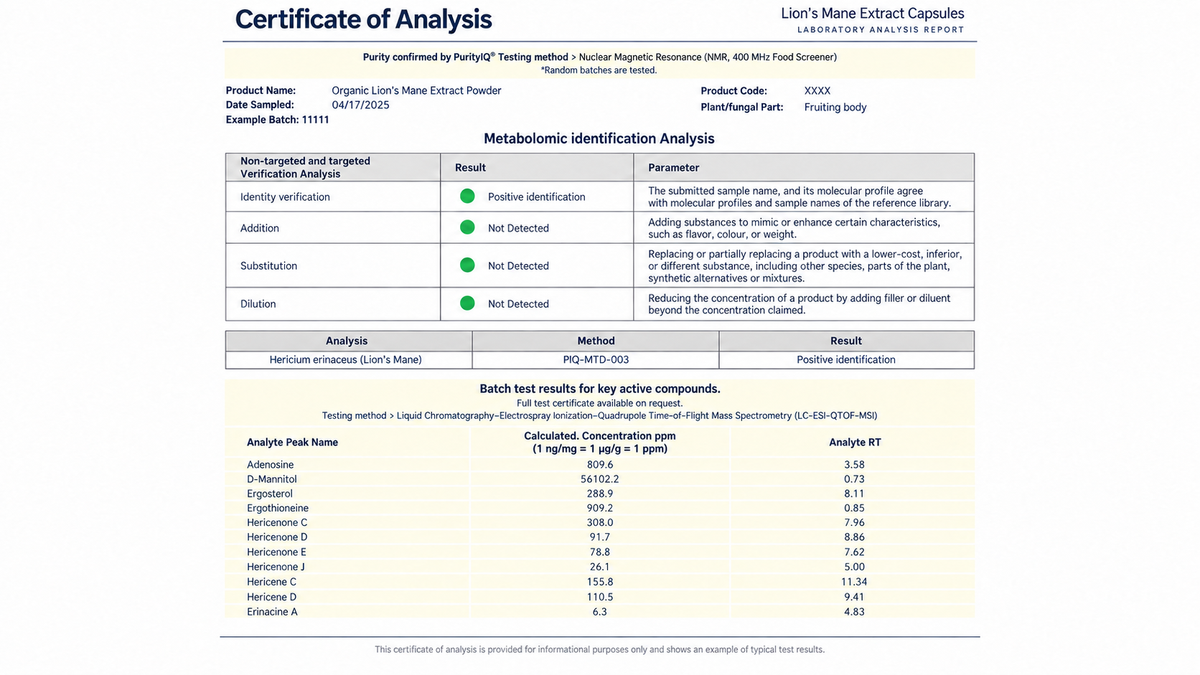
For the wider testing picture, read How We Test Mushroom Extracts: NMR, LC-MS and What the Results Actually Tell Us.
What would we check when buying Cordyceps CS-4?
We’d want clear answers to these questions:
What is it?
CS-4, C. militaris, wild O. sinensis or something else?
What fungal material is used?
Cultured mycelium or fruiting body?
How was it cultivated?
Liquid fermentation or solid grain substrate?
Is it extracted?
If so, how?
What does the extraction ratio mean?
Are carriers present?
Which compositional markers have actually been measured?
Does the testing support the stated identity?
Is there appropriate contaminant testing?
Does the documentation relate to the current batch?
That framework is explained more fully in How to Choose a Mushroom Supplement: 10 Things We’d Check Before Buying One.
How our Cordyceps CS-4 fits into the One Life range
We’ve chosen CS-4 cultured mycelium deliberately.
It’s produced through submerged liquid fermentation and then made into a 6:1 hot-water extract preparation.
That makes it a very different product from either wild Ophiocordyceps sinensis or a Cordyceps militaris fruiting-body extract.
What matters to us is being precise about what it is rather than trying to force every mushroom into the same “fruiting body is best” rule.
Each capsule contains 400 mg of the finished CS-4 extract preparation.
For the full breakdown of the extract and processing carrier, see Cordyceps CS-4 Extract Capsules.
Why Cordyceps is a good lesson for the whole mushroom industry
Cordyceps makes simple mushroom rules fall apart.
“Always choose fruiting body”?
CS-4 is mycelium.
“Cordyceps means Cordyceps militaris”?
Not here.
“Cordyceps sinensis” is the current scientific name?
It isn't.
“Mycelium means grain”?
Not necessarily.
“Contains cordycepin”?
You still need to know which species and what the analysis found.
That’s why Cordyceps might be the best example of the philosophy behind the whole One Life Mushroom Guide:
Specific information beats category buzzwords.
The bottom line
Cordyceps CS-4 is a distinctive fungal ingredient with its own history.
It shouldn’t be sold as wild Ophiocordyceps sinensis.
It shouldn’t be described as a fruiting-body product.
It shouldn’t automatically be treated as identical to Cordyceps militaris.
And it shouldn't be dismissed simply because the word mycelium appears on the specification.
It’s a cultured fungal material developed through fermentation.
Modern taxonomy connects the CS-4-associated fungus with Samsoniella hepiali.
Its composition depends on cultivation, extraction and processing.
And, as with every mushroom product:
the label tells you what it claims to be.
The specification and analysis help tell you what it actually is.
Continue Exploring
Cordyceps CS-4 Extract Capsules
See the current specification for our individual CS-4 product.
Fruiting Body vs Mycelium: It’s More Complicated Than “One Is Good and One Is Bad”
Why cultured mycelium and myceliated grain aren’t the same thing.
What Does 10:1, 15:1 or 8:1 Mushroom Extract Actually Mean?
Understand what ratios such as 6:1 actually describe.
Beta-Glucans vs Polysaccharides: What Do Mushroom Supplement Numbers Really Mean?
See how common fungal carbohydrate measurements differ.
How We Test Mushroom Extracts: NMR, LC-MS and What the Results Actually Tell Us
Learn how deeper analytical methods can help characterise fungal extracts.
Can You Take Lion’s Mane, Reishi, Chaga & Cordyceps Together?
Our practical guide to using individual mushroom products within the same routine.
References
The current NCBI taxonomy places Paecilomyces hepiali under Samsoniella hepiali and includes Paecilomyces sp. Cs-4 among the associated names.
Scientific reviews describe the importance of mycelial fermentation in producing Cordyceps-related fungal materials as an alternative to scarce wild Ophiocordyceps sinensis.
A double-blind, placebo-controlled pilot study examined CS-4 in adults aged 50 to 75 over 12 weeks, reporting changes in certain exercise thresholds but not VO2 max.
Analytical research on Paecilomyces hepiali mycelium has identified nucleosides including adenosine and cordycepin, while also demonstrating that their concentrations depend on the preparation and cultivation conditions.
Scientific and conservation literature describes wild Ophiocordyceps sinensis as a high-altitude caterpillar fungus subject to intense harvesting pressure, with substantial variation in market value according to grade and geographic origin.
Recent CITES material identifies O. sinensis as Vulnerable and notes its protected status in China, while also highlighting concerns around international trade and sustainability.
Written By
Written by Chris Simon, Founder of One Life Foods.
Chris has worked in the supplement industry since 2009 and is known for seeking out exceptional ingredients, products, and formulations. Read more about Chris and the story behind One Life Foods.

Share:
What Does 10:1, 15:1 or 8:1 Mushroom Extract Actually Mean?
Beta-Glucans vs Polysaccharides: What Do Mushroom Supplement Numbers Really Mean?