


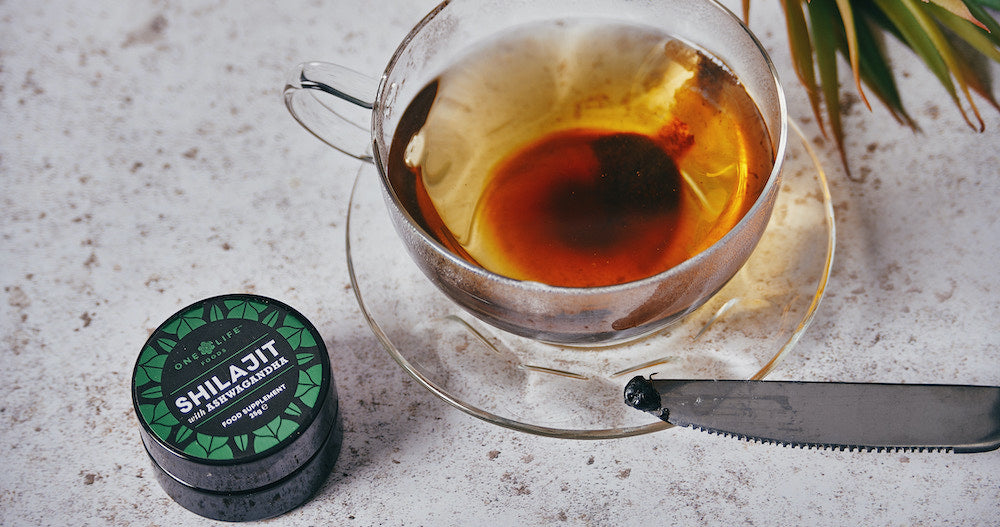
The low-dose mystery, the full-spectrum matrix and how we build our Shilajit blends
A normal serving of Shilajit can weigh less than half a gram.
That’s too little to provide substantial calories, protein, carbohydrates or meaningful nutritional quantities of dozens of minerals.
So why would it do anything?
It’s the most obvious question in Shilajit, and one the industry answers remarkably badly.
Usually, fulvic acid is appointed as a microscopic delivery driver, DBPs are promoted to mitochondrial superheroes and the tiny serving itself is quietly forgotten.
The honest answer is more interesting.
Shilajit may matter at low doses precisely because it isn’t functioning as bulk nutrition. Its potential activity may involve smaller organic compounds, redox-active chemistry, interactions within the digestive environment and the way several fractions behave together inside a concentrated natural matrix.
Human studies using particular purified Shilajit preparations also show that modest quantities can produce measurable outcomes under specific conditions.
That doesn’t mean every pea-sized serving works.
It means the low-dose question deserves a serious answer.
This article examines that mystery, our full-spectrum matrix hypothesis and why we believe Shilajit may have a valuable role in carefully formulated botanical resin blends.
Quick answer: Why might a small dose of Shilajit matter?
A small Shilajit serving may matter because biological activity isn’t always determined by weight.
Shilajit isn’t used as a bulk source of energy or minerals. It’s a concentrated organic-mineral matrix containing fulvic and humic substances, mineral elements, DBPs and numerous smaller constituents.
Different parts of that matrix may act through different routes:
-
Larger humic associations may interact mainly within the digestive environment
-
Smaller compounds may become available for absorption or metabolism
-
DBPs may participate in redox and coenzyme Q-related chemistry
-
The wider matrix may affect stability, solubility, binding and release
-
Gut microbes may transform certain compounds into different metabolites
Human trials have studied specific purified Shilajit preparations at 250 to 500 mg per day. In one eight-week exercise trial, 500 mg produced a measurable result in fatigue-related strength retention among participants with higher baseline strength, while 250 mg didn’t differ significantly from placebo. A separate 90-day trial used 250 mg twice daily and reported changes in several androgen markers in healthy middle-aged men.
Those studies don’t prove that every Shilajit product works at those doses.
They do show that a serving doesn’t need to weigh several grams before Shilajit becomes biologically worth investigating.
Our wider hypothesis is that Shilajit may also influence how selected botanical compounds behave when they’re formulated together.
That bioenhancer theory is plausible and has traditional precedent.
It hasn’t yet been confirmed through direct human absorption or comparative efficacy studies.
The small-dose paradox
People tend to judge supplements by size.
A large scoop looks substantial.
A tiny amount looks symbolic.
But physical weight tells us very little without knowing what the material contains and how its constituents behave.
A gram of protein and a milligram of a biologically active molecule aren’t expected to do the same job. One contributes nutritional mass. The other may interact with enzymes, receptors, membranes, redox systems or signalling pathways.
This doesn’t prove that Shilajit works.
It establishes a more useful starting point:
The fact that a Shilajit serving is small doesn’t make biological activity impossible. It makes composition, dose and mechanism more important.
The questions become:
-
Which compounds are present?
-
At what concentrations?
-
What becomes accessible during digestion?
-
Which compounds are absorbed?
-
How are they metabolised?
-
Do they reach relevant tissues?
-
Does the complete matrix behave differently from isolated fractions?
Those are scientific questions.
“Small dose, therefore impossible” isn’t much better than “ancient mountains, therefore miraculous”.
Both save time by avoiding the interesting part.
Shilajit clearly isn’t working as bulk nutrition
Let’s remove one explanation immediately.
A few hundred milligrams of Shilajit can’t provide substantial nutritional quantities of dozens of common minerals.
Even when an elemental analysis detects calcium, magnesium, iron, zinc or selenium, the actual amount supplied per serving may be extremely small.
Detection doesn’t establish:
-
Nutritional significance
-
Absorption
-
Biological effect
-
Deficiency correction
-
Superiority over another resin
Shilajit therefore shouldn’t be presented as a compressed mountain multivitamin.
Its mineral profile can still matter for composition, quality control, natural variation and contaminant screening. It just isn’t a convincing explanation for why a 250 mg serving might produce a measurable effect.
Read Does Shilajit Really Contain 85 Minerals? for the full arithmetic.
If small amounts of Shilajit matter, the explanation probably involves:
-
Smaller organic compounds
-
Humic chemistry
-
Redox-active constituents
-
Digestive interactions
-
Microbial transformation
-
Cell-signalling pathways
-
Mitochondrial hypotheses
-
Relationships within the wider matrix
The interesting part of Shilajit may not be the heaviest part.
What have human studies actually used?
Human Shilajit research is limited, but it gives us an important clue.
Researchers haven’t needed to administer 10 or 20 grams per day before observing measurable outcomes.
The fatigue-related strength study
A randomised, placebo-controlled study involved 63 recreationally active young men.
Participants took:
-
250 mg of a purified Shilajit preparation per day
-
500 mg per day
-
Placebo
After eight weeks, the 500 mg group showed better retention of maximal isometric strength following a fatiguing exercise protocol within the subgroup of participants who had higher baseline strength.
The 250 mg group didn’t differ significantly from placebo.
That detail matters.
The study doesn’t show that every small dose works.
It suggests that:
-
500 mg of the studied preparation produced a measurable outcome under specific conditions
-
250 mg didn’t produce the same result
-
Dose may still matter
-
The effect wasn’t universal across every participant and outcome
The responsible conclusion isn’t “pea-sized Shilajit is clinically proven”.
It’s:
A modest quantity of one characterised Shilajit preparation produced a measurable fatigue-related result, while a smaller quantity didn’t under the same conditions.
That’s far more useful than pretending dose is irrelevant.
The testosterone study
A separate placebo-controlled trial involved healthy men aged 45 to 55.
Participants received 250 mg of purified Shilajit twice daily for 90 days.
The researchers reported increases in total testosterone, free testosterone and DHEA-S compared with placebo.
Again, this was:
-
One specific purified preparation
-
A total daily amount of 500 mg
-
One age and sex group
-
One study lasting 90 days
It doesn’t prove that all Shilajit increases testosterone.
It does show that a total daily quantity of 500 mg can’t be dismissed as merely decorative.
For the complete studies and their limitations, read Shilajit for exercise performance and does Shilajit increase testosterone?.
What the human evidence does and doesn’t establish
The existing trials tell us something important:
Modest amounts of certain purified Shilajit products can be biologically active under specific experimental conditions.
They don’t tell us exactly why.
The trials generally investigated the finished Shilajit preparation rather than isolating each component and establishing which one produced the result.
They also don’t show that:
-
Every origin has equivalent activity
-
Every resin has the same composition
-
Fulvic acid caused the outcome
-
DBPs caused the outcome
-
Minerals caused the outcome
-
The matrix effect caused the outcome
-
Your subjective experience will match the study
-
250 mg and 500 mg are interchangeable
-
A gummy or generic powder is equivalent to the studied material
This leaves us with an unusual situation.
We have human evidence suggesting modest doses can matter.
But we don’t yet have a complete chain connecting:
-
The compounds inside the resin
-
Their concentration per serving
-
Their digestive release
-
Their absorption and metabolism
-
Their tissue exposure
-
The final measured human outcome
That missing chain is the mystery.
It isn’t a reason to invent an answer.
It’s a reason to examine the plausible mechanisms properly.
Mechanism one: The full-spectrum matrix is concentrated
Shilajit resin isn’t an ordinary food.
It’s a concentrated, purified natural matrix.
A small amount may contain several chemically different fractions, including:
-
Hydrophobic fulvic acids
-
Humic acids
-
Mineral associations
-
Smaller aromatic compounds
-
Organic acids
-
Microbial and plant-derived metabolites
-
Dibenzo-α-pyrones
This doesn’t mean every milligram is active.
It means the serving can’t be evaluated using the same logic as a spoonful of food.
The better comparison isn’t:
How much nutrition does 500 mg provide?
It’s:
Which biologically relevant constituents are present in that 500 mg, and what happens to them?
That distinction sits at the heart of Shilajit Explained: How It Works, and What Actually Matters.
Mechanism two: Some activity may happen inside the gut
A common mistake is to assume that a compound only matters if it enters the bloodstream intact.
That isn’t necessarily true.
Larger humic structures may have limited intact absorption but could still interact locally with:
-
Mineral ions
-
Other organic compounds
-
Food components
-
Digestive fluids
-
Microbial communities
-
Intestinal surfaces
These interactions could affect solubility, binding, dispersion or the chemical environment in which smaller compounds are released.
That doesn’t mean humic acids are proven to improve nutrient absorption.
It means local gastrointestinal activity is biologically relevant and doesn’t require the entire Shilajit matrix to pass through the intestinal wall.
Some components may act locally.
Others may become systemically available.
Others may be transformed before absorption.
Read What Does the Body Actually Absorb from Shilajit? for the full distinction between dissolution, bioaccessibility, absorption and bioavailability.
Mechanism three: Fulvic acids may change the chemical environment
The earlier version of this article described fulvic acids as shuttle buses that collect compounds, carry them through cell membranes and drop them exactly where they’re required.
It’s an easy analogy to understand, but it gives fulvic acid a level of precision and control that hasn’t been demonstrated.
Fulvic substances can interact with minerals and organic compounds. Depending on the compound and surrounding conditions, those interactions may influence:
- Solubility
- Dispersion
- Stability
- Binding
- Oxidation
- Release as pH changes
Those are real chemical properties.
They create a plausible basis for investigating whether Shilajit changes the behaviour of co-formulated ingredients.
What they don’t prove is that fulvic acid:
-
Carries every botanical constituent through the intestinal wall
-
Increases absorption universally
-
Delivers compounds directly into cells
-
Makes a smaller botanical dose equivalent to a larger one
-
Improves the efficacy of whatever is taken alongside it
A substance can bind another molecule and reduce its absorption.
It can bind it and increase solubility.
It can bind it temporarily and then release it.
It can form an association that never crosses the intestinal barrier at all.
“Binding” isn’t a synonym for “better delivery”.
Biology has declined to make things that convenient.
Mechanism four: Smaller compounds may matter disproportionately
Shilajit contains smaller organic compounds that may be biologically relevant at quantities far below those expected for bulk nutrients.
The most intriguing candidates include DBPs.
Dibenzo-α-pyrones are small aromatic compounds linked in early Shilajit research with:
-
Redox activity
-
Antioxidant reactions
-
Coenzyme Q
-
Mitochondrial systems
One Shilajit-associated DBP, 3,8-dihydroxydibenzo-α-pyrone, is the same chemical compound now widely known as Urolithin A.
That gives the older Shilajit literature an unexpected bridge into modern mitochondrial research.
It doesn’t mean that Shilajit supplies the large isolated Urolithin A doses used in modern human trials.
It does support an important principle:
A minor compound can be scientifically interesting without making up a large percentage of the product.
Selected isolated DBPs have shown interesting mitochondrial and CoQ-related behaviour in preclinical experiments. Those studies don’t prove that oral Shilajit resin delivers a clinically meaningful DBP dose into human mitochondria, but they provide a credible low-dose hypothesis.
Read The Secret Stars of Shilajit: Why DBPs Deserve a Standing Ovation.
Mechanism five: The matrix may affect dose efficiency
This may be the most important idea.
We’re not proposing that the Shilajit matrix creates extra milligrams.
It doesn’t multiply the botanical dose.
There’s no mathematical trapdoor through which another 500 mg secretly enters the jar.
Our hypothesis is that the matrix may affect dose efficiency.
By that, we mean it may influence how a given amount of a compound:
-
Dissolves
-
Remains stable
-
Disperses
-
Interacts with digestive fluids
-
Associates with minerals or organic matter
-
Encounters gut microbes
-
Is released as pH changes
-
Becomes accessible for absorption
-
Is metabolised
A complex matrix can change how its constituents behave without increasing their physical quantity.
That’s a common principle in natural-product chemistry and food science.
The difficult question is whether those changes produce a meaningful benefit in this particular context.
We don’t yet know.
But it gives us a more credible model than:
Small dose plus fulvic acid equals magically enormous dose.
Our full-spectrum matrix hypothesis
Our working hypothesis has four parts.
1. Different fractions may act through different routes
Larger humic associations may act mainly within the digestive environment.
Smaller organic compounds may be absorbed, metabolised or transformed.
Mineral ions may interact with both fractions.
The complete matrix doesn’t need to enter the bloodstream intact for several components to matter.
2. The surrounding matrix may influence smaller compounds
Fulvic and humic substances may affect the stability, solubility, binding or release of DBPs and other smaller constituents.
This could change their availability during digestion.
3. Minor compounds may contribute more than their weight suggests
DBPs, phenolics, organic acids and microbial metabolites may be biologically relevant without dominating the ingredient list by weight.
4. The complete resin may behave differently from isolated fractions
Removing humic acids, drying the resin onto carriers or rebuilding it into another format may alter the chemical environment surrounding the remaining compounds.
This is why we prefer properly purified, full-spectrum resin rather than treating Shilajit as an isolated fulvic-acid delivery system.
For the wider argument, read why humic acid matters and full-spectrum versus isolate supplements.
Is Shilajit a bioenhancer?
Traditionally, Shilajit has been described as a yogavahi.
The term refers to the traditional belief that Shilajit can influence or enhance the action of substances taken alongside it.
In modern writing, this is sometimes translated as “bioenhancer”.
That translation is useful, but it can also smuggle modern pharmacological certainty into an older medical concept.
A true modern bioavailability enhancer would need to show that it increases exposure to another compound, perhaps by affecting:
-
Solubility
-
Intestinal transport
-
Metabolism
-
Efflux systems
-
Enzyme activity
-
Tissue distribution
Improved bioavailability would normally be demonstrated through pharmacokinetic measures such as:
-
Maximum blood concentration
-
Time to maximum concentration
-
Area under the concentration-time curve
-
Metabolite exposure
-
Urinary recovery
-
Tissue concentration
We don’t currently have those data for Shilajit combined with our botanical extracts.
So we shouldn’t say:
Shilajit is proven to increase the absorption of Ashwagandha, Lion’s Mane or Cordyceps.
We can say:
Shilajit has a traditional reputation as a yogavahi, and its complex humic matrix provides plausible chemical reasons to investigate whether it changes the behaviour of selected co-formulated botanical compounds.
That’s the theory.
It hasn’t yet become proof.
Could Shilajit increase the efficacy of whatever you take with it?
“Whatever” is doing far too much work in that sentence.
If Shilajit increased the exposure or activity of every substance consumed alongside it, that wouldn’t automatically be beneficial.
It could theoretically alter the effects of:
-
Medicines
-
Stimulants
-
Hormones
-
Blood pressure products
-
Sedatives
-
Anticoagulants
-
Other biologically active substances
A universal bioenhancer wouldn’t simply be a wellness advantage.
It would be a substantial interaction risk.
The sensible hypothesis needs to be narrower:
Could Shilajit influence the dissolution, stability, availability or combined effect of particular botanical constituents within specific formulations?
That is testable.
“Shilajit makes everything work better” isn’t a scientific theory.
It’s a slogan with boundary issues.
Can Shilajit make smaller amounts of herbal extracts work?
Possibly, but this hasn’t been demonstrated directly.
There are two separate questions.
Does Shilajit increase absorption?
We don’t currently have human pharmacokinetic trials showing that Shilajit increases blood concentrations of:
-
Withanolides from Ashwagandha
-
Hericenones or other Lion’s Mane compounds
-
Cordycepin or adenosine from Cordyceps
-
Ecdysteroids from Maral root
Does the combination improve efficacy?
Even if absorption increased, that wouldn’t automatically prove a better practical outcome.
To establish comparative efficacy, a study would need groups such as:
-
A smaller botanical dose with Shilajit
-
The same smaller dose without Shilajit
-
A larger standalone botanical dose
-
Shilajit alone
-
Placebo
That study hasn’t been done for our blends.
We therefore don’t claim that:
-
100 mg inside Shilajit equals 500 mg alone
-
Shilajit multiplies the herbal dose
-
A modest botanical serving reproduces a standalone clinical trial
-
The matrix guarantees improved absorption
-
Every ingredient becomes more effective
Our formulation theory is more measured:
A full-spectrum Shilajit resin and carefully selected botanical extracts may form a functionally complementary combination, even when the partner extract is present at a modest physical dose.
The modest dose remains modest.
We simply don’t assume that weight alone tells us everything about the resulting formula.
Functional complementarity versus dose amplification
These ideas aren’t the same.
Dose amplification
This would mean Shilajit makes a smaller botanical quantity behave like a larger quantity.
That requires direct evidence.
We don’t have it.
Functional complementarity
This means each ingredient contributes different chemistry or a different formulation role within a shared objective.
For example:
-
Shilajit provides the resin matrix
-
Ashwagandha contributes withanolides and related root compounds
-
Lion’s Mane contributes mushroom-derived compounds
-
Cordyceps contributes beta-glucans, nucleosides and related constituents
-
Liquorice contributes its own root chemistry and a traditional balancing role
The ingredients don’t need to increase one another’s absorption for the combination to be rational.
A formula can make sense because its components approach the same broad goal through different routes.
That isn’t quite as dramatic as “bioavailability supercharger”.
It’s considerably easier to defend when someone reads past the headline.
For a wider formulation framework, read how to stack supplements safely.
How this principle applies to our Shilajit blends
Our blends are Shilajit-led resin formulas.
The resin isn’t added as a token ingredient to make an ordinary herbal blend sound more exotic.
It forms the base of the product.
A meaningful quantity of concentrated botanical extract is then blended into that resin, generally accounting for roughly a third of the jar depending on the formula.
We formulate them this way for several reasons.
Shilajit itself is used in modest amounts
Human studies have investigated particular purified products at around 250 to 500 mg per day.
That makes resin suitable as the base of a concentrated daily formula without requiring a large scoop.
Extracts can concentrate selected plant or mushroom constituents
A botanical extract isn’t identical to the unprocessed raw material.
Extraction removes some material while concentrating or standardising other components.
That can make an extract more practical in a low-volume resin formula.
The ingredients are selected for a shared formulation direction
We’re not adding random fashionable ingredients until the front label runs out of room.
Each blend is built around a particular purpose:
-
Balance and stress-heavy routines
-
Focus and cognitive work
-
Physical performance and training
-
Future vitality-oriented formulations
The bioenhancer theory remains part of the rationale
We believe Shilajit’s matrix may influence how the botanical extracts behave inside the formula and digestive environment.
We don’t claim that we’ve proven this.
The blends are built around a scientifically interesting formulation hypothesis, not a completed human pharmacokinetic trial.
A note on extract ratios
Extract ratios are frequently misunderstood.
A 10:1 extract means that ten parts of starting material were used to produce one part of extract under the manufacturer’s defined process.
A 20:1 extract refers to a twenty-to-one starting-material relationship.
That doesn’t automatically mean:
-
Ten or twenty times the clinical potency
-
Ten or twenty times the absorption
-
Ten or twenty times every active compound
-
Direct equivalence to eating that weight of raw material
-
That all starting material ended up in the extract
The extraction solvent, process, starting material, plant part and final standardisation all matter.
A ratio describes manufacturing concentration.
It isn’t a small wormhole through which several kilograms of mushrooms have entered the jar.
For the full explanation, read powdered herbs versus herbal extracts.
Our Shilajit resin blends
Shilajit, Ashwagandha and Liquorice
Our Shilajit and Ashwagandha Resin combines purified Kashmiri Shilajit resin with whole-root Ashwagandha extract and liquorice root extract.
The formulation rationale is balance.
Ashwagandha has a long history of traditional use and substantial modern research interest around stress-related outcomes, sleep, recovery and physical performance.
Shilajit contributes the full-spectrum resin matrix.
We don’t claim that the Shilajit turns a modest Ashwagandha serving into the equivalent of a high-dose standalone clinical extract.
We do think the two ingredients make sense together as part of a measured, non-stimulant formulation.
Formulation direction: demanding work periods, stress-heavy routines and people seeking a steadier formula rather than something designed to feel immediately aggressive.
For more detail, read Shilajit and Ashwagandha: understanding the science behind the stack.
Shilajit, Lion’s Mane and Liquorice
Our Shilajit and Lion’s Mane Resin combines Kashmiri Shilajit resin with Lion’s Mane and liquorice root extract.
The formulation rationale is cognitive work without relying on conventional stimulation.
Lion’s Mane is studied for its mushroom-derived compounds and their relationship with nerve-growth and cognitive pathways.
Shilajit contributes the resin matrix and its own separate area of research interest.
We don’t claim that Shilajit delivers Lion’s Mane compounds directly into brain tissue.
The blood-brain barrier has not appointed fulvic acid as its personal courier.
Our hypothesis is that the combination creates a practical, complementary resin formula aimed at routines involving focus, study, writing and sustained mental work.
Formulation direction: cognitive routines, creative work and people who’d rather not solve every concentration problem by increasing caffeine.
Read Lion’s Mane: benefits, cognitive research and how it works.
Shilajit, Cordyceps and Liquorice
Our Shilajit and Cordyceps Resin combines Altai Shilajit resin with a 20:1 Cordyceps militaris fruiting-body extract and liquorice root extract.
The Cordyceps extract is specified for beta-glucans, polysaccharides, adenosine and cordycepin.
The formulation rationale is performance and sustained output.
Cordyceps has research interest around exercise physiology, fatigue and oxygen-utilisation outcomes, although results differ by species, extract, population and study design.
Shilajit contributes the resin matrix and a separate body of human and preclinical research involving muscular fatigue and mitochondrial hypotheses.
We don’t claim the combination has been clinically shown to increase ATP or oxygen efficiency.
We do think it’s a rational pairing for a performance-oriented resin formula.
Formulation direction: training routines, demanding physical periods and people seeking a non-caffeine-led performance blend.
A future blend we’re exploring: Shilajit and Maral root
Maral root, or Rhaponticum carthamoides, has a history of traditional use in Siberia and Central Asia.
It’s particularly associated with compounds called ecdysteroids, including 20-hydroxyecdysone.
That makes it an interesting candidate for a future vitality and performance-oriented Shilajit blend.
The folklore involving Maral stags digging for the root is memorable.
It isn’t a clinical trial.
Neither is historical use by soldiers, athletes or cosmonauts.
Our interest is more specific:
-
Its distinct phytochemical profile
-
Its traditional performance positioning
-
The potential complementarity with a mineral-organic resin base
-
Whether a concentrated extract can be incorporated without compromising resin quality
That formulation remains a hypothesis and development project until the final composition, quality specifications and evidence-led positioning are established.
Why is liquorice included?
The old explanation said liquorice “smooths absorption”.
We can’t support that claim for these formulas.
Liquorice does, however, have several legitimate reasons for being present.
It has a traditional formulation role
Liquorice has historically been used in multi-herb systems as a balancing or harmonising ingredient.
Traditional use doesn’t prove modern absorption enhancement, but it helps explain why the pairing isn’t arbitrary.
It contributes its own chemistry
Liquorice root contains glycyrrhizin and numerous other constituents.
Those compounds are biologically active, which is precisely why liquorice shouldn’t be treated as a decorative flavouring.
It affects the sensory profile
A small amount can soften the bitterness and intensity of both Shilajit and concentrated botanical extracts.
That can make consistent use more practical.
It may affect formulation behaviour
Liquorice extract can influence flavour, dispersion and the physical character of the resin blend.
What we don’t claim is that it guarantees better absorption.
Liquorice also requires respect.
Excessive or prolonged glycyrrhizin exposure can affect sodium and potassium balance and raise blood pressure, particularly in susceptible individuals. This is why the product directions, cautions and medication warnings matter.
“Natural harmoniser” shouldn’t be translated as “incapable of doing anything inconvenient”.
Do trace minerals help explain the low dose?
Not convincingly on their own.
Authentic Shilajit can contain a broad elemental profile, but most of those elements occur at amounts too small to explain the product as bulk mineral nutrition.
That doesn’t make the mineral profile useless.
Elemental analysis can help with:
- Batch comparison
- Contaminant screening
- Compositional characterisation
- Identifying unusual anomalies
- Comparing different source materials
- Investigating possible links with geology and geographical origin
Different regions may produce recognisably different elemental patterns because their geology, water and surrounding environment aren’t identical.
A mineral fingerprint can therefore contribute useful supporting evidence for provenance, particularly when it’s compared with authenticated source samples and interpreted alongside other chemical data.
But it shouldn’t be treated as a standalone geographical passport.
Different regions can share similar geological features, purification may alter the measured profile and the laboratory method affects which elements are detected and at what concentrations.
Used alongside traceability records, supplier documentation, batch history and wider compositional testing, an elemental profile may strengthen a claimed origin.
On its own, it can’t establish exact provenance or tell us whether the product will produce a particular biological effect.
Read how Shilajit testing works and how we test our Shilajit.
Why purity matters even more at small doses
A small serving doesn’t make testing optional.
It makes the composition of that small serving more important.
Shilajit forms in contact with rock, soil, water and the wider environment. Depending on sourcing and processing, unwanted substances may include:
-
Lead
-
Arsenic
-
Cadmium
-
Mercury
-
Thallium
-
Microorganisms
-
Mycotoxins
-
PAHs
-
Residual solvents
-
Undeclared ingredients
The old article suggested fulvic substances might transport contaminants more effectively.
That isn’t necessary to explain the risk.
Contaminants are undesirable because exposure accumulates according to the compound, concentration, frequency and duration of use.
A bioenhancer theory doesn’t need to be invoked before heavy metals become a bad idea.
Small daily amounts are often taken consistently.
Consistency makes batch testing, purification and concentration especially important.
Does more Shilajit work better?
Not automatically.
But “less is always more” isn’t supported either.
The exercise trial provides a useful example.
The 500 mg group produced a measurable result under the study’s specific conditions.
The 250 mg group didn’t differ significantly from placebo.
That suggests a possible threshold or dose-response relationship for that product and outcome.
It doesn’t establish that 500 mg is universally ideal.
Higher amounts may:
-
Increase exposure
-
Increase side effects
-
Become unnecessary
-
Interact differently with digestion
-
Vary according to product concentration
The sensible position is:
Use a measured dose appropriate to the specific product rather than assuming that either tiny or enormous is automatically superior.
A “pea-sized amount” is useful visual guidance, but it isn’t a standard unit.
Peas appear to range from lentil-sized to agricultural specimens depending on the optimism of the product page.
Read How to Take Shilajit Properly.
Quick myth-busting
“How can 250 mg do anything?”
Weight alone doesn’t determine biological relevance.
Specific purified Shilajit products have produced measurable human outcomes at total daily amounts around 500 mg.
That doesn’t guarantee that every 250 or 500 mg serving will work.
“Fulvic acid carries everything into your cells”
That hasn’t been established.
Fulvic substances can interact with minerals and organic compounds, but binding, absorption, tissue delivery and efficacy are separate stages.
“DBPs keep the electron transport chain humming”
Selected DBPs have shown interesting redox and CoQ-related effects in preclinical research.
We don’t yet know whether normal Shilajit servings contain or deliver enough to produce that effect in humans.
“Shilajit makes every herb stronger”
That hasn’t been shown.
Our theory concerns selected ingredients within specific formulations, not universal enhancement of everything consumed alongside Shilajit.
“A smaller herbal dose with Shilajit equals a full clinical dose”
We don’t claim that.
The physical dose remains the physical dose.
“Why not take much more?”
Because more isn’t automatically more effective, necessary or better tolerated.
The useful dose depends on the material, concentration, individual and intended use.
What we claim, and what we don’t
| Our position | What we don’t claim |
|---|---|
| Small amounts of specific purified Shilajit preparations have produced measurable human outcomes | Every small serving of every product is effective |
| Shilajit isn’t functioning as bulk mineral nutrition | A few hundred milligrams supplies large nutritional quantities of dozens of minerals |
| The matrix may affect solubility, stability, binding and release | Fulvic acid carries every compound directly into cells |
| DBPs provide a credible low-dose research hypothesis | DBPs in ordinary resin are clinically proven to increase ATP |
| Shilajit has traditional precedent as a yogavahi | It’s proven to increase the absorption of whatever is taken with it |
| Our blends are designed around functional complementarity | A smaller botanical serving is equivalent to a larger clinical dose |
| Liquorice has a traditional and practical formulation role | Liquorice guarantees improved absorption |
| Extract ratios provide useful manufacturing information | A 10:1 or 20:1 ratio proves ten or twenty times the efficacy |
That’s the difference between a formulation hypothesis and broscience.
One asks a testable question.
The other adds the word “cellular” and hopes everyone stops asking.
What research would settle the bioenhancer question?
The theory is testable.
For a botanical compound, a proper pharmacokinetic study could compare:
-
Botanical extract alone
-
Botanical extract with Shilajit
-
Shilajit alone
-
Placebo
Researchers could then measure:
-
Parent compounds
-
Relevant metabolites
-
Maximum blood concentration
-
Total exposure over time
-
Time to peak concentration
-
Urinary excretion
-
Tolerability
A comparative efficacy study could then test whether any increase in exposure translates into a meaningful outcome.
For our full matrix hypothesis, an even more ambitious study could compare:
-
Complete Shilajit resin
-
The same resin after selected fractions were removed
-
Isolated fulvic material
-
Isolated humic material
-
Selected DBPs
-
A reconstructed formula
That is the research Shilajit deserves.
Not another laboratory assay followed by a product page claiming total cellular optimisation.
The bottom line: why small amounts may matter
Shilajit’s small serving size looks strange only when it’s treated as a food or bulk mineral supplement.
It probably isn’t acting that way.
Its significance may involve:
-
Smaller organic compounds
-
Humic interactions within the gut
-
Redox-active chemistry
-
Microbial transformation
-
DBPs
-
Mineral associations
-
The behaviour of the full-spectrum matrix
Human studies show that modest doses of particular purified Shilajit products can produce measurable outcomes.
What they don’t show is exactly which compounds were responsible or whether every resin will behave the same way.
That unresolved mechanism is the mystery.
We believe the full-spectrum matrix may help explain it.
We also believe Shilajit may influence how carefully selected botanical extracts behave when they’re formulated together.
That’s why we’ve built our blends around resin rather than adding a token sprinkle of Shilajit powder to a conventional capsule formula.
But we won’t claim that Shilajit multiplies the dose, improves the absorption of everything or makes modest quantities clinically equivalent to much larger standalone servings.
The blends are based on:
-
Traditional precedent
-
Plausible chemistry
-
Human evidence showing Shilajit can be relevant at modest doses
-
Concentrated botanical extracts
-
Functional complementarity
-
A hypothesis that deserves direct testing
Small dose?
Yes.
Meaningless?
The evidence doesn’t support dismissing it that easily.
Mystery solved?
Not quite.
But at least we’re now asking the right question.
Explore the complete Shilajit Guide for deeper articles on absorption, DBPs, humic acid, dosage, testing, forms and the claims that tend to become much less confident once somebody asks how they were measured.
Editorial disclosure
This article was written by One Life Foods, a company that sells Shilajit resin and Shilajit-based botanical blends.
We have a commercial interest in the full-spectrum matrix and bioenhancer hypotheses discussed here.
Direct human studies haven’t yet shown that our Shilajit increases the absorption or efficacy of the botanical extracts used in our blends. We’ve separated established evidence, plausible mechanisms and our own formulation hypothesis throughout the article.
References
-
Keller JL, Housh TJ, Hill EC, et al. The effects of Shilajit supplementation on fatigue-induced decreases in muscular strength and serum hydroxyproline levels. Journal of the International Society of Sports Nutrition. 2019;16:3.
-
Pandit S, Biswas S, Jana U, et al. Clinical evaluation of purified Shilajit on testosterone levels in healthy volunteers. Andrologia. 2016;48(5):570-575.
-
Bhattacharyya S, Pal D, Banerjee D, et al. Shilajit dibenzo-α-pyrones: mitochondria targeted antioxidants. Pharmacologyonline. 2009;2:690-698.
-
Carrasco-Gallardo C, Guzmán L, Maccioni RB. Shilajit: a natural phytocomplex with potential procognitive activity. International Journal of Alzheimer’s Disease. 2012;2012:674142.
-
Patil UK, Singh A, Chakraborty AK. An appraisal of the bioavailability enhancers in Ayurveda in the light of recent pharmacological advances. AYU. 2016.
-
Penninkilampi R, Eslick EM, Eslick GD. The association between consistent liquorice ingestion, hypertension and hypokalaemia: a systematic review and meta-analysis. Journal of Human Hypertension. 2017.
Written By
Written by Chris Simon, Founder of One Life Foods.
Chris has worked in the supplement industry since 2009 and is known for seeking out exceptional ingredients, products, and formulations. Read more about Chris and the story behind One Life Foods.

Share:
FUEL – The Performance Booster That’s Not Just Another Pre-Workout
Fulvic Acid in Shilajit: Which Test Can You Trust?