


If you’ve been with One Life for a while, you might remember us saying:
Four is More.
We did.
We even wrote an article explaining why we’d chosen Lion’s Mane, Reishi, Chaga and Cordyceps for our Four Mushroom Blend rather than filling a capsule with an ever-growing list of different mushrooms.
So now that the Four Mushroom Blend has come to the end of its run and we’re offering the mushrooms individually, there’s an obvious question.
Have we changed our minds?
A little.
But probably not in the way you might think.
We still believe in the thinking behind Four is More
The original idea was never that the number four had some special significance.
It was about something much simpler.
At the time, we were seeing more and more mushroom blends containing long lists of ingredients.
Six mushrooms.
Ten mushrooms.
Twelve mushrooms.
Sometimes more.
The ingredient panel looked impressive, but we weren’t convinced that simply adding more names automatically created a better product.
So we took a more focused approach.
Lion’s Mane.
Reishi.
Chaga.
Cordyceps.
Four distinct mushrooms, all given a meaningful place within the formula.
That philosophy still makes sense to us.
In fact, our move to individual mushrooms is really an extension of the same idea.
If you’re new to the subject, our introduction to functional mushrooms explains just how different these four fungi actually are.
More ingredients doesn’t automatically mean better
This remains one of the principles behind how we approach supplements.
There’s a temptation to judge products by quantity.
More ingredients.
Higher extraction ratio.
More impressive percentages.
Longer lists of compounds.
Bigger numbers on the label.
But the deeper we’ve gone into mushroom sourcing, extraction and testing, the less convinced we’ve become that any one of those things provides a complete picture.
A carefully considered product doesn’t need to win a competition for the longest ingredient list.
That’s what we believed when we chose four mushrooms.
Now we’re taking the same idea one step further.
When the Four Mushroom Blend ended, we had a choice
When our existing Four Mushroom Blend came to the end of its run, we could have simply tried to recreate it.
Same concept.
Same four mushrooms.
Another fixed blend.
But it also gave us an opportunity to look again at what we’d learned since the original product was developed.
So we did.
We’ve continued reading.
We’ve continued researching.
We’ve spoken with mycologists and people who work directly with fungi.
We’ve spent more time understanding cultivation and extraction.
We’ve looked much more closely at analytical testing.
And we’ve become increasingly interested in something that sounds obvious but often isn’t:
What is actually present in the finished mushroom extract?
We’re learning to ask different questions
Mushroom supplements are full of familiar quality signals.
Fruiting body.
15:1 extract.
30% beta-glucans.
Dual extracted.
Those things can all tell us something useful.
But we’ve become increasingly reluctant to let any one of them stand in for the entire question of quality.
A high extraction ratio doesn’t automatically tell us what was successfully extracted.
A beta-glucan number doesn’t tell us the entire chemical profile.
“Fruiting body” doesn’t tell us whether the starting material was good.
“Dual extracted” doesn’t tell us whether the process was performed well.
And “lab tested” isn’t particularly informative until we ask what the laboratory actually tested.
None of this means those specifications are unimportant.
It means they’re pieces of a much bigger picture.
We explore these ideas more fully in What Are Functional Mushrooms?, and we’ll be going much deeper in forthcoming guides to extraction ratios, beta-glucans vs polysaccharides and fruiting body vs mycelium.
We don’t think changing your mind is a weakness
Good product development shouldn’t mean deciding what you believe once and then defending it forever.
You learn.
Research develops.
Testing improves.
Manufacturing changes.
Different analytical techniques become more accessible.
And sometimes you realise that the questions you were asking five years ago aren’t the questions you’d ask today.
We’re comfortable with that.
We’d much rather explain how our thinking has evolved than quietly pretend we’ve always believed exactly the same thing.
Our old approach made sense to us then.
Our new approach makes more sense to us now.
There’s also a very practical difference
Our previous Four Mushroom Blend contained four mushrooms in every capsule:
100 mg Lion’s Mane
100 mg Reishi
100 mg Chaga
100 mg Cordyceps
The recommended daily serving was two capsules.
So a daily serving gave you:
200 mg Lion’s Mane
200 mg Reishi
200 mg Chaga
200 mg Cordyceps
That’s 800 mg in total, divided equally between four mushrooms.
The individual range works very differently.
Each individual capsule contains:
400 mg of the mushroom extract preparation you’ve chosen.
The recommended intake is 2 to 3 capsules per day.
So when one individual mushroom is taken according to those directions:
2 capsules = 800 mg
3 capsules = 1,200 mg
of that mushroom extract preparation.
That’s a significant change in emphasis.
You can explore the individual mushroom range here
Four times the amount doesn’t mean four times stronger
This is an important distinction.
At a two-capsule serving, the individual product provides 800 mg of your chosen mushroom extract preparation.
Our previous two-capsule Four Mushroom serving provided 200 mg of that particular mushroom.
So, by weight, that’s four times the amount of the individual mushroom compared with its contribution to the old daily serving.
But we wouldn’t call that:
four times stronger
or:
four times more potent.
Those aren’t the same thing.
Different extracts can have different extraction methods, specifications and chemical profiles.
Milligrams tell us the amount of material.
They don’t, on their own, give us a universal measurement of potency.
The useful point is simpler:
The new format gives the mushroom you’ve actually chosen much more room.
From breadth to depth
This is probably the best way to describe the change.
Our Four Mushroom Blend gave you breadth.
A little Lion’s Mane.
A little Reishi.
A little Chaga.
A little Cordyceps.
Every day, in fixed proportions.
The individual range allows for more depth.
Choose Lion’s Mane Fruiting Body Extract and Lion’s Mane can have the whole capsule.
Choose Reishi Extract and Reishi can have the whole capsule.
Choose Chaga Extract and you don’t automatically need Cordyceps with it.
Choose Cordyceps CS-4 Extract and you don’t automatically need the other three.
We like that.
Four individual bottles doesn’t mean taking all four
It’s worth making this very clear.
We haven’t separated the Four Mushroom Blend so that everybody can immediately recreate it by taking enormous numbers of capsules.
That rather misses the point.
The new range is about being more selective.
You might decide one mushroom is enough.
You might want two.
You might explore one for a while and then another.
You might make one mushroom the main part of your routine and pair it with another.
The point isn’t to build the biggest possible “stack”.
It’s to give you more control over what’s actually in it.
You can now control the proportions
This is one of the biggest advantages of keeping the mushrooms separate.
Our old blend always made the decision for you.
Lion’s Mane, Reishi, Chaga and Cordyceps appeared together in the same proportions.
Now you can decide.
You might use two mushrooms equally.
You might choose one as your main, or anchor, mushroom and use another or even two alongside it.
You might use one product alone.
And you can change that decision without changing the product itself.
We’ve written a separate guide to exactly this: How to Choose and Combine Lion’s Mane, Reishi, Chaga & Cordyceps.
The mushrooms deserve to be treated individually too
There’s another reason we’ve grown to prefer this format.
Lion’s Mane, Reishi, Chaga and Cordyceps are extraordinarily different.
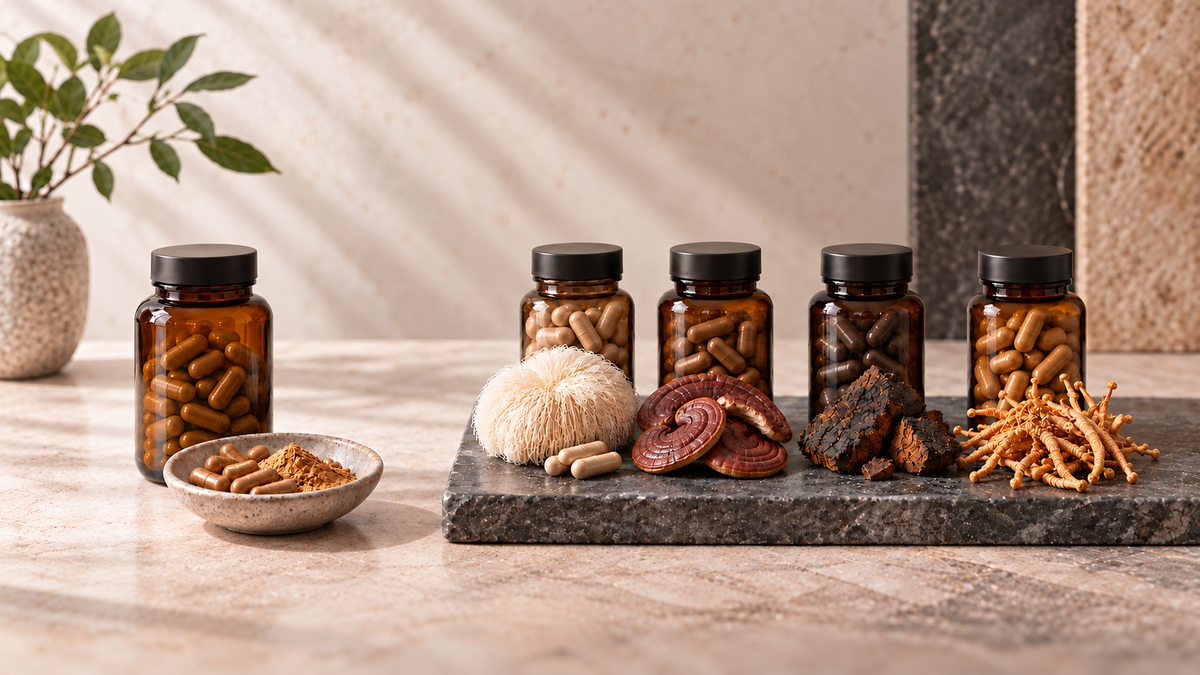
Lion’s Mane produces its distinctive cascading fruiting body.
Reishi has a hard, woody fruiting body.
Chaga is used as a dense conk.
Cordyceps CS-4 uses cultured fungal mycelium.
Even before we start talking about individual compounds, they’re clearly not interchangeable ingredients.
They grow differently.
They’re cultivated or harvested differently.
Different fungal material is used.
And they can require different approaches to extraction.
The more we’ve learned about those differences, the more we’ve wanted to give each mushroom its own identity rather than always talking about them as one collective formula.
Our Functional Mushrooms collection now reflects that approach.
Chaga is a particularly good example
We’ve actually offered Chaga outside the Four Mushroom Blend for some time.
Our Wild Harvested Chaga is dried conk material intended for preparation with hot water.
Our new Chaga Extract Capsules take a completely different approach, using a measured extracted preparation in capsule form.
We don’t see one as replacing the other.
They’re different preparations for people who want different experiences of the same fungal material.
That distinction has also helped shape how we now think about the wider mushroom range.
There doesn’t always need to be one format that does everything.
Our thinking about mushroom quality has changed too
When we first started looking at mushroom products, like most people, we paid close attention to familiar measures such as extraction ratio and beta-glucan content.
We still do.
But we now see them as pieces of evidence rather than final answers.
We’re increasingly interested in the analytical profile of the finished material itself.
Can the identity be verified?
Does the material chemically look like what it’s supposed to be?
Can characteristic compounds actually be detected?
Do batches remain reasonably consistent?
What exactly has been measured rather than simply assumed?
Techniques such as NMR and high-resolution mass spectrometry can add different layers of information to conventional mushroom specifications.
That doesn’t suddenly make mushroom quality simple.
If anything, it’s shown us how oversimplified some of the industry’s favourite rules have become.
That’s why analytical testing and verification will be a major part of our growing Mushroom Guide.
So was Four is More wrong?
No.
We don’t think so.
The original idea was:
More ingredients don’t automatically make a better formula.
Rather than squeezing a long list of mushrooms into one product, we chose four and gave them more space.
We still agree with that.
What’s changed is where that thinking has taken us next.
First, we moved away from the idea that ten or twelve mushrooms were automatically better than four.
Now we’re asking another question.
Do the same four mushrooms always need to appear together?
Our answer today is:
No.
They can.
But they don’t have to.
We see this as an evolution, not a U-turn
We’re not deleting our old article and pretending we never had a Four Mushroom Blend.
Quite the opposite.
We think the journey is worth showing.
The original product reflected our thinking at the time.
We’ve continued to research, question and learn.
Now we’re at a different point.
We don’t see that as contradicting our old philosophy.
We see it as continuing it.
The principle behind Four is More was to give individual mushrooms enough room to matter rather than chasing the longest possible ingredient list.
Now we’ve taken that principle one step further.
We’ve given them a bottle each.
From Four is More to Choose What Matters
Our previous approach was:
Four mushrooms
Fixed proportions
200 mg of each per daily serving
Our new individual format is:
One chosen mushroom per capsule
400 mg per capsule
800 to 1,200 mg when taken individually according to the recommended 2 to 3 capsule intake
But the biggest difference isn’t really the numbers.
It’s choice.
Choose one.
Explore two. Or more.
Change the proportions.
Change your mind.
Keep things simple.
You don’t have to take everything simply because everything is available.
And we don’t have to decide in advance that the same four mushrooms belong together for everybody.
What hasn’t changed
There are some things we’re still just as particular about.
We want to understand what we’re selling.
We want clear information about ingredients and production.
We want to know which fungal material has been used.
We want extraction to make sense for the material.
We want meaningful analytical information rather than relying entirely on assumptions.
And we don’t think adding more ingredients automatically makes a better supplement.
So yes, the range has changed.
Our thinking has developed.
But the underlying philosophy is probably more consistent than it first appears:
Give good ingredients enough room to matter.
That’s what we were trying to do when we chose four.
It’s what we’re trying to do now by giving each one its own place.
Continue Exploring
What Are Functional Mushrooms?
Start with the fundamentals, from fruiting body and mycelium to extraction, beta-glucans and analytical testing.
How to Choose and Combine Lion’s Mane, Reishi, Chaga & Cordyceps
See how the individual products can be approached alone or in different combinations.
Functional Mushrooms Collection
Explore our Lion’s Mane, Reishi, Chaga and Cordyceps range.
Written By
Written by Chris Simon, Founder of One Life Foods.
Chris has worked in the supplement industry since 2009 and is known for seeking out exceptional ingredients, products, and formulations. Read more about Chris and the story behind One Life Foods.



Share:
Fruiting Body vs Mycelium: It’s More Complicated Than “One Is Good and One Is Bad”
What Does 10:1, 15:1 or 8:1 Mushroom Extract Actually Mean?