


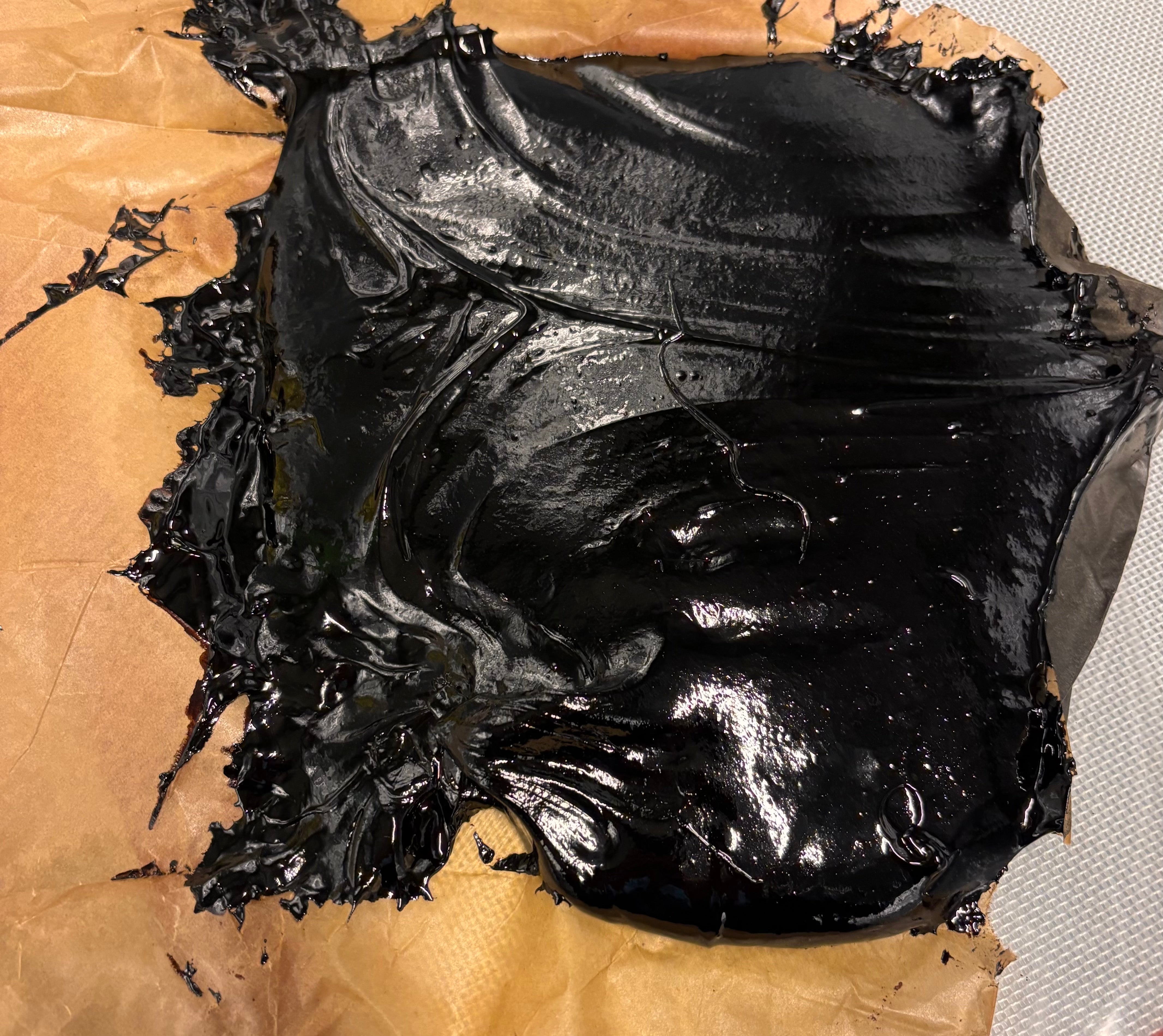
If you only read one page on Shilajit, start here
Most explanations of Shilajit follow the same script.
It comes from ancient mountains, contains 85 minerals and uses fulvic acid to carry nutrients directly into your cells.
Add “gold grade”, print an enormous percentage on the label and apparently the science is complete.
It isn’t.
Shilajit is a complex humic, mineral and organic matrix. No single component explains the whole material, and no single number proves its quality.
Our position is that Shilajit is most compelling when that wider matrix remains intact.
Strip it down to one soluble fraction, dilute it into a weak liquid or hide a token amount inside a gummy, and you may still have something marketable.
You may no longer have a particularly complete version of Shilajit.
This article explains how Shilajit may work, why we believe the full-spectrum matrix matters, what human research has actually shown and why properly purified resin remains the benchmark every other format should be judged against.
Quick answer: How does Shilajit work?
There isn’t one proven Shilajit mechanism.
Shilajit contains several chemically different fractions, including hydrophobic fulvic acids, humic acids, mineral elements, dibenzo-α-pyrones and other smaller organic compounds.
These components may contribute through several overlapping processes:
-
Binding and exchange with mineral ions
-
Redox and antioxidant chemistry
-
Interactions inside the digestive environment
-
Effects on solubility and dispersion
-
Microbial transformation
-
Absorption and metabolism of smaller compounds
-
Possible mitochondrial and cellular pathways
Our full-spectrum matrix hypothesis is that these components may also influence one another’s stability, binding, release, solubility and biological exposure.
That doesn’t mean every compound magically amplifies every other one.
It means removing one fraction may change more than the percentage represented by that fraction.
Human research has reported promising findings with specific purified or standardised Shilajit products, including studies involving testosterone, fatigue-related muscular performance and bone mineral density. But those findings don’t apply automatically to every resin, powder, liquid or gummy carrying the same name.
The product matters.
The dose matters.
The composition matters.
And, despite what the front of the jar may suggest, the testing method matters quite a lot.
For the detailed explanation of Shilajit’s formation, origin, history and composition, read What Is Shilajit?.
Here, we’re interested in a different question: how might that complex material work, and what separates a complete resin from something diluted, stripped down or heavily reformulated?
Shilajit isn’t one active ingredient
Shilajit isn’t a pharmaceutical containing one defined molecule at one controlled concentration.
It’s a variable natural matrix.
That means asking:
What is the active ingredient in Shilajit?
may be the wrong question.
There may be several relevant components, acting in different places and through different chemical or biological routes.
The main areas worth understanding are:
| Part of the matrix | Why it may matter | What remains uncertain |
|---|---|---|
| Hydrophobic fulvic acids | Soluble humic fraction with strong binding and chemical-interaction properties | How much specific fractions improve human absorption or outcomes |
| Humic acids | Broader, generally less acid-soluble fraction that helps preserve matrix complexity | Its direct contribution to human effects |
| DBPs | Smaller aromatic compounds linked with redox chemistry, coenzyme Q and modern urolithin research | Typical levels, absorption and relevance at normal Shilajit doses |
| Minerals and trace elements | Help describe composition, safety and natural variation | Which amounts are nutritionally meaningful and bioavailable |
| Other organic compounds | May include acids, phenolics, metabolites and related structures | Which compounds consistently occur across finished resins |
These aren’t five ingredients sitting neatly in separate layers.
They may associate, bind, disperse, precipitate and respond differently as pH and surrounding chemistry change.
Nature hasn’t organised Shilajit for the convenience of supplement labels.
What role might fulvic acid play?
Fulvic acid matters.
It’s generally more soluble than the larger humic fraction and contains chemical groups capable of interacting with minerals, organic compounds, water and biological surfaces.
This makes several roles plausible, including effects on:
-
Mineral solubility
-
Dispersion
-
Binding
-
Release
-
Redox reactions
-
Digestive behaviour
What it doesn’t prove is that fulvic acid escorts every nutrient directly through the intestinal wall and delivers it into your cells like a molecular courier with impeccable timekeeping.
Binding isn’t the same as absorption.
Absorption isn’t the same as tissue delivery.
Tissue delivery isn’t the same as a health outcome.
Those stages require different evidence.
For the complete distinction between bioaccessibility, absorption and bioavailability, read What Does the Body Actually Absorb from Shilajit?.
Why the highest fulvic percentage isn’t automatically the best
Fulvic-acid results depend heavily on the analytical method.
Different procedures may measure different fractions or include a wider pool of acidic and organic material.
ISO 19822:2018 separately measures humic acid and hydrophobic fulvic acid using a defined extraction and separation procedure. Its figures aren’t directly interchangeable with broader titration, spectrophotometric or organic-carbon results.
This is why a product reported as 80% “fulvic acid” under one method isn’t automatically twice as good as a product reporting 40% under another.
It may not contain twice as much of the same thing.
The two laboratories may not have measured the same thing in the first place.
Read Fulvic Acid in Shilajit: Which Test Can You Trust? and Why High Fulvic Acid Can Be a Red Flag.
Fulvic acid deserves attention.
It doesn’t deserve sole ownership of Shilajit.
Why might humic acid matter?
Humic acid is the less glamorous part of the discussion.
It’s generally darker, less acid-soluble and much harder to turn into one enormous percentage surrounded by lightning graphics.
That doesn’t make it unimportant.
In our view, measurable humic acid helps show that Shilajit retains a broader humic profile rather than being narrowed entirely to its most soluble and marketable fraction.
That doesn’t mean more humic acid is always better.
Generic humic material exists outside Shilajit, and natural Shilajit sources can have very different humic-to-fulvic balances.
A low-humic resin may still be:
-
Genuine
-
Properly purified
-
Safe
-
Useful
-
Naturally fulvic-dominant
But when almost no measurable humic acid remains, we think “full-spectrum” becomes more difficult to defend.
The product may still contain Shilajit-derived material.
It may simply be compositionally narrowed.
Our phrase for that is hollowed out.
Not fake.
Not empty.
Not necessarily ineffective.
Hollowed out because part of the wider measurable matrix has been substantially reduced.
Read The Missing Half: Why Humic Acid Matters in Full-Spectrum Shilajit.
Could DBPs be Shilajit’s secret stars?
Dibenzo-α-pyrones, or DBPs, may be among Shilajit’s most interesting minor compounds.
Selected DBPs discussed in Shilajit research include:
-
3,8-dihydroxydibenzo-α-pyrone, also known as Urolithin A
-
3-hydroxydibenzo-α-pyrone, also known as Urolithin B
They’ve attracted attention because of potential links with:
-
Redox chemistry
-
Antioxidant reactions
-
Coenzyme Q
-
Mitochondrial systems
-
Modern urolithin research
Recent analytical work has continued to characterise the chemical complexity of raw Shilajit, extracts and finished resin using complementary chromatographic and mass-spectrometric techniques.
We don’t yet know the typical DBP profile across finished commercial resins.
We also can’t assume that a small serving of Shilajit supplies anything close to the isolated doses used in modern Urolithin A trials.
But DBPs still offer a credible low-dose hypothesis.
A compound doesn’t need to make up half the jar to matter biologically.
Its importance may depend on:
-
Its chemical activity
-
The dose
-
Whether it’s absorbed
-
How it’s metabolised
-
Where it travels
-
What surrounds it inside the matrix
DBPs may contribute more than their weight suggests.
That’s why we’re exploring compound-specific testing rather than simply writing “DBP-rich” and hoping nobody asks for a result.
Read The Secret Stars of Shilajit: Why Dibenzo-α-Pyrones Deserve a Standing Ovation.
What do the minerals actually contribute?
Shilajit contains mineral elements.
That doesn’t make it a high-dose mineral supplement.
A normal serving weighs only a few hundred milligrams. It can’t provide substantial nutritional doses of dozens of common minerals at once.
Mineral analysis is useful for understanding:
-
Composition
-
Safety
-
Natural variation
-
Batch consistency
-
Possible geological influence
-
Unwanted heavy metals
It’s much less useful when converted into:
Contains 85 ionic minerals for complete cellular nutrition.
That sounds impressively scientific until someone asks for the list, concentrations and amount supplied per serving.
Detecting an element doesn’t mean:
-
It’s present at a meaningful dose
-
It’s readily absorbed
-
It’s beneficial
-
It appears in every Shilajit sample
-
More of it would be desirable
The same analytical instrument that detects calcium or magnesium may also detect lead, arsenic, cadmium or thallium.
The sensible question isn’t:
How many elements can the laboratory find?
It’s:
Which elements are present, at what concentrations, and what do those amounts mean?
Read Does Shilajit Really Contain 85 Minerals?.
Our full-spectrum matrix hypothesis
“Full-spectrum” isn’t a legally standardised Shilajit term.
Any company can use it.
A product doesn’t become full-spectrum because somebody types the phrase beneath a photograph of a mountain.
We therefore need to define what we mean.
For us, full-spectrum Shilajit is a properly purified resin that retains a credible breadth of:
-
Hydrophobic fulvic acids
-
Humic acids
-
Minerals and trace elements
-
Smaller organic compounds
-
The wider soluble and dispersible resin matrix
Full-spectrum doesn’t mean raw.
It doesn’t mean keeping soil, stone, microbes or unwanted contaminants because removing them would be insufficiently traditional.
The aim isn’t to keep everything.
It’s to remove what shouldn’t be there without reducing Shilajit to whichever fraction produces the most flattering label.
How might the matrix effect work?
We see four plausible levels.
1. Compositional completeness
Retaining multiple measurable fractions preserves more of the original chemical breadth.
This is the simplest and strongest part of the argument.
A product containing fulvic compounds, humic acid, minerals and smaller organic constituents is compositionally broader than one reduced mainly to a soluble fulvic fraction.
No mystical explanation is required.
2. Physicochemical interaction
The different parts of Shilajit may influence one another’s:
-
Solubility
-
Stability
-
Binding
-
Dispersion
-
Oxidation
-
Precipitation
-
Release as pH changes
Removing one fraction may therefore change how other components behave.
This is basic complex-mixture chemistry rather than spiritual speculation.
3. Different components may act in different places
Larger humic associations may remain mainly within the digestive tract, where they can interact with food, minerals, microbes and the intestinal environment.
Smaller compounds may have a greater chance of being absorbed or metabolised.
The whole matrix doesn’t need to cross the intestinal wall intact for different parts of it to matter.
4. Functional synergy
The complete matrix may produce effects that differ from those of isolated components.
This is the most exciting part of the hypothesis.
It’s also the least proven.
A convincing experiment would compare:
-
Full-spectrum Shilajit
-
The same Shilajit with selected fractions removed
-
The isolated fractions
-
A reconstructed mixture
-
Matched doses under controlled conditions
That study hasn’t been done.
So we won’t pretend the entourage effect is settled human science.
But the idea itself isn’t unreasonable.
Complex natural mixtures can behave differently from isolated compounds because their components alter one another’s chemical environment.
Our position is therefore specific:
Preserving the wider Shilajit matrix may retain compositional and chemical relationships that are lost when the material is aggressively fractionated, diluted or reconstructed.
That’s our working hypothesis.
It has real chemistry behind it.
Now it needs better direct research.
How might Shilajit affect the body?
The cleanest way to discuss this is through three levels of evidence.
1. What the chemistry suggests
Different Shilajit fractions may:
-
Bind mineral ions
-
Participate in redox reactions
-
Interact with organic compounds
-
Affect dispersion and solubility
-
Respond to changes in pH
-
Interact with digestive material
-
Influence the stability of smaller constituents
These are chemical properties.
They aren’t clinical outcomes.
2. Why those properties could matter biologically
Those interactions could influence:
-
What becomes available during digestion
-
How compounds behave inside the gut
-
Which smaller constituents are absorbed
-
How absorbed compounds are metabolised
-
Redox and oxidative processes
-
Microbial activity
-
Cellular signalling
-
Mitochondrial pathways
This is where a plausible mechanism begins.
It isn’t where the research ends.
Supplement marketing has a habit of moving directly from:
This compound can bind something in a test tube
to:
Therefore it delivers nutrients into every cell and fixes fatigue.
There are usually several missing experiments between those statements.
3. What human studies have actually shown
Human research has investigated specific purified or standardised Shilajit preparations in areas including testosterone, fatigue-related muscular performance and bone mineral density.
Some findings have been promising. A 90-day trial in healthy middle-aged men reported changes in total testosterone, free testosterone and DHEA-S. An exercise study reported better retention of muscular strength after fatigue under particular conditions, while a longer study in postmenopausal women with osteopenia reported preservation of bone mineral density and changes in related biomarkers.
These are legitimate human findings, but they belong first to the exact products, doses and populations studied.
They don’t prove that every resin, powder, liquid or gummy will produce the same result. They also don’t identify one individual component as the cause.
“Shilajit” isn’t one uniform chemical intervention.
Read Shilajit Benefits: What Research Suggests and What’s Overhyped for the full evidence review.
You can also explore Shilajit and testosterone and Shilajit for exercise performance.
Is Shilajit a stimulant?
Shilajit isn’t a conventional stimulant like caffeine.
It hasn’t been established to work primarily by acutely stimulating the central nervous system.
That means it shouldn’t be judged by whether it produces:
-
An immediate buzz
-
A racing heart
-
A sudden burst of alertness
-
An urgent desire to reorganise the garage before breakfast
Some people report noticing subjective effects fairly quickly.
Others describe slower changes.
Some notice nothing.
That variation could reflect:
-
Product quality
-
Dose
-
Individual biology
-
Expectations
-
Diet and sleep
-
Other supplements
-
Placebo effects
-
Normal daily fluctuation
A lack of stimulation doesn’t prove Shilajit is working gradually.
It simply means an immediate caffeine-like hit isn’t the correct benchmark.
Why resin is the best form of Shilajit
Let’s not bury the conclusion beneath a table.
Resin is the best overall form of Shilajit.
Format isn’t the only quality factor.
A poor resin is still a poor product.
But format matters because every additional manufacturing step creates another opportunity to:
-
Dilute the material
-
Add carriers
-
Remove fractions
-
Obscure the physical dose
-
Inflate an extract-equivalent number
-
Replace part of the original matrix
-
Make the finished product harder to evaluate
Properly purified resin is the clearest representation of the concentrated finished material before it’s dried, encapsulated, diluted or rebuilt into another formulation.
Why resin is the benchmark
A straightforward resin generally doesn’t require:
-
Capsule fillers
-
Drying carriers
-
Flow agents
-
A gummy base
-
Sweeteners
-
Flavourings
-
Large quantities of added water
-
A mathematically adventurous extract-equivalent claim
That gives the customer a clearer view of:
-
The physical material
-
The actual serving
-
The concentration
-
The texture
-
The ingredients
-
What has and hasn’t been added
Resin isn’t automatically perfect.
It can still be contaminated, diluted, poorly purified, overheated or supported by meaningless paperwork.
But it removes several layers of formulation between the purified material and the person taking it.
That makes it the strongest benchmark for authenticity, purity and transparency.
How the main Shilajit forms compare
| Form | What you’re buying | Main advantage | Main problem |
|---|---|---|---|
| Resin | Purified, concentrated Shilajit material | Closest view of the finished matrix | Sticky and less convenient |
| Powder | Dried Shilajit or Shilajit-derived extract | Convenient and easy to formulate | Carriers, drying method and concentration may be unclear |
| Capsule | Powder or extract inside a capsule | Simple dosing | Contents are hidden and may include fillers |
| Liquid | Shilajit diluted or dispersed in liquid | Easy to take | Actual Shilajit concentration may be difficult to judge |
| Gummy | Confectionery containing Shilajit extract | Palatable | Most heavily reformulated and often contains a modest physical dose |
Other formats can contain genuine Shilajit.
They aren’t automatically fraudulent.
But they add variables.
A gummy containing Shilajit extract isn’t compositionally equivalent to purified resin merely because both labels contain the word “Shilajit”.
One is the concentrated material.
The other is a sweet containing an ingredient derived from it.
That isn’t an insult.
It’s a description.
Read Shilajit Resin vs Powder, Liquid, Capsules and Gummies.
Why cheap Shilajit is often cheap
Not every affordable product is poor quality.
Not every expensive product is exceptional.
Some costly resins are excellent.
Some are ordinary material inside a box that appears to have consumed most of the production budget.
Price alone doesn’t prove anything.
But properly sourced, purified and tested Shilajit has real costs.
These may include:
-
Collection and sourcing
-
Transport
-
Purification
-
Concentration
-
Controlled processing
-
Finished-product analysis
-
Contaminant testing
-
Traceability
-
Packaging
-
Import and regulatory work
-
Batch losses
-
Quality control
A very cheap product may have reduced costs through:
-
Added water
-
Weak concentration
-
Minimal purification
-
Generic humic or fulvic ingredients
-
Limited finished-product testing
-
Cheap carriers or fillers
-
A small amount of actual Shilajit
-
Supplier certificates reused across multiple batches
-
High-volume marketplace economics
A low price doesn’t prove that any one of those things has happened.
It gives you a reason to ask.
When a product appears to cost less than credible purification, packaging and meaningful analysis should reasonably allow, scepticism isn’t elitism.
It’s arithmetic.
Read How Much Should Shilajit Cost?.
What does “poor-quality Shilajit” actually mean?
Poor quality isn’t one failure.
It can mean several different things.
It may contain very little Shilajit
This is particularly relevant to gummies, capsules, liquids and blends where an impressive extract-equivalent figure may disguise a much smaller physical amount.
It may be diluted
Additional water or syrup can reduce the amount supplied per serving.
Texture alone can’t prove dilution because viscosity changes with temperature, but concentration and declared solids still matter.
It may be compositionally narrowed
Aggressive fractionation may retain a large soluble fraction while reducing humic acid and other parts of the broader matrix.
It may use generic humic ingredients
A fulvic or humic powder derived from peat, lignite or another source isn’t automatically Shilajit.
It may be poorly purified
Raw or inadequately processed material may contain debris, microbes or unwanted contaminants.
It may be adulterated
Undeclared pharmaceutical or stimulant ingredients are a separate concern, particularly where products promise rapid sexual or performance effects.
It may simply be inadequately tested
A product can look authentic, smell authentic and arrive with a certificate while still lacking the analyses needed to establish composition and safety.
Poor products don’t all fail in the same way.
Some are weak.
Some are dirty.
Some are stripped down.
Some are barely Shilajit.
A few show impressive commitment by attempting all four.
Raw Shilajit isn’t better Shilajit
Natural doesn’t mean ready to eat.
Material collected from rock may contain:
-
Soil
-
Grit
-
Insoluble debris
-
Microorganisms
-
Environmental contamination
-
Unwanted concentrations of metals
Purification is necessary.
The meaningful question isn’t:
Has it been processed?
It’s:
Was it purified intelligently, and what did that process remove or preserve?
Too little purification can leave unwanted material behind.
Overly aggressive processing can narrow the chemical profile.
The objective should be a properly purified and tested resin that retains as much of the credible matrix as possible.
Raw material isn’t more authentic because it still contains the mountain attached.
Read Is Raw Shilajit Really Better? The Purification Paradox.
The claims that don’t tell you much
Several familiar claims sound useful but provide very little evidence on their own.
“Gold grade”
There’s no recognised external Shilajit standard defining gold, silver or premium grades.
“Collected above 18,000 feet”
Altitude may provide geographical context.
It doesn’t prove composition, purification or safety.
“Himalayan”
A famous origin isn’t a laboratory result.
“Contains exactly 85 minerals”
There’s no fixed universal mineral count across all Shilajit.
“80% fulvic acid”
Not meaningful without the method, sample basis and analytical definition.
“Passes the flame test”
Setting fire to a supplement doesn’t authenticate it.
It establishes that you own a lighter.
“Dissolves completely”
Dissolution depends on pH, temperature, water chemistry, concentration and composition.
“Sun-dried”
That describes almost nothing unless the producer explains the full process, scale and duration.
“Lab tested”
For what?
By which method?
On which batch?
A slogan isn’t a testing programme.
Read Shilajit Myths: What’s True, What Isn’t and What the Evidence Shows.
What actually determines Shilajit quality?
There isn’t one perfect test or visual shortcut.
Quality is a body of evidence.
1. The finished form
Resin provides the clearest benchmark.
For other formats, establish:
-
How much physical Shilajit is present
-
Whether the declared number is an extract equivalent
-
Which carriers or fillers were used
-
What else is in the formula
-
Whether the product is diluted
2. Traceable sourcing
A credible brand should be able to explain:
-
The claimed source region
-
Its supplier relationship
-
Where purification occurs
-
Whether origins are mixed
-
How finished batches are connected with production and testing records
A mountain photograph isn’t traceability.
A brand doesn’t need to reveal its supplier or commercially sensitive supply-chain arrangements publicly. What matters is that it maintains suitable internal traceability and can support the origin claims made for the finished product.
3. Intelligent purification
The process should remove unwanted insoluble and contaminating material without unnecessarily reducing the wider matrix.
Claims such as “purified seven times” mean very little without explaining what those seven stages are.
Seven unspecified filters aren’t automatically better than three properly controlled ones.
4. Finished-product testing
Supplier paperwork may describe:
-
A raw input
-
An earlier batch
-
A pre-processing sample
-
Material selected by the supplier
-
Something only loosely connected with the jar being sold
Testing the finished product gives more relevant evidence about what reaches the customer.
5. Method-stated composition analysis
For humic and fulvic testing, the report should explain:
-
Which method was used
-
Which fractions were measured
-
Whether humic acid was reported separately
-
Whether results are on an as-received or dry basis
-
Whether the figures can be compared with another method
A laboratory logo isn’t the method.
6. A meaningful contaminant panel
Depending on the product and process, testing may need to consider:
-
Lead
-
Arsenic
-
Cadmium
-
Mercury
-
Thallium
-
Microbiology
-
Mycotoxins
-
PAHs
-
Solvent residues
-
Undeclared ingredients
“Heavy metals passed” doesn’t tell you what was tested or what the results were.
Testing should generate information.
Not just reassurance.
Read How Shilajit Testing Actually Works and How to Read a Shilajit Lab Report.
You can also see how we test our Shilajit.
How should you take Shilajit?
Shilajit resin is generally taken in a modest measured amount, commonly mixed into warm water or another drink.
Human studies have often used specific purified products at daily amounts around 250 to 500 mg, although protocols and products vary.
That doesn’t establish one universal dose for every resin.
Follow the instructions for the product you’re using.
Avoid relying on “pea-sized” as a scientific unit, particularly as peas apparently range from lentils to agricultural specimens depending on which product page you’re reading.
Timing is largely practical.
There isn’t convincing evidence that one precise minute of the day unlocks Shilajit’s hidden potential.
Read How to Take Shilajit Properly.
Is Shilajit safe?
Purified and properly tested Shilajit has generally been well tolerated in the relatively small human studies available.
That doesn’t prove every product is safe or that it’ll suit everyone.
Safety has two sides:
-
Individual tolerance
-
Product quality
Some people may experience unwanted symptoms even with a genuine, properly made product.
Raw, contaminated, adulterated or poorly purified material presents a separate quality risk.
Shilajit should be avoided during pregnancy and breastfeeding, and we don’t recommend it for children.
Anyone taking medication or managing an existing health condition should seek individual medical advice before use.
Read Is Shilajit Safe? Side Effects, Risks and Who Should Avoid It.
What should you look for when buying Shilajit?
The shortest useful checklist is this:
Choose resin where possible
It normally involves the least reformulation and gives you the clearest view of the finished material.
Check the physical amount
Don’t confuse an extract equivalent with the quantity actually inside the serving.
Look for finished-product results
Supplier paperwork alone isn’t enough.
Read the methods
Particularly for humic and fulvic analysis.
Review the contaminant panel
Heavy metals matter, but they aren’t the only potential issue.
Ignore invented grades
“Gold”, “premium”, “ultra” and “supreme” aren’t analytical categories.
Treat instant-effect claims cautiously
Rapid pharmaceutical-style effects deserve considerably more scrutiny than a mountain story and a testimonial.
Look for honest limitations
A trustworthy company should explain what its testing proves and what it doesn’t.
Read What to Look for When Buying Shilajit.
The bottom line: what actually matters
Shilajit isn’t one active ingredient.
It isn’t 85 minerals in a spoon.
It isn’t an 80% fulvic-acid number produced by whichever method gave the most flattering result.
And it isn’t automatically authentic because it arrives in a dark jar with “Himalayan” printed in gold.
Shilajit is a variable natural matrix.
Its scientific interest may lie partly in the relationship between:
-
Fulvic acids
-
Humic acids
-
DBPs
-
Mineral elements
-
Smaller organic compounds
-
The digestive and biological environments they encounter
The full-spectrum matrix effect remains a hypothesis.
But it’s a hypothesis grounded in real chemistry, the behaviour of complex natural mixtures and an improving ability to analyse what’s actually present.
Our position is simple.
Purify the resin properly.
Test the finished product thoroughly.
Preserve the wider matrix wherever reasonably possible.
Use analytical methods that mean something.
Show the customer the numbers.
And stop pretending one fashionable percentage tells the whole story.
Resin remains the best overall form because it preserves and exposes the finished material more clearly than powders, liquids, capsules or gummies.
Fulvic acid matters.
Humic acid matters.
DBPs may matter considerably more than most people realise.
Minerals help describe the material, but they don’t turn a tiny serving into a complete nutritional programme.
Quality comes from the whole picture.
That’s what the rest of this guide is here to investigate.
Explore the complete Shilajit Guide for deeper articles on composition, absorption, human research, purification, testing, safety and the marketing claims that become considerably less impressive once somebody asks a sensible follow-up question.
Editorial disclosure
This article was written by One Life Foods, a company that sells Shilajit resin.
We have a commercial preference for resin and a direct interest in how Shilajit quality is defined.
Our position is based on differences in composition, reformulation, testing and transparency. It isn’t based on claiming that every non-resin product is fake or ineffective.
References
-
International Organization for Standardization. ISO 19822:2018. Fertilizers and soil conditioners: Determination of humic and hydrophobic fulvic acids concentrations in fertilizer materials.
-
Pandit S, Biswas S, Jana U, et al. Clinical evaluation of purified Shilajit on testosterone levels in healthy volunteers. Andrologia. 2016;48(5):570–575.
-
Keller JL, Housh TJ, Hill EC, et al. The effects of Shilajit supplementation on fatigue-induced decreases in muscular strength and serum hydroxyproline levels. Journal of the International Society of Sports Nutrition. 2019;16:3.
-
Pingali U, Nutalapati C, Illendulla VS. Shilajit extract reduces oxidative stress, inflammation and bone loss to dose-dependently preserve bone mineral density in postmenopausal women with osteopenia. Phytomedicine. 2022;105:154334.
-
Kohli HK, Somasekhar V, Reddy MD, Prakash NS. Shilajit analytical study to understand the phytocomplex present in Shilajit raw material, extract and resin using hyphenated techniques. Journal of Chromatography A. 2026;1766:466570.
Written By
Written by Chris Simon, Founder of One Life Foods.
Chris has worked in the supplement industry since 2009 and is known for seeking out exceptional ingredients, products, and formulations. Read more about Chris and the story behind One Life Foods.

Share:
Is Himalayan Shilajit Really the Best? A More Honest Look at Source and Supply
Shilajit Forms: Resin vs Liquid vs Powder (What Actually Matters)