


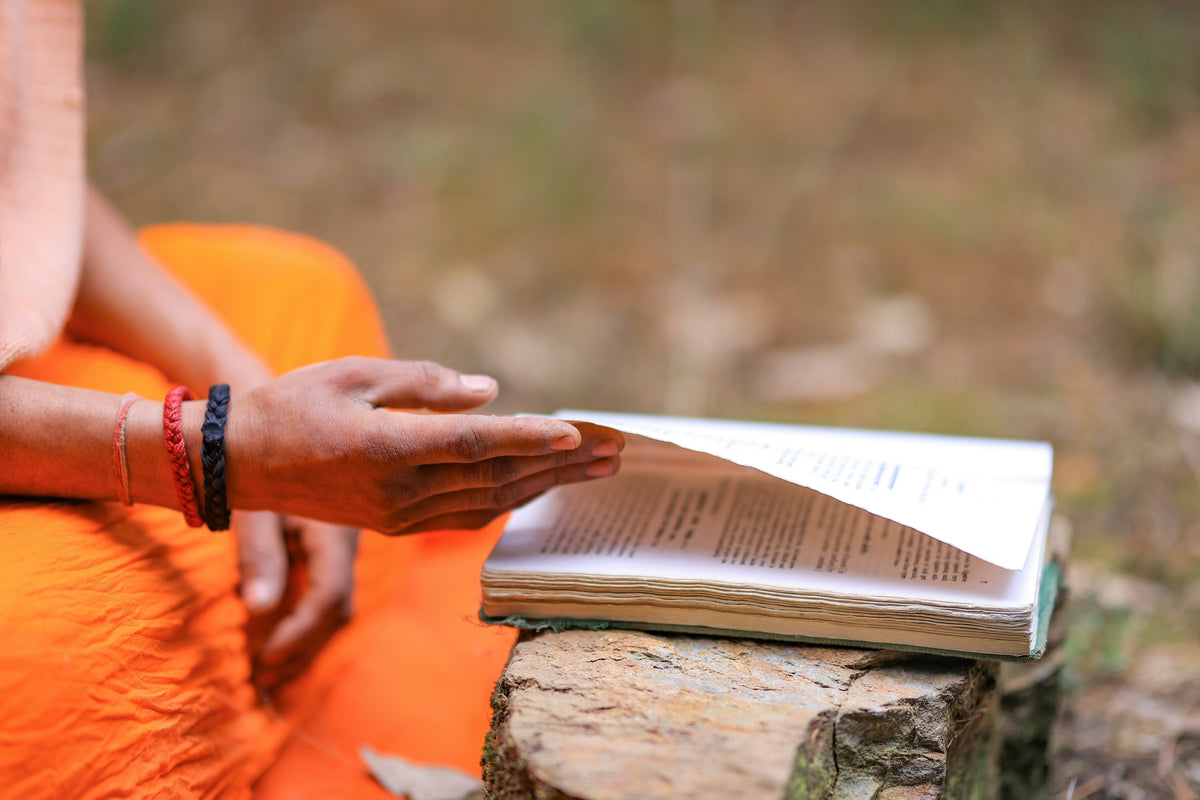
Raw Shilajit doesn’t emerge from a mountain looking like the glossy resin sold in a glass jar.
What comes from a rock seam may contain mineral fragments, clay, soil, plant debris and other unwanted material. It may also contain contaminants that can’t be spotted by eye, dissolved away in a glass of water or exposed by setting a blob on fire for social media.
Some form of preparation is therefore necessary.
Historically, however, purification didn’t always mean what a modern food manufacturer means by purification.
In Ayurveda, Shilajit could be washed, soaked, dissolved, filtered, boiled, levigated, dried in sunlight or concentrated over a substantial open flame. The processing liquid might be plain water, but it could also be Triphala decoction, Bhringaraja juice, milk, cow urine, fermented kanji or another prescribed medium.
The purpose wasn’t necessarily limited to removing stones and dirt. Traditional processing could intentionally change the pharmaceutical character of the substance.
That makes traditional Shilajit purification far more interesting than the usual story about pristine Himalayan water and a piece of muslin.
It also makes it considerably harder to evaluate.
Quick answer: how was Shilajit traditionally purified?
Traditional Shilajit was generally broken into smaller pieces, soaked or dispersed in water or another prescribed liquid, and agitated so that soluble and dispersible material entered the liquid phase.
Heavier insoluble debris was allowed to settle, the upper liquid was collected and filtered, and the recovered extract was concentrated using sunlight or applied heat.
Documented Ayurvedic processing media include:
-
Plain or warm water
-
Triphala decoction
-
Bhringaraja juice
-
Cow’s milk
-
Cow urine
-
Kanji, a fermented sour liquid
-
Acidic or alkaline liquids
-
Other herbal preparations
Sun-based finishing is commonly described as Suryatapi. Heat-based finishing is described as Agnitapi.
Contemporary pharmaceutical studies have recreated both approaches, including hot-plate drying and sun concentration, although these studies aren’t proof that every historical practitioner followed one standard recipe.
Traditional Shilajit purification was therefore often both:
-
A physical separation process
-
A pharmaceutical transformation
Those aren’t the same thing.
What does shodhana actually mean?
The Sanskrit term shodhana is commonly translated as purification.
That translation is useful, but it can also mislead modern readers.
In analytical chemistry, purification generally means increasing the proportion of a desired substance by removing unwanted material.
In traditional Ayurvedic pharmacy, shodhana can involve washing, soaking, boiling, levigating, filtering or repeatedly treating a material with a selected liquid. The intention may include reducing undesirable qualities, making the substance more suitable for use or changing how it behaves within a particular pharmaceutical system.
The processing medium may be part of that intended transformation.
This means Triphala-processed Shilajit isn’t necessarily ordinary Shilajit that has merely been cleaned with botanical water. It may retain compounds extracted from Triphala.
Milk-processed Shilajit may contain milk-derived material.
Acidic or alkaline processing may change which humic and mineral-associated fractions remain soluble.
“Purified” makes the process sound subtractive, as though unwanted material leaves while everything desirable politely stays behind.
Traditional processing may subtract, add and transform material at the same time.
Traditional doesn’t mean raw
Traditional Shilajit and raw Shilajit aren’t synonyms.
Ayurvedic and later pharmaceutical sources repeatedly describe washing, dissolution, filtration, levigation and concentration before Shilajit is used. Different texts describe different procedures, but the broad point remains: preparation was expected.
We examine the wider raw-versus-purified argument in Is Raw Shilajit Really Better? The Purification Paradox Explained.
The traditional position wasn’t necessarily:
Nature made it, so don’t touch it.
It was closer to:
This is powerful and complicated material. Prepare it appropriately before use.
For all the mystical language surrounding Shilajit, that’s a surprisingly practical idea.
The basic traditional Shilajit-processing sequence
There was no single universal traditional recipe. Instructions vary between texts, later compendia, regions and modern pharmaceutical reconstructions.
A broad process can nevertheless be described.
Stage 1: selecting and cleaning the raw material
The processor begins by removing obvious foreign matter.
This may include:
-
Large stones
-
Gravel
-
Twigs
-
Leaves
-
Fibrous material
-
Clearly unsuitable pieces
This is manual sorting.
It can remove a pebble.
It can’t identify dissolved arsenic, lead, microorganisms, mycotoxins or environmental chemicals.
Stage 2: breaking the material apart
Large masses may be broken or crushed before soaking.
Smaller pieces provide more surface area for the processing liquid. This can improve penetration and speed up the movement of soluble or dispersible material into the liquid phase.
Traditional equipment may have included stone, wood, iron or earthen implements. Modern Ayurvedic pharmaceutical studies often recreate traditional instructions using stainless-steel vessels, grinders, water baths or hot plates.
That distinction is important.
A traditional pharmaceutical principle can be implemented using modern equipment. The existence of an old recipe doesn’t require the use of a suspicious bucket and a medieval spoon.
Stage 3: soaking, macerating or heating
The broken Shilajit is placed in the chosen processing liquid.
Depending on the method, this may involve:
-
Soaking at ambient temperature
-
Mixing with warm water
-
Repeated manual stirring
-
Macerating for several hours
-
Boiling
-
Repeated extraction
-
Replacing the liquid between cycles
Some components enter a true solution. Others form fine colloidal dispersions or remain suspended. Dense mineral fragments and poorly soluble matter stay behind or settle later.
“Dissolved Shilajit” is convenient language, but the liquid isn’t necessarily a tidy molecular solution.
Shilajit is a variable organic-mineral matrix containing smaller organic constituents, humic substances, minerals and colloidal material. Its behaviour depends on pH, temperature, particle size, source and processing medium. It isn’t one compound with one clean solubility value.
For a broader explanation of the material itself, read What Is Shilajit? Composition, Origin and Use.
Stage 4: settling and decanting
The mixture is left to stand.
Dense particles sink. Some lighter material may float. The darker upper liquid is then poured, ladled or decanted away from the sediment.
This can remove:
-
Coarse rock fragments
-
Sand
-
Dense grit
-
Larger insoluble particles
It is less reliable against:
-
Very fine mineral particles
-
Stable colloids
-
Dissolved metals
-
Small microorganisms
-
Dissolved organic contaminants
Gravity is an excellent technology.
It is cheap, durable and has been independently verified for several billion years.
It still isn’t a certificate of analysis.
Stage 5: filtering through cloth
The recovered liquid is passed through cloth, fabric or another porous material.
Modern pharmaceutical recreations commonly describe filtration through cotton cloth or another comparable fabric. The aim is to retain larger suspended material while allowing the dark liquid fraction to pass.
Filtration performance depends on:
-
The weave
-
The number of layers
-
Liquid viscosity
-
Particle size
-
Flow rate
-
Pressure
-
Whether a filter cake develops
-
How clean the material is
-
Whether the same cloth is reused
Repeated filtration may improve clarity, but the number of passes tells us very little without the filter specification.
Seven passes through the same loose cloth are still seven passes through the same loose cloth.
A cloth may stop a stone.
It is less persuasive against dissolved cadmium.
Stage 6: concentrating the extract
Once clarified, the liquid must be concentrated.
Water is removed until the material reaches a syrup, paste, resin or dried-mass consistency.
Traditional and later pharmaceutical literature commonly distinguishes between:
-
Suryatapi, concentration or drying using sunlight
-
Agnitapi, concentration or drying using applied heat or fire
These names identify broad processing approaches. They don’t tell us the exact temperature, duration, vessel or endpoint.
That missing information matters enormously.
The Triphala method
Triphala is one of the best-known traditional media used for Shilajit shodhana.
It traditionally combines three fruits:
-
Haritaki, usually Terminalia chebula
-
Bibhitaki, usually Terminalia bellirica
-
Amalaki, commonly Phyllanthus emblica or Emblica officinalis
A decoction is prepared by heating the plant material in water, reducing the liquid and filtering away the coarse plant solids.
Raw Shilajit is then treated with the resulting decoction.
A representative Triphala Shilajit process
Exact ratios and timings vary, but a representative sequence may involve:
-
Coarsely breaking the raw Shilajit.
-
Preparing Triphala decoction separately.
-
Adding the Shilajit to the decoction.
-
Soaking, stirring or macerating the mixture.
-
Allowing heavy insoluble material to settle.
-
Collecting the upper liquid.
-
Filtering the liquid through cloth.
-
Repeating maceration or decantation where prescribed.
-
Concentrating the filtrate.
-
Finishing it using sunlight or applied heat.
One comparative pharmaceutical study used powdered raw Shilajit soaked in Triphala decoction, followed by cycles of maceration and decantation.
It then compared sun-dried and hot-plate-finished samples with Shilajit processed using lukewarm water.
This helps document a contemporary pharmaceutical reconstruction, but it doesn’t establish one universal historical procedure.
Triphala processing isn’t just botanical washing
Triphala decoction contains plant-derived tannins, phenolic acids and numerous other extracted compounds.
When Shilajit is processed in that liquid:
-
Shilajit constituents enter the liquid.
-
Mineral debris separates.
-
Triphala compounds enter the same liquid.
-
Plant polyphenols may interact with metals and organic material.
-
The pH of the medium may alter solubility.
-
Subsequent concentration retains some material from both sources.
The finished preparation may therefore contain both Shilajit-derived and Triphala-derived constituents.
A 2024 HPTLC study reported differences between raw and Triphala-processed Shilajit and used gallic acid as a marker in the processed material.
HPTLC can demonstrate that analytical fingerprints differ, but it doesn’t by itself show that one preparation is safer or more clinically effective.
The chemistry noticed that Triphala had been added.
Hardly supernatural, but important.
Does Triphala remove heavy metals?
Possibly some, under some conditions.
That isn’t the same as reliably detoxifying Shilajit.
Metals may be present as:
-
Coarse mineral particles
-
Fine particles
-
Dissolved ions
-
Organic complexes
-
Humic-associated material
-
Components of the underlying geological matrix
Settling and filtration may reduce coarse particle-associated metals.
Triphala polyphenols may bind certain metal ions under particular experimental conditions. Acidity may alter dissolution, complexation or precipitation.
But binding isn’t necessarily removal.
If a metal binds to a Triphala compound and the complex remains in the liquid that is later concentrated, the metal remains in the product.
The result depends on:
-
Which element is present
-
Its chemical form
-
pH
-
Temperature
-
Contact time
-
Plant composition
-
Water quality
-
What fraction is discarded
-
What fraction is retained
The only way to demonstrate a useful reduction is to analyse representative raw material and the finished product using appropriate elemental methods.
“Purified with Triphala” is a process description.
It isn’t a heavy-metal result.
Does Triphala make Shilajit more effective?
There is no robust human evidence demonstrating that Triphala-processed Shilajit is clinically superior to comparable water-purified Shilajit.
A changed chromatographic fingerprint isn’t a health outcome.
The presence of gallic acid isn’t proof of improved bioavailability.
An antioxidant result isn’t a clinical trial.
Traditional Ayurvedic theory may attribute particular qualities to Triphala processing. That deserves accurate description as traditional pharmaceutical reasoning.
It shouldn’t be quietly upgraded into proven human pharmacology.
At present, Triphala shodhana is best described as:
-
A documented Ayurvedic pharmaceutical method
-
A process that can separate some insoluble matter
-
A process likely to change the chemical fingerprint
-
A process capable of introducing Triphala-derived compounds
-
An incompletely standardised method with limited comparative clinical evidence
That is already interesting.
We don’t need to add miracle dust.
Triphala wasn’t the only processing medium
Reviews of Ayurvedic texts and later pharmaceutical literature describe a range of media for Shilajit shodhana.
They weren’t necessarily used in every region, text or period, and some descriptions come from later compilations rather than the earliest Ayurvedic works.
Plain water
Plain or warm water is the most straightforward option.
The raw material is dispersed, insoluble debris is allowed to separate, the liquid is filtered and the extract is concentrated.
Potential advantages
-
Simple process
-
No intentional herbal or animal-derived additions
-
Easier analytical interpretation
-
Compatible with vegan products
-
Broad extraction of water-soluble and dispersible material
Limitations
-
Dissolved contaminants may remain
-
Water quality may vary
-
Long soaking may create microbial opportunities
-
Extraction yield depends on time, temperature and ratio
-
Water doesn’t selectively recognise desirable and undesirable compounds
Water is natural.
It is also a solvent.
This becomes relevant whenever a brand announces that its resin is “completely solvent-free” two sentences after describing a water-extraction process.
Bhringaraja juice
Some traditional descriptions refer to processing Shilajit with the expressed juice of Bhringaraja, commonly identified as Eclipta prostrata or Eclipta alba.
The juice acts as both processing liquid and botanical ingredient.
It may alter:
-
pH
-
Colour
-
Flavour
-
Extraction behaviour
-
Metal complexation
-
Chromatographic profile
As with Triphala, this is better understood as a distinct herbal-processed preparation than as chemically untouched Shilajit with the dirt removed.
There isn’t enough comparative evidence to declare it superior to water processing.
Cow’s milk
Cow’s milk is also described as a Shilajit-processing medium in Ayurvedic literature and reviews.
Milk is a complex emulsion containing:
-
Water
-
Proteins
-
Fat
-
Lactose
-
Minerals
-
Phospholipids
-
Other minor constituents
Processing Shilajit with milk could therefore affect binding, solubility, precipitation and the composition of the finished material.
From a modern food-production perspective, it also raises questions about:
-
Milk allergens
-
Residual milk proteins
-
Microbiological control
-
Shelf stability
-
Cleaning validation
-
Dietary suitability
-
Accurate labelling
A milk-processed material might be historically legitimate while being entirely unsuitable for a company selling “100% pure vegan Shilajit”.
Tradition doesn’t suspend allergen law.
Cow urine
Some Ayurvedic sources describe cow urine, or gomutra, as a processing medium.
This should be discussed honestly, neither mocked nor sanitised.
Within its traditional framework, cow urine is treated as a pharmaceutical substance with attributed properties.
Within modern food manufacturing, it creates serious questions concerning:
-
Microbiology
-
Chemical variability
-
Source control
-
Residues
-
Animal-derived status
-
Consumer acceptability
-
Regulatory classification
-
Sensory characteristics
-
Finished-product safety
There isn’t adequate evidence that cow urine reliably removes modern toxicological hazards from Shilajit.
A traditional rationale isn’t a validated contaminant-control system.
Kanji and other sour liquids
Kanji is a fermented sour preparation used in some Ayurvedic pharmaceutical procedures.
Its chemical and microbiological profile depends on:
-
Ingredients
-
Fermentation organisms
-
Time
-
Temperature
-
Water
-
Storage
-
Hygiene
Its acidity could change:
-
Mineral solubility
-
Humic-material precipitation
-
Metal complexation
-
Colloidal stability
-
Organic extraction
That doesn’t mean acidic processing automatically detoxifies Shilajit.
Acid may make some metals more soluble, carrying them into the liquid fraction that is later concentrated. It may precipitate one organic fraction while leaving another in solution.
The outcome has to be measured.
Alkaline liquids
Traditional reviews also mention alkaline liquids or kshara jala.
Under alkaline conditions, acidic functional groups within humic material become more ionised, which can increase apparent solubility and change colloidal behaviour.
That may increase extraction yield.
It may also extract more unwanted material.
“More extracted” and “better purified” aren’t interchangeable statements.
Other herbal decoctions and levigation media
Some reviews describe Triphala, Dashamoola, ginger juice, Guggulu-related preparations and disease-specific levigation media.
This reinforces an important point:
There may never have been one definitive traditional Shilajit-purification recipe.
Different sources may reflect different:
-
Textual traditions
-
Intended uses
-
Pharmaceutical theories
-
Available ingredients
-
Regional practices
-
Historical periods
Any brand claiming that its product is made “exactly as ancient Ayurveda intended” should therefore be prepared for a few follow-up questions.
Which text?
Which century?
Which liquid?
Which ratio?
Which temperature?
Which endpoint?
Ayurveda is a large and internally varied medical tradition.
It isn’t a laminated instruction card.
Suryatapi Shilajit: concentration using sunlight
Suryatapi refers broadly to concentration or drying using sunlight or solar warmth.
The clarified liquid may be placed in shallow vessels and exposed until sufficient water has evaporated.
Potential advantages
-
Simple equipment
-
Little direct fuel consumption
-
Feasible for small quantities
-
Strong traditional association
-
Potentially moderate average bulk temperatures
Important limitations
-
Weather dependence
-
Variable solar intensity
-
Dust and insect exposure
-
Ultraviolet exposure
-
Long drying times
-
Rewetting from humidity or rain
-
Large surface-area requirement
-
Variable endpoints
-
Difficult batch reproducibility
-
Opportunities for environmental contamination
Contemporary studies have used sunlight as a finishing method after water or Triphala processing, but this documents a method rather than proving that sunlight uniquely protects Shilajit chemistry.
There’s a persistent marketing tendency to describe sun-dried Shilajit as though every photon personally blesses the fulvic fraction.
The reality is less spiritual and more thermodynamic.
Sun concentration can work.
It can also be slow, exposed and difficult to control.
We examine this in more detail in Sun-Dried and Overhyped: The Dirty Laundry of Shilajit Marketing.
Is sun drying chemically gentle?
Not necessarily.
A lower average temperature may reduce some forms of thermal degradation, but temperature isn’t the only source of process stress.
Sun drying may involve:
-
Long oxygen exposure
-
Ultraviolet radiation
-
Repeated warming and cooling
-
Surface oxidation
-
Prolonged microbial opportunity
-
Environmental contamination
-
Uneven drying
A product exposed outdoors for ten days may experience a greater cumulative oxidative burden than a product concentrated under controlled conditions for several hours.
Low temperature doesn’t automatically mean low total stress.
Time matters.
Oxygen matters.
Light matters.
Hygiene matters.
Agnitapi Shilajit: open fire, vigorous boiling and the mythology of heat damage
Agnitapi refers broadly to Shilajit concentrated or dried using applied heat.
In present-day small-scale practice and traditional reconstructions, this may involve a metal or earthen vessel positioned over a wood, charcoal or gas flame. The boiling can look forceful. The flame may be large. The vessel may be open and manually stirred.
Modern pharmaceutical studies often use a hot plate, water bath or controlled burner because those systems are easier to document and reproduce.
Those modern implementations shouldn’t be mistaken for proof that traditional heating was always gentle. Contemporary studies explicitly describe fire-based or hot-plate Agnitapi finishing.
Some traditional footage looks less like delicate botanical processing and more like somebody attempting to boil the Himalayas into submission.
That doesn’t automatically mean the Shilajit is being destroyed.
A flame beneath the vessel isn’t the same as flame touching Shilajit
Three situations need to be separated:
-
A vessel is heated over an open flame.
-
Thick Shilajit touches the hot vessel surface.
-
Shilajit is placed directly in a flame.
They’re not thermally equivalent.
The flame beneath a pot may reach a very high temperature. That doesn’t mean the liquid inside instantly reaches flame temperature.
While substantial water remains, much of the incoming energy is used to:
-
Warm the liquid
-
Maintain convection
-
Drive boiling
-
Convert water into vapour
A vigorously boiling, water-rich extract may therefore look more violent than its bulk temperature suggests.
Visible bubbling isn’t a chemical obituary.
What happens during the watery stage?
During the early stage, the mixture is relatively fluid.
Natural convection and manual stirring distribute heat through the liquid. Water absorbs large amounts of energy as it evaporates, limiting how rapidly the bulk mixture can rise in temperature.
The precise boiling behaviour will depend on:
-
Altitude
-
Atmospheric pressure
-
Dissolved solids
-
Vessel material
-
Heat input
-
Mixing
-
Concentration
At high altitude, water boils at a lower temperature than it does at sea level. Dissolved solids can move the boiling point in the other direction. A real Shilajit decoction is therefore not identical to pure water in a laboratory beaker.
Still, the governing principle remains: while plenty of water is present and actively evaporating, the bulk liquid can be far cooler than the flame or metal surface heating it.
The risk changes as the extract thickens
As water is removed:
-
Viscosity rises
-
Circulation becomes less effective
-
Stirring becomes harder
-
Surface films form
-
Material sticks to the vessel wall
-
Hot spots become more likely
-
The remaining paste can heat above its earlier boiling region
This is where open-fire concentration becomes more thermally severe.
The last stage may matter more than the first several hours.
A dilute decoction can boil aggressively while remaining comparatively well buffered by water.
An almost-dry layer stuck to the bottom of a pot can overheat with very little visible drama.
What can happen near the endpoint?
Once little free water remains, the resin or paste can experience:
-
Local scorching
-
Oxidation
-
Darkening
-
Loss of volatile compounds
-
Condensation reactions
-
Polymerisation
-
Changes in solubility
-
Formation of burnt or insoluble residues
-
Charring in extreme cases
Herbal processing media complicate this further.
Triphala decoction introduces tannins and other plant-derived compounds. Milk introduces proteins, lactose and fat. These materials may undergo browning or other heat-driven reactions during concentration.
That doesn’t make every change harmful.
It means the final preparation may differ chemically from one produced through slower or lower-temperature concentration.
Does heat destroy Shilajit?
The phrase “heat destroys Shilajit” is scientifically crude.
Shilajit isn’t one fragile molecule with a universal destruction temperature.
It is a heterogeneous matrix. Different components will respond differently to heat, moisture, oxygen and pH.
Heating may cause:
-
Evaporation
-
Oxidation
-
Hydrolysis
-
Rearrangement
-
Aggregation
-
Precipitation
-
Polymerisation
-
Loss of volatile material
-
Degradation of some constituents
-
Formation of new products
Some fractions may remain broadly stable under conditions that alter others.
The useful questions are:
-
How hot did the product itself become?
-
For how long?
-
Was it still water-rich?
-
Was it already a viscous paste?
-
Was it continuously stirred?
-
Was the vessel covered?
-
Did material scorch?
-
Was smoke present?
-
What changed analytically?
“Open flame” doesn’t answer those questions.
Neither does “low heat”.
Fulvic acid doesn’t have one magical destruction temperature
Marketing discussions often claim that heat “kills” or “destroys” fulvic acid.
Fulvic material isn’t a single purified compound. It is an operationally defined, chemically heterogeneous fraction isolated according to analytical behaviour.
Different molecules within that fraction may have different thermal responses.
A brand claiming that its fulvic acid survived because the product never exceeded a particular temperature would need to show:
-
How fulvic material was defined
-
Which analytical method was used
-
Before-and-after results
-
The full time-temperature profile
-
The reporting basis
A larger fulvic percentage after concentration may simply reflect the removal of water.
It doesn’t necessarily mean more fulvic material was created or perfectly preserved.
Our guide to Fulvic Acid in Shilajit: Which Test Can You Trust? explains why the analytical method matters as much as the number itself.
Open fire may introduce more than heat
The fuel source matters.
Wood, dung, charcoal, kerosene and gas don’t produce identical combustion environments.
An uncovered vessel exposed to smoke may plausibly receive:
-
Soot
-
Ash
-
Airborne particles
-
Incomplete-combustion products
-
Polycyclic aromatic hydrocarbons
-
Environmental debris
Whether those substances enter the product depends on:
-
Fuel type
-
Flame quality
-
Smoke direction
-
Vessel height
-
Airflow
-
Lid use
-
Duration
-
Location
-
Surrounding hygiene
This doesn’t mean every fire-heated Shilajit is contaminated.
It means open combustion creates a plausible route that should be controlled and, where appropriate, tested.
Fire is an energy source.
It isn’t automatically a contaminant source, but neither should it be romanticised as chemically irrelevant.
Does aggressive-looking heating prove poor quality?
No.
A large flame beneath a sizeable pot of water may look alarming while producing moderate bulk-liquid temperatures.
A small electric hot plate may look beautifully controlled while scorching a thin layer of nearly dry resin.
A vacuum system may operate at a lower boiling temperature but expose the material to heat for a prolonged period.
A hotter surface used for a very short residence time may impose less overall stress than a cooler surface used for days.
Thermal severity depends on:
-
Product temperature
-
Surface temperature
-
Moisture
-
Duration
-
Mixing
-
Oxygen exposure
-
Film thickness
-
Vessel geometry
-
Heat distribution
-
The stage of concentration
Not whether a flame was visible in the video.
Suryatapi versus Agnitapi
| Factor | Suryatapi | Agnitapi |
|---|---|---|
| Main energy source | Sunlight and ambient heat | Fire, burner, hot plate or another applied source |
| Typical rate | Slower | Faster |
| Temperature control | Weather-dependent | Potentially controllable, but often unmeasured traditionally |
| Main thermal concern | Long cumulative exposure | Local overheating and scorching |
| Oxygen exposure | Usually prolonged | Often shorter, but still significant in open vessels |
| Ultraviolet exposure | Yes | Usually little or none |
| Environmental exposure | Potentially high | Depends on vessel, fuel and setting |
| Endpoint control | Often based on experience | Often based on experience |
| Main end-stage risk | Uneven or prolonged drying | Rapid heating once water is depleted |
| Evidence of superiority | Insufficient | Insufficient |
Sunlight and fire create different stress profiles.
Neither is inherently harmless.
Neither is automatically destructive.
What about Shilajit bhasma?
Shilajit bhasma should not be confused with ordinary Agnitapi resin.
Bhasma preparation generally refers to a much more severe pharmaceutical process involving incineration or calcination.
Some modern Shilajit-bhasma research describes formulations prepared with additional mineral substances such as sulphur, realgar or orpiment before heating.
That is a materially different product from water-purified resin concentrated over a fire.
A customer looking for ordinary Shilajit resin shouldn’t assume that references to calcined Shilajit describe how the familiar sticky supplement is made.
They don’t.
Were there different regional purification methods?
Shilajit-like materials have long histories across South Asia, Tibet, Bhutan, Persia, Central Asia and Russia.
Names include:
-
Shilajit
-
Shilajatu
-
Silajatu
-
Mumiyo
-
Moomiyo
-
Mumia
-
Moomiaii
-
Brag-zun
But the evidence isn’t equally detailed across these traditions.
Ayurvedic South Asian traditions
Ayurvedic and Rasashastra sources provide the richest accessible descriptions of explicit Shilajit processing.
Reported methods include:
-
Water washing
-
Collection of the supernatant liquid
-
Herbal decoctions
-
Triphala
-
Milk
-
Cow urine
-
Bhringaraja juice
-
Acidic and alkaline media
-
Levigation
-
Fumigation in some later sources
-
Sun drying
-
Applied heat
Even within this literature, methods differ between texts. One review notes that some earlier works discuss washing or levigation without prescribing the same detailed process found in later Rasa literature.
It is therefore safer to say:
Ayurvedic literature describes several traditional methods.
It is less safe to say:
This is the one ancient Ayurvedic method.
For a closer look at how these issues apply to a particular regional source, read Kashmiri Shilajit: Tradition, Purification and the Myth of Raw.
Tibetan and Bhutanese traditions
Shilajit-like material is recognised as brag-zun in Tibetan medical traditions.
The available English-language literature is stronger on identity and therapeutic use than on precise, reproducible processing sequences.
Water-based preparation and incorporation into compound medicines are plausible and broadly documented. It would nevertheless be irresponsible to manufacture a detailed “secret Tibetan purification method” without a specific authoritative source.
A gap in the literature isn’t an invitation to fill it with Himalayan fan fiction.
Persian traditions
Persian medical literature discusses moomiaii and its traditional uses.
Again, descriptions of medicinal use are easier to locate than detailed production specifications.
A distinct regional history doesn’t automatically prove a single standard regional manufacturing method.
Altai and Central Asian mumiyo
Modern mumiyo processing is often described as water extraction, clarification, filtration and concentration.
Reliable English-language documentation of one uniform historical Altai village process is much thinner.
Local producers may have used warm water, settling, cloth filtration and sun or fire concentration. Unless a specific ethnographic or technical source establishes the details, these should be described as reported water-based practices rather than the ancient Altai method.
The supplement industry already employs enough imaginary mountain sages.
We don’t need to put words into their mouths as well.
What could traditional purification actually remove?
Traditional sorting, settling and cloth filtration can plausibly remove:
-
Stones
-
Gravel
-
Sand
-
Coarse mineral debris
-
Plant fragments
-
Fibres
-
Dense insoluble sediment
-
Some particle-associated contaminants
It cannot automatically remove:
-
Dissolved lead
-
Dissolved cadmium
-
Dissolved arsenic
-
Mercury compounds
-
Pesticides
-
Polycyclic aromatic hydrocarbons
-
Mycotoxins
-
All bacteria
-
All mould spores
-
Microbial toxins
-
Every unwanted organic compound
Some hazards may be reduced.
Some may remain.
Some may become more soluble under acidic or alkaline conditions.
Some may be introduced by the water, herbs, milk, fuel or equipment.
Some may become more concentrated when water is removed.
Evaporation doesn’t understand which compounds the manufacturer wanted.
It concentrates what remains.
Does traditional filtration sterilise Shilajit?
No.
Cloth filtration removes particles above an effective size threshold. It doesn’t reliably eliminate bacteria, yeasts, mould spores or preformed microbial toxins.
Heating may reduce viable microorganisms, depending on:
-
Time
-
Temperature
-
Product thickness
-
Initial contamination
-
Heat distribution
-
Protective organic material
-
Recontamination after heating
A concentrated resin may become resistant to microbial growth if its water activity is sufficiently low.
That can’t be determined by poking it with a spoon.
For the distinction between water content, water activity, microbial growth and mould risk, read Is Your Shilajit Watered Down or Worse, Mouldy?.
Can traditional processing remove heavy metals?
Sometimes partially.
Never automatically.
Metals associated with large mineral particles may be reduced through settling and filtration.
Dissolved or colloidally associated metals may remain in the liquid.
Acidic treatment may increase the solubility of some metals.
Alkaline treatment may alter complexation and precipitation.
Plant polyphenols may bind certain metal ions, but a bound metal remains present unless the bound fraction is physically discarded.
Safety therefore depends on the actual concentration in the finished product and the amount consumed, not whether the label features the word shodhana.
See Heavy Metals in Shilajit: Context, Concern and Clarity for a fuller explanation of concentration, exposure and testing.
Can traditional processing remove useful compounds?
Yes.
Every separation process draws a boundary.
Sediment may contain unwanted rock and potentially interesting organic-mineral material.
Cloth may retain grit and larger humic aggregates.
Acid treatment may precipitate humic fractions.
Water extraction may leave behind poorly soluble constituents.
Herbal decoctions may add plant compounds.
Heating may alter some constituents.
Sunlight may cause oxidation or photochemical change.
The belief that purification removes only harmful material while preserving every desirable constituent is chemically implausible.
The opposite claim is equally poor.
Processing doesn’t automatically destroy Shilajit.
It changes the distribution and form of its components.
The sensible question is:
Does the process remove relevant hazards while retaining the intended product profile?
That is an optimisation problem.
Not a purity fairy tale.
Is Triphala-processed Shilajit still pure Shilajit?
That depends on what “pure” means.
It may be authentically produced according to a documented traditional method.
It may also contain Triphala-derived material.
Those statements can both be true.
A transparent description would be:
Shilajit traditionally processed with Triphala decoction.
Calling it simply “100% pure Shilajit” may conceal a meaningful part of its composition and production.
This also matters analytically.
Plant polyphenols introduced during processing could affect broad measurements of:
-
Organic content
-
Antioxidant capacity
-
Phenolic content
-
Non-specific fulvic fractions
A larger analytical number after Triphala treatment doesn’t necessarily mean the original Shilajit became richer.
The test may be measuring additional plant-derived compounds.
Traditional knowledge and critical thinking can coexist
There are two lazy approaches to traditional Shilajit processing.
The first assumes that anything ancient must be wise, gentle and superior.
The second assumes that anything traditional must be primitive nonsense.
Neither is especially useful.
Traditional practices may preserve sensible empirical observations:
-
Raw material requires preparation.
-
Coarse debris should be removed.
-
Processing liquids change the material.
-
Sunlight and fire produce different outcomes.
-
Concentration endpoints matter.
-
Source material varies.
-
Pharmaceutical preparation can alter behaviour.
Those are reasonable observations.
Traditional explanations for them may not always align with modern chemistry. Some claimed benefits remain untested. Some media introduce additional hazards. Some processes are too variable for modern food manufacturing without substantial control.
Respecting tradition doesn’t require switching off critical thought.
Critical thought doesn’t require sneering at tradition.
The useful questions are:
-
What exactly was done?
-
Which source actually describes it?
-
What could the process remove physically?
-
What chemical changes are plausible?
-
What new material could be introduced?
-
Which hazards might remain?
-
What was actually measured?
-
Does the finished product meet an appropriate specification?
That is more useful than arguing about which jar contains the greatest amount of Himalayan energy.
What can modern studies tell us?
Modern pharmaceutical studies have compared raw and processed Shilajit using measurements such as:
-
Appearance
-
pH
-
Loss on drying
-
Ash
-
Extractive values
-
HPTLC
-
Elemental screening
-
Yield
-
Processing time
These studies can show that a process changes the material.
They may help document:
-
Practical yield
-
Differences between water and Triphala media
-
Differences between sun and heat finishing
-
Changes in basic physicochemical measurements
-
Changes in chromatographic fingerprints
They usually can’t establish:
-
Superior human efficacy
-
Comprehensive contaminant removal
-
Bioavailability
-
Long-term safety
-
Consistency across geographical sources
-
Equivalence to every historical method
-
Complete preservation of the Shilajit matrix
Much of the available literature has limitations such as:
-
Very small batch numbers
-
Poorly characterised starting materials
-
Incomplete contaminant panels
-
No independent replication
-
Limited process monitoring
-
No human comparison
-
No comprehensive stability testing
-
Publications with limited reach or uncertain quality controls
This doesn’t make every result worthless.
It means the evidence should be described at the level it actually occupies.
An HPTLC fingerprint can show that two samples differ.
It can’t tell us which one makes somebody feel better.
An ash value can show that the quantity of inorganic residue changed.
It can’t identify every element or establish safety.
A lower processing yield doesn’t necessarily mean impurities were successfully removed. Some desired material may simply have been discarded.
Good science involves measurement.
It also involves understanding what the measurement can’t answer.
How should traditionally processed Shilajit be tested today?
The finished product should be tested as the consumer will receive it.
A risk-based programme may include:
-
Identity and compositional characterisation
-
Lead
-
Cadmium
-
Mercury
-
Arsenic
-
Additional relevant elements
-
Total aerobic microbial count
-
Yeasts and moulds
-
Specified pathogens
-
Water content
-
Total solids
-
Water activity
-
PAHs where combustion or environmental exposure creates a risk
-
Pesticides where relevant
-
Mycotoxins where justified
-
Residual solvents if solvents were used elsewhere in the process
-
Relevant botanical markers where herbal media were used
-
Milk allergens where milk was used
-
Stability
-
Batch-to-batch consistency
A certificate is only useful when:
-
The tested sample is identifiable.
-
The methods are appropriate.
-
The reporting basis is clear.
-
The laboratory is competent.
-
The results apply to the finished product.
-
The tested batch matches what is being sold.
Our guides to how Shilajit testing works and how to read a Shilajit lab report explain the difference between a meaningful result and a decorative PDF.
What should brands disclose?
A meaningful explanation of traditional processing should disclose enough of the following information to show how the material was actually prepared:
-
The processing medium
-
Whether herbs were used
-
Whether milk or other animal-derived materials were used
-
Whether the material was soaked, boiled or repeatedly macerated
-
The broad filtration method
-
Whether sunlight, fire or another heat source was used
-
Whether the vessel was open or covered
-
Whether the process intentionally changed the pH
-
Whether compounds from the processing medium may remain
-
Whether carriers or additives were used
-
How the finished resin was tested
Not every point will apply to every process, and brands/manufacturers don’t need to publish every proprietary parameter.
They should provide enough relevant information for customers to understand what was added, what was removed, how the material was concentrated and how the finished product was assessed.
Which traditional purification method is best?
There isn’t enough comparative evidence to declare one method universally best.
Plain-water processing may offer
-
Simplicity
-
Fewer deliberately introduced ingredients
-
Easier analytical interpretation
-
Compatibility with vegan products
-
A broad water-extracted matrix
Triphala processing may offer
-
A strong connection with documented Ayurvedic pharmacy
-
An intentionally transformed preparation
-
Addition of Triphala-derived constituents
-
A distinctive analytical profile
It also makes the composition more complicated and hasn’t been shown to provide universally superior contaminant removal or human efficacy.
Milk and animal-derived processing may offer
-
Historical relevance within particular traditions
-
Different extraction and binding behaviour
They also create additional allergen, microbiological, ethical and labelling questions.
Acidic, alkaline and fermented media may offer
-
Different extraction behaviour
-
Deliberate fractionation
-
A distinct traditional pharmaceutical preparation
They may also increase the solubility of unwanted material or produce a substantially different chemical matrix.
Suryatapi finishing may offer
-
Simple solar concentration
-
Low direct fuel use
-
Traditional association
It also brings long exposure times, weather dependence and environmental risks.
Agnitapi finishing may offer
-
Faster production
-
Less weather dependence
-
Potential microbial reduction
-
Effective water removal
It also increases the risk of hot spots, scorching and combustion-related contamination if poorly controlled.
The best method depends on what the producer is trying to make.
A water-purified broad resin isn’t the same product as Triphala-processed Shilajit.
A classical transformed preparation isn’t the same as a modern standardised extract.
A sun-concentrated resin isn’t automatically better than one heated over fire.
The method must be judged against its purpose, execution and finished results.
Traditional Shilajit processing compared
| Method | Main medium or energy source | What it may achieve | Main uncertainty |
|---|---|---|---|
| Water purification | Plain or warm water | Extracts water-soluble and dispersible material while separating coarse sediment | Dissolved contaminants may remain |
| Triphala shodhana | Triphala decoction | Separates debris and introduces Triphala-derived compounds | Limited comparative safety and clinical evidence |
| Bhringaraja processing | Herbal juice | Produces a distinct herb-processed preparation | Poor standardisation and limited modern analysis |
| Milk processing | Cow’s milk | Changes extraction, binding and precipitation behaviour | Allergens, microbiology and residual milk material |
| Cow urine processing | Cow urine | Traditional pharmaceutical treatment | Serious modern safety and regulatory questions |
| Kanji processing | Fermented acidic liquid | Changes pH, solubility and extraction behaviour | Highly variable composition |
| Alkaline processing | Alkaline liquid | May increase humic-material solubility | May also extract more unwanted material |
| Suryatapi finishing | Sunlight and ambient heat | Gradually removes water | Weather, UV and environmental exposure |
| Agnitapi finishing | Fire or another heat source | Removes water more quickly | Local overheating, smoke and endpoint control |
| Bhasma preparation | High-temperature incineration, sometimes with other minerals | Produces a separate calcined pharmaceutical preparation | Not equivalent to ordinary Shilajit resin |
The uncomfortable truth about traditional purity
Traditional Shilajit processing can be authentic without being analytically complete.
It can remove visible debris while leaving dissolved hazards.
It can preserve a broad matrix while introducing herbal compounds.
It can follow an old textual reference and still fail a modern microbiological specification.
It can be carried out skilfully by an experienced processor.
It can also be done carelessly, in a filthy bucket over a smoky fire.
The word “traditional” doesn’t tell you which.
Neither does “purified”.
The process matters.
The execution matters.
The finished product remains the evidence.
Final verdict: traditional purification wasn’t merely washing Shilajit
Traditional Shilajit purification wasn’t one universal recipe.
Ayurvedic sources describe water, herbal decoctions, milk, cow urine, fermented liquids, acidic and alkaline media, cloth filtration, sunlight and applied heat.
Some of these processes primarily separate physical debris.
Others intentionally transform the material.
Triphala may contribute gallic acid and other plant-derived compounds.
Milk introduces proteins, fats, sugars and minerals.
Acidic or alkaline media can change solubility and fractionation.
Sunlight creates prolonged light, heat and oxygen exposure.
Open-fire heating can produce vigorous boiling without necessarily exposing the bulk liquid to extreme temperatures, but the risks increase sharply as the mixture thickens and water disappears.
A visible flame isn’t proof of destruction.
A sunlit tray isn’t proof of gentleness.
A traditional recipe isn’t proof of safety.
These methods deserve to be studied seriously. They shouldn’t be scientifically validated merely because they are old, nor dismissed merely because they look unfamiliar or aggressive.
The useful questions remain:
-
What was removed?
-
What was retained?
-
What was introduced?
-
How severe was the processing?
-
What did the finished analysis show?
Because “purified according to an ancient method” may sound magnificent.
It still isn’t a certificate of analysis.
Suggested related reading
-
Is Raw Shilajit Really Better? The Purification Paradox Explained
-
Kashmiri Shilajit: Tradition, Purification and the Myth of Raw
-
Sun-Dried and Overhyped: The Dirty Laundry of Shilajit Marketing
References and evidence notes
-
A 2024 HPTLC comparison of raw and Triphala-processed Shilajit using gallic acid as a marker
-
A review of traditional Shilajit-processing methods described across Ayurvedic literature
-
A modern pharmaceutical study of Shilajit bhasma prepared with sulphur, realgar and orpiment
Written by
Written by Chris Simon, Founder of One Life Foods.
Chris has worked in the supplement industry since 2009 and has worked with Shilajit since 2017, with a focus on independent testing, analytical methods and responsible product sourcing.

Share:
Chaga Mushroom: Benefits, History, Brewing & What the Research Says
From Rock to Resin: How Shilajit Is Extracted, Filtered and Processed Today