


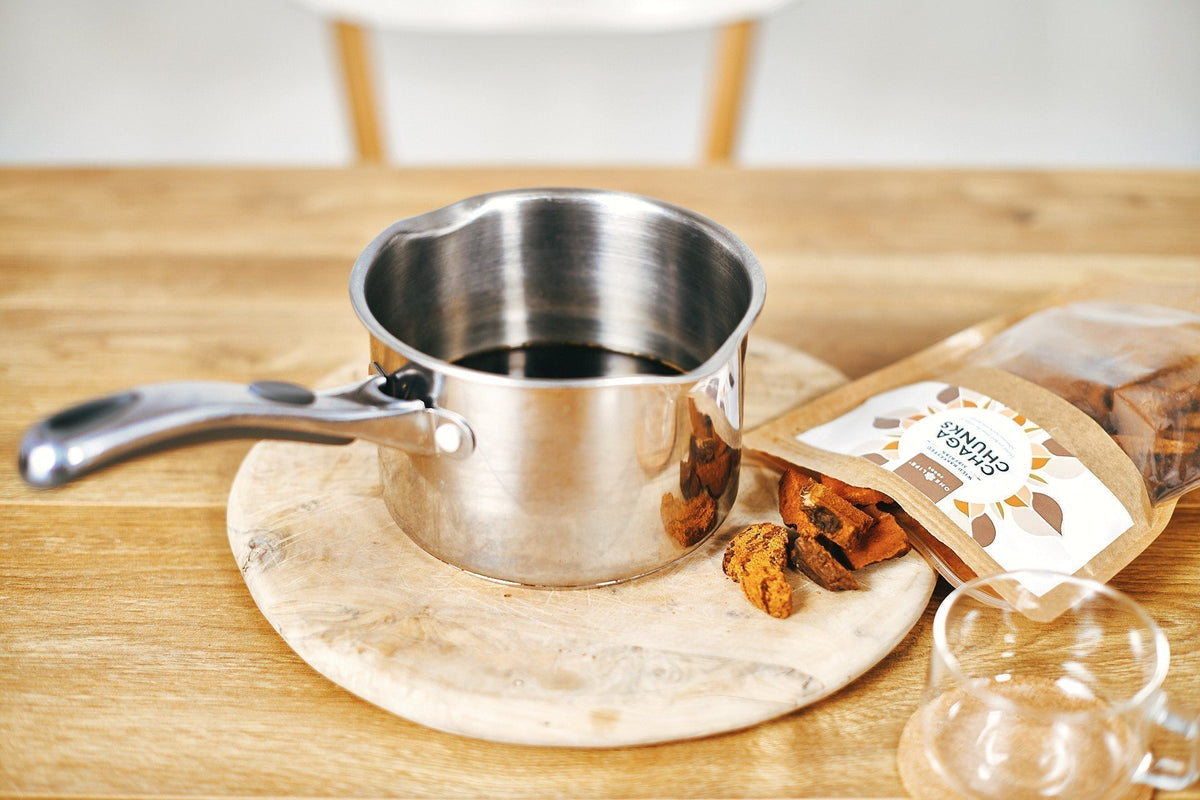
Chaga is one of the most distinctive and highly regarded functional mushrooms.
Often known as the “King of Medicinal Mushrooms”, it has been used traditionally across Siberia, Russia and Northern Europe for centuries. Its slow growth, unusual appearance and naturally occurring compounds have also made it an increasingly popular subject of modern scientific research.
Unlike the familiar mushrooms found in supermarkets, Chaga grows as a hard, dark mass on the trunks of living trees, particularly birch trees. It’s traditionally dried and slowly brewed in hot water to produce an earthy, comforting drink.
In this guide, we’ll explore what Chaga is, where it comes from, how it has been used throughout history and what current research suggests about its potential benefits.
What Is Chaga Mushroom?
Chaga, scientifically known as Inonotus obliquus, is a fungus that grows mainly on birch trees in cold northern climates.
The part of Chaga that is commonly harvested is known as a conk or sterile fungal mass. It has a rough, black exterior and a dense, rusty brown or golden interior.
Its appearance is very different from a typical mushroom. Chaga has no soft cap, visible stem or delicate gills. Instead, it looks more like a dark piece of cracked wood growing from the side of a tree.
Chaga grows slowly and can remain on its host tree for many years. Its growth rate varies according to the age and health of the tree, the surrounding climate and local environmental conditions.
The fungus contains a broad range of naturally occurring compounds, including:
-
Polysaccharides
-
Beta-glucans
-
Polyphenols
-
Triterpenoids
-
Organic acids
-
Melanin-like pigments
These compounds are responsible for much of the scientific interest surrounding Chaga.
Why Does Chaga Grow on Birch Trees?
Chaga is most strongly associated with birch forests, particularly those found across Siberia, Northern Europe, Canada and other cold regions of the Northern Hemisphere.
As the fungus grows, it interacts closely with the tree and develops a complex chemical profile. Birch-grown Chaga may contain compounds associated with the host tree, including betulin and related triterpenes.
This close relationship with birch is one reason why the location, climate and host tree can influence the composition of the final Chaga material.
Although Inonotus obliquus can grow on other hardwood trees, birch-grown Chaga is the form most closely connected with traditional use.
Our Wild Harvested Chaga is sourced from Siberian birch forests and is prepared without added ingredients.
What Does Chaga Look Like?
Chaga has a dark, charcoal-like outer surface that is rough, cracked and irregular.
Inside, it has a dense, woody texture and a warm brown or golden colour.
The dark exterior contains high concentrations of melanin-like pigments. These pigments are produced as part of the fungus’s natural growth and interaction with the tree.
Each piece of wild Chaga is slightly different in shape, size and colour. This natural variation is part of what distinguishes a minimally processed forest ingredient from a highly standardised manufactured product.
What Does Chaga Taste Like?
Chaga has a mild, earthy and woody flavour.
Depending on its origin and preparation, it may also have subtle bitter, nutty or vanilla-like notes. It doesn’t usually have the strong savoury flavour associated with culinary mushrooms.
Traditionally brewed Chaga produces a dark brown drink that can be enjoyed on its own or combined with ingredients such as:
-
Cinnamon
-
Cacao
-
Honey
-
Ginger
-
Lemon
-
Plant-based milk
The flavour becomes stronger the longer the Chaga is brewed.
The Traditional History of Chaga
Chaga has a long history of use among communities living in cold northern forests.
Historical and ethnomycological accounts describe its use in Russia, Siberia, Scandinavia and parts of Eastern Europe. It was often prepared by simmering the hard fungus in water to create a dark drink or decoction.
The Khanty people of Western Siberia are among the communities most frequently associated with the traditional use of Chaga. Preparations varied between regions and could be consumed as a regular drink or used as part of broader cultural wellness practices.
Chaga also appeared in Russian and Soviet-era literature. A Chaga-based preparation known as Befungin was developed and used in parts of the former Soviet Union.
Its traditional reputation eventually attracted greater scientific interest, particularly in relation to its polysaccharides, pigments, antioxidants and triterpenoid compounds.
Traditional use and modern research are different forms of evidence, but they can complement one another. Historical use helps researchers identify ingredients that may be worth studying in greater detail.
Why Is Chaga Called the King of Medicinal Mushrooms?
Chaga’s nickname reflects its important place in traditional mushroom culture.
Its association with remote birch forests, its slow growth and its rich concentration of naturally occurring compounds have all contributed to its reputation.
Today, Chaga is often grouped with functional mushrooms such as Lion’s Mane, Reishi and Cordyceps.
Each mushroom has a different chemical profile and history of use. Chaga is particularly known for its antioxidant compounds, dark pigments and traditional preparation as a slow-brewed tea.
What Are the Potential Benefits of Chaga?
Research into Chaga is still developing.
A large proportion of the available evidence comes from laboratory and animal studies rather than large-scale human clinical trials. These studies can help scientists understand how Chaga compounds behave, although further human research is needed before firm conclusions can be drawn.
It’s also important to consider the type of Chaga used in a study. Researchers may work with concentrated extracts, purified compounds or doses that are different from those found in a traditional cup of Chaga tea.
Here’s what current research suggests.
1. Chaga Contains Antioxidant Compounds
Chaga contains polyphenols, melanin-like pigments and other compounds that have demonstrated antioxidant activity in laboratory studies.
Antioxidants help protect cells against reactions involving unstable molecules known as free radicals.
Free radicals are produced naturally in the body, but their levels may also be influenced by factors such as pollution, smoking, illness, stress and intense exercise.
Laboratory findings suggest that Chaga is a naturally rich source of antioxidant compounds. Researchers are continuing to study how these compounds are absorbed and used by the human body.
2. Chaga and Immune System Research
Polysaccharides and beta-glucans are among the most widely studied compounds found in functional mushrooms.
Research involving Chaga extracts suggests that these compounds may interact with immune cells and influence the production of signalling molecules known as cytokines.
Cytokines help different parts of the immune system communicate with one another. They’re involved in both activating and regulating immune responses.
This has led researchers to explore whether Chaga may have immune-supporting or immune-modulating properties.
Human research is currently limited, so Chaga shouldn’t be viewed as a replacement for sleep, good nutrition, movement and other foundations of immune health.
You can learn more about these everyday foundations in our guide to supporting your immune system during winter.
3. Chaga and Inflammation
Inflammation is a normal part of the body’s response to injury, infection and stress.
Problems can arise when inflammatory activity becomes prolonged or poorly regulated.
Laboratory and animal studies have found that certain Chaga extracts can influence inflammatory pathways and signalling compounds.
These early findings are encouraging, although more human research is needed to understand whether traditional Chaga preparations have a meaningful effect on inflammatory markers.
Anyone experiencing persistent inflammation, digestive discomfort or symptoms of a medical condition should seek advice from a qualified healthcare professional.
4. Chaga and Blood Sugar
Chaga has also been studied in relation to blood glucose and insulin signalling.
Some animal studies have reported changes in blood sugar levels following the use of Chaga extracts. These findings have created interest in its potential relationship with metabolic health.
At present, there isn’t enough human clinical evidence to determine whether Chaga can reliably reduce blood sugar or improve insulin resistance.
People taking insulin or blood glucose-lowering medication should speak to their doctor or pharmacist before using Chaga. Combining several products with potential glucose-lowering activity may affect blood sugar control.
Chaga shouldn’t be used as a substitute for prescribed diabetes treatment.
5. Chaga and Cholesterol
Animal research has explored whether Chaga extracts may influence cholesterol and triglyceride levels.
Some studies have reported changes in LDL cholesterol, HDL cholesterol or total cholesterol. However, these results haven’t yet been confirmed through strong human clinical trials.
Researchers are continuing to investigate whether Chaga’s antioxidant compounds, polysaccharides and triterpenes may play a role in metabolic and cardiovascular health.
For anyone managing high cholesterol, Chaga should complement rather than replace established approaches such as a balanced diet, regular movement and prescribed treatment.
6. Chaga and Cancer Research
Chaga has attracted significant scientific interest in the field of cancer research.
Laboratory studies have examined the effects of Chaga extracts and isolated compounds on different types of cancer cells. Some have reported changes in cell growth, apoptosis and tumour development in animal models.
These findings are an important starting point for further research, but they don’t demonstrate that Chaga can prevent or treat cancer in humans.
Cancer research usually progresses through several stages, beginning with cells and animals before moving into carefully controlled human trials. Many promising compounds don’t produce the same effects once factors such as digestion, absorption, dosage and safety are taken into account.
Chaga shouldn’t be used as an alternative to surgery, chemotherapy, radiotherapy, immunotherapy or other treatment recommended by an oncology team.
Anyone undergoing cancer treatment should discuss Chaga and other supplements with their medical team before using them.
Raw Chaga and Chaga Extracts
Chaga is sold in several different forms, including:
-
Raw chunks
-
Ground Chaga
-
Tea bags
-
Powdered extracts
-
Liquid extracts
-
Blended mushroom supplements
These formats aren’t identical.
Raw Chaga contains the dried whole material and is normally simmered in water before drinking.
An extract has been processed to remove soluble compounds from the raw ingredient. Some extracts are then concentrated or standardised to provide a particular level of polysaccharides or other compounds.
Traditional Chaga tea and concentrated extracts can both have a place, but they should be understood as different products.
When reading scientific research, it’s useful to check:
-
Whether the study used raw Chaga or an extract
-
Whether the extraction involved water or alcohol
-
The concentration and dosage
-
The length of the study
-
Whether the research involved cells, animals or humans
-
Which compounds were measured
A study involving a concentrated extract won’t necessarily produce the same outcome as drinking traditionally brewed Chaga.
For more information about the difference between whole powders and extracts, read our guide to powdered herbs and herbal extracts.
How to Prepare Chaga Tea
Because Chaga is hard and woody, it’s usually prepared as a slow brew rather than a quick infusion.
Always follow the preparation instructions provided with the specific product.
A traditional method generally involves:
-
Adding Chaga chunks or ground Chaga to water.
-
Heating the water gently.
-
Allowing the Chaga to simmer or steep.
-
Waiting until the water develops a rich brown colour.
-
Straining the drink before serving.
A longer brewing time will usually produce a darker and stronger-tasting tea.
Some Chaga chunks can be brewed more than once. The same pieces may continue to release colour and flavour over several brews, although each preparation will gradually become milder.
Chaga can be enjoyed warm or allowed to cool and served over ice.
Is Chaga Safe?
Chaga has been consumed traditionally for a long time, but it may not be suitable for everyone.
One important consideration is its oxalate content.
Oxalates occur naturally in many foods and plants. Chaga can contain significant amounts, and published case reports have associated very high or prolonged Chaga intake with oxalate-related kidney damage.
These reports involved unusually high or extended consumption, but they highlight the importance of using Chaga sensibly.
Speak to a healthcare professional before using Chaga if you:
-
Have kidney disease
-
Have a history of kidney stones
-
Follow a medically advised low-oxalate diet
-
Take diabetes medication
-
Take anticoagulant or antiplatelet medication
-
Have a bleeding disorder
-
Are preparing for surgery
-
Are pregnant or breastfeeding
-
Are receiving cancer treatment
-
Take regular prescription medication
There isn’t enough safety research involving pregnancy or breastfeeding, so professional advice is recommended.
As with any functional food or supplement, the right amount depends on the individual and the form of the product.
How to Choose a Chaga Product
Not all Chaga products are prepared in the same way.
Here are some of the details worth checking before buying.
Species
The product should clearly identify the fungus as Inonotus obliquus.
Host Tree
Birch-grown Chaga has the strongest association with traditional use.
Origin
A transparent supplier should explain where its Chaga has been harvested.
Product Format
Check whether the product contains raw chunks, ground Chaga, an extract or a blend.
Processing
Look for clear information about whether the Chaga is whole, extracted, concentrated or standardised.
Added Ingredients
Check the ingredients list for fillers, flavourings, sweeteners or other mushrooms.
Harvesting
Wild Chaga grows slowly, so careful harvesting is important. Responsible collection methods aim to protect the tree and surrounding forest ecosystem.
Our Approach to Chaga
At One Life Foods, we believe Chaga is interesting enough without exaggerated promises.
Its long history, relationship with birch forests, distinctive taste and naturally occurring compounds have made it one of the most valued functional mushrooms in traditional wellness culture.
Research into Chaga continues to develop, particularly in relation to its polysaccharides, antioxidants, triterpenoids and pigments.
Although more human clinical research is needed, Chaga remains a distinctive traditional ingredient that can be enjoyed as part of a varied diet and considered approach to wellbeing.
Our Wild Harvested Chaga is sourced from Siberian birch forests. It’s supplied as a natural, minimally processed ingredient for traditional brewing.
Sources and Further Reading
-
Chaga Mushroom: A Super-Fungus With Countless Facets and Untapped Potential
-
Chaga Mushroom Information from Memorial Sloan Kettering Cancer Center
Disclaimer
This article is for informational purposes only and isn’t intended to diagnose, treat, cure or prevent any disease. Food supplements shouldn’t be used as a substitute for a varied, balanced diet and healthy lifestyle. Speak to a qualified healthcare professional before starting a new supplement, particularly if you’re pregnant, breastfeeding, taking medication or have an existing medical condition.

Share:
How Much Shilajit Is Actually in Your Shilajit?
How Was Shilajit Traditionally Purified? Triphala, Fire, Sunlight and Ayurvedic Shodhana