


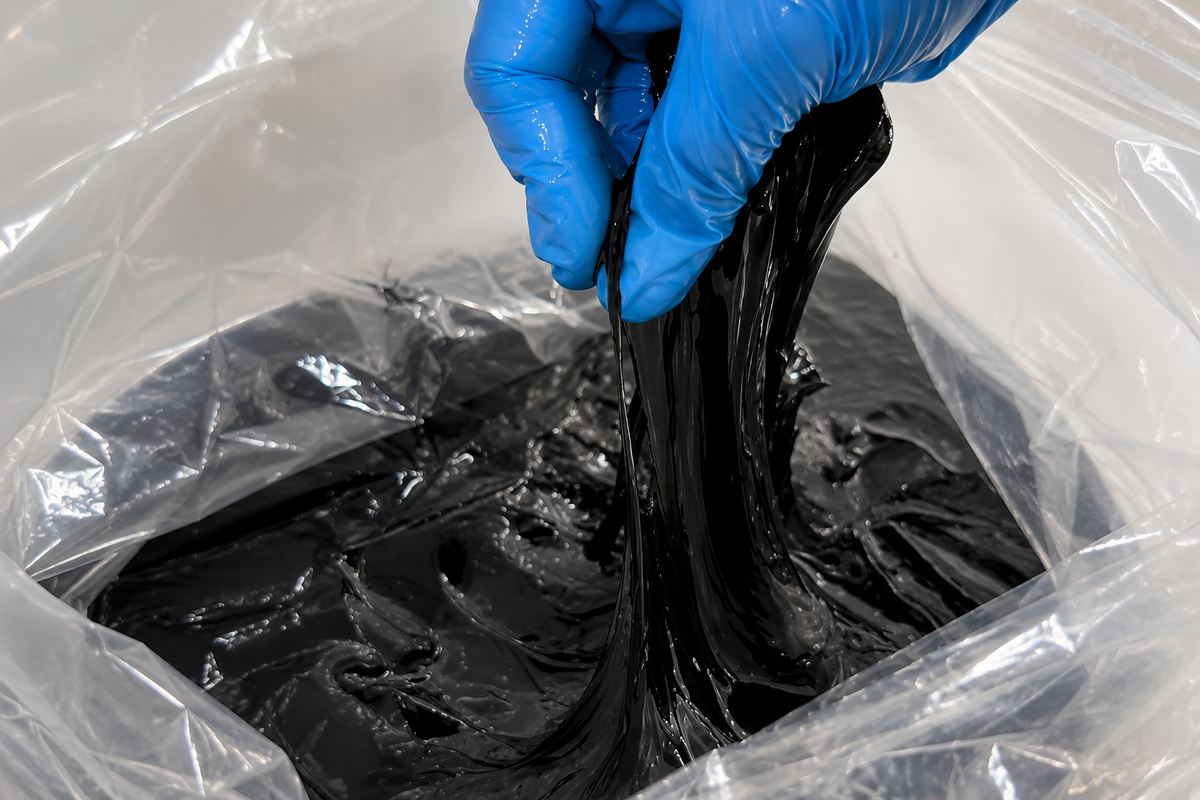
“Purified Shilajit” sounds like a single, tidy process.
It isn’t.
Between raw mountain material and the finished jar lies a chain of decisions involving water, particle size, mixing, settling, filtration, heat, pressure, drying, hygiene and testing.
Change one of those decisions and you may change the yield, mineral content, organic profile, humic and fulvic fractions, texture, water content, microbial stability, contaminant profile and consistency between batches.
This isn’t another argument about whether untreated Shilajit is more authentic. We’ve already examined that in Is Raw Shilajit Really Better? The Purification Paradox Explained.
Nor is it an account of Triphala, milk, herbal juices, sunlight and traditional Ayurvedic shodhana. Those methods belong in How Was Shilajit Traditionally Purified? Triphala, Fire, Sunlight and Ayurvedic Shodhana.
This is the modern production-line version of the story.
We’ll follow two representative approaches:
-
Controlled small-batch or small-commercial resin production
-
Large-scale industrial extraction and standardisation
They may begin with similar raw material. They aren’t necessarily trying to make the same finished product.
Quick answer: how is modern Shilajit processed?
A commonly described modern route involves dispersing raw Shilajit in water, separating insoluble rock and sediment, filtering the liquid phase and removing water until a resin or dry extract remains.
A controlled small-commercial producer may use stainless-steel tanks, settling vessels, filter bags, cartridge filters and a jacketed or vacuum concentration vessel.
A larger industrial manufacturer may use automated extraction tanks, centrifuges, pressure filters, membrane systems, pH-assisted fractionation, adsorption media, vacuum evaporators and spray or freeze drying.
Some industrial processes aim to retain a relatively broad water-extracted matrix. Others deliberately separate and recombine selected fractions to make a standardised ingredient.
There is no single universal Shilajit process.
The two modern processing models
Before comparing equipment, we need to define what the two models are trying to accomplish.
Controlled small-batch or small-commercial processing
This is not somebody stirring raw Shilajit in a bucket behind a shed.
A credible operation may use food-grade stainless-steel vessels, specified water, measured extraction ratios, controlled temperatures, mechanical agitation, defined settling periods, staged filtration, jacketed heating or modest vacuum concentration, batch records and finished-product laboratory testing.
The main objective is often:
Remove unwanted physical material, control relevant hazards and produce a stable resin while retaining a relatively broad water-extracted matrix.
Large-scale industrial processing
A larger ingredient manufacturer may work with much greater volumes and tighter compositional targets.
Equipment may include automated extraction vessels, industrial mills, centrifuges, pressure filtration, cross-flow membranes, pH adjustment, activated carbon, adsorption or ion-exchange resins, film evaporators, spray dryers and in-process analytical monitoring.
The objective may be:
Manufacture large quantities of material that repeatedly meet a defined analytical specification.
That can produce excellent consistency. It can also produce something compositionally narrower than a broad resin.
Important note: these are representative models
Not every small producer uses the same equipment. Not every industrial producer performs chemical fractionation.
Some large manufacturers make relatively simple water extracts. Some small producers use sophisticated vacuum systems. Many operations sit somewhere between the two.
Some processes discussed below, including water extraction, filtration, pH fractionation, activated-carbon treatment, ion exchange and evaporation, are documented in Shilajit patents or published research. Other equipment is presented as a technically plausible option based on established extract-processing practice. Its inclusion shouldn’t be read as evidence that it is widely used across the industry.
The models in this article are not universal recipes. Anyone claiming to know exactly how every Shilajit manufacturer operates is either unusually well travelled or making it up.
Modern Shilajit processing at a glance
A typical process may follow this sequence:
Raw-material receipt → inspection → size reduction → water extraction → settling or centrifugation → staged filtration → optional fractionation → concentration → resin or powder finishing → testing → filling
Each stage has a job. Each stage also has limits.
Stage 1: receiving the raw Shilajit
The process begins before water enters a tank.
Raw-material control may be one of the most important parts of the entire system because purification can’t be expected to rescue every unsuitable starting material.
Controlled small-batch production
A small-commercial producer may receive modest source lots and:
-
Assign a batch or lot number
-
Record the source and collection period
-
Weigh and photograph the material
-
Inspect its appearance and odour
-
Remove obviously unsuitable pieces
-
Review supplier documents
-
Quarantine the lot before use
-
Submit a representative sample for preliminary testing
Smaller lots can sometimes be examined more closely, and the producer may maintain a more direct relationship with collectors or source partners.
That doesn’t make the material safe automatically. It simply makes close observation and source-specific decisions more practical.
Large industrial production
A larger manufacturer may use approved supplier lists, written raw-material specifications, formal sampling plans, composite sampling, identity checks, moisture and elemental screening, microbiological testing, electronic stock control and quarantine-and-release systems.
The advantage is formal consistency and traceability.
The trade-off is that large incoming lots may combine material from multiple sites or collection periods. Variation may be managed statistically rather than understood piece by piece.
What neither approach can do by looking
Visual inspection can identify large rocks, plant fragments, obvious mould, unusual colour, foreign objects and gross contamination.
It can’t establish heavy-metal concentrations, microbial counts, PAHs, pesticide residues, mycotoxins, authenticity, fulvic content or batch safety.
A dark colour and a heroic mountain story are not incoming quality specifications.
Stage 2: breaking, crushing and particle-size control
Raw Shilajit may arrive as lumps, crusts, rock-associated pieces or irregular masses.
Breaking it into smaller pieces increases the surface area exposed to the extraction water.
A small producer may use manual breaking, a cleaned stainless-steel crusher, a low-speed grinder and coarse sieving. A larger plant may use enclosed mills, industrial crushers, mechanical sieves, automated feeding and dust extraction.
More uniform particles can improve extraction consistency, but finer isn’t automatically better. Intensive grinding can create dust, generate heat, increase equipment wear, liberate very fine mineral particles and make later clarification more difficult.
The objective isn’t to pulverise the mountain out of enthusiasm. It’s to create a particle size suited to the next stage.
Stage 3: water extraction
For broad resin production, water is the most obvious and commonly described extraction medium.
It can carry smaller organic compounds, ionic material and colloidally dispersed humic substances away from coarse rock and sediment.
A controlled small-commercial process may specify potable or purified water, a measured raw-material-to-water ratio, a covered stainless-steel vessel, a defined mixing period, temperature range, extraction time and number of extraction cycles.
A larger operation may add purified or deionised water, automated agitation, flow meters, in-line temperature and pH monitoring, enclosed transfers, pumps and automated cleaning systems.
Some industrial processes also alter pH or use organic solvents to isolate selected fractions.
A patented process for purified Shilajit describes water extraction alongside more interventionist stages including organic-solvent extraction, alkaline treatment, acidification, adsorption, ion exchange and recombination of selected fractions. A patent shows that a process has been designed. It doesn’t show that every commercial ingredient is made that way, or that the process is inherently superior.
Does hotter water extract more Shilajit?
Increasing temperature can reduce viscosity, improve wetting, increase diffusion, speed extraction and improve the solubility of some constituents.
It may also extract more unwanted material, alter colloidal behaviour, change mineral solubility, increase oxidation and affect heat-sensitive components.
The correct temperature depends on the intended product.
“Cold extracted” isn’t automatically superior. “Hot extracted” isn’t automatically destructive. Temperature only makes sense alongside time, pH, mixing and the measured result.
Is water extraction really solvent-free?
Water is a solvent.
In supplement marketing, “solvent-free” usually means that no organic extraction solvent such as methanol, ethanol, acetone or ethyl acetate was used.
A more accurate description is:
Extracted using water without organic extraction solvents.
That tells the reader what actually happened. “Solvent-free water extraction” tells us that marketing has declared war on basic chemistry.
Stage 4: clarification by settling or centrifugation
After extraction, the dark liquid contains dissolved, dispersed and suspended material.
A smaller facility may use covered settling vessels, conical-bottom tanks, defined settling periods, bottom drains, careful decanting and repeated clarification stages.
Settling is simple, low-energy and gentle. It can remove coarse grit, but it is slow, fine particles may remain suspended and dissolved contaminants remain in solution.
A larger manufacturer may use continuous clarifiers, decanter centrifuges, disc-stack centrifuges or other density-based separation systems.
Centrifugation increases the effective force applied to suspended material, which can improve throughput and separation of fine solids. It also brings equipment cost, cleaning, maintenance and the possibility of losing desired aggregated or higher-molecular-weight material.
A centrifuge can separate material according to density and particle behaviour. It can’t inspect each molecule’s moral character.
Stage 5: staged filtration
The clarified extract is usually filtered to remove remaining suspended solids.
Modern filtration is better understood as a sequence than as one magical cloth.
A small-commercial line may use stainless-steel mesh, a coarse filter bag, a finer filter bag, cartridge filters and optional depth filtration. Each stage protects the next from excessive loading.
A larger line may use plate-and-frame filters, pressure leaf filters, automated backwashing systems, vacuum filtration, depth filters, cross-flow systems and pressure or flow monitoring.
These systems can improve throughput, reproducibility and hygiene. They also create product losses, cleaning requirements, blocked media and retained solids that need disposal.
What filtration can and can’t prove
A filter specification tells you something about physical separation.
It doesn’t prove that the product is free from lead, cadmium, arsenic, mercury, PAHs, pesticides, mycotoxins, dissolved chemicals or all microorganisms.
“Filtered seven times” is still incomplete.
Seven passes through what? At which grade? Was each stage finer than the previous one? What was retained? What passed through?
A muslin cloth and a validated membrane system are both filters in the same way that a bicycle and a freight train are both transport.
Stage 6: membrane filtration
Membrane filtration sits between ordinary particle removal and deliberate chemical fractionation.
Depending on the membrane and operating conditions, a manufacturer might use microfiltration, ultrafiltration, nanofiltration or cross-flow filtration.
The result depends on pore size or molecular-weight cut-off, pressure, flow, temperature, pH, membrane material, product viscosity and fouling behaviour.
In dead-end filtration, liquid is driven towards the filter surface and retained material accumulates. In cross-flow filtration, liquid moves across the membrane while a portion passes through it, which can reduce cake build-up.
Potential advantages include closed processing, fine clarification, more defined separation and a possible reduction in microbial load.
Potential disadvantages include membrane fouling, product loss, cleaning complexity, concentration polarisation and selective removal of larger matrix components.
When does filtration become reformulation?
A coarse filter removes stones and fibres.
A membrane may separate colloids and larger humic assemblies from smaller soluble material. At that point, the manufacturer may no longer be merely cleaning the extract. It may be selecting which parts of the matrix remain.
That can be intentional and useful. It should still be described honestly.
“Ultra-filtered” sounds magnificent until you ask what was filtered out.
Stage 7: optional pH-assisted fractionation
This stage is usually absent from broad small-batch resin production. It becomes more relevant when a manufacturer is trying to produce a defined ingredient rather than a minimally fractionated resin.
A resin producer may monitor pH without deliberately using it to separate chemical fractions. A more interventionist process may alter pH to change the solubility of broad humic fractions.
Industrial fractionation
Under conventional operational fractionation, humic acid is extracted under alkaline conditions and precipitates when the solution is strongly acidified, commonly to around pH 1. The fulvic-acid fraction remains in solution under those acidic conditions.
These terms describe fractions defined by the separation method, not single, chemically uniform substances.
This behaviour can be used to separate broad fractions.
A patented process for purified Shilajit describes water extraction, an organic-solvent stage, alkaline treatment, acidification to precipitate humic acids, further purification of the fulvic-acid-containing solution using activated carbon and ion exchange, and recombination with selected low-molecular-weight constituents.
Potential advantages include tighter compositional control, improved reproducibility and enrichment of selected marker fractions.
Potential disadvantages include alteration of the original matrix, removal of useful larger fractions, washing and pH-control requirements, and a finished ingredient that may no longer resemble broad resin.
A more standardised product can be less representative of the starting material. Those statements aren’t contradictory.
Does removing humic material make Shilajit better?
Not automatically.
A manufacturer might remove larger humic fractions to make a more soluble or analytically uniform ingredient. Another producer may consider those same fractions part of a broad resin matrix.
The question isn’t whether removal sounds advanced. It’s whether the finished product matches the claims made for it.
Stage 8: adsorption, activated carbon and ion exchange
Some specialised systems use solid media that bind selected compounds. These may include activated carbon, adsorption resins, ion-exchange resins and other solid-phase media.
Activated carbon has a large surface area and may reduce colour bodies, odour compounds, some organic contaminants and selected process impurities. It can also remove desired organic constituents.
Ion-exchange materials contain charged sites that can bind certain ions. Depending on the resin and conditions, they may alter mineral composition, metal-ion content, salt balance, pH and conductivity.
The result depends on the media, competing ions, contact time, flow and regeneration process.
Selective purification can improve control. It can also narrow the product. The more sophisticated the separation, the more important it becomes to define what the finished ingredient actually is.
Stage 9: can processing remove heavy metals?
Sometimes. Not reliably without measurement.
Metals may occur as coarse mineral particles, fine particulate matter, dissolved ions, organic complexes, humic-associated material or components of geological minerals.
Settling, centrifugation and filtration may reduce metals associated with large rocks, sand, dense particles and filterable mineral debris. They may have limited effect on dissolved ions, very fine colloids, strong organic complexes or metals associated with retained humic fractions.
pH adjustment, adsorption and ion exchange may change metal concentrations, but the effect can vary between elements and chemical forms. Depending on the process, one particle-associated metal may fall while another remains largely unchanged or redistributes between fractions.
A 2024 review of heavy metals in Shilajit collated published metal measurements, highlighted wide variability and concluded that consumption without knowing the concentrations could present a risk. It didn’t validate one universal purification method that guarantees safe levels.
This is why finished-product testing matters more than purification folklore.
For the exposure side of the argument, see Heavy Metals in Shilajit: Context, Concern and Clarity.
Stage 10: concentrating the liquid extract
Once insoluble material has been removed, the extract may still be mostly water.
That water must be reduced to produce concentrated liquid, resin or dry powder.
Open-pan concentration
An open stainless-steel pan is the simplest modern heated system. Water evaporates from the surface while the extract is stirred.
It is flexible, relatively inexpensive and easy to inspect. It also brings high oxygen exposure, environmental exposure, slow heat transfer, possible hot spots, labour-intensive stirring and greater batch variation.
Open-pan production can be done well. It can also become a pot of dark sludge being cooked until someone decides it looks resinous enough.
The difference is process control.
Jacketed-vessel concentration
A jacketed vessel transfers heat through the wall using water, steam or another heat-transfer medium. Mechanical agitation can keep the extract moving and reduce local overheating.
This offers better heat distribution, cleaner operation and more repeatable temperature control than an improvised vessel.
It doesn’t eliminate wall fouling, difficult mixing near the endpoint or the possibility of overheating at surfaces.
A stainless-steel jacket doesn’t make a process scientific by itself. It does make it easier to clean than a suspicious cauldron.
Vacuum concentration
Reducing the pressure above a liquid lowers its boiling temperature. Water can therefore be removed at a lower bulk-product temperature than under atmospheric pressure.
Potential advantages include reduced oxygen exposure in a closed system, faster concentration, lower boiling temperatures and more reproducible endpoints.
Potential limitations include foaming, carryover, cleaning difficulty, product loss and long residence times in some batch systems.
“Vacuum concentrated” is useful process information. It isn’t proof that the product experienced no heat.
Vacuum is not a magical cold dimension.
Falling-film and thin-film evaporation
In a falling-film system, liquid moves as a relatively thin film over heated surfaces. Wiped-film or thin-film evaporators mechanically spread more viscous material across a surface.
These systems can provide rapid heat transfer and shorter residence times, but they are expensive, complex, vulnerable to fouling and highly dependent on feed viscosity and control.
A hotter surface used briefly may cause less overall alteration than a cooler pan used all day. Thermal severity depends on time, temperature, moisture, oxygen, mixing and the stage of concentration.
Stage 11: heat and the myth that modern processing must be cold
Shilajit marketing has developed a peculiar relationship with heat.
Anything described as “cold processed” is treated as sacred. Anything that admits to warmth is treated as though it has been cremated.
That isn’t serious chemistry.
Heat may reduce viscosity, improve extraction, improve clarification in some systems, speed filtration, reduce microbial load when an adequate time-temperature treatment is achieved, remove water and help produce a stable resin.
Depending on severity, it may also contribute to oxidation, loss of volatile compounds, darkening, hydrolysis, condensation, polymerisation, changes in aggregation, local scorching and insoluble residues.
The useful questions are:
-
What was the product temperature?
-
What was the heated-surface temperature?
-
How long was it heated?
-
Was the product still water-rich?
-
How viscous had it become?
-
Was it stirred?
-
Was oxygen limited?
-
Did it scorch?
-
What changed analytically?
“Low temperature” without a number and duration is barely information.
Does heat destroy fulvic acid?
“Fulvic acid” isn’t one individual molecule with a universal destruction point.
It is a chemically diverse fraction defined partly by the extraction and separation method used. Heating may alter components within the wider matrix, but there is no scientifically defensible switch at which Shilajit suddenly becomes dead.
The analytical result also depends on how the laboratory defines and measures the fulvic fraction.
Our guide to Fulvic Acid in Shilajit: Which Test Can You Trust? explains why apparently precise percentages may not be directly comparable.
Stage 12: deciding when the resin is finished
Concentration has to stop somewhere.
Historically, that decision may have been based on appearance, texture and experience. A controlled modern process should use more than vibes.
A small-commercial producer may monitor batch weight, percentage yield, total solids, loss on drying, moisture, water activity, viscosity, flow behaviour and texture at a defined temperature.
A larger system may add in-line refractive measurements, density, conductivity, mass balance, solids sensors, automated sampling and process-control software.
Why jar weight is not concentration
A 30 g jar contains 30 g of product.
It doesn’t tell you how much is water and how much is dry matter.
Two resins can have the same jar weight while containing different quantities of non-water material. That is why finished-product total solids, dry matter and moisture matter.
For a complete explanation, see How Much Shilajit Is Actually in Your Shilajit?.
Stage 13: producing finished resin
A broad water-extracted resin may be filled after concentration and release testing.
Its behaviour depends on water content, total solids, humic profile, mineral composition, temperature, pH, processing history and storage conditions.
A resin may be firm, soft, stretchy, sticky, brittle, glassy, crystalline or runny.
Texture is useful process information. It isn’t proof of authenticity or safety.
Our guide to Why Is Shilajit Resin So Sticky? explores how water, humic material, minerals and temperature affect its behaviour.
Stage 14: producing Shilajit powder
Not all processed Shilajit ends as resin.
Powder may be made for capsules, tablets, drink mixes, sachets, standardised ingredients and blended supplements.
Spray drying
In spray drying, a liquid extract is atomised into small droplets and passed through heated air. Water evaporates rapidly and dry particles are collected.
The process offers high throughput, consistent powder and commercially useful particle properties. It also involves thermal exposure, possible oxidation, wall sticking and product loss.
Sticky extracts can be difficult to spray dry alone, so manufacturers may add carriers or processing aids such as maltodextrin, gum arabic, starch-derived materials or silica.
These may be technologically justified. They should still be declared.
A 500 mg “Shilajit powder” capsule doesn’t necessarily contain 500 mg of dried native Shilajit solids.
Freeze drying
Freeze drying, or lyophilisation, freezes the extract and removes ice under vacuum through sublimation.
It avoids high bulk drying temperatures and may retain some heat-sensitive or volatile material better than hotter methods. It is also expensive, slow, energy intensive and capable of changing physical structure through freezing, ice-crystal formation and dehydration.
“Freeze dried” sounds like the ingredient has been placed in suspended animation. It hasn’t.
Vacuum tray and contact drying
A concentrated extract may be spread on trays and dried under reduced pressure. This can lower the drying temperature but may create uneven layers, long drying times and manual handling.
Contact or drum drying can provide rapid commercial throughput, but it exposes the material to hot surfaces and strong thermal gradients. It may be less suitable for products presented as minimally processed.
Resin versus powder is not a morality contest
Resin isn’t automatically authentic. Powder isn’t automatically industrial rubbish.
A carefully manufactured powder may provide better dosing, stability and handling. A poor powder may be overheated, diluted with carrier, hygroscopic or poorly characterised.
A good resin may retain a broad matrix. A poor resin may simply contain a generous serving of water and mountain-themed copywriting.
See Shilajit Resin vs Powder vs Liquid: Which Form Is Best? for a format-by-format comparison.
Stage 15: microbial control
Shilajit processing involves water, organic material, equipment, waiting periods and sometimes open vessels.
Microbial control can’t be treated as an optional garnish.
A credible small-commercial process may use suitable water, cleaned and sanitised equipment, covered vessels, defined maximum hold times, controlled heating, prompt concentration, hygienic filling and finished-product microbiological testing.
A larger facility may add HACCP-based controls, closed transfers, environmental monitoring, validated cleaning procedures, in-process sampling, automated filling, filter-integrity checks, hold-time studies and formal stability programmes.
Does fine filtration sterilise Shilajit?
Not by default.
Some membrane systems may substantially reduce microbial load. That isn’t the same as validated sterilisation.
Effectiveness depends on pore size, membrane integrity, organism size, viscosity, pressure, bypass and post-filtration hygiene.
A product can be beautifully filtered and then contaminated during filling.
For more on microbiology, mould and water activity, read Can Shilajit Go Mouldy? Water Activity, Safety and Testing.
Stage 16: preservatives and processing aids
A preservative isn’t automatically evidence of a bad product.
Whether one is needed depends on water activity, pH, packaging, handling, intended shelf life, contamination risk and product format.
A properly concentrated resin with low water activity may not require one. A more dilute water-based liquid product may need a validated preservation system or other validated controls.
The relevant questions are:
-
Is it permitted?
-
Is it declared?
-
Is it effective?
-
Is the product stable without it?
-
Has the finished formula been tested?
“Preservative free” is only impressive when the product remains safe. Otherwise, it is a slogan in search of microbiology.
Stage 17: filling and packaging
Processing doesn’t end when the evaporator stops.
The finished product still has to enter its jar, bottle, drum or capsule without being recontaminated.
A small-commercial producer may use clean manual or semi-automatic filling, heated dispensing for flow control, sanitised jars, batch coding, controlled cooling and tamper-evident seals.
A large manufacturer may use enclosed filling lines, automated dosing, check weighing, coding, environmental controls, metal detection where appropriate, formal line clearance and packaging-integrity checks.
The container can affect moisture uptake, oxidation, light exposure, microbial entry, user contamination and texture.
A jar that looks luxurious under a ring light may still have a poor seal.
Stage 18: testing and batch release
The process description tells us what the manufacturer intended.
Testing tells us something about what actually came out.
A strong small-commercial programme may include appearance, odour, total solids, moisture, water activity, humic and fulvic analysis, elemental screening, lead, cadmium, mercury, arsenic, microbiology, PAHs where relevant, residual solvents where relevant, pesticides or mycotoxins where justified, batch comparison and stability.
A larger ingredient manufacturer may add identity fingerprinting, chromatographic markers, in-process specifications, carrier content, particle-size distribution, bulk density, flow properties, dispersibility, retention samples, trend analysis and formal quality-unit release.
Testing should be batch-specific, performed using fit-for-purpose methods and assessed against defined acceptance criteria relevant to the product, intended use and market.
A certificate is meaningful only when it identifies the sample, batch, laboratory, test date, method, result and reporting limit.
The EMA quality framework for herbal preparations isn’t written specifically for Shilajit food supplements. It is useful here only as an analogy for good practice in defining extracts, manufacturing controls, specifications and stability.
More tests don’t automatically mean better Shilajit
Testing reveals characteristics. It doesn’t create quality retrospectively.
A poor starting material with an impressive testing package remains a poor starting material whose problems have been documented.
Likewise, an extensive specification may describe a heavily fractionated ingredient that bears little resemblance to broad resin.
The point isn’t to collect certificates. It’s to define the intended product and show that the batch meets that definition safely and consistently.
For a detailed guide, read How Shilajit Testing Works and How to Read a Shilajit Lab Report.
Small-commercial versus industrial Shilajit processing
| Stage | Controlled small-batch or small-commercial | Large-scale industrial |
|---|---|---|
| Raw-material intake | Smaller source lots, manual inspection and batch records | Approved suppliers, specifications, formal sampling and electronic traceability |
| Size reduction | Manual breaking or modest crushing | Enclosed milling and controlled particle sizing |
| Extraction | Measured water ratio, temperature, time and mixing | Automated tanks, sensors and repeated extraction cycles |
| Clarification | Settling tanks and careful decanting | Clarifiers and centrifuges |
| Filtration | Mesh, bags, cartridges and depth media | Pressure filters, cross-flow and membrane systems |
| Fractionation | Usually minimal | May use pH, adsorption, ion exchange or solvents |
| Main compositional goal | Retain a broad water-extracted matrix | Meet a defined analytical specification |
| Concentration | Jacketed vessel or modest vacuum system | Batch or continuous vacuum and film evaporation |
| Final format | Usually resin or concentrated liquid | Resin, powder, granules or standardised extract |
| Process flexibility | Relatively high | Lower once the process is validated |
| Batch consistency | Can be strong with good controls | Usually higher |
| Main strength | Balance of broad matrix and process control | Scale, reproducibility and defined specifications |
| Main limitation | More natural variation and operator dependence | Potential over-processing or narrowing of the matrix |
What do the main trade-offs really mean?
Which method preserves more of the natural matrix?
Probably the less fractionated method, but that doesn’t automatically make it safer or better.
A controlled water extraction followed by settling, staged filtration and careful concentration is likely to retain a broader range of water-soluble and colloidally dispersed material than a process designed to isolate selected fractions.
A broad matrix also carries greater natural variability. It may include more mineral diversity, humic material, colloidal material, source-dependent compounds and contaminants that require control.
A fractionated industrial extract may be narrower but more reproducible.
The trade-off isn’t natural versus fake. It is broader variability versus tighter specification.
Does minimal processing mean better processing?
Not necessarily.
“Minimally processed” may mean that water was the only extraction medium, no deliberate fractionation occurred, only physical filtration was used, the resin wasn’t converted into powder and no carrier was added.
It may also mean the company hasn’t disclosed what happened.
Minimal processing can preserve a broad matrix. It can also preserve fine sediment, microbes, excess water, environmental contaminants and batch inconsistency.
The number of stages isn’t a quality score. One well-designed filtration stage may be better than seven theatrical ones. One controlled heating stage may be better than five days in an exposed tray.
Does industrial processing mean over-processing?
Not automatically.
Industrial equipment can provide closed processing, better hygiene, accurate temperatures, shorter processing times, better filtration control, reduced environmental exposure, stronger traceability and consistent products.
It may also be used to strip larger fractions, isolate selected compounds, add carriers or produce an ingredient quite different from broad resin.
The correct question isn’t whether industrial equipment was used. It’s what the equipment was used to achieve.
Stainless steel is neither virtuous nor evil. It is just considerably easier to clean than a bucket.
Can a small producer outperform a large manufacturer?
Yes, in some respects.
A competent small producer may have better source relationships, smaller and more traceable lots, greater flexibility, more selective raw-material rejection, a broader finished matrix and less reliance on carriers.
A large manufacturer may have stronger validation, more controlled equipment, better documentation, wider sampling, greater consistency and more formal stability programmes.
Either can make a good product. Either can make expensive brown nonsense.
Scale tells you about scale. It doesn’t tell you about competence.
What should a Shilajit brand disclose?
A useful process description should disclose enough of the following, where relevant, to explain how the material was actually processed:
-
What extraction medium was used?
-
Was it water only, or were organic solvents involved?
-
How was the material clarified?
-
What filtration media or grades were used?
-
Was the pH deliberately changed?
-
Were humic or fulvic fractions separated?
-
Were activated carbon, ion exchange or other adsorption media used?
-
How was the extract concentrated?
-
How was powder produced?
-
Were carriers, preservatives or processing aids added?
-
What are the finished moisture, water activity or total-solids results?
-
Was the finished batch independently tested using identified methods?
Not every point will apply to every process, and a brand needn’t disclose every proprietary operating parameter.
It should provide enough relevant information to distinguish a real production process from a mountain photo and the phrase “purified 21 times”.
Marketing terms translated into actual questions
“Cold processed”
Ask:
-
What was the highest product temperature?
-
For how long?
-
Was extraction cold but drying hot?
-
What was preserved compared with a control?
“Low temperature”
Ask:
-
What temperature?
-
At what pressure?
-
For how long?
-
During which stage?
“Filtered seven times”
Ask:
-
Through what?
-
At which grades?
-
Was each stage finer than the previous one?
-
What was removed?
“Vacuum processed”
Ask:
-
Vacuum extracted or vacuum concentrated?
-
What pressure?
-
What boiling temperature?
-
What residence time?
“Full spectrum”
Ask:
-
Which fractions were measured?
-
Was humic material intentionally removed?
-
Was the product standardised only to fulvic acid?
“Solvent free”
Ask:
-
Does this mean water extracted?
-
Does it mean no organic solvent was used?
-
Was residual-solvent testing performed where relevant?
“No chemicals”
Ask:
Apart from the water, minerals, organic acids, humic substances and the entire product?
Everything is chemicals. The useful question is which processing substances were used and whether anything inappropriate remains.
Which modern Shilajit-processing method is best?
There is no universally best process.
A good process should:
-
Begin with suitable raw material
-
Use appropriate-quality water
-
Remove coarse and fine unwanted solids
-
Control microbial risk
-
Avoid unnecessary chemical alteration
-
Concentrate the extract consistently
-
Produce a stable finished format
-
Measure the actual finished product
-
Meet defined safety specifications
-
Remain traceable from batch to batch
A strong small-batch process may be best when the goal is a broad resin matrix, batch sizes are manageable, source-specific character is valued, deliberate chemical fractionation is undesirable and the producer can control water, hygiene, filtration, concentration and finished-product testing.
A strong industrial process may be best when large quantities, tight standardisation, powder manufacture, in-process automation or a fixed research specification are required, provided that the degree of fractionation and any added carriers are described honestly.
The best method isn’t the one with the fewest pieces of equipment. Nor is it the one with the greatest amount of stainless steel.
It is the one that produces the intended material safely, consistently and honestly.
Final verdict: the machinery matters, but the finished product matters more
Modern Shilajit production isn’t one process.
At small commercial scale, raw material may be broken, extracted in controlled water, settled, passed through staged filters and concentrated in a jacketed or vacuum vessel.
At industrial scale, the same broad sequence may be accelerated or altered using mills, automated tanks, centrifuges, pressure filtration, membranes, pH fractionation, adsorption media and continuous evaporation.
The small producer may preserve a broader resin. The industrial producer may create a tighter specification.
Both can produce excellent material. Both can also produce expensive brown nonsense.
A centrifuge doesn’t prove that dissolved metals were removed.
A membrane doesn’t prove that the retained composition is better.
A vacuum system doesn’t prove that no thermal change occurred.
A spray dryer doesn’t prove that the powder is pure Shilajit.
“Minimally processed” doesn’t prove that the product is clean.
“Industrially purified” doesn’t prove that it still resembles broad resin.
What matters is whether the process was appropriate, controlled and verified.
Ask what was extracted.
Ask what was filtered out.
Ask whether the chemistry was deliberately fractionated.
Ask how the water was removed.
Ask whether carriers were added.
Ask what the finished laboratory results show.
Because “purified Shilajit” is a process claim.
The finished product is the evidence.
Suggested related reading
-
How Was Shilajit Traditionally Purified? Triphala, Fire, Sunlight and Ayurvedic Shodhana
-
Is Raw Shilajit Really Better? The Purification Paradox Explained
Written by
Chris Simon, Founder of One Life Foods.
Chris has worked in the supplement industry since 2009 and has worked with Shilajit since 2017, with a focus on independent testing, analytical methods and responsible product sourcing.

Share:
How Was Shilajit Traditionally Purified? Triphala, Fire, Sunlight and Ayurvedic Shodhana
Is Shilajit a Novel Food in the UK? The Supplement Exception Explained