


The quick answer
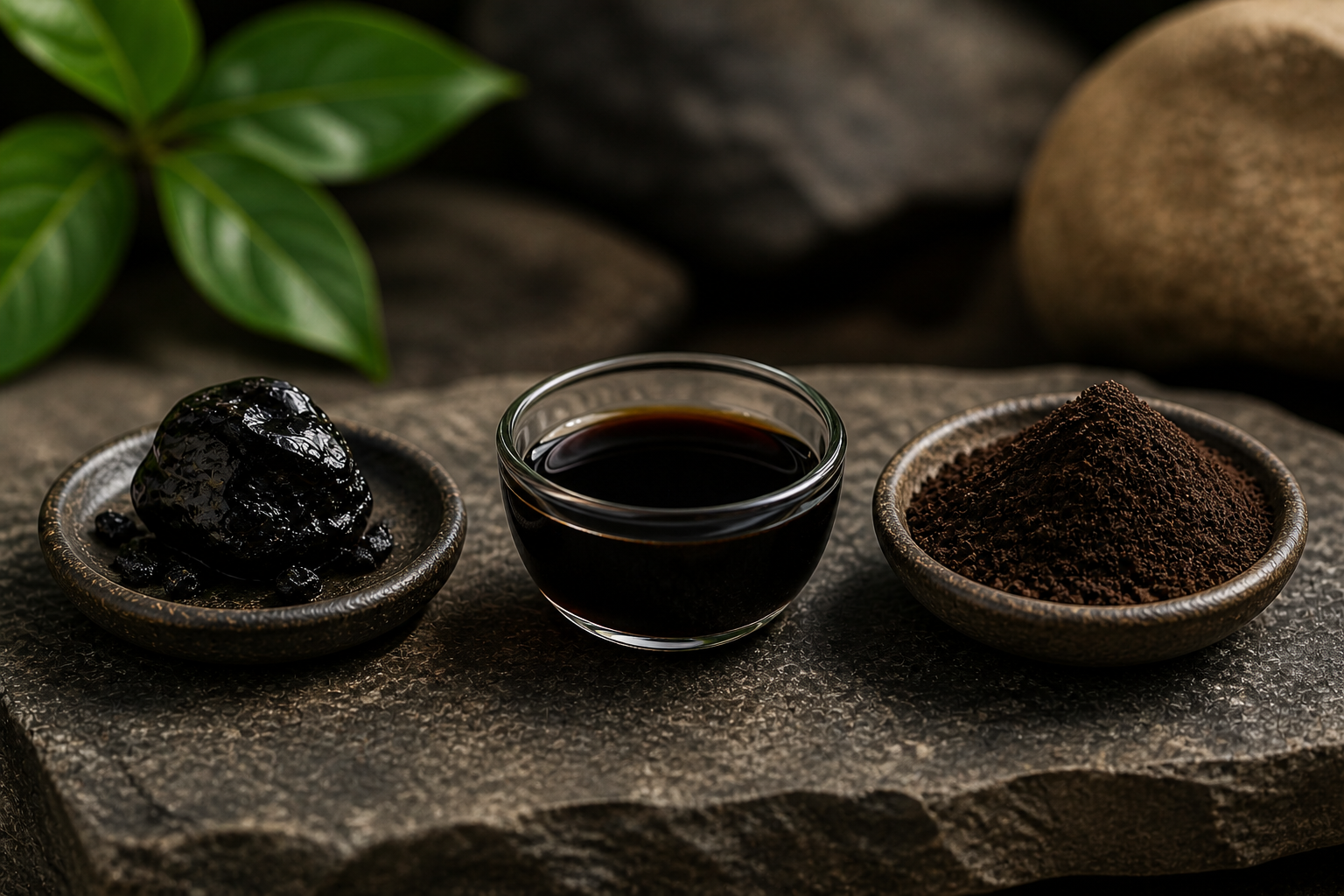
Shilajit is sold as resin, liquid, powder, capsules, tablets and gummies.
The best format depends on what you value most:
-
Resin is our preferred option for minimal formulation, directness and a closer relationship with purified finished Shilajit.
-
Liquid is convenient and easy to mix, but its concentration must be clearly explained.
-
Powder works well for standardised extracts, capsules and multi-ingredient blends, but the original source can be difficult to verify.
-
Capsules and tablets provide fixed servings without the strong taste or sticky texture.
-
Gummies are pleasant and convenient, but they’re normally the most heavily formulated option.
A good powder can be better than a poor resin.
A transparent liquid can be better than an adulterated capsule.
A gummy can contain genuine Shilajit extract.
The format alone doesn’t prove authenticity, purity, safety or effectiveness.
At One Life Foods, we sell Shilajit resin and have a clear commercial preference for it. We believe resin is the best overall format for customers who want Shilajit with minimal additional formulation. That doesn’t mean every resin is good or that every alternative format is poor.
Source, purification, composition and finished-product testing still matter more than the word printed on the front of the package.
Shilajit forms compared
| Form | Main advantage | Main trade-off | Best suited to |
|---|---|---|---|
| Resin | Minimal additional formulation | Sticky and less convenient to measure | Customers prioritising directness and transparency |
| Liquid | Quick and easy to mix | Concentration and dilution can be unclear | Convenience |
| Powder | Easy to standardise and formulate | Source, carriers and processing require investigation | Capsules and blended supplements |
| Capsules | Fixed serving with no strong taste | Quality depends on the powder inside | Travel and simple routines |
| Tablets | Fixed serving and compact format | Usually requires more manufacturing ingredients | Convenience and portability |
| Gummies | Pleasant taste and easy routine | Highly formulated and often dominated by the gummy base | People who won’t use other formats |
That is the simple comparison.
The complete answer depends on what each product contains and how it reached its final form.
Start with the material, not the format
Before comparing resin with powder or liquid, separate two questions:
-
What format is the product supplied in?
-
What material was used to make it?
The second question matters more.
A resin may be produced by purifying and concentrating material collected from a recognised Shilajit source.
A liquid may contain dissolved resin, a dry extract, a humic concentrate or a multi-ingredient formulation.
A powder may come from dried purified Shilajit, a standardised extract, a broader humic source or a mixture of ingredients.
A gummy may contain a relatively small amount of one of those extracts within a much larger sweetened and gelled base.
The word “Shilajit” doesn’t prove that every product began with the same source material or followed the same manufacturing process.
Humic and fulvic substances also occur in materials such as peat, lignite, leonardite, soil and sediments. Researchers have successfully extracted fulvic acid from lignite, demonstrating why the presence of fulvic acid alone can’t establish that a powder originated from genuine Shilajit.
For a clear introduction to the original material, read what Shilajit is, how it forms and what it contains.
Shilajit resin
What is Shilajit resin?
Resin is the format most closely associated with traditional Shilajit.
That doesn’t mean finished resin is untouched material scraped directly from a mountain.
Material collected from rock may contain:
-
Grit
-
Soil
-
Plant debris
-
Insoluble mineral matter
-
Microorganisms
-
Environmental contaminants
-
Variable amounts of water
It therefore needs to be purified and tested before it’s suitable for use as a food supplement.
Purification commonly involves dissolving or extracting the soluble material, separating it from rock and insoluble debris, filtering it and reducing its water content until a concentrated resin remains. The exact process varies between suppliers.
Resin is best described as the closest format to purified finished Shilajit, not raw or untouched Shilajit.
To explore how purified resins differ by origin and composition, browse our Shilajit resin collection, where you can compare regional varieties and their available laboratory analyses.
Read why raw Shilajit isn’t necessarily better for a deeper explanation.
What are the advantages of Shilajit resin?
A single-ingredient resin will normally contain:
-
Purified Shilajit
-
No capsule shell
-
No sweetener
-
No flavouring
-
No gelling agent
-
No drying carrier
-
No extract-equivalent calculation
You are dealing directly with the concentrated finished material.
This makes it easier to observe:
-
Texture
-
Aroma
-
Solubility
-
Temperature-related changes
-
Natural batch variation
-
Water content and total solids
-
The relationship between the tested sample and the product in the jar
Resin also allows the serving to be adjusted within the manufacturer’s labelled guidance.
That flexibility shouldn’t be confused with precision. Resin varies in density, moisture and texture, and visual descriptions such as “a grain of rice” or “a small pea” are only approximations.
For greater accuracy, a suitable digital milligram scale can be used. For everyday use, follow the product’s serving guidance and measure it as consistently as possible.
Read how to take Shilajit properly for preparation, measuring, timing and cycling guidance.
What are the disadvantages of Shilajit resin?
Resin isn’t the most convenient format.
It can be:
-
Sticky
-
Strong in taste
-
Difficult to measure precisely
-
Slower to prepare
-
Awkward to travel with
-
Firmer and harder to handle in cold conditions
It requires more effort than swallowing a capsule or chewing a gummy.
That inconvenience is real. It’s also partly why resin usually requires less reformulation. The manufacturer hasn’t needed to turn the material into a free-flowing powder, compressed tablet or flavoured sweet.
Is every Shilajit resin genuine?
No.
A sticky, dark product isn’t automatically genuine Shilajit.
Resin-like textures can potentially be produced using concentrated extracts, humic powders, glycerol, sweeteners and other dark ingredients.
Texture, colour, stretching and solubility may provide clues, but none can prove identity or safety.
A resin still needs:
-
Traceable sourcing
-
A clear ingredient declaration
-
An explained purification process
-
Finished-batch testing
-
Heavy-metal analysis
-
Microbiological testing
-
Relevant environmental contaminant screening
-
Meaningful composition and concentration data
Resin is the most direct format.
It isn’t a substitute for evidence.
Liquid Shilajit
What is liquid Shilajit?
Liquid Shilajit is often described as resin that has already been dissolved for you.
Sometimes that is exactly what it is.
A liquid product could also contain:
-
Resin diluted with water
-
A water-soluble Shilajit extract
-
A liquid humic concentrate
-
Shilajit mixed with glycerol
-
A flavoured formula
-
A multi-ingredient supplement
Once Shilajit is sold in a liquid base, you are dealing with a formulation rather than resin alone.
That isn’t automatically a problem.
The question is whether the formulation is clearly explained.
What are the advantages of liquid Shilajit?
Liquid products can be:
-
Quick to use
-
Easy to mix into drinks
-
Less messy than resin
-
Easier for people who dislike handling sticky products
-
Convenient when the dropper or pump provides a defined volume
For some customers, that convenience may make liquid the most practical option.
A product that is used consistently can be more useful than a theoretically ideal format that remains unopened.
What should a liquid Shilajit label tell you?
A good liquid label should make it possible to understand:
-
How much actual Shilajit or extract is supplied per serving
-
Whether the stated amount refers to resin, dry extract or raw-material equivalent
-
The volume of one serving
-
The liquid base
-
Every added ingredient
-
The concentration or extract ratio, where applicable
-
Storage requirements
-
Whether refrigeration is needed after opening
-
Whether the finished liquid was tested
“Take one dropper” isn’t enough information if the label doesn’t explain the volume or amount of Shilajit in that dropper.
Two liquids can look equally dark while delivering very different amounts.
Colour isn’t a reliable measure of concentration.
Is liquid Shilajit more bioavailable?
Liquid products are often marketed as faster-absorbing or more bioavailable because the material has already been dissolved.
Being dissolved may affect how quickly a product disperses in the digestive system.
It doesn’t automatically prove that more of its components enter the bloodstream or reach the tissues.
Dissolution, bioaccessibility, absorption and bioavailability aren’t interchangeable terms. Human research hasn’t yet mapped the absorption and metabolism of complete Shilajit preparations in enough detail to establish that liquid is inherently superior to resin or powder.
Read what the body may actually absorb from Shilajit for the complete explanation.
The main liquid Shilajit trade-off
Liquid Shilajit prioritises convenience.
The trade-off is increased reliance on:
-
The manufacturer’s concentration claim
-
The accuracy of the dropper or pump
-
The formulation
-
Preservation and storage
-
Label transparency
Convenience increases.
Direct visibility often decreases.
Does liquid Shilajit need preservatives?
Not necessarily.
Preservatives are one way to control the growth of bacteria, yeasts and moulds, but they aren’t the only option. A liquid product may also rely on:
-
A sufficiently low pH
-
Controlled water activity
-
Heat treatment
-
Hygienic or aseptic filling
-
Refrigerated storage
-
Protective packaging
-
A combination of several controls
The absence of a conventional preservative doesn’t automatically mean that a liquid product is unsafe.
However, adding water creates a different microbiological challenge from selling concentrated resin. This is particularly relevant to a bottle that is opened repeatedly, stored for several weeks or kept at room temperature.
If a liquid Shilajit product contains water but no declared preservative, the manufacturer should be able to explain:
-
How microbial growth is controlled
-
Whether the product requires refrigeration
-
How long it can be used after opening
-
Whether the pH and water activity have been assessed
-
Whether the complete liquid has undergone microbiological and shelf-life testing
-
Whether the stated shelf life was validated under realistic storage conditions
“Preservative-free” can sound reassuring, but it isn’t evidence of safety on its own.
The more useful question is:
What prevents bacteria, yeasts and moulds from growing in this product throughout its stated shelf life?
A water-based, ambient-stable liquid with no preservatives, no refrigeration instructions and no explanation of its preservation system should be treated cautiously.
Shilajit powder
Is Shilajit powder real?
It can be.
Genuine purified Shilajit can be dried and milled into a powder. It may also be processed into a standardised dry extract.
The problem is that “Shilajit powder” can describe several very different materials.
A dark powder may be:
-
Dried purified Shilajit
-
A concentrated Shilajit extract
-
A spray-dried extract containing a carrier
-
Shilajit blended with another ingredient
-
A generic humic or fulvic powder
-
A combination of several materials
These products may look similar.
They aren’t necessarily chemically or commercially equivalent.
What are the advantages of Shilajit powder?
Powder offers genuine manufacturing and consumer advantages:
-
Easier capsule filling
-
More consistent serving weights
-
Less mess
-
Improved portability
-
Easier use in multi-ingredient blends
-
Greater compatibility with tablets, sachets and powdered drinks
-
The ability to standardise selected components
The problem isn’t that powder exists.
The problem is that appearance tells the customer very little about the material’s identity.
Not every humic powder is Shilajit
Fulvic acid and humic acid aren’t exclusive to Shilajit.
Humic substances can be extracted from sources including:
-
Peat
-
Lignite
-
Leonardite
-
Soil
-
Sediments
-
Other decomposed organic deposits
A laboratory may accurately confirm that a powder contains fulvic or humic material.
That doesn’t prove that the powder came from a recognised Shilajit deposit.
A lignite-derived fulvic powder doesn’t become Shilajit simply because it’s dark, soluble and high in fulvic acid. Research has shown that both fulvic and humic substances can be isolated from non-Shilajit materials.
This is why powdered products require particularly strong identity and sourcing evidence.
What does a 10:1 or 30:1 Shilajit extract mean?
Extract ratios can create an impression of potency without providing enough context.
A 10:1 claim generally means that ten parts of starting material were used to produce one part of extract.
It doesn’t automatically mean the product is:
-
Ten times stronger
-
Ten times more effective
-
Ten times higher in fulvic acid
-
Equal to ten times the serving of resin
-
More bioavailable
-
Made from genuine Shilajit
Extract ratios describe a manufacturing relationship. They don’t independently describe the complete chemical composition of the finished extract.
To understand a ratio properly, you also need to know:
-
What the starting material was
-
Whether the ratio refers to raw mountain material or purified Shilajit
-
Which extraction method was used
-
What was removed
-
Whether carriers were added
-
How much actual extract is in the serving
-
How the final product was tested
Technical reviews of botanical extracts have highlighted that raw-material-to-extract ratios don’t, by themselves, establish chemical equivalence or clinical potency.
A high ratio can partly reflect the removal of water, rock, debris or insoluble material.
It isn’t a clinical potency score.
What is spray-dried Shilajit?
Spray drying is a manufacturing process used to convert liquid extracts into powder.
The liquid is dispersed into heated air so that moisture is removed rapidly. Ingredients such as maltodextrin or gum arabic may be used as drying carriers to reduce stickiness, improve powder flow or protect selected compounds.
These carriers are commonly used in the spray drying of food and botanical extracts. Their presence doesn’t automatically mean the product is poor quality, but it does change the composition of the finished powder.
A spray-dried product should clearly explain:
-
The original extract
-
The drying process
-
Whether a carrier was used
-
The identity of the carrier
-
The approximate proportion of carrier
-
The actual quantity of Shilajit extract per serving
A powder containing a drying carrier shouldn’t be presented as though every milligram is pure Shilajit extract.
How should you evaluate Shilajit powder?
Ask:
-
Was it made from genuine purified Shilajit?
-
Where did the original material come from?
-
How was it extracted and dried?
-
Does it contain a carrier?
-
How much of the powder is carrier?
-
Is the stated amount actual extract or an equivalent figure?
-
Was the finished powder tested?
-
Are fulvic and humic results both provided?
-
Is the analytical method explained?
-
Is there evidence distinguishing it from a generic humic material?
-
Have any isolated fulvic ingredients been added?
Without those answers, the phrase “Shilajit powder” remains too broad to tell you what you are buying.
Read why an unusually high fulvic acid percentage can be a red flag for more on methods, dry-basis figures and generic humic powders.
Shilajit capsules
Are Shilajit capsules different from powder?
Capsules are a delivery system.
The capsule shell is rarely the most important part of the product. The real question is what powder has been placed inside it.
A capsule might contain:
-
Dried purified Shilajit
-
A standardised Shilajit extract
-
A spray-dried extract with a carrier
-
Shilajit blended with herbs or nutrients
-
A generic fulvic or humic material
-
A small quantity of extract supported by a large equivalent claim
What are the advantages of Shilajit capsules?
Capsules offer:
-
Fixed serving sizes
-
No strong Shilajit taste
-
No sticky preparation
-
Easy storage
-
Simple travel
-
A quick daily routine
Fixed dosing can be useful, provided the label clearly states what the serving contains.
Capsules can be an excellent format when the powder inside is genuine, appropriately formulated and properly tested.
They can also hide poor or substituted material very effectively.
Don’t judge the product by the shell.
Judge the contents.
What should you check on a capsule label?
Look for:
-
Actual extract weight per capsule
-
Number of capsules per serving
-
Extract ratio, where relevant
-
Raw-material equivalent shown separately from actual extract weight
-
Source of the extract
-
Carrier ingredients
-
Added anti-caking or flow agents
-
Finished-product testing
-
A complete ingredient list
The presence of an excipient isn’t automatically a red flag. Some ingredients are used in small quantities to help powders flow consistently or to make manufacturing possible.
The problem is poor disclosure, not the existence of every manufacturing aid.
Shilajit tablets
Tablets are also made from powdered or granulated material.
Unlike capsules, the ingredients are compressed into a solid piece. This will often require additional ingredients to help the tablet hold together, break apart after swallowing and survive manufacturing.
A tablet may contain:
-
Shilajit extract
-
Fillers
-
Binders
-
Disintegrants
-
Lubricants
-
Coating ingredients
-
Other active ingredients
Tablets offer consistent servings and convenient storage.
Their disadvantages include:
-
Additional formulation
-
Less visibility of the powder
-
Potentially larger serving sizes
-
Possible difficulty swallowing
-
Reliance on the tablet breaking apart properly after ingestion
As with capsules, the format isn’t inherently good or bad.
The ingredient declaration and extract quality decide what the tablet represents.
Shilajit gummies
Are Shilajit gummies real?
Some gummies contain genuine Shilajit extract.
That doesn’t mean the gummy itself is resin in a different shape.
A gummy is a formulated food supplement in which Shilajit extract is mixed into a sweetened and gelled base.
Depending on the formula, the other ingredients may include:
-
Glucose syrup
-
Sugar
-
Fruit concentrate
-
Sugar alcohols or alternative sweeteners
-
Pectin or gelatine
-
Citric acid
-
Malic acid
-
Flavourings
-
Colourings
-
Vegetable oils
-
Glazing agents
-
Vitamins
-
Minerals
-
Ashwagandha
-
Mushrooms
-
Other botanical extracts
That doesn’t automatically make the product fake.
It does mean the majority of the physical gummy may consist of ingredients other than Shilajit.
What are the advantages of Shilajit gummies?
Gummies are:
-
Pleasant to take
-
Easy to remember
-
Familiar
-
Portable
-
Free from the strong taste and sticky handling of resin
For someone who won’t use resin, liquid, powder or capsules, a transparent and properly made gummy may be a practical option.
Convenience and taste are valid purchasing considerations.
They shouldn’t be confused with evidence of superior quality, absorption or effectiveness.
Why do some Shilajit gummies claim thousands of milligrams?
Gummy labels often display large figures such as:
-
1,000 mg
-
2,000 mg
-
3,000 mg
-
5,000 mg
The headline may refer to:
-
An equivalent amount of starting material
-
The total across two or more gummies
-
A combined multi-ingredient blend
-
An extract amount before carriers were included
-
A calculation based on a 10:1, 20:1 or 30:1 ratio
For example, a gummy containing 100 mg of a 10:1 extract might be marketed using a 1,000 mg raw-material-equivalent figure.
That calculation isn’t necessarily false.
It can still be easy to misunderstand.
The label should state the actual weight of extract alongside any equivalent figure and clearly explain the serving size.
Are Shilajit gummies better than resin?
There’s no convincing evidence that gummies are inherently:
-
More authentic
-
Better absorbed
-
More potent
-
More effective
-
More complete
-
More bioavailable
Their clearest advantages are flavour and convenience.
Resin remains closer to purified finished Shilajit because it doesn’t need to be rebuilt into a sweetened, flavoured and gelled product.
Why doesn’t One Life Foods sell Shilajit gummies?
We sell Shilajit because we value the material itself.
Turning it into a gummy would require decisions about:
-
The type of extract
-
Sweeteners
-
Gelling agents
-
Flavour masking
-
Acidity
-
Stability
-
Colour
-
Serving-size calculations
-
Additional ingredients
Every one of those decisions would create more distance between the customer and the resin.
That may be a reasonable choice for a company focused on confectionery-style supplements.
It isn’t the direction we want to take.
We’d rather explain how to use Shilajit resin properly than turn it into a fruit-flavoured sweet.
What about drops, softgels, sticks and sachets?
Some products use less common descriptions such as:
-
Shilajit drops
-
Shilajit softgels
-
Single-serving sticks
-
Liquid sachets
-
Dissolvable powders
-
Effervescent tablets
-
Shilajit honey
-
Ready-to-drink shots
These aren’t completely separate forms of Shilajit.
They’re delivery systems built around a liquid, powder or extract.
The same questions still apply:
-
What was the starting material?
-
How much actual Shilajit is present?
-
What else has been added?
-
Is the stated quantity actual extract or an equivalent?
-
Was the complete finished product tested?
A creative package doesn’t remove the need for basic transparency.
Resin vs liquid vs powder vs capsules vs gummies
| Question | Resin | Liquid | Powder | Capsules or tablets | Gummies |
|---|---|---|---|---|---|
| Closest to purified finished Shilajit? | Usually | Sometimes | Depends on manufacturing | Depends on contents | Rarely |
| Normally requires added ingredients? | No | Often | Sometimes | Usually | Almost always |
| Easy to use? | Moderate | High | High | High | Very high |
| Fixed serving? | No | Sometimes | Can be measured | Yes | Yes |
| Easy to judge by appearance? | Limited | Very limited | No | No | No |
| Can hide a non-Shilajit humic source? | Yes | Yes | More easily | More easily | More easily |
| Suitable for multi-ingredient blends? | Less suitable | Suitable | Very suitable | Very suitable | Very suitable |
| Main advantage | Directness | Convenience | Formulation | Fixed serving | Taste |
| Main concern | Handling and measurement | Dilution and concentration | Identity and carriers | Contents and equivalence claims | Formulation and dose clarity |
Which form of Shilajit is best?
There isn’t one answer for every customer.
Best for minimal formulation: resin
In our view, resin is the best overall format for someone who prioritises:
-
Minimal additional ingredients
-
A direct relationship with purified Shilajit
-
Visibility of natural variation
-
Flexible use
-
Clear comparison with batch testing
This is our commercial and editorial position.
A poor-quality, contaminated or adulterated resin can still be inferior to a well-made powder, capsule or liquid. Format never overrides sourcing and testing.
Best for convenience: capsules or liquid
Capsules are useful when you want:
-
A fixed serving
-
No preparation
-
No strong taste
-
Easy travel
Liquid can be useful when you want:
-
Quick mixing
-
Less mess than resin
-
A product that is easy to add to a drink
Choose the option with the clearest actual dose, ingredients, source information and finished-product testing.
Best for fixed serving sizes: capsules or tablets
Capsules and tablets provide a defined quantity per unit.
This can make a routine easier, but only if the label distinguishes between:
-
Actual extract weight
-
Raw-material equivalent
-
Added carriers
-
Other active ingredients
A fixed number isn’t useful if the number itself is misleading.
Best for multi-ingredient blends: powder
Powder is the easiest form to combine with:
-
Ashwagandha
-
Functional mushrooms
-
Vitamins
-
Minerals
-
Protein products
-
Performance supplements
-
Other botanical extracts
That is a practical manufacturing advantage.
It doesn’t prove that the powder preserves the same composition as resin.
Best for taste: gummies
Gummies normally win on taste and familiarity.
That is why they exist.
Taste is a valid advantage.
It isn’t a quality certificate.
What matters more than the form?
The format is only one part of the decision.
These factors matter more.
1. Source
Where did the original material come from?
Broad descriptions such as “Himalayan” don’t provide much traceability on their own.
Look for a defined source region and documentation connecting the original material to the finished product.
2. Identity
Has the company demonstrated that the material is Shilajit rather than a generic humic or fulvic extract?
This becomes increasingly important with powders, capsules, tablets and gummies, where appearance reveals very little.
3. Purification
How were grit, rock, insoluble debris and unwanted contamination removed?
Raw material shouldn’t be treated as ready for consumption simply because it came from a mountain.
4. Finished-product testing
Testing should be performed on the product or representative batch being sold, not only on an upstream supplier sample.
Depending on the format, a meaningful programme may consider:
-
Heavy metals
-
Microbiology
-
Moisture or total solids
-
Fulvic and humic fractions
-
Mineral composition
-
PAHs
-
Mycotoxins
-
Solvent residues
-
Other relevant environmental contaminants
Our guide to how Shilajit testing actually works explains why the sample, method and specification matter.
5. Dose clarity
Does the label state the actual amount of Shilajit or extract per serving?
Or does it rely on a large equivalent figure without explaining the calculation?
The actual amount and equivalent amount should be shown separately.
6. Concentration
A jar, bottle or gummy tub can’t be compared by total weight alone.
For resin and liquid products, consider:
-
Water content
-
Total solids
-
Actual Shilajit per serving
-
Whether water has been added
-
Whether the stated quantity refers to the product as sold or its dry matter
Read how much Shilajit is actually in your Shilajit for a detailed explanation.
7. Full composition
Don’t reduce Shilajit to one fulvic acid percentage.
Consider the complete picture:
-
Fulvic compounds
-
Humic substances
-
Mineral and trace-element profile
-
Water content
-
Carriers
-
Sweeteners
-
Additional extracts
-
Contaminant results
-
Testing method
A high number isn’t meaningful without context. Different methods, sample preparations and reporting bases can produce figures that aren’t directly comparable.
8. Ingredient list
The front of the label tells you what the company wants you to notice.
The ingredient list tells you what you’re buying.
Read it in full.
Red flags by Shilajit form
Resin red flags
Be cautious when you see:
-
No source information
-
No finished-batch testing
-
Added glycerol, sweeteners or other ingredients that aren’t clearly explained
-
Texture presented as proof of authenticity
-
No moisture or concentration information
-
The same supplier report used for every batch
-
Claims that black colour alone proves quality
Liquid red flags
Be cautious when you see:
-
No actual Shilajit quantity per serving
-
“One dropper” with no measured volume
-
No explanation of the liquid base
-
Dark colour presented as proof of concentration
-
No storage instructions
-
Claims of superior absorption without comparative human evidence
-
A water-based, shelf-stable product with no explained preservation system, refrigeration instructions or shelf-life validation
Powder red flags
Be cautious when you see:
-
No evidence that the powder originated from Shilajit
-
No source information
-
A 10:1 or 30:1 ratio used as the only proof of strength
-
Undeclared or unexplained carriers
-
No finished-product testing
-
A large fulvic percentage with no named method
-
No distinction between Shilajit and a generic humic source
Capsule and tablet red flags
Be cautious when you see:
-
Only an equivalent amount, with no actual extract weight
-
No information about the powder inside
-
A long proprietary blend that hides individual quantities
-
No source or processing information
-
No complete ingredient list
-
No testing of the finished capsule or tablet
Gummy red flags
Be cautious when you see:
-
A huge milligram number with no actual extract weight
-
Multiple gummies required to reach the advertised amount
-
Sugar or syrup dominating the ingredient list
-
Numerous added actives that make the Shilajit quantity unclear
-
No explanation of the extract ratio
-
A fulvic acid percentage with no testing method
-
No evidence connecting the extract to genuine Shilajit
-
Testing performed on the extract but not the finished gummy
How to choose a Shilajit form in 30 seconds
Ask yourself:
Do I want the least reformulated format?
Choose a properly purified and tested resin.
Do I want a fixed serving with no taste or preparation?
Consider a transparent capsule or tablet.
Do I want something quick to add to a drink?
Consider liquid, but check the actual concentration.
Do I want Shilajit as part of a multi-ingredient supplement?
A genuine, well-documented powder may make sense.
Will I only take it if it tastes sweet?
A gummy may be the most realistic option, but check how much actual extract it contains.
Then ask the more important questions:
-
Where did it come from?
-
What was the starting material?
-
How was it purified and processed?
-
What was added?
-
How much actual Shilajit is present?
-
Was the complete finished product tested?
The bottom line
Shilajit changes between formats because every processing and formulation step changes what the customer receives.
Resin is the closest format to purified finished Shilajit and normally requires the least additional formulation.
Liquid prioritises convenience but may introduce dilution, bases and storage considerations.
Powder enables drying, standardisation, encapsulation and blending, but requires strong evidence about the original material and any carriers used.
Capsules and tablets provide fixed servings, but their quality depends entirely on the extract inside.
Gummies prioritise taste by placing an extract within a sweetened and gelled delivery system.
Every format can be made well.
Every format can also be made badly.
At One Life Foods, we choose resin because we believe it offers the clearest relationship between the source, the purified material, the finished product and the laboratory testing.
No syrup.
No gummy base.
No capsule hiding the material.
No inflated extract-equivalent number designed to look more impressive than the actual serving.
Just independently tested Shilajit resin, with its source, composition and available laboratory information clearly explained.
Explore our Shilajit resin range.
Related reading
References and evidence notes
-
Nieweś D, et al. Ultrasound-assisted extraction of humic substances from peat. Molecules. 2022.
-
Gong G, et al. Extraction of fulvic acid from lignite and characterisation of its functional groups. ACS Omega. 2020.
-
Monagas M, et al. Understanding plant-to-extract ratios in botanical extracts. Frontiers in Pharmacology. 2022.
-
Pudžiuvelytė L, et al. Spray-drying microencapsulation of natural bioactives. 2025.
-
Sarabandi K, et al. Effects of different carriers on the physical properties of spray-dried extracts. 2018.
Written by
Written by Chris Simon, Founder of One Life Foods.
Chris has worked in the supplement industry since 2009 and has worked with Shilajit since 2017, with a focus on independent testing, analytical methods and responsible product sourcing.
Read more about Chris and the story behind One Life Foods.
Editorial disclosure
This article was written by One Life Foods, a company that sells Shilajit resin.
We therefore have a commercial preference for resin-based products. Our recommendation is based on minimal formulation, directness and transparency rather than an assumption that every liquid, powder, capsule, tablet or gummy is ineffective.
Products should be judged individually according to their source, processing, composition, labelling and finished-product testing.

Share:
Shilajit Explained: How It Works, and What Actually Matters
How to Take Shilajit Properly (Dosage, Timing, and Best Practices)