


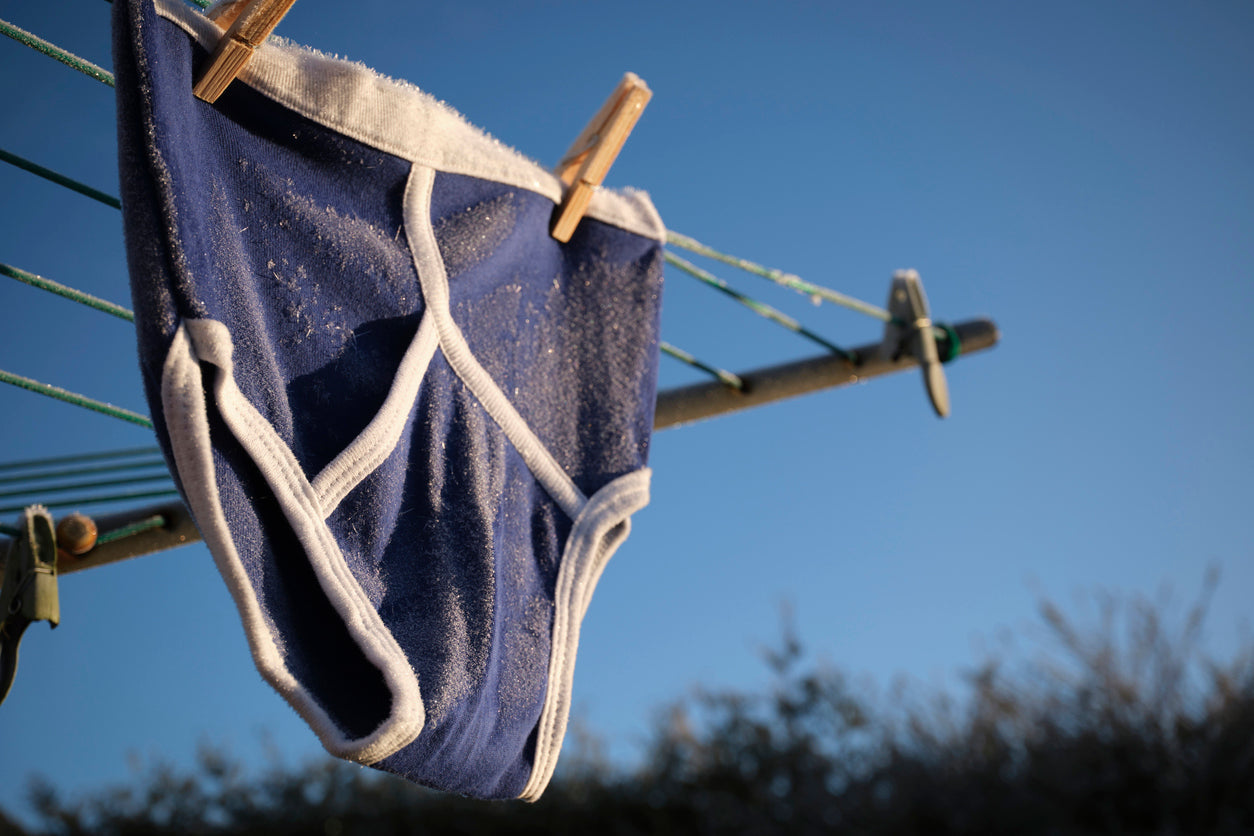
Sun-drying: perfect for your laundry. Less convincing for Shilajit
Spend more than five minutes on the supplement side of the internet and you will eventually encounter some version of this story:
Our Shilajit is slowly sun-dried beneath the Himalayan sky for 40, 60 or perhaps 90 spiritually significant days.
It is normally accompanied by photographs of mountains, wooden trays and a man who appears to have been patiently stirring resin since the Bronze Age.
The implication is clear.
Sun-dried Shilajit is traditional, gentle and natural.
Anything produced using controlled equipment must be industrial, damaged or somehow less authentic.
It is an excellent story.
The problem is that stories are much easier to scale than solar drying.
Shilajit marketing already has a slightly unhealthy relationship with mountains. We have seen the same thing with supposedly precise collection heights, despite brands rarely providing credible evidence for their high-altitude Shilajit claims.
Sun drying belongs to the same family of claims.
It sounds specific.
It feels traditional.
Yet once you ask how the process actually works, the detail often evaporates faster than the water supposedly leaving the trays.
Quick answer: Is sun-dried Shilajit better?
There is no convincing evidence that sun-dried Shilajit is inherently purer, more potent or better preserved than Shilajit concentrated using a properly controlled low-temperature process.
Sun drying is a genuine traditional method. Enclosed solar dryers can also process commercial quantities of certain agricultural materials.
What we have not found is strong, independently documented evidence showing that large volumes of finished Shilajit resin are produced entirely through sunlight from the original dilute purified extract.
Most brands making the claim do not disclose:
-
How dilute the purified extract is before drying
-
How many kilograms enter each batch
-
How much water must be removed
-
The total tray or tunnel area
-
The depth of the liquid in each tray
-
The average drying time
-
Temperature and humidity records
-
Whether fans or auxiliary heat are used
-
Whether the extract is pre-concentrated
-
Finished moisture or water activity
-
Actual annual production capacity
Without that information, “sun-dried” is not a meaningful manufacturing specification.
It is a mood.
What does “sun-dried Shilajit” actually mean?
That should be a simple question.
It is not.
The term may describe several substantially different processes.
| Process | What may actually be happening |
|---|---|
| Open-sun drying | Purified liquid is placed in uncovered or loosely covered trays under direct sunlight |
| Direct solar-tunnel drying | The product sits inside a transparent enclosure and receives direct solar radiation |
| Indirect solar drying | Sunlight heats air, which is then passed through an enclosed drying chamber |
| Hybrid solar drying | Solar energy is combined with fans, electrical heating, biomass heating, dehumidification or thermal storage |
| Solar finishing | Most water is removed using another process before the thick concentrate is placed in sunlight |
| Token sun exposure | The product receives a limited solar stage that allows the finished resin to be marketed as “sun-dried” |
Modern solar-drying literature distinguishes between direct, indirect and hybrid systems because they do not expose a product to the same light, temperatures, airflow or environmental conditions.
A brand saying only “sun-dried” therefore tells you remarkably little.
It is rather like a restaurant describing a meal as “heat prepared”.
Technically informative.
Practically useless.
It is also important to separate drying from purification. Raw mountain material is normally dissolved, settled, filtered and cleaned before it becomes finished resin. Our guide to why raw Shilajit is not automatically better explains why the romantic language surrounding minimal processing often ignores the reason purification exists in the first place.
Is sun drying a genuine traditional Shilajit process?
Yes.
Traditional Ayurvedic processing literature describes Suryatapi methods in which prepared Shilajit is exposed to sunlight.
That part is real.
But the published examples are small.
One study began with 250 grams of raw Shilajit and one litre of Bhringraj juice. The mixture was heated until it reached a syrup consistency before being transferred to sunlight. It was then processed over eight days and produced 249 grams of finished material.
That is not really evidence of a dilute extract being concentrated from start to finish by sunlight alone.
It is closer to solar finishing.
The same study recommended:
-
Carrying out the process during summer
-
Using an open terrace with strong sunlight
-
Moving the material indoors each evening
-
Closing it with a lid to prevent flies and dust entering
-
Collecting and transferring the surface layer each day
Traditional practitioners apparently understood something that modern marketing occasionally forgets.
Nature is not a cleanroom.
A separate comparison began with 500 grams of raw Shilajit, five litres of water and, in one preparation, 250 ml of Triphala decoction.
The solar-dried Triphala preparation:
-
Used a vessel approximately 27.6 cm in diameter
-
Was exposed outdoors for eight hours and kept indoors for 16 hours
-
Reached reported temperatures between approximately 28.2°C and 40°C
-
Ran from 8 October to 30 November
-
Produced 185 grams of finished material
That is approximately 53 days to produce less than 200 grams in one vessel.
A second water-only sunlight preparation ran from 13 October to 15 December and produced 150 grams.
The equivalent hot-plate preparations reportedly dried in approximately 18 hours at a controlled temperature of 65°C.
These are not modern commercial manufacturing trials, and the herbal preparation is not directly equivalent to the purified resin sold today. They are still useful because they demonstrate the difference between traditional scale and international supply.
The traditional evidence we found is not based on 100-kilogram batches quietly tanning beneath the Himalayan sky. It involves 250 to 500 grams of starting material, with finished yields measured in hundreds of grams. One process took eight days only after the liquid had already been heated to syrup consistency. Another took approximately 53 days to produce 185 grams.
That does not make larger solar production impossible. It does make it reasonable to ask where the industrial-scale facilities, tray area and production records are. In practical terms, genuine traditional sun drying appears most credible at sub-kilogram or low-kilogram tray scale. Larger commercial supply is more plausibly supported by multiple parallel dryers, pre-concentration, hybrid systems or solar finishing.
Traditional does not mean imaginary.
It also does not automatically mean scalable.
How does sun drying work?
There is no mysterious solar intelligence involved.
Water leaves the extract through evaporation.
The rate depends mainly on:
-
Product temperature
-
Air temperature
-
Relative humidity
-
Air velocity
-
Exposed surface area
-
Extract depth
-
Starting water content
-
Concentration of dissolved material
-
Viscosity
-
Solar intensity
-
How efficiently moist air is removed
Sunlight may heat the product directly, or it may heat air that flows through an enclosed dryer.
As water evaporates, the air immediately above the material becomes more humid. That moist boundary layer must be moved away and replaced with drier air.
This is why airflow matters so much.
A shallow layer dries faster than a deep container because more material is exposed relative to its volume.
This is also why the tray videos normally show thin layers.
The trays are not merely decorative props for Instagram. They provide the surface area required for evaporation.
Why Shilajit becomes harder to dry as it concentrates
Drying does not normally proceed at one constant rate.
Early in the process, when the extract is relatively dilute, water can move towards the surface and evaporate more freely.
As the concentration increases:
-
The material becomes more viscous
-
Water mobility decreases
-
The surface becomes increasingly concentrated
-
Moisture must migrate through a thicker organic matrix
-
The evaporation rate may fall
-
Heat and mass transfer become less efficient
Drying science commonly describes this as the falling-rate period.
At that point, internal moisture movement can become a greater limitation than surface evaporation.
This matters because Shilajit resin is not a garlic bulb or a sliced mango.
It begins as an aqueous extract and ends as a dense, sticky concentrate.
The final stage may be the slowest and least predictable part.
More sunlight does not magically repeal mass transfer.
The scalability problem nobody seems interested in discussing
Producing a few trays of sun-dried Shilajit is entirely believable.
Supplying an international market continuously is a different engineering problem.
Imagine that a producer wants to make 1,000 kilograms of finished resin containing approximately 90% solids.
That final batch contains around:
-
900 kilograms of solid material
-
100 kilograms of remaining water
The amount of liquid entering the drying process depends on how concentrated it already is.
| Starting extract | Liquid entering the dryer | Water that must be removed |
|---|---|---|
| 10% solids | 9,000 kg | 8,000 kg |
| 20% solids | 4,500 kg | 3,500 kg |
| 30% solids | 3,000 kg | 2,000 kg |
These are illustrative calculations, not figures taken from a particular Shilajit factory.
But the question they expose is unavoidable.
If the purified extract enters the solar trays at 20% solids, producing one tonne of finished resin requires approximately three and a half tonnes of water to leave the facility.
That water must be:
-
Heated
-
Evaporated
-
Carried away in the air
-
Prevented from condensing back onto the product
-
Replaced by enough dry incoming air to keep evaporation moving
The sun can supply energy.
It cannot supply unlimited surface area, perfectly dry air, endless good weather or an exemption from physics.
Could an enclosed solar tunnel handle it?
In principle, yes.
Commercial solar tunnels are real.
They can raise internal temperatures, improve airflow and protect material more effectively than leaving it in an uncovered yard.
One published garlic study described a solar tunnel with a nominal capacity of 400 kilograms. After cleaning and preparation, approximately 245 to 255 kilograms of garlic entered the drying trials.
Reducing the moisture content from approximately 63 to 72% down to around 9 to 10% took eight to ten days.
That tells us two useful things.
First, solar tunnels can process hundreds of kilograms of suitable agricultural material.
Second, “400 kg capacity” does not mean that 400 kilograms of finished dried product emerges every afternoon.
Wet input weights are excellent for making capacity sound impressive.
Water is heavy and apparently very good at marketing.
More importantly, garlic is not Shilajit.
Garlic has a defined physical structure and much better studied drying behaviour. Its results cannot simply be transferred to a viscous organic-mineral extract.
A large Shilajit operation could theoretically use:
-
Several greenhouse-sized tunnels
-
Hundreds of shallow trays
-
Forced ventilation
-
Staggered batches
-
Thermal storage
-
Dehumidification
-
Auxiliary low-temperature heating
-
Pre-concentration
-
Continuous environmental monitoring
That is technically possible.
It is also a modern industrial drying facility, not a few bowls quietly absorbing ancient wisdom from a mountain sunrise.
There is nothing wrong with that.
We would simply like brands to describe it honestly.
Where is the evidence of mass solar drying?
This is where the story becomes strangely shy.
We have found:
-
Small traditional Shilajit studies
-
General solar-dryer research involving fruit, vegetables, herbs, fish and agricultural products
-
Businesses claiming to use solar dryers
-
Photographs and videos showing small numbers of trays
What we have not found is independently documented commercial Shilajit production data showing:
-
Starting extract concentration
-
Starting batch weight
-
Finished resin weight
-
Kilograms of water removed
-
Tray dimensions
-
Total tray area
-
Extract depth
-
Tunnel dimensions
-
Temperature and humidity records
-
Drying duration by season
-
Number of simultaneous batches
-
Use of fans or backup heat
-
Finished water activity
-
Annual resin output
Perhaps these facilities exist.
They may be producing tonnes of resin behind very private doors.
But when almost every brand repeats the same claim and almost none can show the production mathematics behind it, scepticism is not cynicism.
It is quality control with its eyes open.
A video of twelve trays proves the existence of twelve trays.
It does not prove global supply.
Is “sun-finished” Shilajit more plausible?
Yes.
This may be the most credible explanation behind at least some commercial sun-dried claims.
A producer could:
-
Dissolve and purify the raw material in water.
-
Filter or settle out unwanted insoluble matter.
-
Remove most of the water using controlled heat or reduced pressure.
-
Transfer the already-thick concentrate into shallow trays.
-
Use sunlight for the final consistency adjustment.
-
Describe the finished resin as sun-dried.
That process could be perfectly legitimate.
It would also be far easier to scale than taking a dilute extract all the way to finished resin using sunlight alone.
The important question is not:
Did the product ever see the sun?
The important question is:
What percentage of the water had already been removed before it reached the solar trays?
If sunlight removed only the final 5% or 10% of the water, “sun-finished” would be a much more informative description.
If a supplier refuses to discuss pre-concentration, the silence is doing rather a lot of work.
Does sunlight preserve more fulvic acid?
There is no Shilajit-specific evidence demonstrating that prolonged sun drying preserves more hydrophobic fulvic acid than controlled low-temperature concentration.
We should also correct an overstatement that appeared in an earlier version of this article.
A frequently repeated claim says that one study found a 32% loss of organic carbon from fulvic acid after approximately 12 days of sunlight.
That is not what the research reported.
The study described an approximately 32% decrease in fluorescence in a dilute alkaline fulvic-acid solution after 13 days of UV-B irradiation.
A change in fluorescence is evidence of photochemical alteration.
It is not the same as proving that 32% of the fulvic acid disappeared from finished Shilajit resin.
The distinction matters.
Dilute environmental fulvic-acid solutions are not equivalent to concentrated Shilajit sitting in a tray. Light exposure, oxygen, pH, concentration, layer depth and temperature can all affect the result.
What the wider evidence does show is that humic and fulvic substances can absorb light and participate in photochemical reactions. Irradiation may change fluorescence, molecular characteristics and reactive oxygen chemistry.
That gives us two defensible conclusions:
-
We should not claim that sunlight inevitably destroys a fixed percentage of Shilajit’s fulvic acid.
-
Brands should not claim that prolonged sunlight preserves “100% potency” without comparative evidence.
The honest answer is less dramatic.
Light may alter parts of the organic matrix, but nobody has published a convincing commercial comparison showing that weeks of sun exposure produce a chemically superior finished Shilajit resin.
There is another problem with fulvic-acid marketing: the headline percentage depends heavily on the laboratory method. Before being impressed by 70%, 80% or 86%, read our explanation of which fulvic-acid test can actually be trusted.
Very high figures may reflect sample preparation, dry-basis reporting or a broader analytical method rather than better resin. We examine that separately in why high fulvic acid can sometimes be a red flag.
Does sun drying retain more minerals?
This claim makes even less sense.
Most mineral ions present in an aqueous Shilajit extract are not going to evaporate because a controlled low-temperature system was used.
Drying primarily removes water.
Mineral retention is more likely to depend on:
-
What dissolves during extraction
-
The pH of the extraction liquid
-
Filtration
-
Settling
-
Precipitation
-
Which insoluble material is removed
-
Which fractions are discarded
-
Whether minerals remain bound within the retained matrix
A calcium ion does not know whether the surrounding water left under Himalayan sunshine or reduced pressure.
It does not become more traditional in a wooden tray.
The drying method may affect where solids deposit, how evenly the material concentrates and whether certain organic compounds undergo heat-related or light-related changes.
But “sunlight preserves the minerals” is not a serious explanation of the chemistry.
The false choice between sunshine and fire
Sun-dried Shilajit is often contrasted with “fire-dried” Shilajit.
This creates a wonderfully convenient choice:
-
Gentle natural sunshine
-
A bubbling industrial cauldron apparently being attacked with a flamethrower
Modern concentration does not have to involve direct flames, smoke or extreme temperatures.
Controlled methods may include:
-
Low-temperature jacketed vessels
-
Vacuum evaporation
-
Controlled tray dehydration
-
Dehumidified airflow
-
Enclosed low-temperature drying rooms
-
Hybrid systems using several stages
Reduced pressure allows water to be removed at a lower boiling temperature.
Controlled systems also make it easier to record:
-
Temperature
-
Pressure
-
Time
-
Moisture removal
-
Batch conditions
-
Cleaning
-
Final consistency
The advantage is not that stainless steel possesses superior spiritual energy.
The advantage is control.
Does open sun drying create a contamination risk?
Yes.
That does not mean every sun-dried product is contaminated.
It means exposure creates hazards that need to be controlled and tested.
Open trays may be exposed to:
-
Dust
-
Soil particles
-
Insects
-
Birds
-
Animals
-
Airborne microorganisms
-
Human handling
-
Dirty surrounding surfaces
-
Rain
-
Condensation
-
Contaminated water
-
Cross-contamination from other materials
Codex guidance for commercial sun-drying yards specifically addresses separation from livestock and waste areas, cleanable surfaces, fencing, pest exclusion, dust, rodents, insects and birds.
The small traditional Shilajit study discussed earlier also instructed processors to move the vessel indoors each evening and close it to prevent flies and dust entering.
That precaution was written into the method for a reason.
For a deeper explanation of the testing required after collection and processing, read our guide to PAHs, solvents and microbial testing in Shilajit.
You want Shilajit.
Not spore salad.
Do enclosed solar tunnels eliminate contamination?
No.
They can reduce direct exposure to animals, rain, debris and some airborne contamination.
That is an improvement.
But an enclosure is not automatically hygienic, and warmth is not automatically sterilisation.
Contamination can still enter through:
-
Raw Shilajit material
-
Extraction water
-
Filters
-
Pipes and vessels
-
Trays
-
Workers
-
Air intakes
-
Fans and ducting
-
Condensation
-
Inadequate cleaning
-
Previous batches
-
Packaging
A transparent tunnel may also create warm, humid conditions if moisture is not removed efficiently.
The manufacturer needs to demonstrate that humid air is being exhausted rather than allowed to circulate around the product like a small tropical holiday.
Sunlight should not be treated as a validated microbial kill step unless the manufacturer has data showing that the process achieves one.
Finished-batch testing matters because a process description, however picturesque, cannot tell you what microorganisms remain in the jar.
Can Shilajit ferment or grow mould while sun drying?
Potentially.
But it is important not to turn a plausible risk into a universal claim.
Uncontrolled fermentation or microbial growth requires several conditions:
-
Viable microorganisms
-
Available water
-
Suitable temperature
-
Sufficient time
-
A usable organic substrate
-
Compatible acidity
-
Conditions that do not otherwise inhibit growth
A dilute Shilajit extract will normally contain more available water than finished resin.
The early and middle stages of slow concentration may therefore create a greater theoretical opportunity for microbial activity than the final dense product.
However, we have not found published research showing that sun-dried Shilajit routinely ferments or develops mould.
The proper question is whether the process controls the risk.
Water content is not the same as water activity
Total water tells you how much water is present.
Water activity describes how available that water is for microorganisms and chemical reactions.
The measurements are related, but they are not interchangeable.
As a general food-microbiology reference, the FDA notes that products with greater water availability can support bacteria, yeasts and moulds, while reducing water activity can inhibit growth.
A finished water activity of 0.85 or below prevents the growth of many pathogenic bacteria, although some yeasts and moulds may tolerate lower values.
Those figures are not a validated Shilajit specification.
They simply demonstrate why saying “the resin looks thick” is not a microbial control programme.
For a slowly solar-concentrated extract, we would want to know:
-
Starting water activity
-
Water activity during drying
-
Finished water activity
-
pH
-
Time spent at warm temperatures
-
Yeast and mould results
-
Total viable count
-
Pathogen screening
-
Mycotoxin results where relevant
We explore the relationship between consistency, added water and microbial risk in is your Shilajit watered down or mouldy?.
Without this information, a brand cannot responsibly dismiss microbial risk simply because sunlight was involved.
The sun has many admirable qualities.
Completing microbiological paperwork is not one of them.
What happens when the weather changes?
Solar drying depends on:
-
Solar radiation
-
Temperature
-
Relative humidity
-
Airflow
-
Incoming air quality
Those variables change:
-
Between morning and evening
-
Between clear and cloudy days
-
Between summer and winter
-
Before and after rain
-
Between high and low humidity
-
Across geographical locations
-
Between one production season and the next
If incoming air is already humid, it has less capacity to accept additional water vapour.
If temperatures fall overnight, moisture may condense inside an enclosure.
If a batch is left outside, dew or rain may rewet the material.
If the layer is too deep, the surface may appear ready while lower material remains wetter.
If production relies on uninterrupted sunshine, cloudy weather becomes a manufacturing delay rather than merely something to complain about politely.
Hybrid solar systems address these problems using:
-
Fans
-
Auxiliary heat
-
Thermal storage
-
Dehumidification
-
Night-time heating
-
Automated ventilation
Again, that may be an excellent manufacturing approach.
It is simply not the untouched, minimally processed method normally implied by the marketing.
The batch-consistency problem
Customers expect one jar to resemble the next.
That requires control over:
-
Concentration
-
Moisture
-
Water activity
-
Texture
-
Solubility
-
Microbiology
-
Humic and fulvic fractions
-
Contaminants
-
Packaging stability
A batch concentrated during hot, dry summer conditions may behave differently from one processed under cooler, cloudier and more humid conditions.
A producer can compensate by:
-
Changing tray depth
-
Extending the drying period
-
Increasing airflow
-
Blending batches
-
Using auxiliary heat
-
Reprocessing material
-
Pre-concentrating it further
-
Adjusting final moisture
All of these are forms of process control.
They also mean the process is more complicated than “we leave it in the sun”.
The questions every sun-dried Shilajit brand should answer
Before accepting “sun-dried” as evidence of quality, ask the following.
What type of solar drying is used?
Is it open sun, a direct tunnel, an indirect dryer, a hybrid system or a finishing stage?
Is sunlight used for the complete concentration process?
Or is the liquid pre-concentrated first?
What is the starting solids percentage?
A 10% liquid and a 40% concentrate have completely different drying requirements.
How much material enters each batch?
Ask for the weight before drying, not merely the amount of finished resin.
How much finished resin leaves the dryer?
Input capacity is not finished-product capacity.
How many kilograms of water are removed?
This is the number that exposes the real scale of the process.
What is the total tray area?
A photograph of three trays is not a capacity calculation.
How deep is the extract spread?
Drying rate depends heavily on surface area and layer depth.
How long does one batch take?
Ask for summer, winter and average drying times.
What temperatures are recorded?
Ask for product temperature, not merely the warmest air temperature inside the tunnel.
How are humidity and airflow controlled?
Warm air that cannot escape eventually becomes warm, wet air.
Is auxiliary heat used?
Fans, heaters and dehumidifiers are not automatically bad.
Failing to disclose them is the problem.
What happens overnight?
Is the product covered, moved, heated or left inside the tunnel?
How are trays cleaned?
Ask what they are made from and how cleaning is documented between batches.
How is contamination controlled?
Look for filtered water, screened air intakes, pest control, protective clothing and environmental monitoring.
Is water activity measured?
Finished moisture alone does not answer the microbial question.
Is the finished batch tested?
A legitimate process should end with evidence, including appropriate microbiological and contaminant testing.
A laboratory report also needs to match the actual finished batch. Our guide to reading a Shilajit lab report explains how to check the sample description, dates, methods, units and batch traceability.
What is the annual production capacity?
The claimed output should be compatible with the disclosed tray area, drying time and number of batches.
Do the videos show normal production?
Or do they show a small demonstration batch prepared for marketing?
That final question may feel slightly rude.
So does charging premium prices for an unexplained adjective.
Why supplier assurances are not enough
Many brands do not manufacture their own Shilajit.
They receive:
-
A processing description
-
A few photographs
-
A supplier certificate
-
A laboratory report selected by the supplier
-
A familiar story about sunlight and mountains
They then repeat those claims to customers as established fact.
That does not necessarily mean the claim is false.
It means the brand may be relying on information it has never independently verified.
A supplier may genuinely use sunlight somewhere in the process while omitting:
-
Earlier thermal concentration
-
Vacuum evaporation
-
Auxiliary heating
-
Blending
-
Reprocessing
-
The percentage of water removed before solar exposure
This is why supplier-provided Shilajit lab reports need scrutiny.
The same principle applies to processing claims.
A certificate tells you what was written on the certificate.
It does not automatically tell you what happened in the factory.
Why controlled low-temperature concentration makes more sense to us
At One Life Foods, we favour controlled low-temperature dehydration because it allows the important variables to be measured and repeated.
That includes:
-
Temperature
-
Processing time
-
Environmental exposure
-
Finished water content
-
Batch consistency
-
Hygiene controls
-
Testing
Controlled does not mean chemically aggressive.
Modern equipment is not automatically the enemy of natural ingredients.
The purpose is to remove water without applying unnecessary heat, leaving the finished resin concentrated, stable and suitable for finished-batch analysis.
No drying method proves quality by itself.
A poorly controlled vacuum process can still produce a poor product.
A carefully managed solar process could produce a good one.
The difference is evidence.
That is why we publish how we test our Shilajit, including the results from different origins and the analytical methods used.
The process should support the laboratory results.
It should not replace them.
Our position on sun-dried Shilajit
Sun drying is a genuine traditional technique.
It can be performed responsibly at small scale.
Solar tunnels can improve protection and increase drying efficiency.
Hybrid or solar-finishing systems may be entirely legitimate commercial processes.
What we do not accept is the assumption that “sun-dried” automatically means:
-
More natural
-
More potent
-
More mineral-rich
-
Higher in fulvic acid
-
Less processed
-
Safer
-
Purer
-
Better
None of those conclusions follows from the adjective.
The lack of transparent commercial-scale production data is also difficult to ignore.
If a supplier is producing tonnes of finished resin through sunlight alone, it should be able to show:
-
The tunnels
-
The tray area
-
The mass balance
-
The production records
-
The drying times
-
The environmental controls
-
The finished-batch testing
Not one beautifully lit tray.
The operation.
Final word: Shilajit deserves more than a tan
“Sun-dried” Shilajit is not automatically fraudulent.
It is automatically incomplete.
The phrase may describe a genuine traditional process, an enclosed solar tunnel, a hybrid drying system, a brief finishing stage or little more than an afternoon arranged for the camera.
Without production details, customers cannot know which.
The traditional evidence we found points to small batches, with starting quantities measured in hundreds of grams and finished yields measured in hundreds of grams. Genuine start-to-finish sun drying therefore appears most credible at sub-kilogram or low-kilogram tray scale.
Larger solar production is technically possible, but it would require substantial infrastructure:
-
Large drying areas
-
Numerous shallow trays
-
Multiple overlapping batches
-
Controlled airflow
-
Humidity management
-
Hygiene controls
-
Weather planning
-
Finished-product testing
What appears more plausible for continuous international supply is a combination of pre-concentration, hybrid drying, multiple parallel solar units or a final sun-finishing stage.
That is a reasoned proposal, not a proven universal fact.
It is also considerably easier to reconcile with the quantities of “sun-dried” resin now appearing across the global market.
If a supplier genuinely produces tonnes of finished Shilajit using sunlight from start to finish, the evidence should be straightforward to provide:
-
Starting solids percentage
-
Batch input and finished output
-
Total tray and tunnel area
-
Drying time
-
Temperature and humidity records
-
Details of auxiliary heat
-
Finished moisture and water activity
-
Annual production capacity
Not one beautifully lit tray.
The operation.
Sunlight may be part of a legitimate production process. It may even be useful as a carefully controlled finishing stage.
What it does not provide is automatic proof of purity, potency, mineral retention, fulvic acid preservation or superior quality.
We are not opposed to sunlight.
We are opposed to sunlight being used as a substitute for process disclosure.
Tradition deserves respect.
Marketing claims deserve questions.
Shilajit deserves more than a tan.
For a broader checklist covering processing, sourcing, composition and laboratory evidence, read what to look for when buying Shilajit.
You can also explore our complete Shilajit Guide for evidence-led articles on purification, testing, origins, composition and the claims brands would usually rather you did not examine too closely.
References
-
Elias A, et al. Pharmaceutico analytical study of Shodhita Shilajatu. The study documents a 250 g traditional Suryatapi preparation, prior heating, an eight-day solar stage and precautions against flies and dust.
-
Ojha R, Pathak R, Shrivastava A. A comparative study of physicochemical properties and pharmaceutical processing of Shilajit. The study compares sunlight and controlled heating in small preparations.
-
Arjoo, Yadvika, Yadav YK. Performance evaluation of a solar tunnel dryer for drying garlic.
-
Mostofa KMG, et al. Photochemical behaviour of dissolved humic and fulvic material.
-
Codex Alimentarius. Code of Hygienic Practice for Dried Fruits.
-
US Food and Drug Administration. Water Activity in Foods.
Written By
Written by Chris Simon, Founder of One Life Foods.
Chris has worked in the supplement industry since 2009 and is known for seeking out exceptional ingredients, products, and formulations. Read more about Chris and the story behind One Life Foods.

Share:
Exposing the Sea Moss Market: The Seaweed Saga You Didn’t Know You Needed
Herbs, Hype, and Horny Lies