


Mushroom Testing & Analytical Documents
- Home
- Mushroom Guide
- Testing & analytical documents
Testing & quality
What we hold, what it covers, and what it doesn't
We publish the supplier-issued analytical documentation for the mushroom extracts used in our Lion's Mane, Reishi, Chaga and Cordyceps CS-4 capsules. The documents are redacted to protect our supplier's identity. None of the analytical content has been altered.
"Lab tested" is easy to write on a product page. It's harder to show the paperwork and let people read it for themselves, partly because the paperwork always raises questions that a two-word claim doesn't.
We'd rather deal with those questions. Below you'll find the certificates for all four mushrooms, the results transcribed into readable tables, and a plain account of what each document does and doesn't cover. Where the documents contain something awkward, we've pointed it out ourselves rather than hoping you don't notice.
- 4 mushrooms, 16 certificate pages
- NMR identity and LC-MS compound profiling
- Supplier-issued, not commissioned by us
- Last reviewed September 2026
What's been redacted, and why
Parts of these documents are blacked out. That's deliberate, and it's worth being specific about what we've removed.
The redactions cover commercially sensitive information that would identify our supplier: company names and logos, organic registration numbers, and supplier-identifying batch or product codes, along with contact details.
We haven't altered any analytical result, testing method, species name, specification or measured value.
One note on wording. These documents are headed "Organic Extract Capsules". References to "organic" within supplier documents describe the supplier's certification and status, and shouldn't be interpreted as an organic certification claim by One Life Foods.
What these documents are, and what they aren't
- They're supplier-issued. One Life Foods didn't commission this analysis.
- The documents include information about the finished capsule specification, but much of the analytical testing relates to the raw mushroom extract ingredient before encapsulation.
- LC-MS compound profiling is carried out on each raw extract batch. NMR identity testing is periodic rather than carried out on every batch.
- Compositional, microbiological and heavy-metal results within these documents also relate primarily to the raw extract material, unless specifically stated otherwise.
- They are not independent finished-product tests commissioned by One Life Foods, and we don't present them as such.
That distinction matters enough that we've written a full article about it: How to read a mushroom Certificate of Analysis.
Contents
The four at a glance
Every capsule in the range contains 400 mg of extract preparation. Beyond that the four are quite different materials, produced in different ways, and the documents show it.
| Mushroom | Species on the document | Fungal part | Preparation |
|---|---|---|---|
| Lion's Mane | Hericium erinaceus | Fruiting body | Hot water, 8:1 |
| Reishi | Ganoderma lucidum | Fruiting body | 50% 1:1 preparation + 50% 15:1 dual extract |
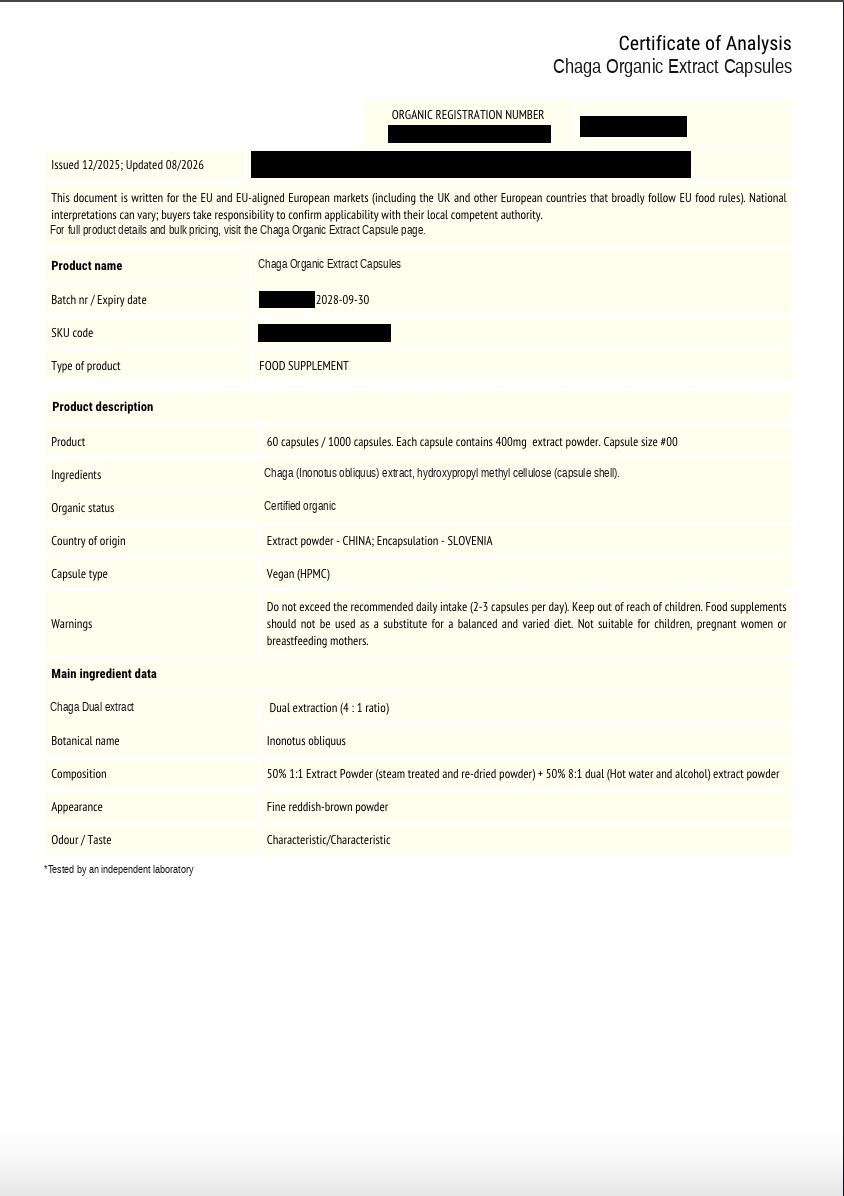
| Chaga | Inonotus obliquus | Conk | 50% 1:1 preparation + 50% 8:1 dual extract |
| Cordyceps CS-4 | Samsoniella hepiali | Mycelium | Hot water, 6:1 |
Reishi and Chaga each combine two differently prepared fractions. Reishi contains 50% 1:1 steam-treated extract powder and 50% 15:1 dual extract. Chaga contains 50% 1:1 extract powder and 50% 8:1 dual extract. We show the underlying formulation because it tells you more than reducing the preparation to a single headline ratio.
| Mushroom | Lead | Cadmium | Arsenic | Mercury |
|---|---|---|---|---|
| Lion's Mane | 0.19 | 0.096 | 0.06 | 0.005 |
| Reishi | 0.12 | 0.110 | 0.31 | 0.018 |
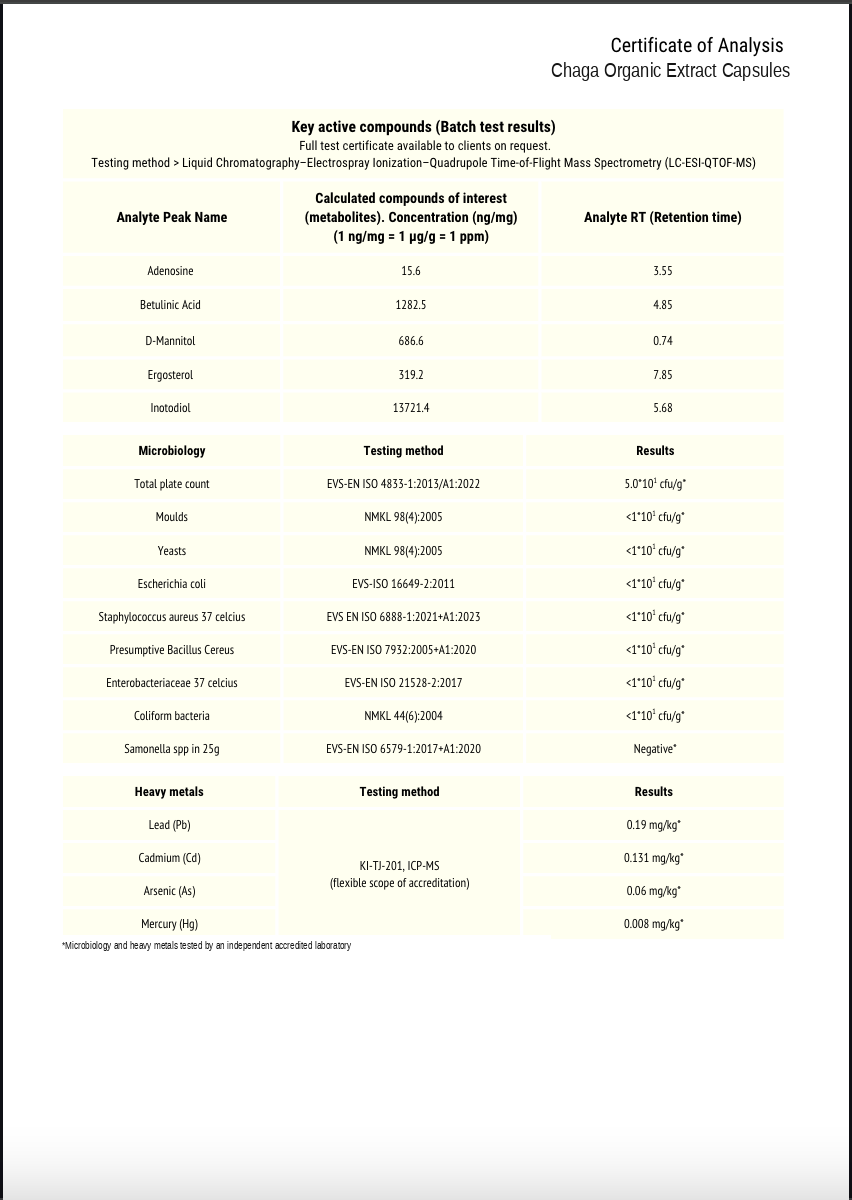
| Chaga | 0.19 | 0.131 | 0.06 | 0.008 |
| Cordyceps CS-4 | 0.15 | 0.030 | 0.07 | < 0.004 |
All by ICP-MS, described on the documents as sitting within a flexible scope of accreditation. Every result is a measured figure rather than a pass mark, which is what we'd want to see.
| Mushroom | What was measured | Method | Result |
|---|---|---|---|
| Lion's Mane | Beta-glucans | Megazyme K-YBGL | 27.06% |
| Lion's Mane | Polysaccharides | Megazyme K-YBGL | 32.23% |
| Reishi | Beta-glucans | Megazyme K-YBGL | 32.33% |
| Reishi | Polysaccharides | Megazyme K-YBGL | 35.32% |
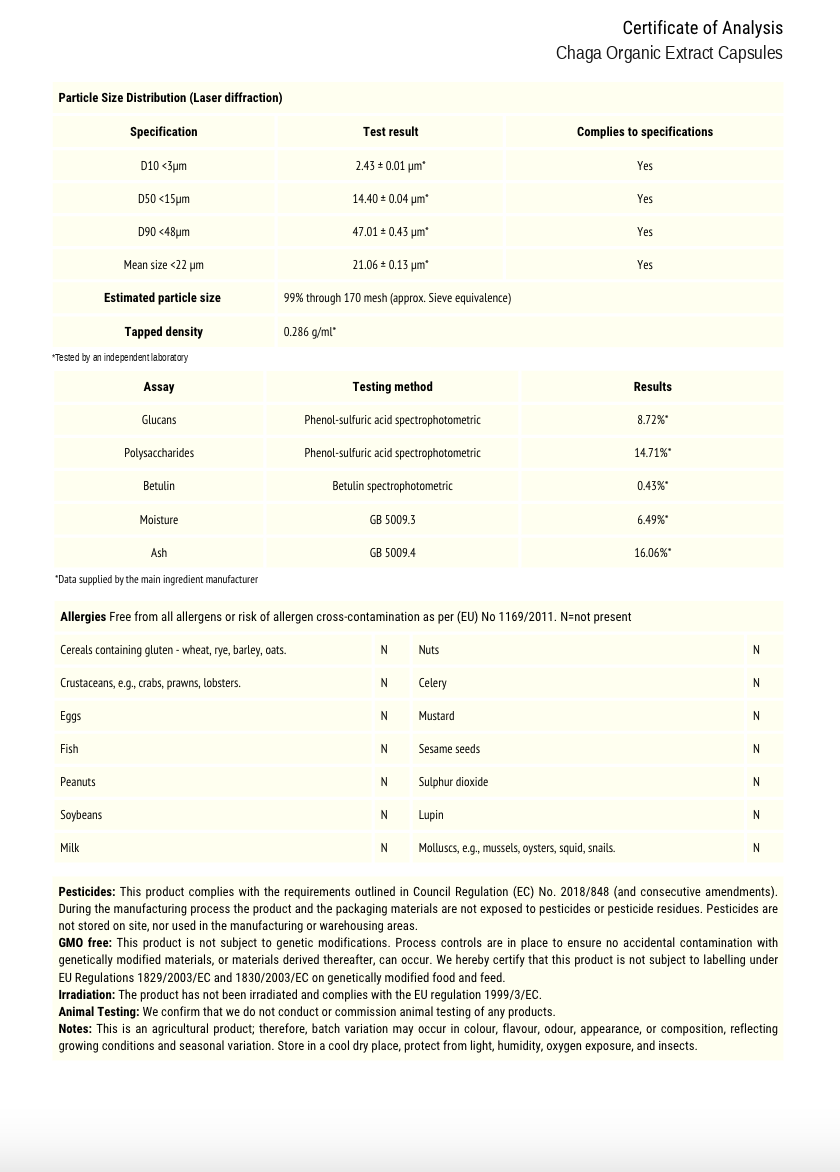
| Chaga † | Glucans | Phenol-sulfuric spectrophotometric | 8.72% |
| Chaga | Polysaccharides | Phenol-sulfuric spectrophotometric | 14.71% |
| Cordyceps CS-4 | Polysaccharides | Phenol-sulfuric spectrophotometric | 28.83% |
Read the method column before comparing anything in this table. More than one analytical approach is in use, and a figure produced by one method can't be ranked against a figure produced by another. There's more on this below.
† This row is currently under query. The certificate records this determination as glucans by phenol-sulfuric acid spectrophotometry, and that's what we've transcribed. Our supplier has since told us the figure is beta-glucans measured by the Megazyme method. We're showing what the certificate says rather than what we've been told, and we'll update this table if the documentation is revised.
Five things worth pointing out
Publishing documents is only useful if you also say what's in them. These are the things a careful reader would spot, so we'd rather raise them first.
1. Our Reishi label says Ganoderma lucidum. The identity analysis says Ganoderma lingzhi.
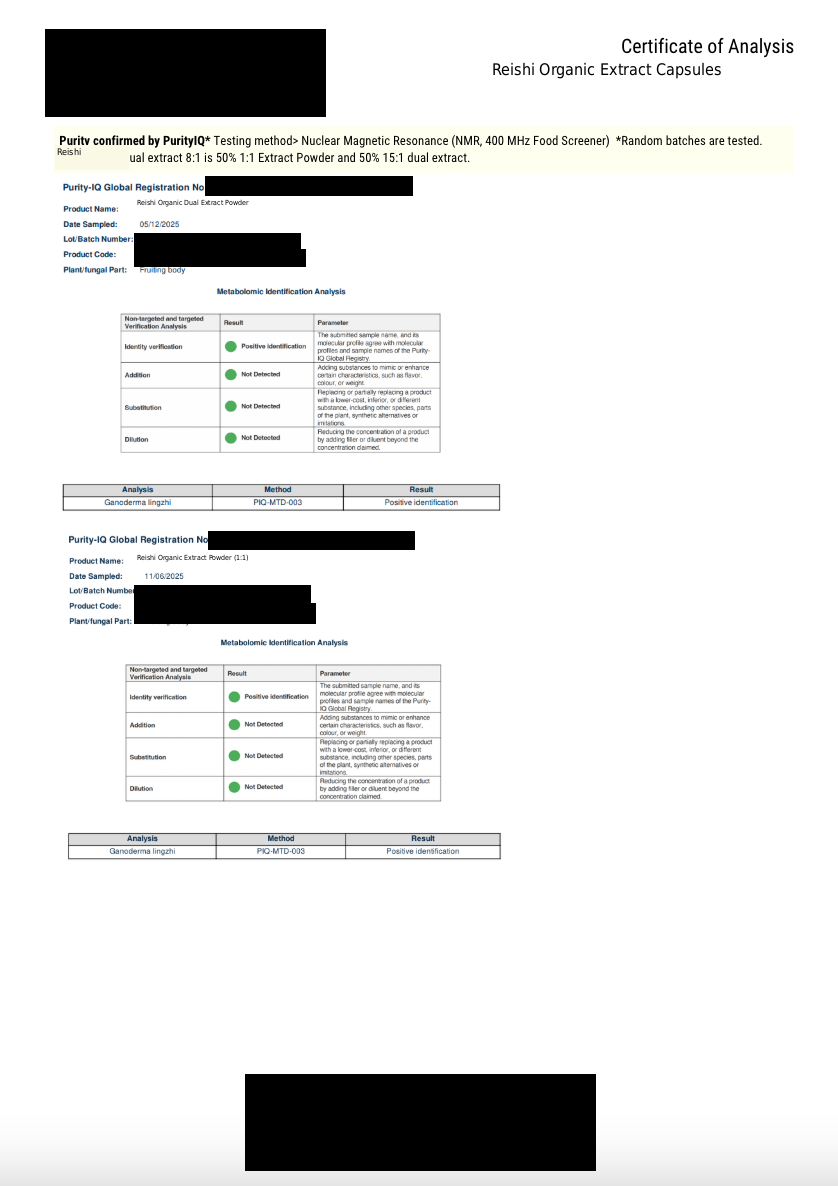
Page one of the Reishi document gives the botanical name as Ganoderma lucidum. Page two, where the NMR identity work sits, reports the analysis as Ganoderma lingzhi for both extract fractions.
This is the exact situation we described in our Reishi article before we published these documents. The name G. lucidum was applied broadly for decades to shiny Reishi-like fungi, and modern molecular work separates out several species, G. lingzhi among them. Research on commercial Reishi products has found that most material labelled G. lucidum is actually G. lingzhi.
So this isn't a surprise, and it doesn't necessarily indicate substitution. What it shows is that a product specification and an analytical identity report can use different taxonomic naming conventions for material sold historically as Reishi. We use Ganoderma lucidum on our label because that's the name used on the current product specification. We'd rather show you the G. lingzhi result than quietly leave the identity page out.
2. The glucan and polysaccharide figures aren't comparable across the four
Lion's Mane and Reishi were assayed with the Megazyme K-YBGL kit, which measures total glucans and alpha-glucans separately and calculates beta-glucans from the difference. That's the established approach for mushroom materials.
The Cordyceps figure is a total polysaccharide result by phenol-sulfuric acid spectrophotometry, which is a broader carbohydrate measurement. No glucan figure is reported for that material at all.
The Chaga certificate records glucans by phenol-sulfuric acid, and our supplier has since told us the figure is in fact beta-glucans by the Megazyme method. We're not going to resolve that by choosing whichever version reads better, so the table shows the certificate and flags the query.
Either way the wider point stands. Chaga's 8.72% and Lion's Mane's 27.06% aren't a ranking, because a number is only meaningful alongside the method that produced it and the fraction it refers to. Lining figures up as though one beats the other is exactly the mistake we warn about elsewhere.
3. The Cordyceps polysaccharide figure needs reading carefully
The Cordyceps extract preparation is described on the document as extract plus up to 20% water-soluble non-GMO maize starch, used as a processing carrier. The same document reports polysaccharides at 28.83% by phenol-sulfuric acid.
Maize starch is itself a polysaccharide. A broad carbohydrate method doesn't distinguish fungal polysaccharides from starch, so that 28.83% shouldn't be read as 28.83% fungal polysaccharide. We don't know from this document how the two contribute, and we're not going to guess. It's a good illustration of why we keep saying that the method behind a number matters more than the number.
4. Lion's Mane is fruiting body grown on a substrate that includes grain
The Lion's Mane document lists the culture medium as a blend of sawdust, organic wheat bran, organic rice and gypsum, and separately confirms the fungal part as fruiting body.
Those two facts sit together comfortably. Lion's Mane fruiting bodies are commonly grown on supplemented sawdust blocks, and the substrate is what the mushroom grows on, not what ends up in the extract. This is different from myceliated grain, where the fungus is grown through a cereal substrate and the whole thing is milled together. The same document declares gluten-containing cereals as not present in the finished material, and that's a supplier declaration rather than a test result we hold. The point below about allergen documentation applies here too.
5. The Cordyceps culture medium contains soybean flour
The Cordyceps specification states that soybean flour is used as part of the liquid fermentation medium. The supplier document also records soy as not present in the finished material.
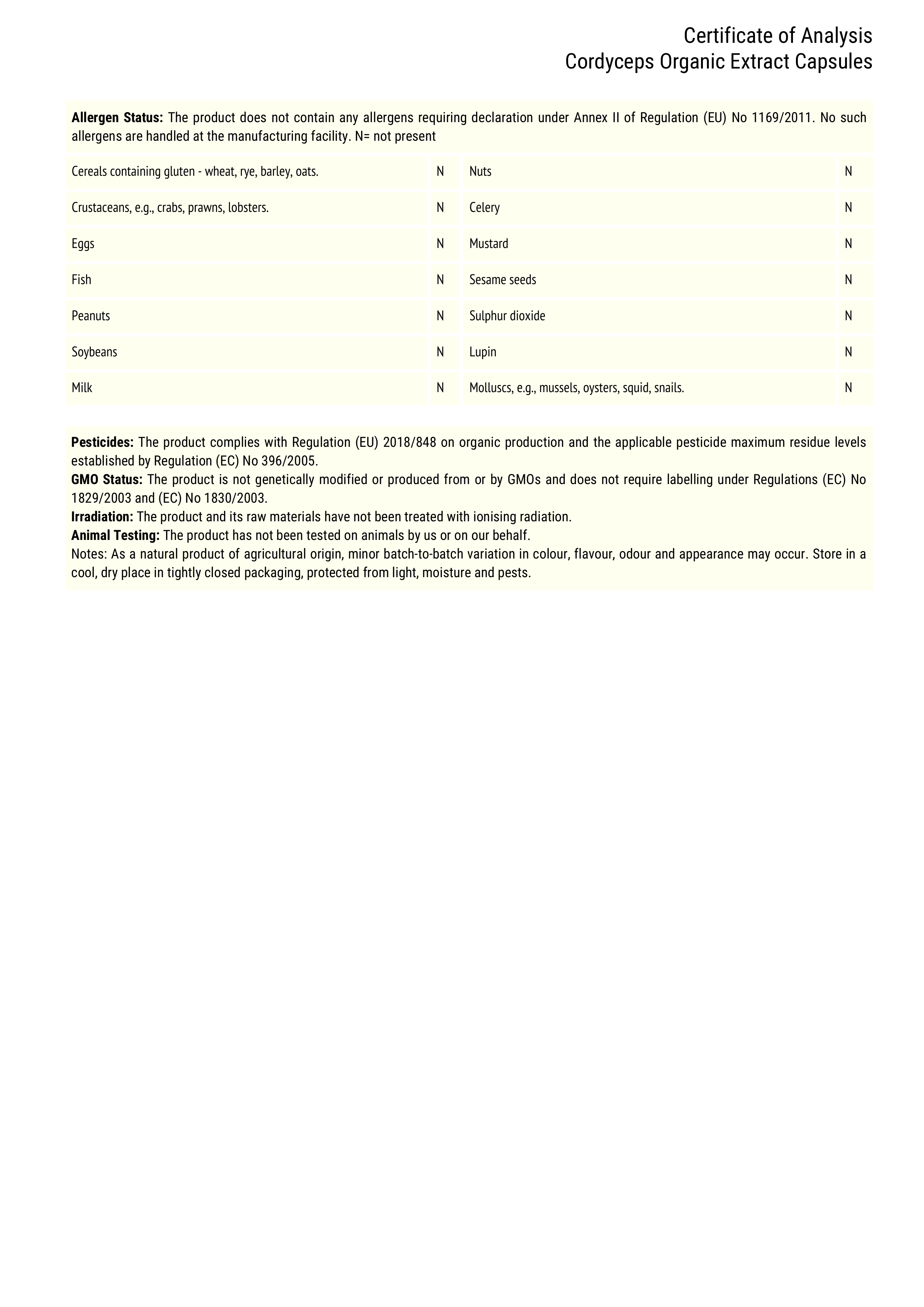
Soy is one of the fourteen allergens that must be declared in the UK, so we'd rather set out the position plainly than leave it in a table. That declaration is our supplier's, and we're not describing the product as soy-free or allergen-free on the strength of it. If you have a soy allergy, contact us before ordering and we'll tell you exactly what documentation we hold.
The same applies to the allergen declarations on the other three documents. They're supplier declarations, and we describe them that way rather than presenting them as tests we've commissioned.
Lion's Mane
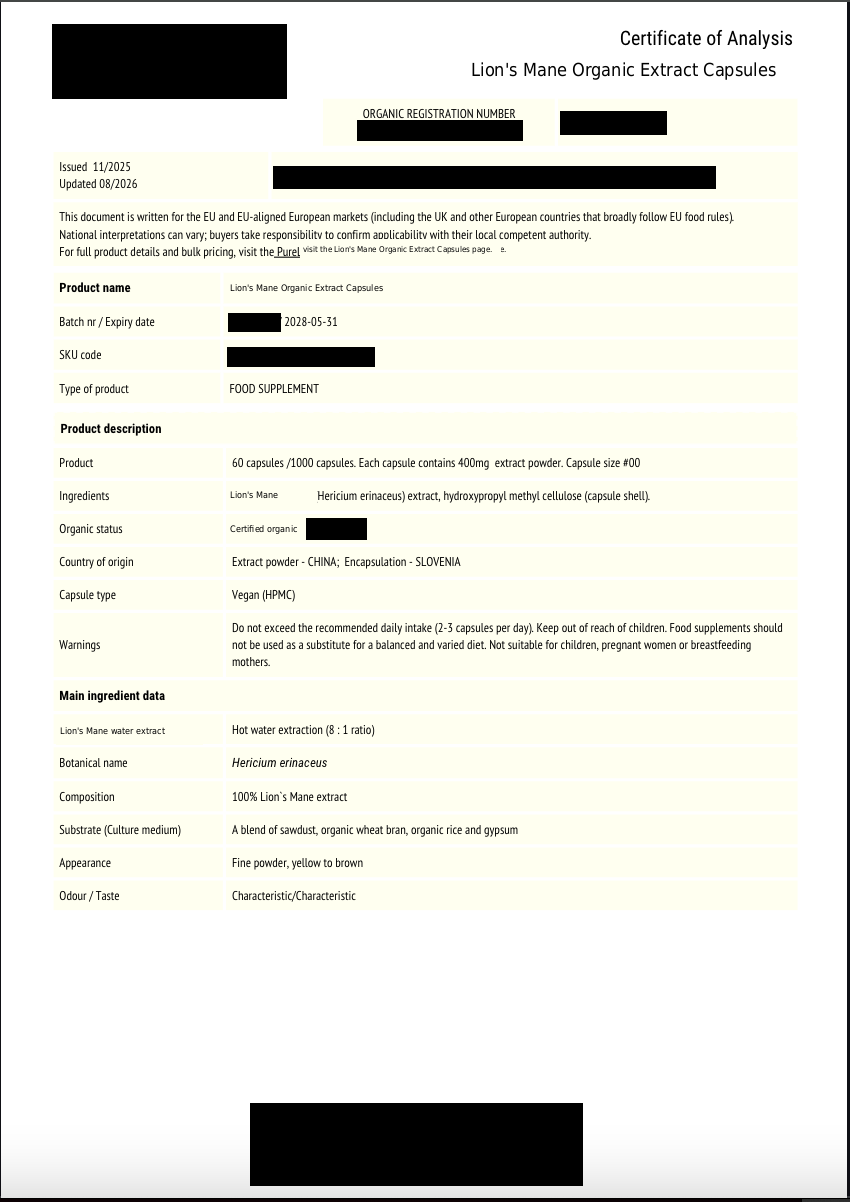
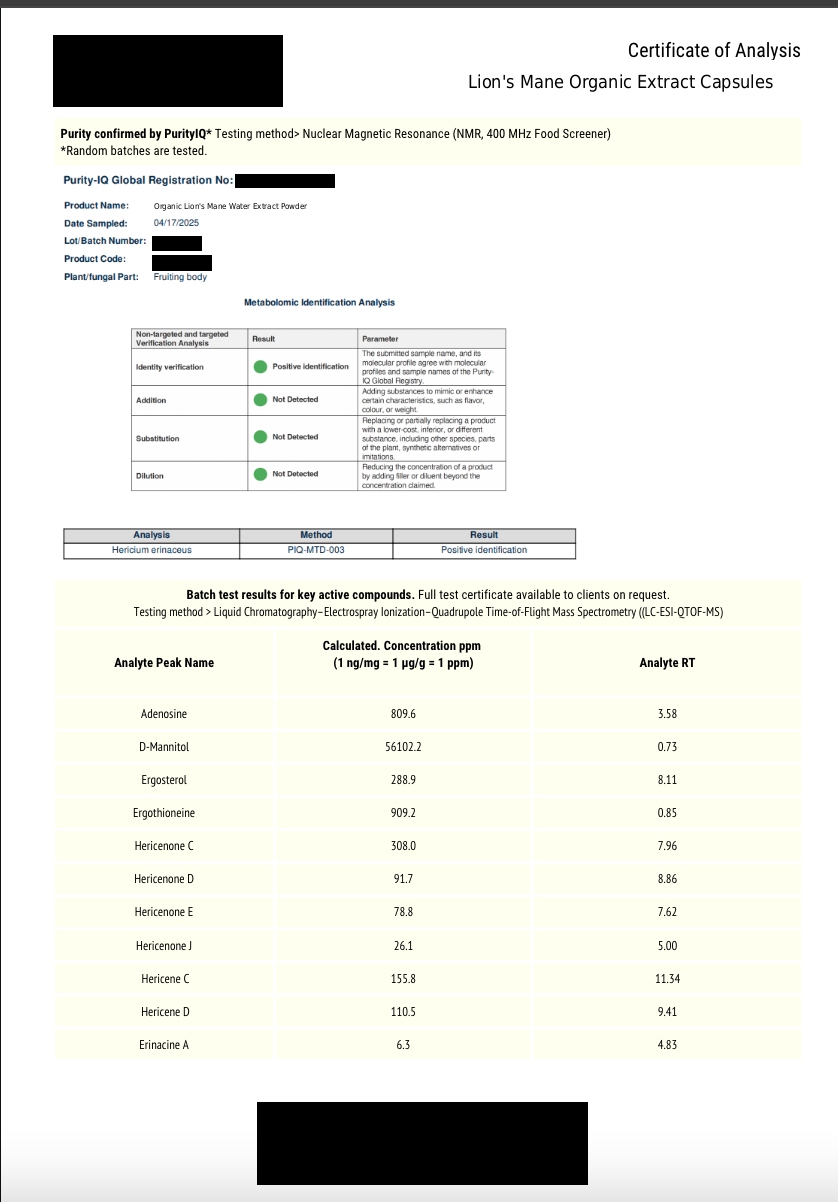
Supplier Certificate of Analysis for Lion's Mane Organic Extract Capsules. Issued 11/2025, updated 08/2026. Expiry 2028-05-31. Supplier batch reference held on file. Extract powder produced in China, encapsulated in Slovenia. NMR identity sampled 17 April 2025 on the raw extract powder.
| Item | Method | Result |
|---|---|---|
| Species | NMR, 400 MHz food screener | Hericium erinaceus, positive identification |
| Fungal part | Stated on report | Fruiting body |
| Addition | Metabolomic verification | Not detected |
| Substitution | Metabolomic verification | Not detected |
| Dilution | Metabolomic verification | Not detected |
| Analyte | Concentration | Retention time |
|---|---|---|
| D-Mannitol | 56,102.2 | 0.73 |
| Ergothioneine | 909.2 | 0.85 |
| Adenosine | 809.6 | 3.58 |
| Hericenone C | 308.0 | 7.96 |
| Ergosterol | 288.9 | 8.11 |
| Hericene C | 155.8 | 11.34 |
| Hericene D | 110.5 | 9.41 |
| Hericenone D | 91.7 | 8.86 |
| Hericenone E | 78.8 | 7.62 |
| Hericenone J | 26.1 | 5.00 |
| Erinacine A | 6.3 | 4.83 |
Erinacine A is worth a comment. Erinacines are principally associated with cultured mycelium rather than fruiting bodies, and our Lion's Mane article says that if a fruiting-body product claims them we'd want to see analytical evidence rather than an assumption. Here there is evidence, and it's small: 6.3 ppm, against 308 ppm for hericenone C. We're showing it because it's on the report, not because we think it supports a claim.
| Determination | Method | Result |
|---|---|---|
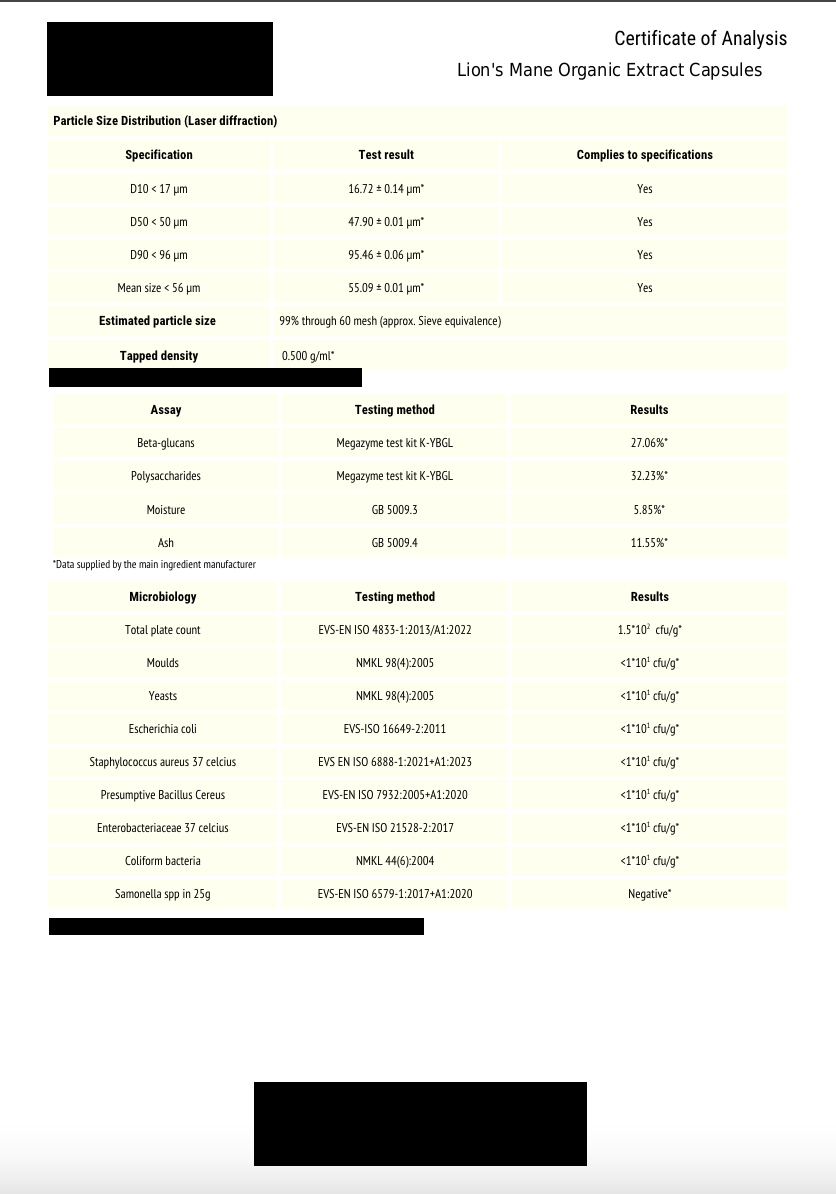
| Beta-glucans | Megazyme test kit K-YBGL | 27.06% |
| Polysaccharides | Megazyme test kit K-YBGL | 32.23% |
| Moisture | GB 5009.3 | 5.85% |
| Ash | GB 5009.4 | 11.55% |
| Extraction | Stated on report | Hot water, 8:1 |
| Culture medium | Stated on report | Sawdust, wheat bran, rice, gypsum |
| Determination | Method | Result |
|---|---|---|
| Total plate count | EVS-EN ISO 4833-1:2013/A1:2022 | 1.5 × 10² cfu/g |
| Moulds | NMKL 98(4):2005 | < 1 × 10¹ cfu/g |
| Yeasts | NMKL 98(4):2005 | < 1 × 10¹ cfu/g |
| Escherichia coli | EVS-ISO 16649-2:2011 | < 1 × 10¹ cfu/g |
| Staphylococcus aureus | EVS-EN ISO 6888-1:2021+A1:2023 | < 1 × 10¹ cfu/g |
| Presumptive Bacillus cereus | EVS-EN ISO 7932:2005+A1:2020 | < 1 × 10¹ cfu/g |
| Enterobacteriaceae | EVS-EN ISO 21528-2:2017 | < 1 × 10¹ cfu/g |
| Coliform bacteria | NMKL 44(6):2004 | < 1 × 10¹ cfu/g |
| Salmonella spp in 25 g | EVS-EN ISO 6579-1:2017+A1:2020 | Negative |
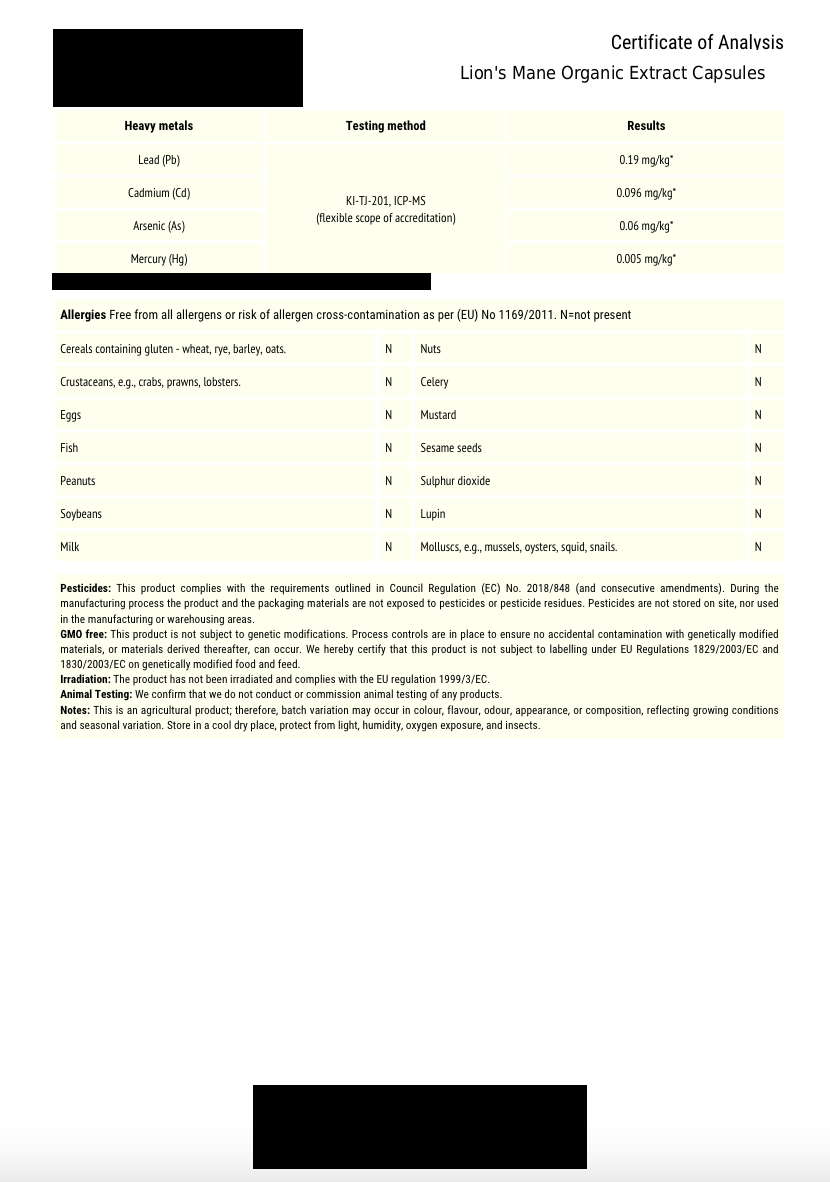
| Lead | ICP-MS | 0.19 mg/kg |
| Cadmium | ICP-MS | 0.096 mg/kg |
| Arsenic | ICP-MS | 0.06 mg/kg |
| Mercury | ICP-MS | 0.005 mg/kg |
The supplier document reports all fourteen declarable allergen categories as not present, and carries pesticide, GMO, irradiation and animal testing statements. These are supplier declarations rather than test results we hold. Point five above sets out our position on allergen documentation.
Reishi
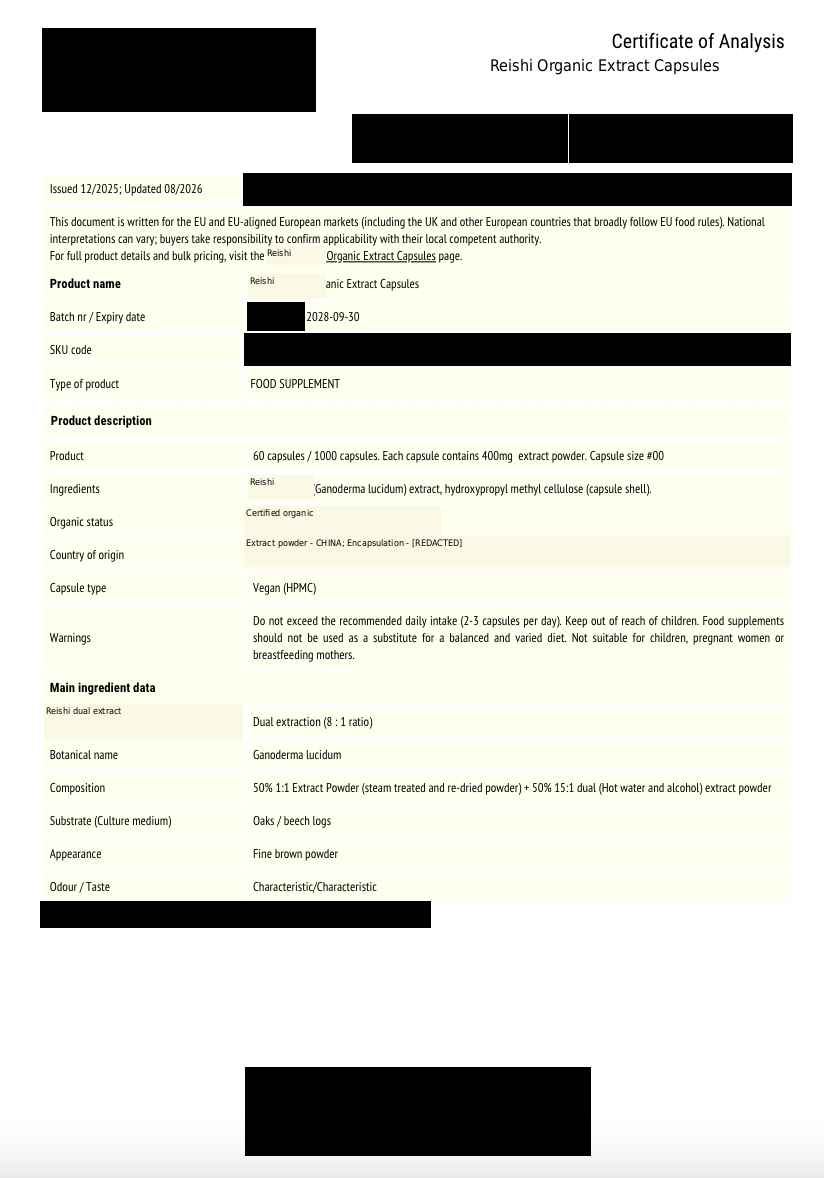
Supplier Certificate of Analysis for Reishi Organic Extract Capsules. Issued 12/2025, updated 08/2026. Expiry 2028-09-30. Supplier batch reference held on file. Extract powder produced in China. NMR identity sampled 12 May 2025 on the dual extract fraction and 6 November 2025 on the 1:1 fraction, both on raw extract powder.
| Item | Method | Result |
|---|---|---|
| Species on specification | Product specification | Ganoderma lucidum |
| Species, dual extract fraction | NMR, 400 MHz food screener | Ganoderma lingzhi, positive identification |
| Species, 1:1 fraction | NMR, 400 MHz food screener | Ganoderma lingzhi, positive identification |
| Fungal part | Stated on report | Fruiting body |
| Addition, substitution, dilution | Metabolomic verification | Not detected on either fraction |
See point one above for why the specification and the identity analysis give different species names.
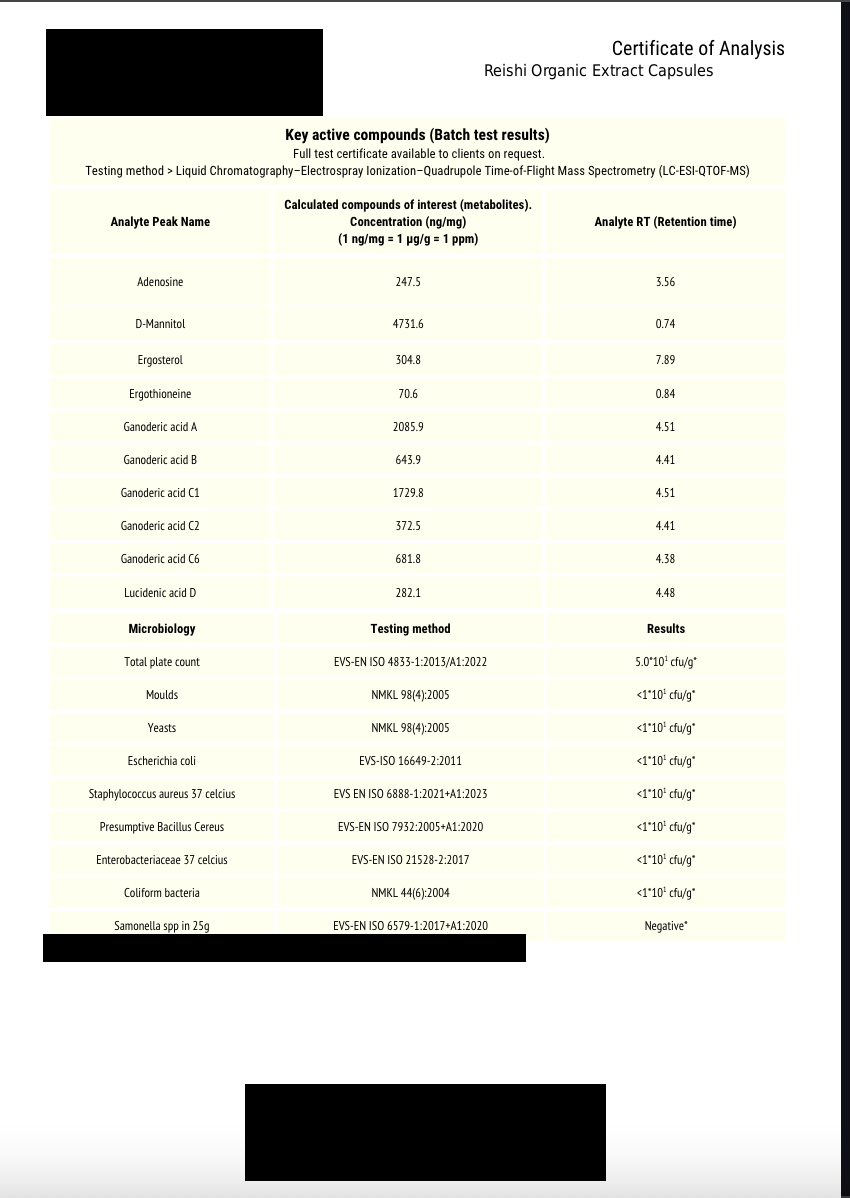
| Analyte | Concentration | Retention time |
|---|---|---|
| D-Mannitol | 4,731.6 | 0.74 |
| Ganoderic acid A | 2,085.9 | 4.51 |
| Ganoderic acid C1 | 1,729.8 | 4.51 |
| Ganoderic acid C6 | 681.8 | 4.38 |
| Ganoderic acid B | 643.9 | 4.41 |
| Ganoderic acid C2 | 372.5 | 4.41 |
| Ergosterol | 304.8 | 7.89 |
| Lucidenic acid D | 282.1 | 4.48 |
| Adenosine | 247.5 | 3.56 |
| Ergothioneine | 70.6 | 0.84 |
Five ganoderic acids and one lucidenic acid, detected and quantified rather than assumed from the species name. This is the compound profile our Reishi article refers to.
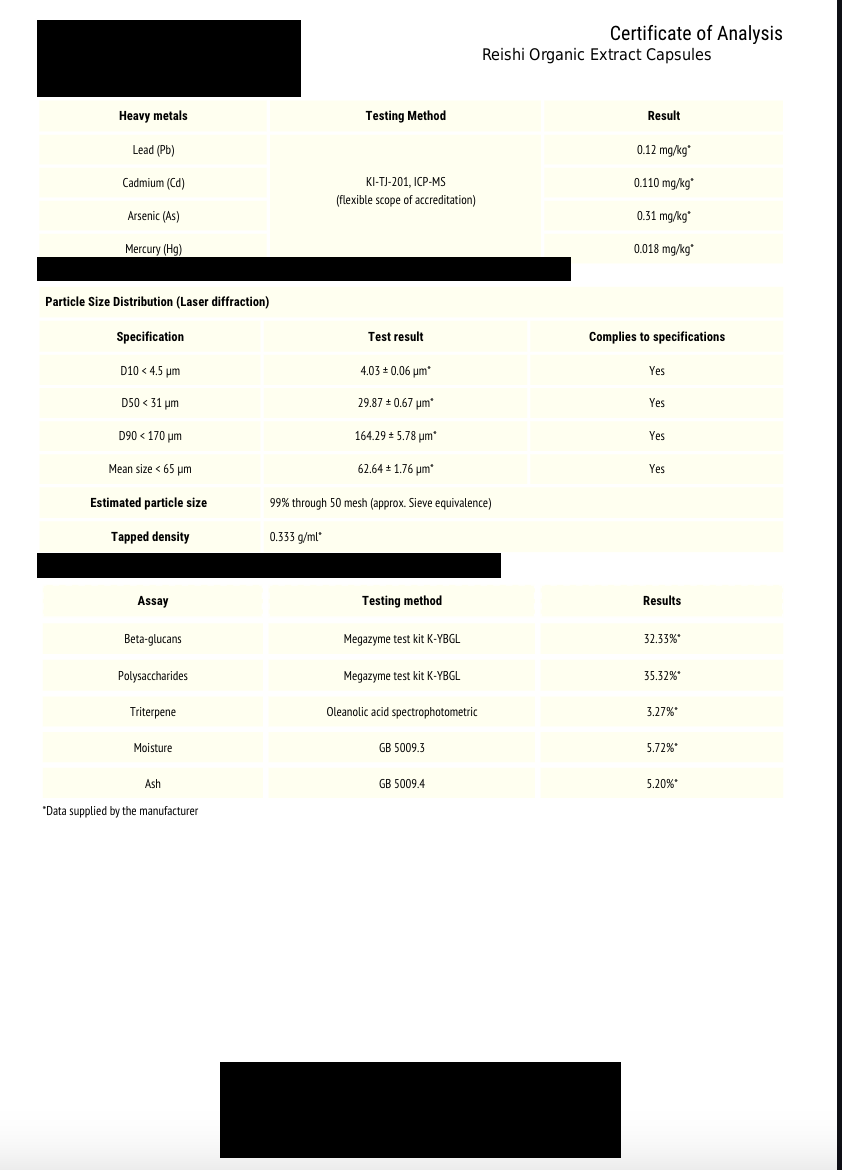
| Determination | Method | Result |
|---|---|---|
| Beta-glucans | Megazyme test kit K-YBGL | 32.33% |
| Polysaccharides | Megazyme test kit K-YBGL | 35.32% |
| Triterpene | Oleanolic acid spectrophotometric | 3.27% |
| Moisture | GB 5009.3 | 5.72% |
| Ash | GB 5009.4 | 5.20% |
| Composition | Stated on report | 50% 1:1 plus 50% 15:1 dual |
| Culture medium | Stated on report | Oak and beech logs |
| Determination | Method | Result |
|---|---|---|
| Total plate count | EVS-EN ISO 4833-1:2013/A1:2022 | 5.0 × 10¹ cfu/g |
| Moulds and yeasts | NMKL 98(4):2005 | < 1 × 10¹ cfu/g |
| Escherichia coli | EVS-ISO 16649-2:2011 | < 1 × 10¹ cfu/g |
| Staphylococcus aureus | EVS-EN ISO 6888-1:2021+A1:2023 | < 1 × 10¹ cfu/g |
| Presumptive Bacillus cereus | EVS-EN ISO 7932:2005+A1:2020 | < 1 × 10¹ cfu/g |
| Enterobacteriaceae | EVS-EN ISO 21528-2:2017 | < 1 × 10¹ cfu/g |
| Coliform bacteria | NMKL 44(6):2004 | < 1 × 10¹ cfu/g |
| Salmonella spp in 25 g | EVS-EN ISO 6579-1:2017+A1:2020 | Negative |
| Lead | ICP-MS | 0.12 mg/kg |
| Cadmium | ICP-MS | 0.110 mg/kg |
| Arsenic | ICP-MS | 0.31 mg/kg |
| Mercury | ICP-MS | 0.018 mg/kg |
At 0.31 mg/kg, this is the highest arsenic result among the four extracts. We publish the measured result rather than reducing it to a pass mark.
Chaga
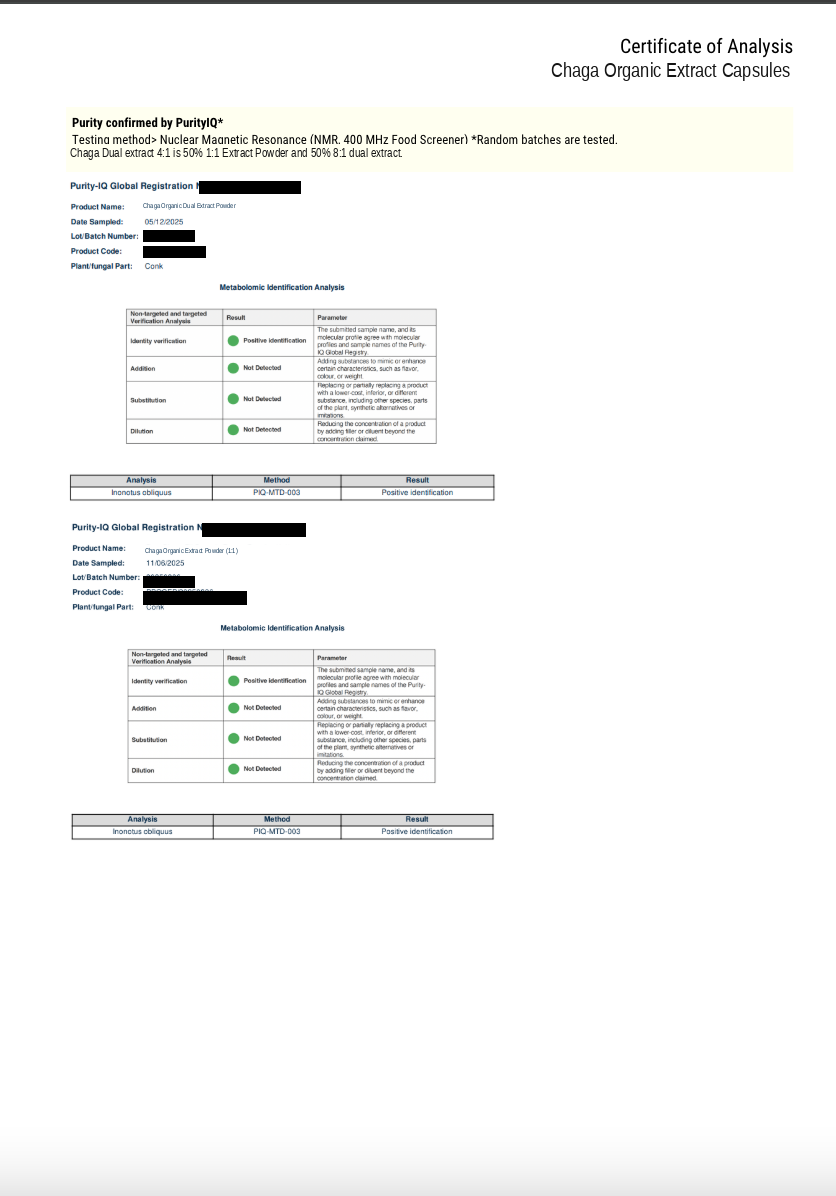
Supplier Certificate of Analysis for Chaga Organic Extract Capsules. Issued 12/2025, updated 08/2026. Expiry 2028-09-30. Supplier batch reference held on file. Extract powder produced in China, encapsulated in Slovenia. NMR identity sampled 12 May 2025 on the dual extract fraction and 6 November 2025 on the 1:1 fraction. Microbiology and heavy metals described on the document as tested by an independent accredited laboratory.
| Item | Method | Result |
|---|---|---|
| Species, both fractions | NMR, 400 MHz food screener | Inonotus obliquus, positive identification |
| Fungal part | Stated on report | Conk |
| Addition, substitution, dilution | Metabolomic verification | Not detected on either fraction |
Chaga is the one material in the range where the fungal part isn't a fruiting body or mycelium. The document records it as conk, which is the terminology we use on the product and throughout the guide.
| Analyte | Concentration | Retention time |
|---|---|---|
| Inotodiol | 13,721.4 | 5.68 |
| Betulinic acid | 1,282.5 | 4.85 |
| D-Mannitol | 686.6 | 0.74 |
| Ergosterol | 319.2 | 7.85 |
| Adenosine | 15.6 | 3.55 |
Inotodiol and betulinic acid are the two compounds most closely associated with birch-grown Chaga, and both are quantified here rather than inferred.
| Determination | Method | Result |
|---|---|---|
| Glucans † | Phenol-sulfuric acid spectrophotometric | 8.72% |
| Polysaccharides | Phenol-sulfuric acid spectrophotometric | 14.71% |
| Betulin | Betulin spectrophotometric | 0.43% |
| Moisture | GB 5009.3 | 6.49% |
| Ash | GB 5009.4 | 16.06% |
| Composition | Stated on report | 50% 1:1 plus 50% 8:1 dual |
† Under query. The certificate reports this as glucans by phenol-sulfuric acid, which is what the table shows. Our supplier has since told us it's beta-glucans by the Megazyme method, which would change both what the number means and how it compares with the Lion's Mane and Reishi results. We'll update this table if the certificate is revised.
There's no culture medium row because Chaga conk is harvested rather than cultivated. The composition row gives the two fractions rather than a combined ratio, for the reason set out in the first table above.
| Determination | Method | Result |
|---|---|---|
| Total plate count | EVS-EN ISO 4833-1:2013/A1:2022 | 5.0 × 10¹ cfu/g |
| Moulds and yeasts | NMKL 98(4):2005 | < 1 × 10¹ cfu/g |
| Escherichia coli | EVS-ISO 16649-2:2011 | < 1 × 10¹ cfu/g |
| Staphylococcus aureus | EVS-EN ISO 6888-1:2021+A1:2023 | < 1 × 10¹ cfu/g |
| Presumptive Bacillus cereus | EVS-EN ISO 7932:2005+A1:2020 | < 1 × 10¹ cfu/g |
| Enterobacteriaceae | EVS-EN ISO 21528-2:2017 | < 1 × 10¹ cfu/g |
| Coliform bacteria | NMKL 44(6):2004 | < 1 × 10¹ cfu/g |
| Salmonella spp in 25 g | EVS-EN ISO 6579-1:2017+A1:2020 | Negative |
| Lead | ICP-MS | 0.19 mg/kg |
| Cadmium | ICP-MS | 0.131 mg/kg |
| Arsenic | ICP-MS | 0.06 mg/kg |
| Mercury | ICP-MS | 0.008 mg/kg |
Cordyceps CS-4
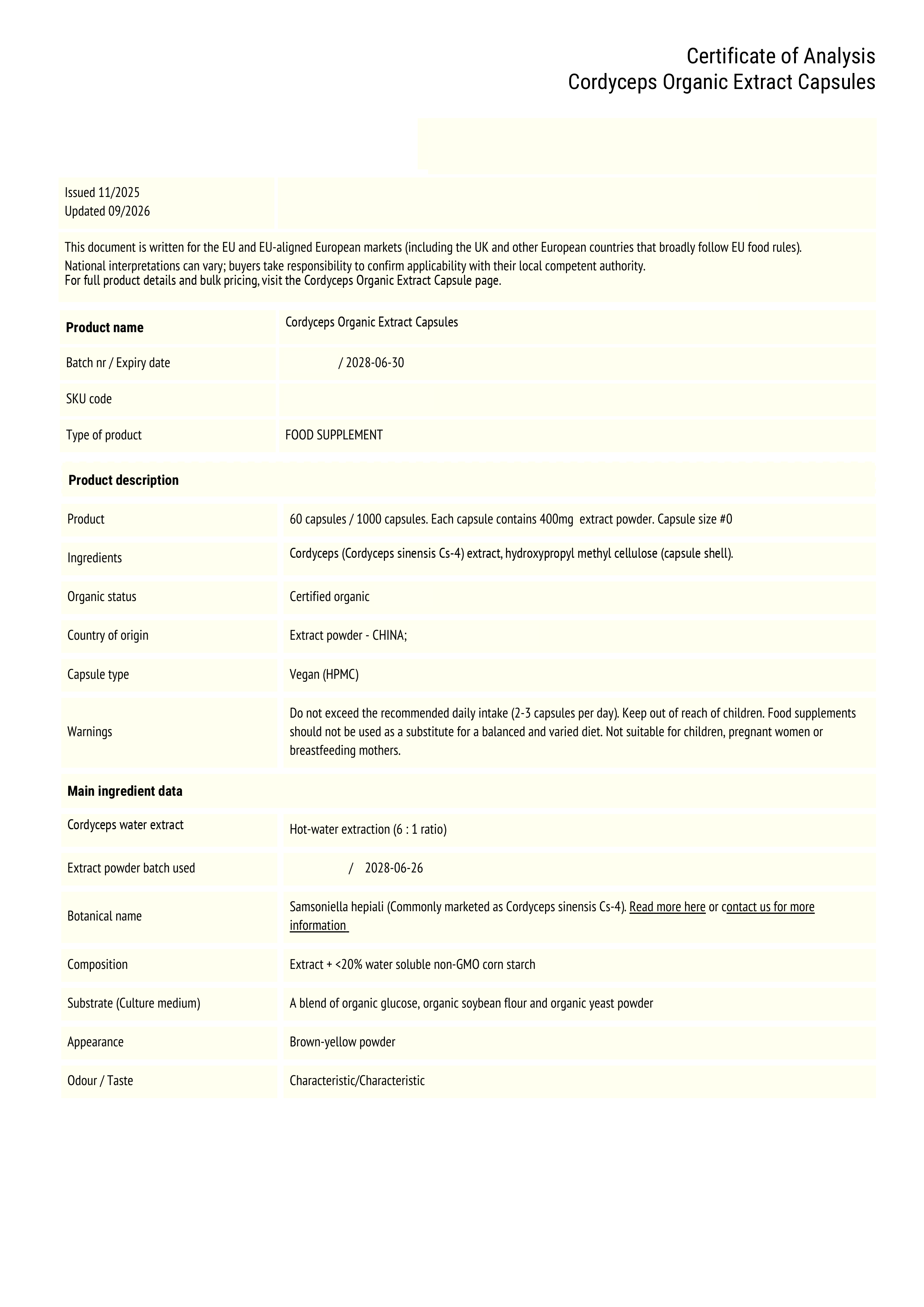
Supplier Certificate of Analysis for Cordyceps Organic Extract Capsules. Issued 11/2025, updated 09/2026. Expiry 2028-06-30. Supplier batch reference held on file. Extract powder produced in China. NMR identity and LC-MS compound work carried out on the raw extract powder, with no NMR sample date printed. Capsule size #0, where the other three use #00.
| Item | Method | Result |
|---|---|---|
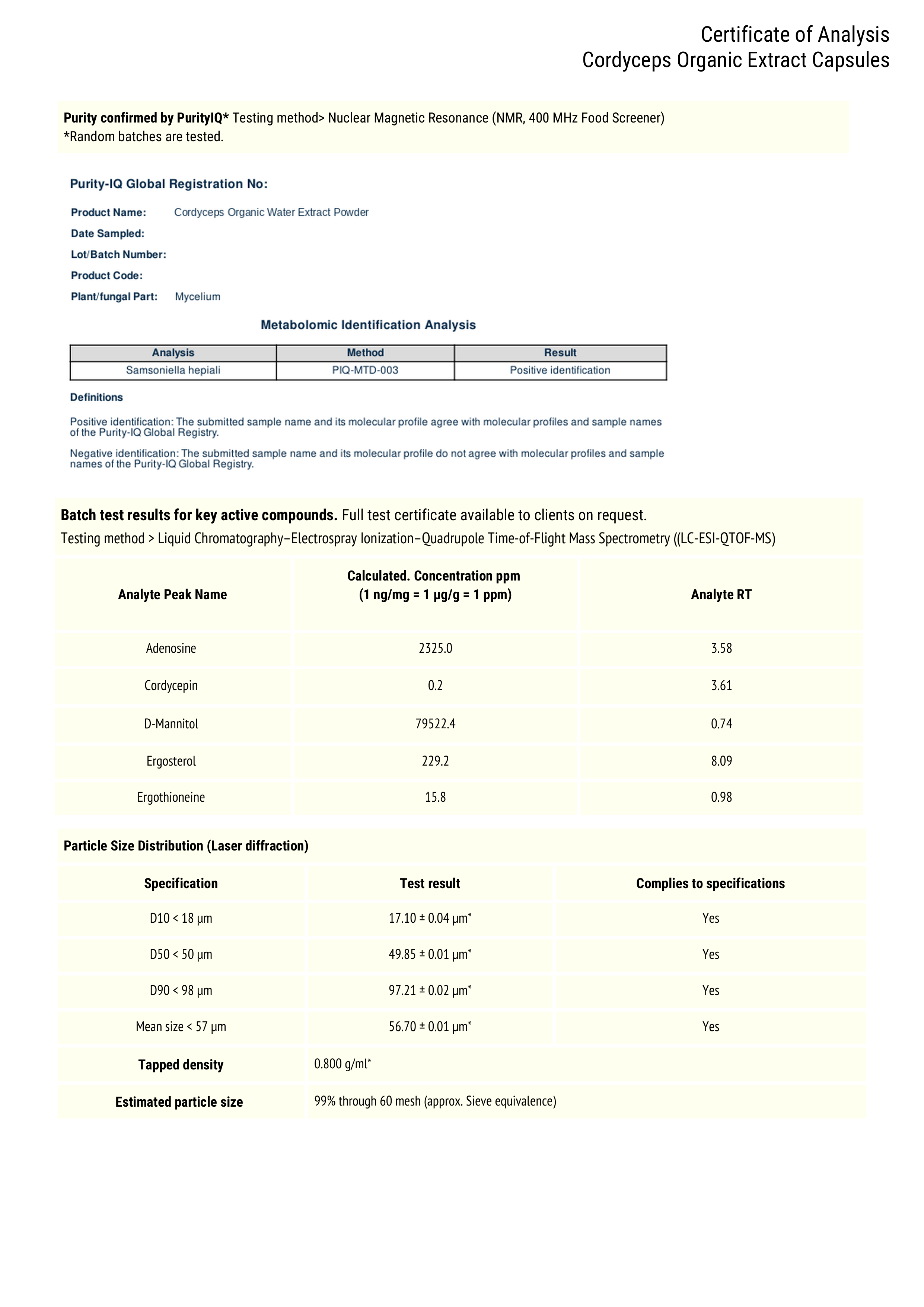
| Species | NMR, 400 MHz food screener | Samsoniella hepiali, positive identification |
| Species on specification | Product specification | Samsoniella hepiali, commonly marketed as Cordyceps sinensis Cs-4 |
| Fungal part | Stated on report | Mycelium |
This is the one product in the range where the specification and the identity analysis agree on a modern name. Samsoniella hepiali is where current taxonomy places the fungus historically described as Paecilomyces hepiali and sold as CS-4. The document says so on its own front page, which we think is to the manufacturer's credit.
| Analyte | Concentration | Retention time |
|---|---|---|
| D-Mannitol | 79,522.4 | 0.74 |
| Adenosine | 2,325.0 | 3.58 |
| Ergosterol | 229.2 | 8.09 |
| Ergothioneine | 15.8 | 0.98 |
| Cordycepin | 0.2 | 3.61 |
Cordycepin at 0.2 ppm is worth dwelling on, because cordycepin is heavily marketed across the Cordyceps category. It's strongly associated with Cordyceps militaris rather than with CS-4, and this result shows what that means in practice: adenosine here is roughly ten thousand times more abundant. If you're buying CS-4 for cordycepin, this document is a good reason to reconsider.
| Determination | Method | Result |
|---|---|---|
| Polysaccharides | Phenol-sulfuric acid spectrophotometric | 28.83% |
| Moisture | GB 5009.3 | 3.29% |
| Ash | GB 5009.4 | 8.22% |
| Extraction | Stated on report | Hot water, 6:1 |
| Composition | Stated on report | Extract plus < 20% maize starch |
| Culture medium | Stated on report | Glucose, soybean flour, yeast powder |
No beta-glucan figure is reported for this material, only total polysaccharides by a broad carbohydrate method. See point three above for why the 28.83% shouldn't be read as fungal polysaccharide alone. The culture medium is a liquid fermentation broth rather than a cereal substrate, which is consistent with how CS-4 is produced. It includes soybean flour, and point five above explains where we've got to on allergen documentation.
| Determination | Method | Result |
|---|---|---|
| Total plate count | EVS-EN ISO 4833-1:2013/A1:2022 | 1 × 10³ cfu/g |
| Moulds and yeasts | NMKL 98(4):2005 | < 1 × 10¹ cfu/g |
| Escherichia coli | EVS-ISO 16649-2:2011 | < 1 × 10¹ cfu/g |
| Staphylococcus aureus | EVS-EN ISO 6888-1:2021+A1:2023 | < 1 × 10¹ cfu/g |
| Presumptive Bacillus cereus | EVS-EN ISO 7932:2005+A1:2020 | < 1 × 10¹ cfu/g |
| Enterobacteriaceae | EVS-EN ISO 21528-2:2017 | < 1 × 10¹ cfu/g |
| Coliform bacteria | NMKL 44(6):2004 | < 1 × 10¹ cfu/g |
| Salmonella spp in 25 g | EVS-EN ISO 6579-1:2017+A1:2020 | Negative |
| Lead | ICP-MS | 0.15 mg/kg |
| Cadmium | ICP-MS | 0.030 mg/kg |
| Arsenic | ICP-MS | 0.07 mg/kg |
| Mercury | ICP-MS | < 0.004 mg/kg |
At 1 × 10³ cfu/g, the total plate count here is the highest of the four, and the document records it as within its own specification. Every specific organism test returned below the limit of detection. We mention it because it's the one microbiological figure in the set that isn't the lowest possible number, and we'd rather point it out than let you find it.

What comes next
Everything on this page is supplier-issued. That's a real limitation and we're not going to dress it up as something else.
Supplier documentation of this quality is still useful. It names methods, it gives measured results rather than pass marks, it identifies the fungal part, and it includes compound profiling that goes considerably beyond a basic headline specification. But it was produced by the company that sells us the material, and no amount of detail changes that.
Our next step is independent finished-product testing commissioned by One Life Foods, on the capsules as they ship rather than on the extract before encapsulation. That's the layer these documents can't provide. When we have those results we'll publish them here alongside the supplier documents, and we'll say plainly where the two agree and where they don't.
We'll keep this page current as documentation changes, rather than leaving it as a snapshot of one moment.
Checking a document against your jar
These certificates identify the supplier's laboratory sample and batch references, most of which are redacted. If you want to confirm which document covers the bottle you have, send us the lot code printed on it and we'll tell you.
Shop the range
See the products these documents relate to
Lion's Mane, Reishi, Chaga and Cordyceps CS-4, each sold individually rather than as a fixed blend.
Browse functional mushroomsTo understand how to read any of this for yourself, start with how to read a mushroom Certificate of Analysis, then how we test mushroom extracts for the analytical techniques behind these numbers. The full Mushroom Guide puts the paperwork in context with the rest of the product.
Last reviewed: September 2026