


Pure Mongolian Shilajit Resin
Secure & flexible ways to pay
Defined fulvic and humic profile. Smooth Mongolian Altai resin.
Sourced from the Mongolian Altai in western Mongolia and supplied as a purified, single-ingredient resin.
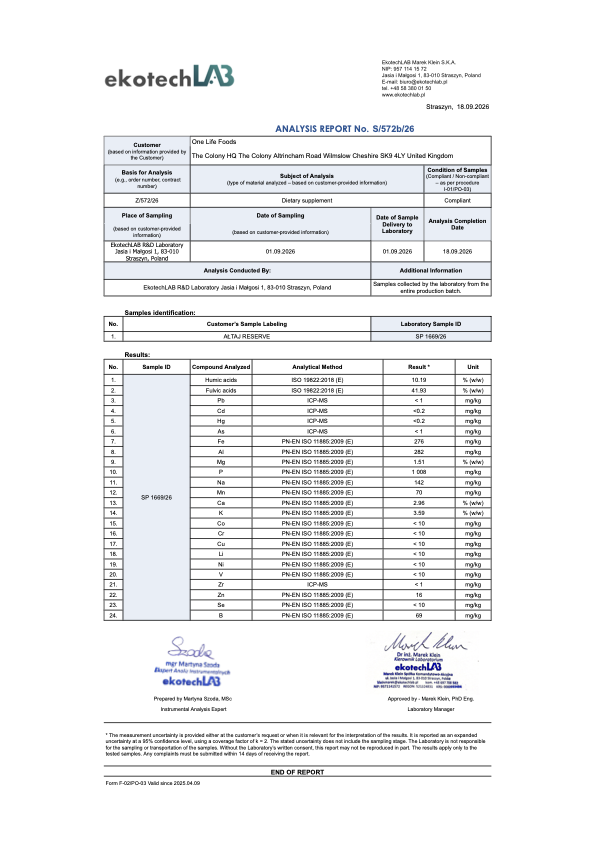
The current published analysis returned substantial measured fulvic and humic fractions using ISO 19822:2018. At 51.93% fulvic acids and 10.19% humic acids, Mongolian Altai has one of the highest measured humic fractions in our regional range, alongside a distinct elemental profile.
That does not make Mongolian Altai universally better or establish a measure of potency. It gives the product a clear compositional identity for customers who want to consider both measured fractions rather than selecting primarily on one headline percentage.
25 g | Purified resin | Dispatched from the UK
-
Pure Mongolian Altai Shilajit resin
-
Sourced from the Mongolian Altai in western Mongolia
-
51.93% fulvic acids and 10.19% humic acids in the current published analysis
-
Fulvic and humic substances analysed using ISO 19822:2018
-
Detailed eighteen-element analytical panel, with ten elements quantified
-
Published heavy-metal analysis, with current-batch water-content and microbiology testing pending
-
No fillers, carriers or unnecessary ingredients
-
Held and dispatched from within the UK
View the published Mongolian Altai testing
The September 2026 analysis covers humic substances, elemental composition and heavy metals. Water-content and microbiological testing have also been commissioned for the current batch, with results to be added when available.
Overview
Mongolian Altai occupies a distinctive position within our regional Shilajit range.
Hunza currently has the highest measured fulvic acid result, while Hindu Kush has the highest measured humic acid result. Mongolian Altai sits between these profiles, with substantial measured amounts of both fractions.
Its current published analysis returned:
-
51.93% fulvic acids
-
10.19% humic acids
The humic acid result is particularly close to Hindu Kush at 10.40%, while its fulvic concentration remains higher than those measured in Siberian Altai and Kashmiri.
These figures do not create a ranking of potency or effectiveness. They describe the chemical fractions measured in a particular sample.
Mongolian Altai also has a smoother, less astringent sensory character than the Kashmiri resin, giving it a distinctive but relatively approachable traditional resin experience.
Why Choose Mongolian Altai?
Substantial measured fulvic and humic fractions
The current published analysis returned:
-
51.93% fulvic acids
-
10.19% humic acids
Both were measured using ISO 19822:2018.
Shilajit is often compared using whichever single percentage looks most impressive. That approach overlooks the fact that fulvic and humic substances are different fractions within a complex organic-mineral material.
Mongolian Altai does not have the highest individual result for either fraction. What distinguishes the tested resin is the combination of a comparatively high fulvic result with one of the highest measured humic concentrations in our current range.
That does not:
-
Represent an official potency scale
-
Demonstrate greater absorption
-
Establish a health benefit
-
Prove superior effectiveness
-
Mean that higher percentages are inherently better
Its value is compositional rather than an implied physiological advantage.
For customers who want to consider both fractions when comparing regional resins, Mongolian Altai has a clearly differentiated analytical profile within our current range.
Mongolian Altai Origin
This resin is sourced from the Mongolian Altai in Bayan-Ölgii, western Mongolia.
The Mongolian and Siberian Altai share the wider Altai mountain name, but that does not make them chemically identical sources.
The mountain system extends across several countries, encompassing different geological formations, climates and collection environments. The Mongolian section has a distinct geological character from the older Precambrian formations further north in Siberia.
Our published analyses show differences between the two tested products in areas including:
-
Fulvic acid measurements
-
Humic acid measurements
-
Elemental composition
-
Reported mineral concentrations
-
Sensory character
Mongolian Altai, for example, has a higher measured magnesium concentration than our Siberian Altai resin, while Siberian Altai returned higher potassium, calcium and iron results.
This illustrates why “Altai Shilajit” is too broad a description to function as a precise compositional category.
Origin provides geographic context. Laboratory analysis provides information about the material in the tested product.
For the wider comparison, read Altai vs Himalayan Shilajit: Which Is Better?.
Smooth, Earthy and Rounded
Mongolian Altai has a relatively approachable sensory character within our regional range.
It has:
-
A mild, earthy aroma
-
A smooth, mineral-like flavour
-
Less pronounced astringency than the Kashmiri resin
-
Medium viscosity
-
A dark brown to black appearance when dispersed
-
A natural semi-gloss finish in the jar
These characteristics describe the product's taste, appearance and handling. They are not measurements of potency or effectiveness.
Its texture naturally changes with temperature and may become firmer when cool and softer when warm.
Some fine material may remain visible after the resin has dispersed and the drink has been left to stand. Fine sediment can form part of the natural material and is not, by itself, evidence of contamination or poor quality.
Equally, the presence of visible residue is not proof of authenticity. The nature of any remaining material matters, and solubility alone cannot establish the overall quality or safety of Shilajit.
For customers who prefer a traditional resin without the pronounced smoky and astringent character of Kashmiri, Mongolian Altai offers a comparatively rounded sensory experience.
Read Does Shilajit Completely Dissolve? Fine Residue Explained for more detail.
Fulvic and Humic Composition
Shilajit is not a single isolated substance.
It is a variable organic-mineral matrix containing different chemical fractions, including:
-
Fulvic substances
-
Humic substances
-
Minerals and trace elements
-
Other naturally occurring organic material
The current Mongolian Altai results are:
| Fraction | Current published result |
|---|---|
| Fulvic acids | 51.93% w/w |
| Humic acids | 10.19% w/w |
Both results were produced using ISO 19822:2018.
These measurements provide a defined basis for describing the tested resin. They do not establish a recognised measure of quality, potency or effectiveness.
Different laboratory methods can produce substantially different fulvic and humic percentages. Results should therefore be compared with consideration of the analytical method and reporting basis.
A percentage without information about how it was obtained is of limited value, particularly when comparing certificates from different suppliers.
Read Fulvic Acid in Shilajit: Which Test Can You Trust? for a more detailed explanation.
How the Fulvic and Humic Profile Compares
Our current published regional analyses show five different measured profiles.
Hunza has the highest fulvic acid result at 64.13%, but its humic fraction is considerably lower at 1.16%.
Hindu Kush has the highest measured humic concentration at 10.40%, alongside 59.53% fulvic acids. Mongolian Altai follows closely on humic acids at 10.19%, with a fulvic result of 51.93%.
Kashmiri and Siberian Altai have lower measured fulvic concentrations, alongside their own distinct humic and elemental profiles.
Mongolian Altai therefore sits within the range as a resin containing substantial measured amounts of both fractions, rather than being distinguished by the highest individual percentage.
The fuller comparison also includes mineral content, which provides a different perspective on the composition of each tested resin.
These comparisons relate to the products and batches currently analysed. They should not be treated as permanent characteristics of every Shilajit resin associated with each region.
The complete five-origin table, including direct links to the other products, appears in How Mongolian Altai Fits Within Our Range below.
A Detailed Elemental Profile
The current Mongolian Altai report also includes an eighteen-element analytical panel.
Ten elements returned numerical concentrations, while the remaining results were reported below their respective laboratory thresholds.
The September 2026 analysis returned a measured elemental total of 8.25% in our current regional comparison.
Selected results include:
| Element | Current published result |
|---|---|
| Potassium | 3.59% w/w |
| Calcium | 2.96% w/w |
| Magnesium | 1.51% w/w |
| Phosphorus | 1,008 mg/kg |
| Aluminium | 282 mg/kg |
| Iron | 276 mg/kg |
| Sodium | 142 mg/kg |
| Manganese | 70 mg/kg |
| Boron | 69 mg/kg |
| Zinc | 16 mg/kg |
| Copper | Below 10 mg/kg |
These figures describe the composition of the tested product.
Potassium, calcium and magnesium account for most of the quantified elemental total. The magnesium result is more than three times that of our Siberian Altai sample, while the reported phosphorus, aluminium and manganese concentrations also distinguish Mongolian Altai within the current regional comparison.
The phosphorus result of 1,008 mg/kg and aluminium result of 282 mg/kg are the highest reported in our current range. Manganese, at 70 mg/kg, is also the highest measured result, although it is close to Siberian Altai at 64 mg/kg.
These differences provide useful analytical context, but they do not establish a nutritional or physiological advantage.
They do not mean that a normal serving:
-
Is a nutritional source of these minerals
-
Makes a significant contribution to daily mineral requirements
-
Provides the elements with a particular level of bioavailability
-
Produces a specific physiological effect
Percentages and mg/kg values are reproduced in the units used by the published report and should not be compared numerically without first converting them to an equivalent basis.
The scope of each elemental panel also matters. Not every origin has been assessed against identical elements or reporting thresholds, so measured mineral totals should not be interpreted as universal quality rankings.
What the Elemental Results Do and Don’t Tell Us
Elemental testing can provide useful compositional information about a Shilajit resin.
It can show:
-
Which elements were measured
-
Their reported concentrations
-
How one tested sample differs from another
-
Whether broad compositional statements are supported by analytical data
-
Why products from different regions should not automatically be treated as chemically identical
It cannot establish:
-
A specific health benefit
-
A meaningful contribution to daily mineral requirements
-
Superior absorption
-
Greater potency
-
Geographic origin on its own
-
That every future batch will be compositionally identical
A measured elemental profile can also contribute to understanding the wider geological context of a resin, but it does not independently authenticate the source region.
We present the elemental results as analytical and compositional information rather than nutrition or health claims.
For Mongolian Altai, the main distinction remains the combination of its measured fulvic and humic composition, distinctive elemental profile and western Mongolian provenance.
Tested Beyond the Humic Fractions
The current published testing programme includes more than humic and fulvic acid measurements.
Elemental analysis
The September 2026 report covers eighteen elements, including potassium, calcium, magnesium, phosphorus, aluminium, iron, sodium, manganese, boron and zinc.
The remaining elements were reported below their respective analytical thresholds.
These results provide information about the tested resin's composition, but the number of elements detected should not be treated as a standalone measure of quality.
Heavy-metal analysis
The current laboratory certificate includes:
-
Lead
-
Arsenic
-
Cadmium
-
Mercury
The published results were:
| Element | Current published result |
|---|---|
| Lead | Below 1 mg/kg |
| Arsenic | Below 1 mg/kg |
| Cadmium | Below 0.2 mg/kg |
| Mercury | Below 0.2 mg/kg |
All four were reported below the stated laboratory detection limits.
These results relate to the September 2026 sample and the scope of the methods used. A result below a reporting threshold should not be rewritten as absolute zero.
The certificate identifies the laboratory and analytical methods. The current report does not carry the same accreditation marking as some earlier certificates, and we explain that distinction on our testing page.
Water content
Water content provides information about the physical composition of a resin and may influence its consistency and handling.
An earlier Mongolian Altai analysis included a water-content measurement, but that result should not be presented as though it describes the September 2026 batch.
Fresh water-content testing has been commissioned for the current material, alongside microbiological analysis. Both are pending in the published testing record.
Water content should not be treated as a complete measure of quality on its own.
A softer resin is not automatically diluted, just as a firmer resin is not automatically more authentic. Temperature, water content and overall composition all influence how a natural resin behaves.
The laboratory documentation identifies the current sample and the scope of the completed analyses, allowing customers to distinguish what has been measured from what remains outstanding.
View the complete Mongolian Altai laboratory results
What This Product Is: and What It Isn’t
It is:
-
A purified, single-ingredient Shilajit resin
-
Sourced from the Mongolian Altai in western Mongolia
-
Analysed for fulvic and humic substances using ISO 19822:2018
-
Characterised by substantial measured fulvic and humic fractions
-
Accompanied by published elemental and heavy-metal testing
-
Smooth and comparatively less astringent in sensory character
-
Held and dispatched from within the UK
It isn’t:
-
The same product as Siberian Altai Shilajit
-
A flavoured syrup
-
A fixed-dose capsule
-
A powder containing added carriers
-
Defined by an unsupported “85 minerals” claim
-
Presented as superior because of a particular fulvic or humic percentage
-
Sold using promises about energy, performance, absorption or recovery
Its main point of difference is its measured fulvic and humic composition, supported by elemental and contaminant-testing information that helps place those measurements in context.
How Mongolian Altai Fits Within Our Range
Choose Mongolian Altai if your priorities are:
-
Substantial measured fulvic and humic fractions
-
A defined composition rather than one dominant headline percentage
-
A smooth, relatively approachable sensory character
-
Mongolian Altai regional identity
-
Published elemental and heavy-metal analysis
-
Pure resin without added herbs or mushroom extracts
Compare Our Five Shilajit Origins
The following figures describe the tested samples in our current regional range.
| Origin | Fulvic acids | Humic acids | Measured minerals* |
|---|---|---|---|
| Siberian Altai | 41.19% | 5.80% | 11.11% |
| Mongolian Altai | 51.93% | 10.19% | 8.25% |
| Kashmiri | 41.84% | 7.08% | 10.08% |
| Hunza | 64.13% | 1.16% | 2.16% |
| Hindu Kush | 59.53% | 10.40% | 0.80% |
Mineral totals represent the sum of quantified elements reported in the relevant laboratory analyses, not nutritional values or a measure of product quality. Laboratory panels and testing dates differ between origins. Results refer to the samples analysed.
Choose Siberian Altai if you prioritise the broadest measured elemental profile and the most extensive published testing programme in our current regional range.
Choose Kashmiri if you prefer its Pir Panjal origin, comparatively high measured mineral total and deeper, more astringent sensory character.
Choose Hunza if you prioritise its Gilgit-Baltistan origin and the highest measured fulvic acid concentration in our current comparison.
Choose Hindu Kush if you are interested in its northern Pakistan provenance, the highest measured humic acid concentration in our range, and a comparatively low mineral total.
Mongolian Altai has the second-highest measured humic acid percentage in our current comparison, alongside 51.93% fulvic acids and a mineral profile that differs from both Siberian Altai and the other regional resins.
Its relatively smooth sensory character provides another practical distinction that the laboratory results alone cannot describe.
These comparisons relate to the products and batches currently tested. They should not be treated as permanent characteristics of every Shilajit resin associated with each region, nor as evidence of greater physiological effectiveness.
Read Which Shilajit Is Best? Siberian Altai vs Mongolian Altai vs Kashmiri vs Hunza for a broader comparison, or explore our updated Shilajit Guide covering all five origins.
Looking beyond pure resin? Explore our full Shilajit collection, featuring all five mountain origins alongside our Shilajit blends.
Is Mongolian Altai Shilajit Right for You?
This resin may suit you if you:
-
Want Mongolian Shilajit sourced from the western Altai region
-
Prefer substantial measured fulvic and humic fractions
-
Value detailed published composition data
-
Prefer a smoother, less astringent sensory profile
-
Want pure Shilajit without added herbs or mushrooms
-
Prefer resin to capsules or powder
-
Want stock held and dispatched from within the UK
It may be less suitable if you want:
-
A completely neutral flavour
-
A pre-measured capsule
-
A sweetened or flavoured product
-
A blended formulation
-
A resin selected solely for the highest individual fulvic or humic acid result
See the Ingredients and Directions accordions for the complete ingredient declaration, serving guidance and preparation instructions.
The Bottom Line
Mongolian Altai is the fulvic-and-humic composition-led choice within our current regional Shilajit range.
Its September 2026 analysis returned 51.93% fulvic acids and 10.19% humic acids using ISO 19822:2018, alongside a measured mineral total of 8.25%.
Those results distinguish the tested product from the other regional resins we stock. They do not create a potency scale, establish clinical superiority or guarantee a particular outcome.
Combined with its western Mongolian origin, relatively smooth sensory character and published elemental and heavy-metal analysis, the resin has a clear analytical and product-level identity.
For customers who want to consider both measured fulvic and humic fractions rather than selecting a resin solely according to one headline percentage, Mongolian Altai provides a clearly differentiated option.
Pairs well with
Pure Mongolian Shilajit Resin
If you have any questions, you are always welcome to contact us. We'll get back to you as soon as possible, within 24 hours on weekdays.
-
Shipping Information
Orders are dispatched from within the UK. Delivery options, prices and estimated times are shown at checkout. For full details, including UK delivery, international delivery and dispatch times, please see our Shipping & Delivery page.
-
Customer Support
Need help with an order, product question or delivery issue? Contact us and we’ll get back to you as soon as possible, usually within 24 hours on weekdays.
-
FAQs
Product-specific FAQs are listed further down each product page. They cover usage, ingredients, testing, storage and suitability. For anything not covered, please contact us.
-
Contact Us
For order support, product questions or general enquiries, please contact us through our Contact page. If your question is about an existing order, include your order number so we can help more quickly.
Product details
Ingredients
Pure Mongolian Altai Shilajit resin. Hand harvested in the foothills of Munkh Khairkhan.
Directions
Take 250–500 mg daily, or as directed by a healthcare professional.
Shilajit is best taken by dissolving it into warm water, green tea, black coffee, cacao, or warm milk. If using hot drinks, allow boiling liquids to cool slightly before adding.
For resin, take a small amount using a clean, dry spoon or knife tip and place it against the inside of your cup, just below the liquid line. Leave for a couple of minutes to soften, then gently stir or press against the side of the cup until fully dissolved.
Avoid introducing moisture into the jar. Always use a clean, dry utensil and close the lid tightly after use.
How to Measure Shilajit
100 mg = approximately the size of 1 rice grain
250 mg = approximately a small pea-sized amount
500 mg = approximately the size of 1 green pea
Recommended Usage Cycle
Take the recommended daily serving for 6–8 weeks, followed by a four-week break.
After the break, you may begin another cycle if the product remains suitable for you.
We recommend this cycling schedule as a cautious usage protocol and an opportunity to periodically reassess your experience. It has not been clinically proven that cycling prevents tolerance or increases Shilajit’s effectiveness.
Always follow the serving instructions shown on your product. Do not exceed the recommended daily intake.
Safety Information
Food supplement. Do not exceed the recommended daily intake. Keep out of reach of young children. Food supplements should not be used as a substitute for a varied, balanced diet and healthy lifestyle.
Not intended for use by children. If pregnant, breastfeeding, taking medication, or under medical supervision, consult a healthcare professional before use.
Use only as directed. This product contains purified Shilajit resin and is batch tested for heavy metals, contaminants, quality, and purity.
Store in a cool, dry place away from direct sunlight.
FAQs
What does Mongolian Shilajit taste like?
Milder and smoother than more astringent variants, with a balanced mineral profile characteristic of its composition.
How do you take Shilajit resin?
Shilajit resin is typically dissolved in warm water or milk and taken in small amounts. Its resin form allows for flexible dosing compared to fixed-dose capsules or powders.
How long should Shilajit be taken for?
Usage varies depending on individual preference. Some choose to use it continuously, while others cycle use as part of a broader routine.
Is Mongolian Shilajit different from other types?
Yes. Its composition reflects the environmental conditions of the Mongolian Altai region, resulting in a more balanced profile compared to more intense or more astringent variants.
Can it be combined with other supplements?
Yes, it is often used alongside other products as part of a broader routine.
How should it be stored?
Store in a cool, dry place away from direct sunlight to maintain consistency and quality.
Where is this product shipped from?
This product is supplied from within the UK, with stock held domestically for reliable delivery.