


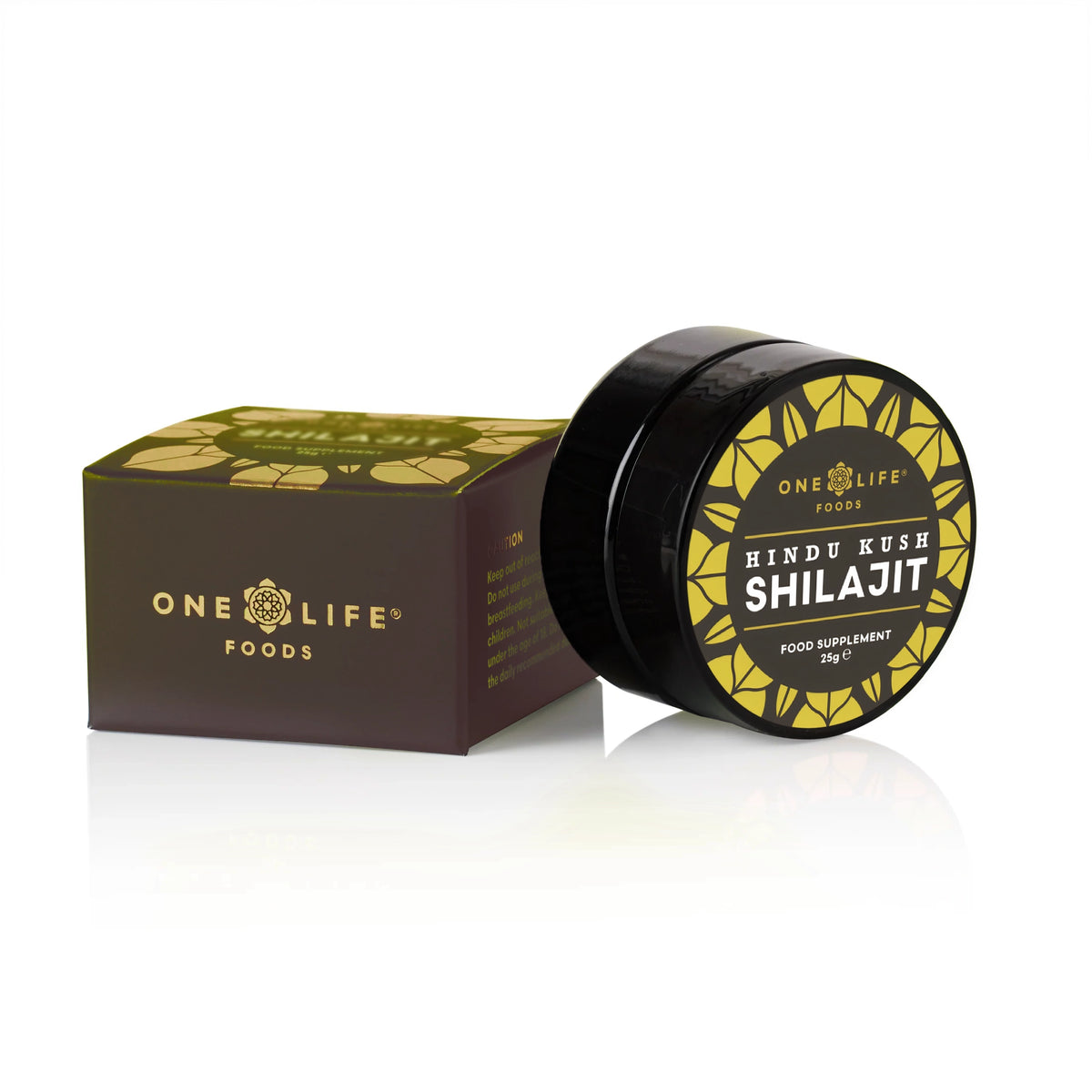
Pure Hindu Kush Shilajit Resin
Firm, smoky and distinctive. Traditionally purified Hindu Kush resin.
Sourced from the Yarkhun–Mastuj–Chitral region of northern Pakistan and supplied as a traditionally purified, single-ingredient resin.
From another ancient mountain world comes a distinctive addition to our regional Shilajit range.
This is one of the firmest and densest Shilajit resins we have handled, becoming noticeably harder, and sometimes slightly brittle, as temperatures fall.
Its sensory profile is equally characteristic: pungent, earthy, smoky and grassy, with light astringency and an extremely subtle honey-liquorice-like note in the background.
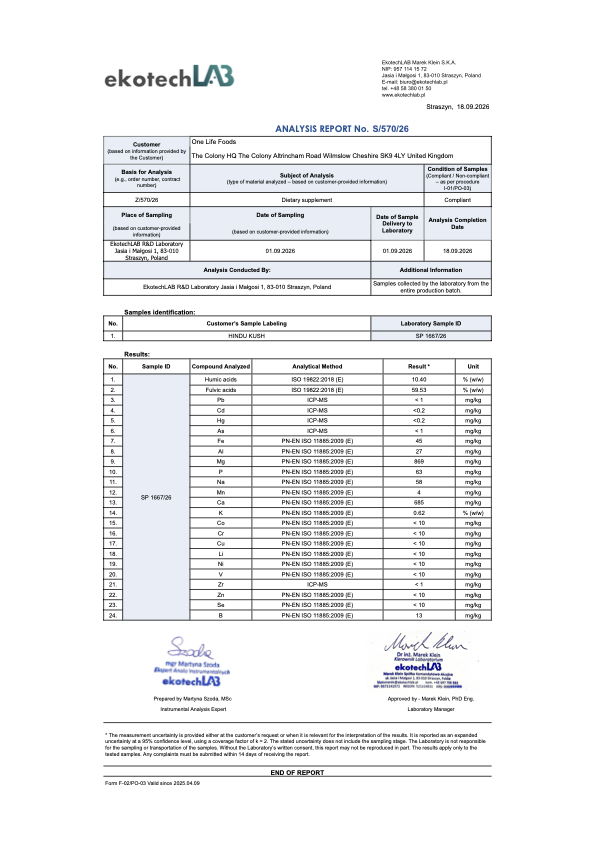
The September 2026 production-batch analysis adds another distinction. Hindu Kush returned 59.53% fulvic acids, 10.40% humic acids and the lowest measured elemental total in our current five-origin comparison.
Those measurements give the resin a defined analytical identity. They do not establish greater purity, potency or effectiveness.
25 g | Traditionally purified resin | Yarkhun–Mastuj–Chitral origin | Dispatched from the UK
-
Pure Hindu Kush Shilajit resin
-
Sourced from the Yarkhun–Mastuj–Chitral region of northern Pakistan
-
Highest measured humic acid result in our current regional range
-
59.53% fulvic acids and 10.40% humic acids
-
Fulvic and humic substances analysed using ISO 19822:2018
-
Eighteen elements analysed, with nine numerically quantified
-
Published production-batch elemental and heavy-metal testing
-
Dense, unusually firm texture that can become slightly brittle in colder weather
-
Pungent, earthy, smoky and grassy sensory character
-
No added herbs, flavours or unnecessary fillers
-
Held and dispatched from within the UK
View the published Hindu Kush testing
The September 2026 report covers fulvic and humic substances, elemental composition and specified heavy metals. Water-content and microbiological testing have also been commissioned, with results still pending in the published testing record.
Overview
Shilajit is often spoken about as though every resin is essentially the same.
It isn't.
Regional origin, geology, natural source material, purification, water content, processing and individual batch variation can all influence the finished product.
That is one of the reasons we continue to explore distinct geographical Shilajit origins rather than treating every dark resin as interchangeable.
Our Hindu Kush Shilajit comes specifically from the Yarkhun–Mastuj–Chitral region of northern Pakistan.
It joins our Siberian Altai, Mongolian Altai, Kashmiri and Hunza resins as another clearly defined mountain origin within the One Life Foods range.
Its principal distinctions are:
-
A specific Yarkhun–Mastuj–Chitral provenance
-
The highest measured humic acid result in our current regional comparison
-
The second-highest measured fulvic acid result
-
A comparatively low measured elemental total
-
An unusually dense and temperature-sensitive texture
-
A pungent, smoky and grassy sensory profile
-
Published production-batch laboratory results
The laboratory figures describe the tested material. Its pronounced physical character is something customers will notice when handling the resin.
Both matter when choosing between origins, but neither should be treated as a guarantee of a particular health effect.
Why Choose Hindu Kush Shilajit?
A distinctive measured humic and fulvic profile
The current Hindu Kush analysis returned:
-
59.53% fulvic acids
-
10.40% humic acids
Both were measured using ISO 19822:2018.
The humic acid result is the highest among our five current regional analyses, marginally above Mongolian Altai at 10.19%.
The fulvic acid result is the second highest, behind Hunza at 64.13%.
The elemental profile tells a different part of the story.
Despite those substantial measured organic fractions, the tested Hindu Kush sample returned a calculated elemental total of just 0.80%, the lowest in our current comparison.
That is a clear compositional distinction.
It does not establish that Hindu Kush is more concentrated in a clinically meaningful sense, more effective or better suited to every customer.
Nor does its firm texture prove that the resin contains more fulvic acids or has undergone more extensive purification.
What we have is a particular combination of measured composition, regional provenance and sensory characteristics.
That is a more useful basis for describing the product than relying on a mountain name or an unsupported purity percentage.
A Distinctive Elemental Profile
The September 2026 Hindu Kush report includes an eighteen-element analytical panel.
Nine elements returned numerical concentrations. The remaining nine were reported below their respective laboratory thresholds.
Selected results include:
| Element | Current published result |
|---|---|
| Potassium | 0.62% w/w |
| Magnesium | 869 mg/kg |
| Calcium | 685 mg/kg |
| Phosphorus | 63 mg/kg |
| Sodium | 58 mg/kg |
| Iron | 45 mg/kg |
| Aluminium | 27 mg/kg |
| Boron | 13 mg/kg |
| Manganese | 4 mg/kg |
When the numerical concentrations are placed on an equivalent basis and added together, the measured elemental total is approximately 0.80%.
That is the lowest reported total in our current regional comparison.
For context, the tested Kashmiri resin returned 10.08%, Mongolian Altai 8.25% and Siberian Altai 11.11%.
Potassium accounts for most of the quantified Hindu Kush elemental total, at 0.62%. Calcium was reported at 685 mg/kg, compared with percentage-level concentrations in our Kashmiri and Mongolian Altai samples.
The difference is substantial.
It means the tested Hindu Kush resin has a distinctly leaner measured elemental profile than those origins.
It does not mean the resin is deficient, inferior or less effective.
Nor should a lower measured mineral total automatically be interpreted as proof of a particular purification process.
These figures describe the elements quantified on the published certificate. They are not nutritional values or a quality score.
What the Elemental Profile Means
Elemental testing can provide useful information about a Shilajit resin, but it needs careful interpretation.
It can show:
-
Which elements were measured
-
Their reported concentrations
-
Which results were below laboratory reporting thresholds
-
How one tested batch differs from another
-
Whether broad compositional statements are supported by analytical data
It cannot establish:
-
A specific health benefit
-
A meaningful contribution to daily mineral requirements
-
Superior absorption
-
Greater potency
-
Geographic origin on its own
-
That every future batch will have the same composition
The number of elements reported also depends on the analytical panel and its reporting limits.
Shilajit is frequently marketed as containing “85+ minerals”. We don't assign that number to a particular resin without evidence identifying what was actually measured.
Eighteen elements were analysed in the current Hindu Kush sample, and nine were numerically quantified.
That does not mean the resin contains only nine elements. It means nine returned numerical concentrations within the scope of this analysis.
The measured mineral total is useful for comparing our published samples, but the laboratory panels and testing dates differ across the range.
We present the results as compositional information, not as implied nutrition or health claims.
Hindu Kush Shilajit from Yarkhun–Mastuj–Chitral
The Hindu Kush is one of the great mountain systems of Central and South Asia.
Our Shilajit comes specifically from the Yarkhun–Mastuj–Chitral area of northern Pakistan, giving it a more precise regional provenance than products described only as Pakistani or high-mountain Shilajit.
It is a landscape of high mountains, exposed rock, steep valleys and considerable geological variation.
That context matters because Shilajit is a naturally variable organic-mineral material.
Different collection environments, source materials and preparation methods can produce resins with noticeably different composition and physical characteristics.
But geography alone cannot tell us what a finished batch contains.
That requires testing.
We did not choose this Hindu Kush source blindly.
Before committing to the product, we obtained and assessed an initial sample, including analytical testing. Those results helped inform our decision to proceed with the Yarkhun–Mastuj–Chitral source.
The subsequent production batch was tested separately.
We deliberately avoided using measurements from the original sourcing sample as though they described the resin customers were receiving.
The September 2026 report now provides the published composition results for the production batch tested.
The product has also been traditionally purified before being supplied in its finished resin form.
We use the term traditionally purified to describe its preparation rather than attaching an unsupported numerical purity percentage.
Origin provides geographic and cultural context. Purification describes part of the preparation process. Laboratory results describe what was measured in the tested material.
Those are related questions, but they are not interchangeable.
Read Hindu Kush Shilajit: History, Folklore and a Distinctive Mountain Resin for the regional history and the distinction between traditional accounts and modern analytical evidence.
A Dense, Firm and Smoky Resin
One of the first things we noticed about this Hindu Kush resin was its texture.
It is noticeably firmer and denser than the other regional Shilajit resins in our current range, even when handled under similar conditions.
That difference becomes particularly apparent as temperatures fall.
In colder conditions the resin can become:
-
Very firm
-
Harder to scoop
-
Less elastic
-
Slightly brittle
-
More likely to break away in small pieces rather than stretch
This is worth knowing before your first winter jar arrives.
If a small piece breaks away while the resin is cold, that does not necessarily mean anything is wrong with the product.
It may simply need warming before use.
Allowing the closed jar to reach room temperature, warming it between your hands or briefly standing it in warm, not boiling, water can make the resin easier to handle.
Do not microwave the jar or expose it to excessive direct heat. Detailed preparation and serving guidance should be followed separately.
Aroma and taste
Hindu Kush also has a distinctive sensory profile.
Its aroma is fairly pungent, with earthy, smoky, grassy and resinous notes.
Behind those stronger characteristics, we sometimes detect an extremely subtle honey-like sweetness. It is delicate enough that not everyone will necessarily pick it up.
On the palate, the resin is:
-
Earthy and mineral-like
-
Resinous
-
Slightly smoky
-
Grassy
-
Lightly astringent
As the flavour develops, there is also a very faint background note somewhere between honey and liquorice-like.
It isn't overtly sweet.
That character sits quietly behind the stronger earthy, grassy and astringent elements.
These are our own sensory observations rather than fixed flavour specifications.
Taste, aroma and texture can vary between batches. A stronger smell, firmer texture or more bitter flavour does not establish greater purity, potency or effectiveness.
For Hindu Kush, its unusual firmness and pronounced sensory profile remain practical product characteristics, not claims about physiological strength.
Fulvic and Humic Composition
Shilajit is not purified fulvic acid.
It is a variable organic-mineral matrix containing different chemical fractions, including:
-
Fulvic substances
-
Humic substances
-
Minerals and trace elements
-
Other naturally occurring organic material
The current Hindu Kush analysis returned:
| Fraction | Current published result |
|---|---|
| Fulvic acids | 59.53% w/w |
| Humic acids | 10.40% w/w |
Both results were produced using ISO 19822:2018.
The 10.40% humic acid result is the highest in our current regional comparison. Mongolian Altai follows closely at 10.19%.
Hindu Kush also has a substantial measured fulvic fraction, second only to Hunza in the present range.
Those figures help describe the tested resin, but they should not be turned into an unofficial potency scale.
They do not establish:
-
A guaranteed health benefit
-
Greater absorption
-
Superior clinical effectiveness
-
That every batch from the Hindu Kush will return identical figures
-
That adding the two percentages creates a recognised quality measurement
Different laboratory methods can produce substantially different results. Comparisons should therefore account for the method used and the sample tested.
The interesting point here is the combination of substantial measured humic and fulvic fractions with a comparatively low elemental total.
That is a compositional distinction, not a demonstrated physiological advantage.
Read Fulvic Acid in Shilajit: Which Test Can You Trust? for a closer explanation of analytical methods and the limitations of headline percentages.
Tested Beyond the Headline Percentage
Fulvic acid analysis answers one compositional question.
It does not provide a complete quality or contaminant assessment.
The September 2026 Hindu Kush report also includes elemental analysis and specified heavy-metal testing.
Heavy metals
The published results were:
| Element | Current published result |
|---|---|
| Lead | Below 1 mg/kg |
| Arsenic | Below 1 mg/kg |
| Cadmium | Below 0.2 mg/kg |
| Mercury | Below 0.2 mg/kg |
All four were reported below the stated laboratory detection limits.
A result below a reporting limit should not be rewritten as absolute zero.
These measurements relate to the production-batch sample submitted for analysis. They do not establish that every possible contaminant has been excluded.
Elemental analysis
The laboratory analysed eighteen elements, with numerical results reported for nine.
The quantified results form the basis of the 0.80% measured elemental total discussed above.
The remaining results were reported below their respective thresholds rather than treated as absent.
Water content and microbiology
Water content can influence resin consistency and handling, particularly at lower temperatures.
Microbiological testing addresses a separate aspect of the finished material.
Both analyses have been commissioned for Hindu Kush, but their results remain pending in the published testing record.
We have not substituted values from an earlier sourcing sample or from another regional resin.
Production-batch testing
The source was initially selected after assessment and testing of a separate sample.
That sample was useful for deciding whether to proceed.
The production batch was subsequently analysed independently by EkotechLAB R&D Laboratory.
The published September 2026 certificate identifies:
-
Analysis report: S/570/26
-
Laboratory sample: SP 1667/26
-
Analysis completed: 18 September 2026
This distinction matters because natural products can vary between batches.
We use sample testing to help decide what we buy.
We use batch testing to tell you what you're buying.
The results and their limitations are available on our Shilajit laboratory testing page.
What This Product Is: and What It Isn’t
It is:
-
A traditionally purified, single-ingredient Shilajit resin
-
Sourced from the Yarkhun–Mastuj–Chitral region of northern Pakistan
-
Associated with the Hindu Kush mountain system
-
Independently analysed for fulvic and humic substances using ISO 19822:2018
-
The highest measured humic acid result in our current regional comparison
-
Supported by elemental and specified heavy-metal testing
-
Dense, unusually firm and temperature-sensitive
-
Pungent, earthy, smoky and grassy, with subtle background sweetness
-
Held and dispatched from within the UK
It isn’t:
-
A flavoured syrup
-
A capsule or powdered extract
-
An herbal blend
-
Defined by an unsupported “85 minerals” claim
-
Proven stronger because it becomes harder in cold weather
-
Claimed to be purer because it smells more pungent
-
Presented as a conventional mineral supplement
-
Assumed superior because it comes from the Hindu Kush
-
Sold using promises about energy, recovery or performance
-
Described using sourcing-sample results as though they came from the production batch
The product's main point of difference is its combination of specific regional provenance, unusual physical character and a measured composition distinct from the other origins in our range.
How Hindu Kush Fits Within Our Range
Our regional Shilajit range is designed to allow different origins to retain their own identity rather than reducing every resin to the same generic description.
Choose Hindu Kush Shilajit if your priorities are:
-
Yarkhun–Mastuj–Chitral provenance
-
A traditional resin from northern Pakistan
-
The highest measured humic acid result in our current range
-
A substantial measured fulvic fraction
-
A comparatively low measured elemental total
-
A particularly firm and dense texture
-
A stronger smoky, earthy and grassy sensory character
-
Pure resin without added herbs or mushroom extracts
-
Published production-batch composition and heavy-metal results
Compare Our Five Shilajit Origins
The following results describe the tested samples in our current regional range.
| Origin | Fulvic acids | Humic acids | Measured minerals* |
|---|---|---|---|
| Siberian Altai | 41.19% | 5.80% | 11.11% |
| Mongolian Altai | 51.93% | 10.19% | 8.25% |
| Kashmiri | 41.84% | 7.08% | 10.08% |
| Hunza | 64.13% | 1.16% | 2.16% |
| Hindu Kush | 59.53% | 10.40% | 0.80% |
Mineral totals are calculated from the elements numerically quantified on the relevant laboratory certificates. They are not nutritional values or a measure of product quality. Testing panels, reporting limits and dates differ between origins. The figures describe the samples analysed.
Choose Siberian Altai if you prioritise the broadest measured elemental profile and the most extensive published testing programme in our current regional range.
Choose Mongolian Altai if you are particularly interested in its substantial measured fulvic and humic fractions and smoother, less astringent sensory character.
Choose Kashmiri if you prefer its Pir Panjal origin, comparatively high measured mineral total and deeper smoky, astringent profile.
Choose Hunza if you prioritise its Gilgit-Baltistan origin and the highest measured fulvic acid result in our current regional comparison.
Hindu Kush stands apart for its combination of the highest measured humic fraction, the second-highest measured fulvic fraction and the lowest reported elemental total in our current range.
It is also one of our most physically distinctive resins, particularly in colder conditions.
Those differences are useful when comparing products. They are not evidence that Hindu Kush produces stronger physiological effects or is the right choice for everyone.
The comparisons relate to the batches tested, not permanent properties of every Shilajit resin associated with each mountain range.
Read Which Shilajit Is Best? Siberian Altai vs Mongolian Altai vs Kashmiri vs Hunza for broader context, or explore our updated Shilajit Guide covering all five origins.
Looking beyond pure resin? Explore our full Shilajit collection, featuring all five mountain origins alongside our Shilajit blends.
Is Hindu Kush Shilajit Right for You?
This resin may suit you if you:
-
Want Shilajit sourced from the Hindu Kush
-
Are specifically interested in the Yarkhun–Mastuj–Chitral region
-
Prefer precise geographical provenance
-
Value published humic, fulvic and elemental measurements
-
Want a particularly firm traditional resin
-
Don't mind a pungent, earthy and smoky sensory profile
-
Prefer resin to capsules or powder
-
Want pure Shilajit without added herbs or flavours
-
Value a clear distinction between sourcing-sample and production-batch testing
-
Want stock held and dispatched from within the UK
It may be less suitable if you want:
-
A soft resin that remains easily scoopable in cold weather
-
A mild or nearly neutral flavour
-
A sweetened or flavoured formulation
-
A pre-measured capsule
-
A blended Shilajit product
-
The broadest measured elemental profile in our range
-
Completed water-content and microbiological results already published
If those outstanding laboratory analyses are important to your purchasing decision, their current status is clearly identified on our testing page.
See the product's Ingredients, Directions and Safety Information for the complete ingredient declaration, serving instructions, preparation guidance and warnings.
The Bottom Line
Hindu Kush is one of the most physically distinctive regional Shilajit resins in our current range.
It comes from the Yarkhun–Mastuj–Chitral region of northern Pakistan, within the Hindu Kush mountain system.
It is traditionally purified, dense and unusually firm. In colder weather, it can become hard enough to feel slightly brittle, with small pieces breaking away rather than stretching.
Its sensory character is pungent, earthy, smoky and grassy, with light astringency and a very faint honey-liquorice-like note in the background.
The September 2026 analysis adds another point of difference.
The tested resin returned 59.53% fulvic acids, 10.40% humic acids and a measured elemental total of 0.80%.
That gives Hindu Kush the highest measured humic fraction and the lowest reported elemental total in our current regional comparison.
Those figures do not establish greater purity, potency or effectiveness. They provide measurable differences to consider alongside the resin's provenance and physical characteristics.
For customers interested in a particularly firm traditional resin, specific Chitral-region provenance and a distinctive measured humic and fulvic profile, Hindu Kush has a clear place within our range.
Pairs well with
Pure Hindu Kush Shilajit Resin
If you have any questions, you are always welcome to contact us. We'll get back to you as soon as possible, within 24 hours on weekdays.
-
Shipping Information
Orders are dispatched from within the UK. Delivery options, prices and estimated times are shown at checkout. For full details, including UK delivery, international delivery and dispatch times, please see our Shipping & Delivery page.
-
Customer Support
Need help with an order, product question or delivery issue? Contact us and we’ll get back to you as soon as possible, usually within 24 hours on weekdays.
-
FAQs
Product-specific FAQs are listed further down each product page. They cover usage, ingredients, testing, storage and suitability. For anything not covered, please contact us.
-
Contact Us
For order support, product questions or general enquiries, please contact us through our Contact page. If your question is about an existing order, include your order number so we can help more quickly.
Product details
Ingredients
Traditionally purified Hindu Kush Shilajit resin. Single ingredient, sourced from the Yarkhun–Mastuj–Chitral region of northern Pakistan.
Directions
Take 250–500 mg daily, or as directed by a healthcare professional.
Shilajit is best taken by dissolving it into warm water, green tea, black coffee, cacao, or warm milk. If using hot drinks, allow boiling liquids to cool slightly before adding.
For resin, take a small amount using a clean, dry spoon or knife tip and place it against the inside of your cup, just below the liquid line. Leave for a couple of minutes to soften, then gently stir or press against the side of the cup until fully dissolved.
Avoid introducing moisture into the jar. Always use a clean, dry utensil and close the lid tightly after use.
How to Measure Shilajit
100 mg = approximately the size of 1 rice grain
250 mg = approximately a small pea-sized amount
500 mg = approximately the size of 1 green pea
These are visual estimates, not precision measurements. Use a suitable scale where accurate weighing is required.
Hindu Kush resin can become unusually firm or slightly brittle in cold weather. If necessary, allow the closed jar to come to room temperature, warm it between your hands, or stand it briefly in warm, not boiling, water. You can also place the jar on top of a radiator for a few minutes.
Recommended Usage Cycle
Take the recommended daily serving for 6–8 weeks, followed by a four-week break.
After the break, you may begin another cycle if the product remains suitable for you.
We recommend this cycling schedule as a cautious usage protocol and an opportunity to periodically reassess your experience. It has not been clinically proven that cycling prevents tolerance or increases Shilajit’s effectiveness.
Always follow the serving instructions shown on your product. Do not exceed the recommended daily intake.
Safety Information
Food supplement. Do not exceed the recommended daily intake. Keep out of reach of young children. Food supplements should not be used as a substitute for a varied, balanced diet and healthy lifestyle.
Not intended for use by children. If pregnant, breastfeeding, taking medication, or under medical supervision, consult a healthcare professional before use.
Use only as directed. This product contains purified Shilajit resin and is batch tested for heavy metals, contaminants, quality, and purity.
Store in a cool, dry place away from direct sunlight.
.
FAQs
What is Shilajit resin?
Shilajit resin is a natural substance formed over time from the decomposition of plant matter in mountainous regions. It contains a complex matrix of organic compounds, including fulvic and humic substances, along with naturally occurring trace minerals.
What does Shilajit taste like?
Earthy and slightly bitter, characteristic of purified Shilajit resin.
How do you take Shilajit resin?
Shilajit resin is typically dissolved in warm water or milk and taken in small amounts. Its resin form allows for flexible dosing compared to fixed-dose capsules or powders.
How long should Shilajit be taken for?
Usage varies depending on individual preference. Some choose to use it continuously, while others cycle use as part of a broader routine.
Is Shilajit resin better than capsules or powder?
Resin is generally considered the most traditional and least processed form of Shilajit. It retains the full natural matrix of organic compounds and trace minerals.
In contrast, some powders and capsule products may be derived from processed materials or isolated fulvic fractions rather than true Shilajit resin. These forms may not provide the same balance of minerals and associated compounds that define naturally formed Shilajit.
Can Shilajit be combined with other supplements?
Yes, it is often used alongside other products as part of a broader routine.
Is the flame test a reliable way to assess Shilajit?
The flame test may highlight obvious impurities, but it cannot verify composition or authenticity. Learn more in our guide: The Shilajit Flame Test
How should it be stored?
Store in a cool, dry place away from direct sunlight to maintain consistency and quality.
Where is this product shipped from?
This product is supplied from within the UK, with stock held domestically for reliable delivery.