


Pure Kashmiri Shilajit Resin
Secure & flexible ways to pay
Pir Panjal origin. Distinctive mineral profile. Deep resin character.
Sourced from the Pir Panjal range of Kashmir and supplied as a purified, single-ingredient resin.
This product has the second-highest reported mineral total in our current regional Shilajit comparison. Its published elemental analysis shows a composition that differs clearly from the other origins we presently stock, particularly in its measured potassium, magnesium and boron concentrations.
For customers looking beyond origin alone or a single fulvic acid percentage, Kashmiri offers a defined humic and fulvic profile, pronounced sensory character and published testing across composition and contaminants.
25 g | Purified resin | Dispatched from the UK
-
Pure Kashmiri Shilajit resin
-
Sourced from the Pir Panjal range of the western Himalayas
-
Second-highest measured mineral total in our current regional comparison
-
Fulvic and humic substances analysed using ISO 19822:2018
-
Detailed elemental profile, including potassium, calcium, magnesium and boron
-
Published heavy-metal testing, with earlier-batch mycotoxin and water-content results
-
No fillers, carriers or unnecessary ingredients
-
Held and dispatched from within the UK
View the published Kashmiri Shilajit testing
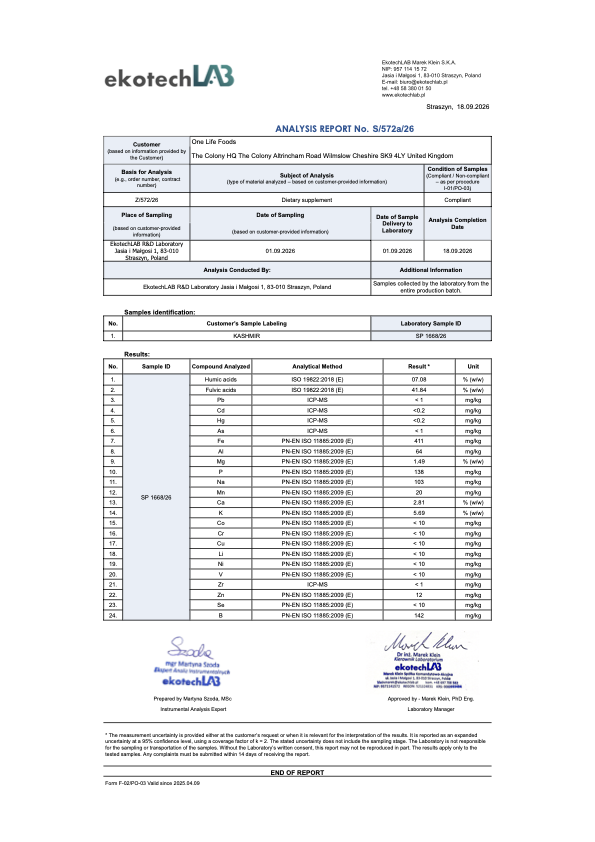
The September 2026 analysis records 41.84% fulvic acids, 7.08% humic acids, an elemental profile and heavy-metal analysis. Earlier testing also documents seven individually named mycotoxins and 4.67% water content, with the sample dates identified separately.
Overview
Kashmiri Shilajit occupies a distinct position within our regional resin range.
Its defining analytical feature is a comparatively high measured mineral total alongside its humic and fulvic composition. It also has a deep, smoky and noticeably astringent sensory profile that distinguishes it from the milder regional resins we stock.
The product is sourced from the Pir Panjal range within the western Himalayan system. That gives it a clear geographic and traditional identity, but its place in our range is not based on the word “Himalayan” alone.
Its principal distinctions are:
-
The second-highest measured mineral total in our current regional comparison
-
A distinctive elemental profile, particularly potassium, magnesium and boron
-
Pir Panjal and western Himalayan identity
-
A pronounced traditional resin character
-
Published analytical information across composition and contaminants
Why Choose Kashmiri Shilajit?
A fuller measured humic fraction
Shilajit is often compared using fulvic acid alone.
That overlooks the humic fraction and the wider composition of the resin.
Our current Kashmiri analysis returned:
-
41.84% fulvic acids
-
7.08% humic acids
The humic acid result sits between those of the other origins in our current published comparison. It is higher than Siberian Altai and Hunza, but lower than Mongolian Altai and Hindu Kush.
That does not establish that Kashmiri Shilajit is more effective, nor does it make humic acid a universal measure of quality.
It does make the tested resin compositionally distinct.
For customers who want to consider both measured humic and fulvic fractions rather than selecting a resin solely on the highest fulvic acid figure, Kashmiri provides a clearly differentiated option within our current range.
Pir Panjal Shilajit from the Western Himalayas
This resin is sourced from the Pir Panjal range in Kashmir.
The Pir Panjal forms part of the western Himalayan system, so describing the product as Kashmiri Himalayan Shilajit provides broader geographic context. “Pir Panjal” is the more specific regional description.
Kashmiri Shilajit also sits within the wider South Asian and Ayurvedic history associated with Shilajit, including a longstanding emphasis on purification before use.
That background provides cultural and historical context, but traditional use is not presented as evidence of a modern health effect. Nor does mountain origin alone establish that raw material is ready for consumption.
Our approach combines:
-
Regional and traditional context
-
Appropriate purification
-
Finished-product analysis
-
Clear limits on what the analytical results establish
Read Kashmiri Shilajit: Tradition, Purification and the Myth of Raw for the deeper history. The article explores the Pir Panjal, the Kashmir Himalayan context and traditional approaches to purification while separating historical use from modern product claims.
Deep, Smoky and Astringent
Kashmiri Shilajit has one of the most pronounced sensory profiles among the regional resins currently in our range.
It has:
-
A dark appearance
-
A smoky, slightly herbal aroma
-
An earthy and mineral-like taste
-
Noticeable astringency
-
A subtle bitter finish
-
A light brown appearance when dispersed in warm liquid
These characteristics help distinguish the product but are not measurements of strength, potency or effectiveness.
A stronger or more bitter flavour does not establish that a resin will produce stronger effects. It simply gives customers a practical way to understand how the product differs before buying it.
Its texture changes naturally with temperature and may become firmer when cool and softer when warm.
This resin is likely to suit customers who specifically prefer a pronounced, traditional resin character rather than a mild or neutral-tasting format.
Measured Humic and Fulvic Composition
The current published Kashmiri analysis records:
| Fraction | Current published result |
|---|---|
| Fulvic acids | 41.84% w/w |
| Humic acids | 7.08% w/w |
The results were produced using ISO 19822:2018.
Within our five-origin comparison, Kashmiri has a measured humic fraction higher than Siberian Altai and Hunza, but lower than Mongolian Altai and Hindu Kush.
This means that the tested Kashmiri resin contains a defined humic fraction alongside its fulvic content, forming part of its wider organic-mineral composition.
It does not mean:
-
Higher humic acid guarantees better results
-
Kashmiri Shilajit is universally superior
-
Every Kashmiri batch will return identical figures
-
The measured ratio proves a specific physiological effect
-
Humic acid should be considered in isolation
The relevant distinction is compositional rather than an implied health advantage.
Read Why Humic Acid Matters in Full-Spectrum Shilajit for wider scientific context and the limitations of interpreting humic measurements.
A Distinctive Elemental Profile
The Kashmiri analysis also reports an elemental profile that differs from the other origins currently in our range.
The September 2026 sample returned a measured elemental total of 10.08%, the second highest in our current regional comparison.
Selected results include:
| Element | Current published result |
|---|---|
| Potassium | 5.69% w/w |
| Calcium | 2.81% w/w |
| Magnesium | 1.49% w/w |
| Sodium | 103 mg/kg |
| Boron | 142 mg/kg |
| Iron | 411 mg/kg |
| Phosphorus | 138 mg/kg |
Within our current published regional analyses, the tested Kashmiri sample returned distinctive measured concentrations of several elements, particularly potassium, magnesium and boron.
Potassium accounts for the largest measured elemental fraction, followed by calcium and magnesium. Its potassium and boron results are also the highest reported in our current regional comparison.
These values are presented as analytical information rather than promoted nutritional benefits.
The testing page also discusses the elemental profile in relation to the geological context of Kashmir. That provides useful compositional context but does not establish geographic origin on its own.
Earlier certificates included strontium, but the September 2026 elemental panel did not. We therefore use the current results for direct comparisons rather than combining figures from different analyses without identifying their dates.
What the Elemental Results Do and Don’t Tell Us
The elemental profile helps describe how the tested Kashmiri resin differs from the other regional products.
It can show:
-
Which elements were measured
-
Their reported concentrations
-
How the tested sample differs compositionally
-
Whether the profile is plausible within a wider geological context
-
Why different regional resins should not automatically be treated as chemically identical
It cannot establish:
-
A specific health benefit
-
A meaningful contribution to daily mineral requirements
-
Superior absorption
-
Greater potency
-
Absolute geographic authenticity
-
That every future batch will be compositionally identical
We present elements such as potassium, magnesium and boron as analytical and compositional data points, not as nutrition or health claims.
Beyond the Fulvic Acid Percentage
The current Kashmiri analysis illustrates why Shilajit should not be reduced to a single number.
Its 41.84% fulvic acid result is accompanied by:
-
7.08% humic acids
-
A detailed elemental profile
-
Heavy-metal analysis
-
Published mycotoxin screening from an earlier batch
-
Published water-content measurement from an earlier batch
Together, these results provide a broader analytical picture than a single percentage without information about the method used.
Different analytical methods can generate substantially different fulvic acid figures. The current humic and fulvic measurements were produced using ISO 19822:2018, providing a defined methodological basis for the reported results.
The testing dates matter. The September 2026 composition and heavy-metal analysis relates to a different sample from the earlier May 2026 mycotoxin and water-content reports.
We retain those earlier findings as part of the published testing history, without presenting them as measurements of the same batch.
Read Fulvic Acid in Shilajit: Which Test Can You Trust? before comparing percentages across products or brands.
Tested Beyond Humic and Fulvic Substances
The published Kashmiri testing programme includes more than composition alone.
Heavy metals and elemental analysis
The September 2026 documentation reports heavy-metal and elemental measurements, with the relevant laboratory certificate available to review.
Lead, arsenic, cadmium and mercury were reported below their respective laboratory detection limits in the tested sample.
The certificate identifies the analytical methods and reporting limits. These findings describe the tested sample and should not be interpreted as proof that every possible contaminant has been excluded.
Mycotoxin screening
Seven individual mycotoxins were analysed in the earlier sample:
-
Aflatoxin B1
-
Aflatoxin B2
-
Aflatoxin G1
-
Aflatoxin G2
-
Ochratoxin A
-
Deoxynivalenol
-
Zearalenone
Each was reported below its stated laboratory detection limit.
The screening was completed in May 2026 and relates to an earlier sample, not the September 2026 composition analysis.
Water content
The earlier water-content analysis returned:
4.67% w/w water content
Water content provides information about the physical composition of the tested resin and may influence its consistency and handling. It should not be treated as a complete measure of quality on its own.
This result also relates to an earlier sample. It is retained as part of the available testing record rather than presented as a measurement of the September 2026 batch.
The laboratory documentation records the relevant sample conditions and results within the scope of the analyses shown.
Full reports, methods, sample references and testing updates are available on our Shilajit laboratory testing page.
What This Product Is: and What It Isn’t
It is:
-
A purified, single-ingredient Shilajit resin
-
Sourced from the Pir Panjal range of Kashmir
-
A geographically specific western Himalayan Shilajit
-
Characterised by the second-highest measured mineral total in our current regional comparison
-
Supported by humic, fulvic, elemental and heavy-metal analysis, with additional earlier-batch mycotoxin and water-content results
-
Supplied in a traditional resin format
-
Held and dispatched from within the UK
It isn’t:
-
A flavoured supplement
-
A capsule or powdered formula
-
Proven better simply because it is Himalayan
-
Presented as a nutritional source of magnesium or any other mineral
-
Defined only by its fulvic acid percentage
-
Sold using promises about energy, hormones, recovery or performance
Its strongest proposition is the combination of measured mineral composition, detailed analytical information, Pir Panjal identity and pronounced sensory character.
How Kashmiri Fits Within Our Range
Choose Kashmiri Shilajit if your priorities are:
-
The second-highest measured mineral total in our current regional comparison
-
A defined humic and fulvic composition
-
Detailed elemental data, particularly potassium, magnesium and boron
-
Pir Panjal and western Himalayan identity
-
A deep, smoky and astringent sensory character
-
Pure resin without added herbs or mushroom extracts
Compare Our Five Shilajit Origins
The following figures describe the tested samples in our current regional range.
| Origin | Fulvic acids | Humic acids | Measured minerals* |
|---|---|---|---|
| Siberian Altai | 41.19% | 5.80% | 11.11% |
| Mongolian Altai | 51.93% | 10.19% | 8.25% |
| Kashmiri | 41.84% | 7.08% | 10.08% |
| Hunza | 64.13% | 1.16% | 2.16% |
| Hindu Kush | 59.53% | 10.40% | 0.80% |
Mineral totals represent the sum of quantified elements reported in the relevant laboratory analyses, not nutritional values or a measure of product quality. Laboratory panels and testing dates differ between origins. Results refer to the samples analysed.
Choose Siberian Altai if you prioritise the broadest measured elemental profile and the most extensive published testing programme in our current regional range.
Choose Hunza if you prefer its Gilgit-Baltistan origin and the highest measured fulvic acid concentration in our current comparison.
Choose Mongolian Altai if you prefer its western Mongolian origin and a different measured balance of humic and fulvic substances.
Choose Hindu Kush if you prefer its northern Pakistan provenance, comparatively high measured humic and fulvic fractions, and lower measured mineral total.
Kashmiri sits towards the higher end of our measured mineral comparison, with a humic and fulvic profile distinct from the other four origins. Its pronounced sensory character provides another practical point of difference that laboratory percentages alone cannot describe.
These distinctions relate to the products and batches currently tested. They should not be treated as permanent characteristics of every Shilajit resin associated with each region, nor as evidence of greater physiological effectiveness.
Read Which Shilajit Is Best? Siberian Altai vs Mongolian Altai vs Kashmiri vs Hunza for a broader comparison, or explore our updated Shilajit Guide covering all five origins.
Looking beyond pure resin? Explore our full Shilajit collection, featuring all five mountain origins alongside our Shilajit blends.
Is Kashmiri Shilajit Right for You?
This resin may suit you if you:
-
Want Kashmiri or Himalayan Shilajit sourced from the Pir Panjal range
-
Prefer a resin with a defined measured humic fraction
-
Value detailed published composition data
-
Prefer a pronounced smoky and astringent flavour
-
Want pure Shilajit without added herbs or mushrooms
-
Prefer resin to capsules or powder
-
Want stock held and dispatched from within the UK
It may be less suitable if you want:
-
A mild or nearly neutral flavour
-
A pre-measured capsule
-
A flavoured or sweetened product
-
A blended formulation
-
A resin selected solely according to its fulvic acid percentage
See the Ingredients and Directions accordions for the complete ingredient declaration, serving guidance and preparation instructions.
The Bottom Line
Kashmiri is the mineral-profile and sensory-led choice within our current regional Shilajit range.
It combines Pir Panjal and western Himalayan identity with the second-highest measured mineral total in our current comparison, a defined humic and fulvic composition, and a pronounced traditional resin character.
Those measurements do not make the resin a conventional mineral supplement or establish that it produces stronger physiological effects.
They provide customers with measurable compositional differences to consider rather than treating all Himalayan Shilajit as chemically identical or inherently superior.
For customers who value a distinctive mineral profile, detailed analytical information and a pronounced traditional resin character, Kashmiri has a clear point of difference within our range.
Pairs well with
Pure Kashmiri Shilajit Resin
If you have any questions, you are always welcome to contact us. We'll get back to you as soon as possible, within 24 hours on weekdays.
-
Shipping Information
Orders are dispatched from within the UK. Delivery options, prices and estimated times are shown at checkout. For full details, including UK delivery, international delivery and dispatch times, please see our Shipping & Delivery page.
-
Customer Support
Need help with an order, product question or delivery issue? Contact us and we’ll get back to you as soon as possible, usually within 24 hours on weekdays.
-
FAQs
Product-specific FAQs are listed further down each product page. They cover usage, ingredients, testing, storage and suitability. For anything not covered, please contact us.
-
Contact Us
For order support, product questions or general enquiries, please contact us through our Contact page. If your question is about an existing order, include your order number so we can help more quickly.
Product details
Ingredients
Pure Kashmiri Shilajit resin. Hand harvested from the Pir Panjal range.
Directions
Directions for Use
Take 250–500 mg daily, or as directed by a healthcare professional.
Shilajit is best taken by dissolving it into warm water, green tea, black coffee, cacao, or warm milk. If using hot drinks, allow boiling liquids to cool slightly before adding.
For resin, take a small amount using a clean, dry spoon or knife tip and place it against the inside of your cup, just below the liquid line. Leave for a couple of minutes to soften, then gently stir or press against the side of the cup until fully dissolved.
Avoid introducing moisture into the jar. Always use a clean, dry utensil and close the lid tightly after use.
How to Measure Shilajit
100 mg = approximately the size of 1 rice grain
250 mg = approximately a small pea-sized amount
500 mg = approximately the size of 1 green pea
Recommended Usage Cycle
Take the recommended daily serving for 6–8 weeks, followed by a four-week break.
After the break, you may begin another cycle if the product remains suitable for you.
We recommend this cycling schedule as a cautious usage protocol and an opportunity to periodically reassess your experience. It has not been clinically proven that cycling prevents tolerance or increases Shilajit’s effectiveness.
Always follow the serving instructions shown on your product. Do not exceed the recommended daily intake.
Safety Information
Food supplement. Do not exceed the recommended daily intake. Keep out of reach of young children. Food supplements should not be used as a substitute for a varied, balanced diet and healthy lifestyle.
Not intended for use by children. If pregnant, breastfeeding, taking medication, or under medical supervision, consult a healthcare professional before use.
Use only as directed. This product contains purified Shilajit resin and is batch tested for heavy metals, contaminants, quality, and purity.
Store in a cool, dry place away from direct sunlight.
FAQs
What does Kashmiri Shilajit taste like?
Earthy, slightly smoky and more astringent than lighter regional variants, reflecting its composition.
How do you take Shilajit resin?
Shilajit resin is typically dissolved in warm water or milk and taken in small amounts. Its resin form allows for flexible dosing compared to fixed-dose capsules or powders.
How long should Shilajit be taken for?
Usage varies depending on individual preference. Some choose to use it continuously, while others cycle use as part of a broader routine.
Is Kashmiri Shilajit different from other types?
Yes. Its composition reflects the environmental conditions of the Pir Panjal range, resulting in a deeper and more intense profile compared to more balanced or lighter variants.
Can it be combined with other supplements?
Yes, it is often used alongside other products as part of a broader routine.
Why do fulvic acid percentages vary between products?
Differences often come down to how the material is analysed. Simpler testing methods can overestimate fulvic content by including non-specific soluble compounds, whereas more advanced approaches provide a clearer distinction between fulvic and humic fractions. Learn more in our guide: The Shilajit Deception: Why High Fulvic Acid Is a Red Flag.
How should it be stored?
Store in a cool, dry place away from direct sunlight to maintain consistency and quality.
Where is this product shipped from?
This product is supplied from within the UK, with stock held domestically for reliable delivery.