


Not all sports drinks do the same job
Sports drinks often get thrown into one big category.
That is not very helpful.
Some drinks are built mainly for hydration.
Some are built for hydration plus fuel.
Some are built mainly to deliver carbohydrate.
Some are just colourful sugar water with a sports cap and ambition.
The difference often comes down to concentration.
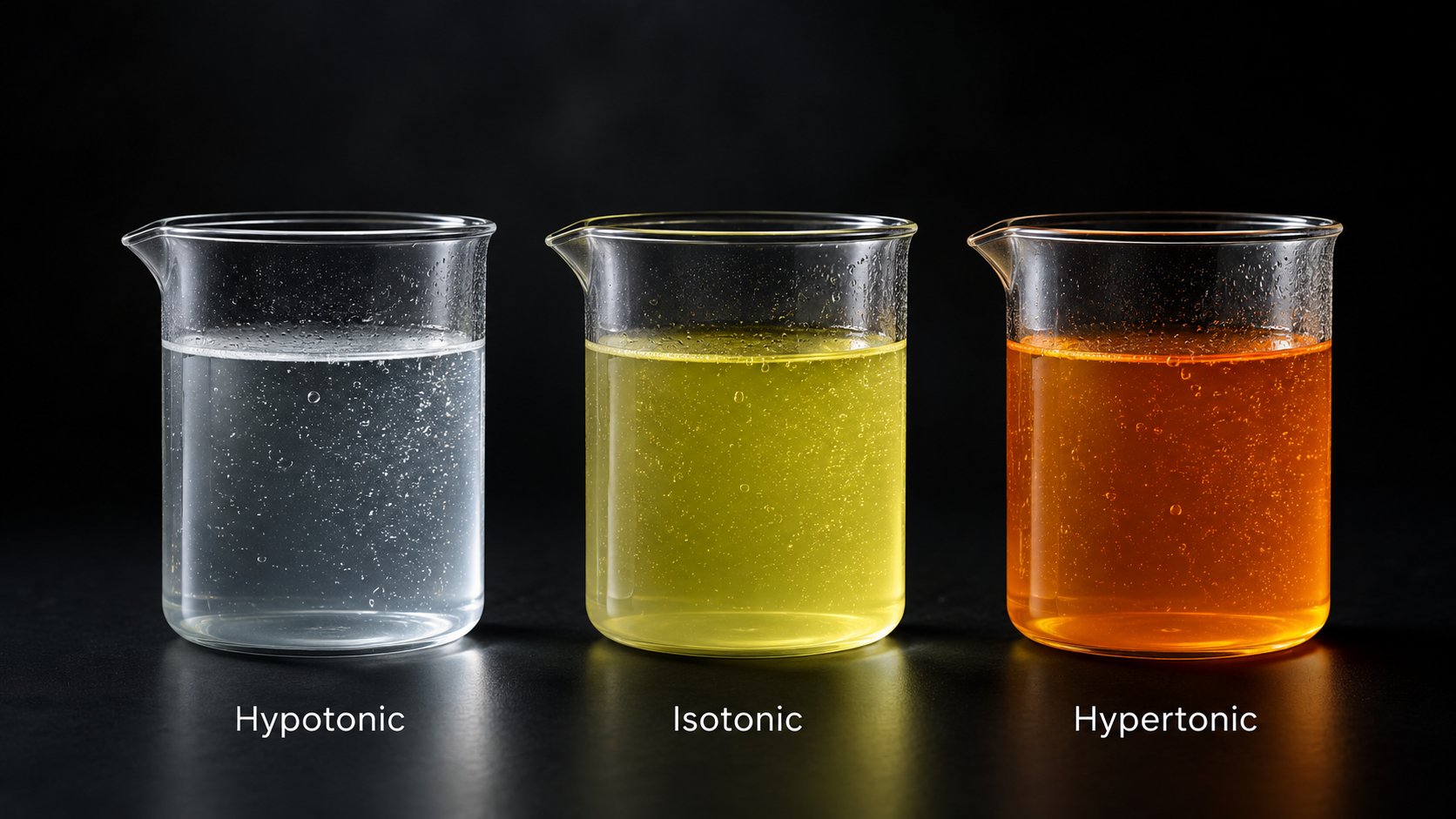
That is where the terms hypotonic, isotonic and hypertonic come in.
They describe how concentrated a drink is compared with body fluids. This matters because concentration can affect fluid absorption, gut comfort, energy delivery and how suitable the drink is during training.
In other words, these words are not just technical garnish.
They tell you what the drink is likely built to do.
What does tonicity mean?
Tonicity describes how a fluid compares with body fluids in terms of dissolved particles.
Those particles can include:
-
Electrolytes
-
Carbohydrates
-
Amino acids
-
Sugars
-
Minerals
-
Other dissolved ingredients
The more dissolved particles a drink contains, the more concentrated it becomes.
This matters because a drink designed for quick hydration will usually look different from a drink designed for endurance fuelling.
Same aisle.
Different purpose.
For the deeper science behind concentration, see Osmolality, Osmosis and Hydration: How Water Actually Moves Through the Body.
This article is the practical version: what each drink type means and when it makes sense.
Hypotonic drinks explained
A hypotonic drink has a lower concentration of dissolved particles than body fluids.
In practice, hypotonic drinks are usually hydration-led.
They often contain water and electrolytes, with little or no carbohydrate.
This can make them useful when the main goal is fluid and electrolyte support rather than energy intake.
Hypotonic drinks may suit:
-
Strength training
-
Conditioning
-
Hot-weather training
-
Team sports
-
Shorter endurance sessions
-
Sweat-heavy gym sessions
-
People who want electrolytes without much sugar
-
Sessions where fuel is coming from food instead
Hypotonic-style drinks are often lighter to sip because they are less concentrated.
That can matter during training, especially when the stomach is not in the mood for a heavy, sugary drink.
The gut gets a vote. Usually at the worst possible time.
What is usually in a hypotonic drink?
A hypotonic drink may contain:
-
Water
-
Sodium
-
Chloride
-
Potassium
-
Magnesium
-
Calcium
-
Flavouring
-
Sweeteners
-
Sometimes amino acids or performance ingredients
-
Little or no carbohydrate
The key point is not the exact ingredient list.
The key point is the job.
A hypotonic-style drink is usually there to support hydration more than fuelling.
That can make sense for gym sessions, conditioning, hybrid training and some endurance sessions where carbohydrate is not the main need.
Isotonic drinks explained
An isotonic drink has a similar concentration of dissolved particles to body fluids.
These drinks are often designed to provide both hydration and carbohydrate fuel.
That is why isotonic drinks are common in endurance sport.
They usually contain:
-
Water
-
Electrolytes
-
Carbohydrate
-
Flavouring
The electrolytes help support fluid balance and sweat replacement.
The carbohydrate provides energy.
This can be useful when the session is long enough or hard enough that fuel and fluid both matter.
When isotonic drinks make sense
Isotonic drinks are often used for:
-
Longer runs
-
Cycling
-
Triathlon
-
Team sports
-
Long endurance sessions
-
Events lasting over 60 to 90 minutes
-
Training where fuel and hydration are needed together
The main advantage is convenience.
You can drink and fuel at the same time.
That can be useful. It can also be unnecessary if the session does not require carbohydrate.
Isotonic does not mean automatically superior.
It means suited to a particular job.
The supplement world would be much calmer if more people accepted that sentence.
Isotonic drinks and carbohydrate
Carbohydrate is the main difference between many isotonic and hypotonic products.
During longer exercise, carbohydrate helps provide fuel.
It can also work with sodium in the gut to support fluid absorption.
This is why carbohydrate-electrolyte drinks are popular in endurance sport.
But carbohydrate is not always needed.
If your session is short, gym-based, lower volume, late at night or already well fuelled by food, a carbohydrate drink may not be necessary.
Some athletes prefer to separate hydration from fuelling.
That is fine.
The best product is the one that fits the session.
A long-distance cyclist and someone doing a 60-minute push session after work do not need the same drink.
Unless that push session has become wildly overcomplicated.
Hypertonic drinks explained
A hypertonic drink has a higher concentration of dissolved particles than body fluids.
These drinks are usually more carbohydrate-focused.
They may contain higher levels of sugars or other carbohydrates, making them more concentrated.
Hypertonic drinks are generally used when the main goal is energy delivery rather than fast hydration.
Hypertonic drinks may suit:
-
Post-training carbohydrate replenishment
-
Long endurance events with planned fuelling
-
Situations where energy intake is the priority
-
Athletes who tolerate concentrated drinks well
-
Times when rapid fluid delivery is not the main goal
During exercise, hypertonic drinks may feel heavier for some people.
They can sit in the gut longer or cause discomfort if used at the wrong time or concentration.
That does not make them bad.
It means they need the right context.
The simple version
Use this as a working guide:
Hypotonic drinks are hydration-led.
Isotonic drinks are hydration plus fuel.
Hypertonic drinks are fuel-led.
That is not perfect in every case, because formulas vary.
But it is a useful way to start.
Hypotonic
Lower concentration.
Usually best when you want fluid and electrolytes without much carbohydrate.
Isotonic
Similar concentration.
Often useful when you want fluid, electrolytes and carbohydrate together.
Hypertonic
Higher concentration.
Usually better when carbohydrate delivery is the main goal.
Different tools.
Different sessions.
Different reasons to exist.
Why concentration matters during training
During training, your body is trying to manage several jobs at once.
It needs to:
-
Keep blood moving
-
Regulate temperature
-
Supply working muscles
-
Manage gut comfort
-
Absorb fluid
-
Replace electrolytes
-
Provide fuel if needed
Drink concentration affects how easily a product fits into that process.
A very concentrated drink may provide more carbohydrate, but it can feel heavier.
A very dilute drink may be easy to sip, but may not provide enough electrolytes or fuel for the session.
A good formula is not about adding more of everything.
It is about choosing the right concentration for the intended use.
That is formulation.
Not just a label with a whistle around its neck.
Electrolytes and drink concentration
Electrolytes contribute to drink concentration.
So do carbohydrates, amino acids and other dissolved ingredients.
That means meaningful electrolyte dosing needs careful formulation.
Sodium is especially important here.
It is central to sweat replacement, but it also affects taste. A higher-sodium drink can be very useful for heavy sweating, but it must be built properly to remain drinkable.
A low-sodium drink may taste lighter, but may not suit sweat-heavy training.
This is one reason products aimed at daily wellness often look very different from products aimed at serious intra-workout hydration.
They are trying to solve different problems.
Or at least they should be.
Sugar-free electrolyte drinks
Sugar-free electrolyte drinks are usually hydration-led.
They can be useful when you want fluid and electrolytes without carbohydrate.
This may suit:
-
Strength training
-
Conditioning
-
Hybrid training
-
Shorter endurance sessions
-
Low-calorie phases
-
Late sessions
-
General sweat support
-
Athletes who fuel through food instead
Sugar-free does not mean better.
Carbohydrate-containing does not mean better.
The question is whether the session needs fuel.
If yes, carbohydrate may help.
If no, a hydration-led formula may be more appropriate.
Context remains annoyingly undefeated.
Carbohydrate-electrolyte drinks
Carbohydrate-electrolyte drinks make sense when hydration and fuel need to happen together.
They are common in endurance sport because longer sessions use significant energy.
Carbohydrate can help support performance when glycogen demand is high.
Sodium can support fluid balance and absorption.
This combination can be useful during:
-
Long runs
-
Long rides
-
Races
-
Triathlon
-
Long team-sport sessions
-
High-duration training blocks
The trade-off is that carbohydrate adds sweetness, calories and concentration.
Some athletes tolerate this well.
Others prefer to separate hydration from fuelling.
Neither approach is automatically superior.
The best strategy is the one that fits the sport, the session and the gut.
Which type is best for strength training?
For most strength training sessions, a hydration-led formula is usually more relevant than a high-carbohydrate sports drink.
That means hypotonic-style or lower-carbohydrate electrolyte formulas often make sense, especially when the session is:
-
Long
-
High volume
-
Sweat-heavy
-
Done in heat
-
Combined with conditioning
-
Performed late in the day
-
Stacked with pre-workout
Strength athletes may not need carbohydrate during every session, especially if they have eaten beforehand.
They may still benefit from electrolytes and fluid during harder sessions.
For the full gym-focused breakdown, see Hydration for Strength Training: Power, Pump, Performance and Recovery.
Which type is best for endurance athletes?
Endurance athletes need to think about session length and fuelling demand.
Shorter endurance sessions
Water or a hydration-led electrolyte drink may be enough.
Moderate sessions
Electrolytes become more relevant, especially sodium.
Carbohydrate may be useful depending on intensity and goals.
Longer sessions
Carbohydrate-electrolyte drinks often become more useful because fuel and hydration both matter.
Very long events
Athletes usually need a structured plan involving fluid, sodium, carbohydrate and gut tolerance.
For endurance athletes, the question is:
Do I need hydration only, or hydration plus fuel?
That answer changes the formula.
For more detail, read Hydration for Endurance Athletes: Sweat Rate, Sodium Loss and Carbohydrate Transport.
Which type is best for hot weather?
Hot weather usually increases sweat loss.
That means fluid and electrolytes become more important.
If the session is not very long, a hydration-led electrolyte drink may be enough.
If the session is long or intense, carbohydrate may also be needed.
In heat, drink tolerance matters too.
Some people prefer lighter, less concentrated drinks because they are easier to sip.
A drink that feels fine in winter can feel like punishment in summer.
Hydration should help the session.
Not become another event.
Where RE-UP fits
RE-UP is a hydration-focused intra-workout.
That means it sits closer to the hydration-led side of the spectrum than the high-carbohydrate endurance-fuel side.
It is not a sugary sports drink.
It is not a high-carb race fuel.
It is not a stimulant pre-workout.
Its job is to support hydration and training consistency during sessions where fluid balance, sweat loss and repeated output matter.
It is mixed with 300 to 800 ml of water, allowing users to adjust concentration and taste depending on the session.
That is the important point for this article.
RE-UP is built around a use case: structured intra-workout hydration.
How to choose the right drink type
Use this as a simple guide.
Choose water when:
-
The session is short
-
Sweat loss is low
-
You have eaten and hydrated normally
-
Conditions are cool
Choose a hydration-led electrolyte drink when:
-
You sweat heavily
-
You train in heat
-
The session is long enough for sweat loss to matter
-
You do strength training, conditioning or hybrid work
-
You want electrolytes without carbohydrate
-
You want stimulant-free intra-workout support
Choose a carbohydrate-electrolyte drink when:
-
The session is long
-
You need fuel during training
-
You are doing endurance sport
-
You struggle to maintain energy output
-
You are racing or training for long-duration performance
Choose a more concentrated carbohydrate drink when:
-
The goal is fuel more than hydration
-
You are using it away from the hardest parts of training
-
You tolerate concentrated drinks well
-
You are following a specific endurance fuelling plan
Choosing correctly is less glamorous than buying whatever has the loudest packaging.
It also works better.
Common mistakes with sports drinks
Assuming isotonic means best
Isotonic does not mean automatically superior. It means similar concentration to body fluids.
Using a high-carb drink when hydration is the goal
If you do not need fuel, extra carbohydrate may be unnecessary.
Using a low-electrolyte drink for heavy sweating
If sweat loss is high, token electrolyte dosing may not be enough.
Ignoring sodium
Sodium is central to sweat replacement. A sports drink without meaningful sodium may not suit serious training.
Confusing coconut water powder with a full electrolyte strategy
Coconut water powder can support a formula, but it should not replace clear electrolyte dosing.
Judging by ingredient count
More ingredients does not automatically mean better formulation.
A label can be busy and still not be doing much.
A familiar problem beyond supplements, frankly.
The One Life Foods view
Hypotonic, isotonic and hypertonic drinks are not marketing tribes.
They are different tools.
A good hydration product should know what it is built to do.
If the goal is hydration during training, the formula should prioritise fluid balance, electrolytes and drinkability.
If the goal is endurance fuel, carbohydrate becomes more important.
If the goal is recovery, the needs may change again.
The problem is not that different products exist.
The problem is when they are all marketed as if they solve the same thing.
They do not.
Measured hydration means understanding the relationship between formula, water, session and athlete.
Not guessing from the front of the label.
The bottom line
Hypotonic, isotonic and hypertonic drinks differ by concentration.
Hypotonic drinks are usually hydration-led.
Isotonic drinks usually combine hydration and fuel.
Hypertonic drinks are usually more fuel-led.
For strength training, conditioning and many gym sessions, a hydration-focused electrolyte drink may be more appropriate than a high-carbohydrate sports drink.
For longer endurance sessions, carbohydrate-electrolyte drinks may be useful because fuel and hydration both matter.
For heavy sweating, sodium and chloride deserve proper attention.
The best sports drink is not the one with the most technical category name.
It is the one built for the job you are actually doing.
Continue learning
Explore more from the One Life Foods hydration hub:
-
Hydration for Performance: Electrolytes, Sweat Loss and Intra-Workout Consistency Explained
-
Osmolality, Osmosis and Hydration: How Water Actually Moves Through the Body
-
Hydration for Endurance Athletes: Sweat Rate, Sodium Loss and Carbohydrate Transport
-
Electrolytes Before, During and After Training: Timing Your Hydration Properly
- What Makes a Good Electrolyte Formula? Hydration Dosing, Label Tricks and Formulation Science
Written By
Written by Chris Simon, Founder of One Life Foods.
Chris has worked in the supplement industry since 2009 and is known for seeking out exceptional ingredients, products, and formulations. Read more about Chris and the story behind One Life Foods.


Share:
What Electrolytes Do You Lose in Sweat? Sodium, Chloride, Potassium and Magnesium Explained
Is Shilajit Safe? Side Effects, Safety, and What to Know Before Taking It