


Honey ought to be a fairly simple product. Bees collect nectar, transform it inside the hive, reduce its water content and store it in the comb. A beekeeper takes the honey out, removes the bits of wax nobody particularly wants on their toast, puts it into a jar, and everybody goes home happy.
Naturally, the modern food industry has found ways to make the story considerably more complicated.
Honey can now be heated, finely filtered, blended from multiple origins and processed to produce something that stays clear, pours predictably and looks exactly the same every time somebody picks up a bottle in a supermarket. None of those things automatically make a honey bad. But they do raise a fairly obvious question: at what point does processing begin removing the very things that made honey interesting in the first place?
That is where raw honey is different.
What is raw honey?
Raw honey is honey kept as close as reasonably possible to the form in which it leaves the hive. It is normally extracted, allowed to settle and strained sufficiently to remove unwanted material such as pieces of wax and debris, but it isn't subjected to the more aggressive heating and fine filtration used with some commercially processed honeys.
There is an important technical point here. UK honey legislation defines categories including extracted, pressed and filtered honey, with “filtered honey” specifically referring to filtration that results in the significant removal of pollen. It doesn't create a separate statutory category called “raw honey”. Legislation.gov.uk
So “raw” needs a little more explanation than simply printing the word on a label. What temperature has the honey reached? How heavily has it been filtered? Has anything been added? Where did it come from? Those questions tell consumers considerably more than one attractive word on the front of a jar.
Raw, processed and highly processed honey aren't the same thing
Processing isn't binary.
Honey may need to be warmed gently simply to move it from a storage vessel into a jar. That is very different from holding honey at substantially higher temperatures for long enough to alter heat-sensitive components. Likewise, passing honey through a coarse strainer to remove wax isn't the same thing as fine filtration designed to remove tiny suspended particles and much of the pollen.
It therefore makes more sense to think of honey on a spectrum.
At one end is minimally handled raw honey: extracted, settled, strained and bottled with as little interference as practicable. Somewhere in the middle is honey that has been warmed and filtered for easier handling and consistency. At the other end is extensively processed honey, where considerably more heat and filtration have been used to create a stable, clear and remarkably uniform product.
Those aren't formal legal grades. They're simply a more useful way of understanding what happens between hive and jar.
And if sugar syrup has been added, that is another issue altogether. That's adulteration, not merely “processing”. UK honey rules reserve the description honey for a product meeting defined compositional standards, precisely because authenticity matters. GOV.UK
So is raw honey actually better?
If the comparison is between the same genuine honey kept raw and that honey after aggressive heat treatment and filtration, then yes, there is a good argument that raw is the better product.
That shouldn't be especially controversial.
Honey is mostly sugar and water. Depending on the honey, roughly 70–80% of its weight is carbohydrate, primarily glucose and fructose. What makes honey more chemically interesting than simply dissolving table sugar in water is everything present in much smaller quantities: organic acids, phenolic compounds, enzymes, amino acids, pollen-derived material, volatile compounds and other constituents whose exact profile depends heavily on floral and geographical origin. PubMed Central (PMC)
If those minor components are part of the reason somebody chooses honey rather than ordinary refined sugar, it makes very little sense to deliberately process more of them away.
That doesn't turn raw honey into medicine. It does make minimal processing the more logical way of preserving the food the bees actually produced.
What does heating do to honey?
This is where the difference between gentle handling and heavy processing becomes important.
Honey contains naturally occurring enzymes including diastase, invertase and glucose oxidase. Enzyme activity is sufficiently sensitive to heat and storage that diastase activity is routinely used as one measure of honey quality. International honey standards even specify limits relating to diastase activity and hydroxymethylfurfural, usually shortened to HMF, because both can provide information about heating and deterioration. PubMed Central (PMC)
HMF naturally increases as honey ages and is accelerated by heat. In a 2024 study comparing raw honey with different preservation treatments, pasteurisation at 78°C for six minutes increased HMF and reduced physicochemical quality and antioxidant activity. Diastase activity was also affected, with deterioration continuing during storage. PubMed Central (PMC)
Other research has similarly shown that conventional heat treatment can alter diastase activity, HMF, antioxidant properties and antibacterial activity. The precise effect depends on the honey, temperature and duration, which is why saying that any warmth whatsoever ruins honey would be silly. Heating a crystallised jar gently in warm water is not the same process as aggressive industrial treatment. PubMed
Temperature and time matter.
That distinction is often missing from the raw-honey conversation. One side behaves as though honey becomes nutritionally dead the moment it gets slightly warm; the other treats processing as though chemistry politely stands still while the factory gets on with its work. Neither is particularly helpful.
What about antioxidants and plant compounds?
Honey contains a range of phenolic acids, flavonoids and other plant-derived compounds, although their concentrations vary enormously between honeys.
This is one reason dark honey from one geographical region can be chemically quite different from a pale honey produced somewhere else. Nectar source, local vegetation, climate, storage and processing all contribute to the finished composition. Nature, inconveniently, doesn't make every jar to the same specification. PubMed Central (PMC)
These compounds are commonly discussed because many display antioxidant activity in laboratory testing. That doesn't mean a spoonful of honey should suddenly be marketed as a cardiovascular treatment, and it certainly doesn't justify promising that it will prevent disease.
It does, however, give another reason not to process honey more aggressively than necessary.
Studies examining heated honey have shown changes in phenolic profiles and antioxidant behaviour, although the results aren't identical across every honey and every analytical method. That's exactly why the sensible claim isn't that heating magically deletes every useful molecule. The better-supported point is that processing can alter the chemical profile and reduce some of the properties associated with minimally processed honey. PubMed Central (PMC)
Does filtration matter too?
Yes, particularly when filtration becomes fine enough to remove pollen.
Pollen enters honey naturally during the bees' work and can also be useful when establishing botanical and geographical origin. It contains proteins, amino acids, lipids and plant compounds, although the quantity of pollen somebody eats in an ordinary serving of honey is far too small to justify pretending honey is a meaningful protein or micronutrient supplement.
Its importance here is slightly different.
The UK regulations actually distinguish “filtered honey” as honey processed in a way that results in significant pollen removal. Legislation.gov.uk Research has also noted that filtration capable of removing pollen can alter the phenolic signature and may reduce some measured antioxidant characteristics compared with less processed honey. PubMed Central (PMC)
Again, nobody needs bits of wax and bee in the breakfast jar merely to prove how natural the product is. Straining honey makes perfect sense. Removing everything small enough to remind you that it came from flowers and bees is a rather different proposition.
Is highly processed honey basically sugar syrup?
Chemically, even heavily processed genuine honey is still mostly glucose, fructose and water, just as raw honey is. So describing every processed honey literally as sugar syrup isn't quite accurate.
But there is a more interesting point hiding underneath the exaggeration.
If honey is chosen because of its enzymes, plant compounds, pollen, distinctive floral chemistry and the complexity associated with its natural origin, then progressively removing or damaging those things leaves less and less to distinguish the product nutritionally from a sweetener whose main contribution is sugar.
At some point, consumers are entitled to ask what exactly all that processing improved for them.
A clearer appearance? Certainly.
Slower crystallisation? Probably.
Easier industrial handling? Absolutely.
More of what was originally present in the honey? That's considerably harder to argue.
Raw honey and organic honey aren't the same thing
This is another distinction that gets muddled surprisingly often.
“Raw” describes how the honey has been handled after it has been produced. “Organic” concerns the standards under which the bees, apiaries and product are managed and certified.
Organic certification in Great Britain operates under defined production and certification standards. It doesn't simply mean “no synthetic pesticide residues”, and it doesn't automatically tell somebody whether the finished honey has been heated or how heavily it has been filtered. Soil Association
A honey can therefore be organic without necessarily being raw, and raw without being certified organic.
They answer different questions.
Why does raw honey crystallise?
Because honey crystallises.
Glucose can come out of solution and form crystals over time, and the rate at which this happens varies according to the honey's glucose-to-fructose ratio, moisture content, temperature and floral origin.
It isn't spoilage, and it isn't evidence that somebody has added sugar to the jar.
If anything, the modern expectation that honey should remain permanently clear and liquid has created part of the incentive to heat and process it in the first place. Consumers became accustomed to honey behaving in a way that natural honey doesn't always particularly feel like behaving.
Crystallised honey can simply be eaten as it is, or the sealed jar can be warmed gently until the desired consistency returns. There is no need to boil it into submission.
How should raw honey be stored?
Raw honey should be kept sealed, dry and away from excessive heat and direct sunlight.
Honey's low water activity and acidity make it naturally resistant to microbial spoilage, which is why properly stored honey keeps remarkably well. The main practical concern is introducing unnecessary moisture or contamination into the jar, so a clean, dry spoon makes more sense than treating it like a communal dipping pot.
Storage matters because heat and time continue to change honey even after it has been bottled. Research into honey stability consistently shows changes in enzyme activity, HMF and other quality measures during prolonged storage, particularly at less favourable temperatures. PubMed
Is raw honey safe?
For most adults and older children, honey is a normal food. There is one very important exception: honey should not be given to children under 12 months of age, whether it is raw, pasteurised, organic, expensive, cheap or delivered in a jar bearing a particularly convincing picture of a mountain.
Honey can contain Clostridium botulinum spores, which can cause infant botulism. The advice from public-health authorities is therefore straightforward: no honey before 12 months. CDC
Honey is also still predominantly sugar. Calling it raw doesn't turn three tablespoons of it into a low-sugar food.
Both of those facts can be true at the same time as raw honey being the preferable form of honey.
Does where the honey comes from matter?
Probably more than most of the marketing terminology on the front of the jar.
Floral source and geography influence honey's colour, aroma, flavour, sugar profile, phenolic composition and other chemical characteristics. Two genuine raw honeys collected thousands of miles apart needn't look, taste or analyse exactly alike. PubMed Central (PMC)
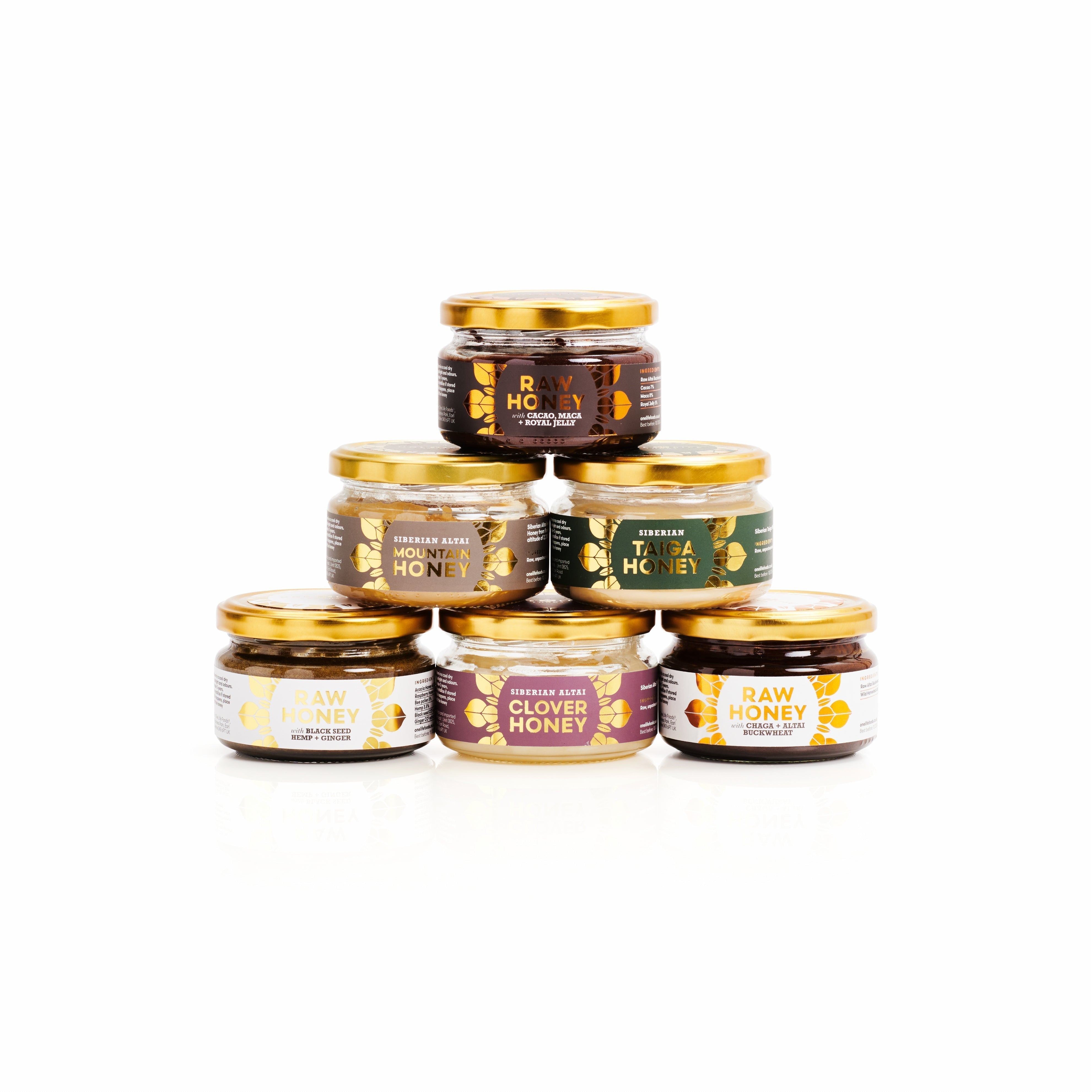
One Life Foods sources its raw honey from the Altai mountain region, where the surrounding flora produces honeys with very different characteristics from the uniform blended honey commonly found on supermarket shelves.
The Wild Forest Clover Honey is lighter and sweeter. Altai Mountain Honey has a deeper multifloral character. Neither needs a story about honey curing every modern ailment in order to be interesting.
The provenance, flavour and lack of unnecessary processing are enough. Explore our raw honey range.
The argument for raw honey is actually quite simple
There is a strange habit in nutrition of making relatively straightforward things unnecessarily dramatic.
Raw honey doesn't need to be described as a miracle food. It isn't a substitute for vegetables, it isn't a multivitamin and nobody needs to pretend a teaspoon is going to reverse heart disease.
But the alternative conclusion — that processing doesn't matter — makes even less sense.
Honey contains a complicated mixture of sugars and smaller quantities of enzymes, acids, phenolic compounds, pollen-derived material and other constituents. Heat can degrade some of them. Fine filtration can remove others. More aggressive processing therefore moves the finished product progressively further away from what came out of the hive. The scientific literature on honey quality is not especially mysterious on that point. PubMed Central (PMC)
If somebody wants sugar alone, there are much cheaper ways of buying it.
If they're going to buy honey, there is a fairly persuasive argument for buying honey that still contains as much as reasonably possible of what made it honey in the first place.
That's the case for raw honey. It doesn't really need a more spectacular one.

Share:
Why are cold process soaps better than conventional soaps?
Shilajit for women