


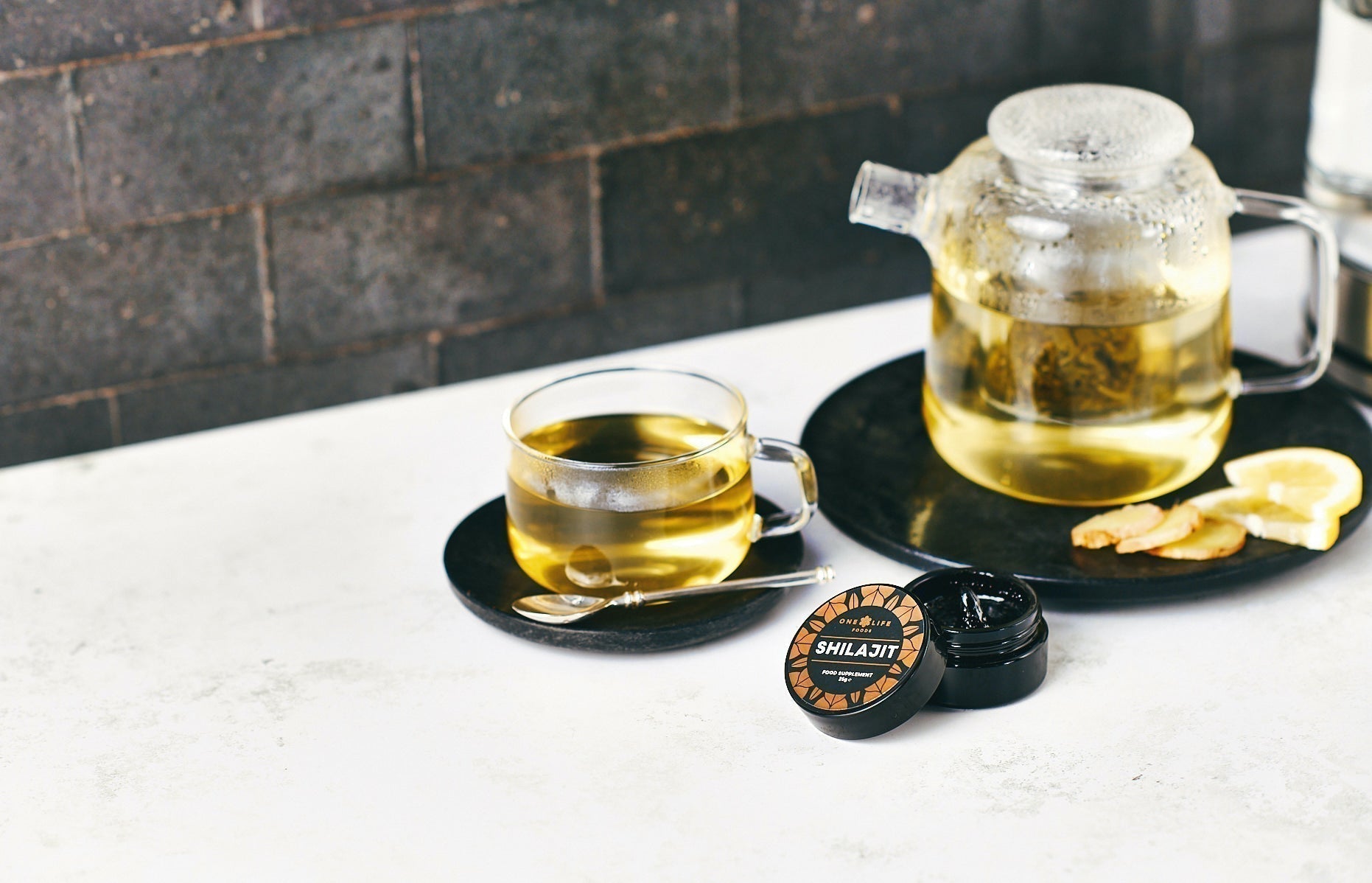
Quick answer: how should you take Shilajit?
The best way to take Shilajit is to follow the serving instructions on the product you’ve bought.
There is no single scientifically established dose or perfect time that applies to every Shilajit product. Follow the serving instructions for the specific product, take it at a consistent time that suits your routine, and use it with food if that improves tolerance.
For Shilajit resin, this usually means measuring a small serving and either:
-
Dissolving it in warm water
-
Stirring it into tea or coffee
-
Mixing it with warm milk or a plant-based alternative
-
Swallowing it directly and drinking water afterwards
-
Adding it to food or a cold drink after dispersing it in a little warm water
There’s no proven perfect time to take Shilajit, and there’s no convincing evidence that it works better on an empty stomach.
Most people take it once a day as part of a consistent routine. Morning is convenient, but timing matters less than taking the correct amount and using a purified, properly tested product.
How much Shilajit should you take?
There isn’t one scientifically established Shilajit dosage that applies to every product.
Human studies have used particular purified or standardised Shilajit preparations at amounts including:
-
250 mg per day
-
500 mg per day
-
250 mg twice per day
These studies used specific products, populations and study periods. They don’t prove that every resin, liquid, powder or capsule should be used at the same dose.
The most practical rule is simple:
Follow the serving instructions on your product rather than copying a dosage from another brand, research paper or social media video.
Differences in purification, water content, concentration and formulation can affect how much material is delivered by each gram or serving. A 500 mg serving of one resin isn’t necessarily identical to 500 mg of another product.
Our guide to Shilajit concentration, water content and total solids explains why jar weight and serving weight don’t always tell the complete story.
Should beginners start with less?
If the product label provides a serving range, starting at the lower end is a sensible way to assess tolerance.
Don’t immediately increase the serving because you haven’t felt anything.
Shilajit isn’t a conventional stimulant, and a larger amount shouldn’t be expected to create a stronger or more immediate sensation. Taking more than the recommended serving can simply increase the likelihood of discomfort or waste product.
If you miss a serving, don’t double the next one.
When is the best time to take Shilajit?
There’s no established best time to take Shilajit.
Most people choose the morning because it’s easy to attach the serving to an existing routine such as breakfast, tea or coffee.
You could also take it:
-
With breakfast
-
With lunch
-
Before training
-
After training
-
At another consistent time that suits you
Taking Shilajit before exercise hasn’t been shown to create an immediate pre-workout effect. Human exercise research has generally studied repeated daily supplementation rather than a single serving taken just before training.
Shilajit isn’t a conventional stimulant. However, individual experiences vary. If you believe taking it late in the day affects your sleep, move it to the morning rather than assuming you need to stop entirely.
Consistency is normally more practical than chasing a theoretically perfect time.
Should you take Shilajit on an empty stomach?
You don’t have to take Shilajit on an empty stomach.
There isn’t enough comparative human evidence to show that taking it fasted produces better overall absorption or results than taking it with food.
Food changes digestion in several ways. It can affect stomach emptying, intestinal pH, bile release and the availability of individual minerals or organic compounds. That doesn’t mean food improves or reduces the absorption of the complete Shilajit matrix in a predictable way.
Choose the option that suits you:
-
Take it before food if you tolerate it well
-
Take it with or after food if that feels more comfortable
-
Avoid changing several parts of your routine at once
Our guide to what the body may actually absorb from Shilajit examines the limits of the current evidence.
If Shilajit repeatedly causes nausea, stomach pain, diarrhoea, headaches or another unwanted reaction, stop taking it. Don’t treat feeling unwell as evidence that it’s “detoxing” you or working particularly strongly.
Read our full guide to Shilajit safety, side effects and who should avoid it.
Can you split your Shilajit serving?
Follow the product label.
If the instructions allow the daily serving to be split, you may prefer taking part in the morning and part later in the day.
There’s no strong evidence that splitting an equivalent daily amount produces better results than taking it once. It may simply improve convenience or tolerance.
Don’t split a serving if doing so makes accurate measuring more difficult.
How to measure Shilajit resin
Shilajit resin can become softer in warm conditions and firmer when it’s cold. Its texture, moisture content and density can also vary between products and batches.
This means visual descriptions such as “a grain of rice” or “a small pea” should only be treated as rough guides. They aren’t precise measurements.
Small spoons and serving tools aren’t necessarily exact either. The amount they hold can change depending on:
-
How firmly the resin is packed
-
Whether the resin is warm or cold
-
How much sticks to the tool
-
Whether the serving is level or heaped
-
The shape and capacity of the tool
The most accurate way to measure resin is with a suitable digital scale that can reliably measure small amounts in milligrams. However, not everyone will want to weigh every serving.
For everyday use, follow the serving guidance provided and aim to measure the resin in a reasonably consistent way. Use the same method each time and avoid increasing the amount simply because one serving looks smaller than another.
The goal isn’t laboratory-level precision. It’s to stay within the product’s recommended intake and avoid large, inconsistent servings.
What should you do if the resin is too firm?
Shilajit resin naturally becomes firmer in cooler conditions.
To soften it, keep the lid tightly closed and either:
-
Place the jar in a shallow cup or bowl of warm water for a few minutes
-
Place the closed jar on top of a warm radiator for a few minutes
The radiator should feel warm rather than extremely hot. Don’t leave the jar there unattended or for an extended period.
This should soften the resin enough to measure without adding water directly to the product.
If you use warm water, dry the outside of the jar thoroughly before opening it. Always use a clean, dry utensil, as introducing water, food or saliva into the jar can affect product hygiene and stability.
Don’t microwave the jar, place it in boiling water or heat the resin directly.
Best ways to take Shilajit resin
There’s no single required method. The best method is the one that lets you measure the product properly, consume the complete serving and remain consistent.
1. Dissolve Shilajit in warm water
Warm water is the simplest method.
-
Measure the serving shown on the product label.
-
Add it to a cup of warm water.
-
Leave it for a few moments to soften.
-
Stir until the resin has dispersed.
-
Drink it shortly after mixing.
Warm water helps soften the resin and reduces the amount left behind on the spoon or cup. There’s currently no human evidence showing that warm water produces better overall absorption than every other method. Its clearest benefit is convenience.
The water doesn’t need to be extremely hot.
2. Take Shilajit with coffee
Yes, you can put Shilajit in coffee.
Prepare your coffee normally, let it cool until it’s comfortable to drink, add the measured resin and stir until dispersed.
There’s no evidence that caffeine “cancels out” Shilajit. There’s also no clinical evidence showing that coffee improves its absorption or effects.
Coffee is simply a convenient carrier.
Remember that any immediate alertness you feel after taking Shilajit in coffee may be caused by the caffeine. This can make it harder to judge what, if anything, you’re noticing from the Shilajit itself.
Read our detailed guide to taking Shilajit with coffee for more on caffeine, temperature and common combinations.
3. Take Shilajit with tea
Shilajit can be stirred into black tea, green tea or herbal tea.
Let the tea reach a comfortable drinking temperature before adding the resin. Stir it well and drink the full cup so the complete serving is consumed.
The flavour of Shilajit is earthy and slightly bitter, so stronger teas may mask it more effectively.
4. Mix Shilajit with milk
Shilajit can be mixed with warm dairy milk or a plant-based alternative.
This is a useful option if you dislike the flavour in water or find supplements easier to tolerate with something more substantial.
Milk hasn’t been shown to activate Shilajit or make it more effective. It’s simply another practical way to consume it.
Avoid boiling the Shilajit in the milk. Warm the drink first, allow it to cool slightly, then add the resin.
5. Add Shilajit to a smoothie or cold drink
Resin doesn’t disperse as easily in a cold liquid.
The easiest method is to:
-
Measure the resin.
-
Dissolve it in a small amount of warm water.
-
Add that mixture to your smoothie, juice or cold drink.
-
Consume the complete drink shortly afterwards.
This prevents a sticky piece of resin from remaining attached to the blender, glass or straw.
There’s no evidence that fruit juice, smoothies or vitamin C activate the complete Shilajit matrix. Choose the drink because you enjoy it, not because of an unproven absorption claim.
6. Mix Shilajit into food
Shilajit can also be mixed into a small amount of:
-
Yoghurt
-
Honey
-
Porridge
-
Overnight oats
-
Nut butter
Use a small portion of food so you can be confident you’ve consumed the full serving.
Mixing resin into an entire bowl or meal makes it easier for some of the product to remain behind.
Food hasn’t been shown to make Shilajit universally more effective, but it may make the routine more pleasant or easier on the stomach.
7. Take Shilajit directly
You can take resin directly from the measuring spoon and drink water afterwards.
Some people place it on or under the tongue before swallowing. There’s no good evidence that holding Shilajit under the tongue improves absorption, increases bioavailability or makes it work faster.
It can also stick to the teeth, tongue or spoon, so dissolving it in a drink is normally less messy.
8. Take Shilajit powder, capsules or liquid
Capsules and tablets should be swallowed according to the label instructions.
Powder can usually be swallowed in capsules or mixed into a drink. Liquid products may be taken directly or diluted, depending on the formulation.
The important question isn’t only how you take them. It’s what the product actually contains.
A powder might be made from dried purified Shilajit, a standardised extract, a broader humic source or a combination of ingredients. A liquid may be concentrated or heavily diluted.
Check:
-
The amount of Shilajit per serving
-
The source material
-
Whether other ingredients have been added
-
How the product was purified
-
Whether the finished product was tested
-
Whether the label explains the concentration clearly
Our comparison of Shilajit resin, liquid, powder, capsules and gummies explains the trade-offs in more detail.
Can you put Shilajit in hot water?
Shilajit can be added to a warm drink.
You’ll often see claims that it becomes useless above an exact temperature such as 60°C or 70°C. There’s no scientifically validated household temperature at which every useful part of Shilajit suddenly becomes inactive.
Shilajit is a complex organic and mineral material rather than one heat-sensitive molecule. Its different components may respond differently to temperature and prolonged heating.
The practical approach is:
-
Don’t boil or cook the resin
-
Don’t add it to liquid that’s still aggressively bubbling
-
Let your drink cool until it’s comfortable to sip
-
Add the resin and consume it reasonably soon
There’s no need to check the drink with a thermometer.
Should Shilajit dissolve completely?
Purified resin will usually soften and disperse in warm liquid.
A small amount of fine sediment can be normal because Shilajit contains a mixture of soluble and less soluble material.
The exact appearance may vary with:
-
Temperature
-
Moisture content
-
Concentration
-
Mineral composition
-
Filtration
-
Purification
-
Geographic source
Fine sediment isn’t the same as obvious grit, sand, stones or plant debris.
Dissolution also can’t prove whether Shilajit is authentic, safe or high quality. Many different substances dissolve in water, and many can be made to behave like resin.
Proper laboratory testing tells you more than a glass of water. Read how Shilajit testing actually works or see how we test our own Shilajit.
How long should you take Shilajit?
Shilajit doesn’t have a scientifically established moment when it suddenly starts working.
Most human studies have measured outcomes after repeated use over several weeks or months. Some have assessed participants after around eight weeks, while other studies have used 90-day or longer periods.
That doesn’t mean everyone will notice a result after eight weeks or 90 days. It means those were the points at which researchers measured particular outcomes.
A sensible way to assess any supplement is to:
-
Decide why you’re taking it.
-
Keep the serving and timing reasonably consistent.
-
Avoid starting several new supplements simultaneously.
-
Track one or two relevant outcomes.
-
Review whether it’s providing enough value to continue buying.
Don’t judge Shilajit by whether you feel a dramatic sensation after the first serving.
For a more detailed discussion, read how long Shilajit takes to work and what the studies actually measured.
Should You Cycle Shilajit?
At One Life Foods, we recommend taking Shilajit daily for 6–8 weeks, followed by a four-week break.
This is the cycling protocol stated on our product packaging and directions.
There is currently no strong clinical evidence showing that Shilajit must be cycled, that continuous use causes a defined pharmacological tolerance or that planned breaks increase its effectiveness.
Our recommendation is a cautious, practical approach. A planned break provides an opportunity to:
-
Reassess whether the supplement remains useful.
-
Compare how you feel with and without it.
-
Review whether you are continuing to tolerate it well.
-
Avoid taking a supplement indefinitely without reassessment.
-
Decide whether it still represents good value for you.
After the four-week break, you may begin another cycle if Shilajit remains appropriate for you.
This protocol is our practical product-use recommendation rather than a requirement established by clinical trials. Always follow the serving and cycling directions provided with your product.
Can You Take Shilajit Every Day?
Shilajit is taken daily during each recommended usage cycle.
At One Life Foods, we recommend taking it daily for 6–8 weeks, followed by a four-week break. After the break, you may begin another cycle if the product remains suitable for you.
Daily use during a cycle does not mean:
-
Taking more than the recommended serving.
-
Using an unpurified product.
-
Continuing despite unwanted effects.
-
Assuming indefinite continuous use has been established as safe.
-
Ignoring medicines, medical conditions or professional advice.
Always follow the instructions and warnings provided with your product.
Can you take Shilajit with other supplements?
Shilajit is commonly used alongside products such as creatine, protein powder, vitamins, minerals, medicinal mushrooms and herbal extracts.
That doesn’t prove every combination has been studied or is appropriate for everyone.
When combining supplements:
-
Check for repeated ingredients
-
Check the total amount of minerals or herbs across products
-
Introduce one new product at a time
-
Avoid assuming that one ingredient automatically improves another’s absorption
-
Speak to a pharmacist, GP or qualified healthcare professional if you take medication or have a medical condition
A logical combination isn’t automatically a clinically proven one.
Who should get advice before taking Shilajit?
Speak to an appropriate healthcare professional before taking Shilajit if you:
-
Are pregnant or breastfeeding
-
Take regular medication
-
Have a diagnosed medical condition
-
Are preparing for surgery
-
Have previously reacted to a similar product
-
Have been advised to control your intake of particular minerals
-
Are considering giving it to a child
Tell your doctor or pharmacist about the supplements you use. Natural doesn’t mean interaction-free.
Food supplements aren’t intended to replace a varied diet, healthy lifestyle or necessary medical treatment.
Why product quality matters more than the perfect routine
You can measure a serving carefully, take it at the same time every morning and mix it into the ideal drink.
None of that can compensate for a poorly sourced, inadequately purified or incompletely tested product.
Before buying Shilajit, look for:
-
Clear serving instructions
-
Traceable sourcing
-
Appropriate purification
-
Finished-product testing
-
Heavy-metal analysis
-
Microbiological testing
-
Relevant environmental contaminant screening
-
Transparent concentration or solids information
-
Batch-specific results where available
A dramatic origin story, an unusually high fulvic acid figure or the words “gold grade” don’t replace proper quality control.
Read what to look for when buying Shilajit before comparing products.
Common mistakes when taking Shilajit
Taking more because you can’t feel it
Shilajit isn’t expected to behave like caffeine or a pre-workout. A lack of immediate sensation isn’t a reason to increase the serving.
Ignoring the product label
Different formats and concentrations can require different serving instructions.
Adding water directly to the jar
Use a clean, dry utensil and keep moisture out of the container.
Using raw or untreated Shilajit
Shilajit collected directly from rock isn’t ready to consume. Purification is necessary to remove unwanted debris and reduce contamination risks.
Starting several supplements together
If something helps or causes discomfort, you won’t know which product was responsible.
Believing discomfort proves potency
Headaches, nausea or stomach upset aren’t signs of a successful detoxification process. Stop taking a supplement that makes you unwell.
Focusing on timing instead of quality
The difference between 8am and 10am is unlikely to matter as much as purification, testing, concentration and sensible use.
How to store Shilajit resin
Keep the jar:
-
Tightly closed
-
In a cool, dry place
-
Away from direct sunlight
-
Away from excessive heat
-
Protected from water and food contamination
Follow any storage instructions on the label.
Resin may become firmer when cold and softer when warm. A texture change caused by room temperature doesn’t automatically mean the product has spoiled.
If the product develops an unexpected smell, visible mould, damaged packaging or another concerning change, don’t use it.
The bottom line
Taking Shilajit doesn’t require a complicated protocol.
The simplest approach is:
-
Choose purified, properly tested Shilajit.
-
Follow the serving instructions on the label.
-
Measure the resin as consistently as possible.
-
Dissolve it in warm water or another drink you enjoy.
-
Take it at a time you can maintain.
-
Don’t increase the amount to chase an immediate feeling.
-
Stop if it makes you unwell.
-
Review whether it’s providing enough value to continue.
Timing is flexible.
Taking it with food is optional.
Cycling has not been clinically established as necessary, but it is the cautious usage protocol we recommend: 6–8 weeks of daily use followed by a four-week break.
Product quality, accurate dosing and consistent use matter more than internet rituals.
Explore our Shilajit range
One Life Foods sells purified Shilajit resin, so we have a clear commercial interest in this subject.
We prefer resin because it keeps the format simple and allows customers to see and handle the material they’re taking. That doesn’t mean every resin is good or that every liquid, powder or capsule is poor.
Source, purification, concentration and testing still decide whether a product deserves your trust.
Explore our Shilajit resin range, compare the different regional sources and review the available testing information before choosing.
Related reading
References
-
Clinical evaluation of purified Shilajit on testosterone levels in healthy volunteers
-
Safety and efficacy of Shilajit resin supplementation at 500 mg per day
-
Food Standards Agency guidance on consuming food supplements safely
Written by
Written by Chris Simon, Founder of One Life Foods.
Chris has worked in the supplement industry since 2009 and has worked with Shilajit since 2017, with a focus on independent testing, analytical methods and responsible product sourcing.

Share:
Shilajit Forms: Resin vs Liquid vs Powder (What Actually Matters)
Shilajit Myths: What’s True, What Isn’t, and What The Evidence Shows