


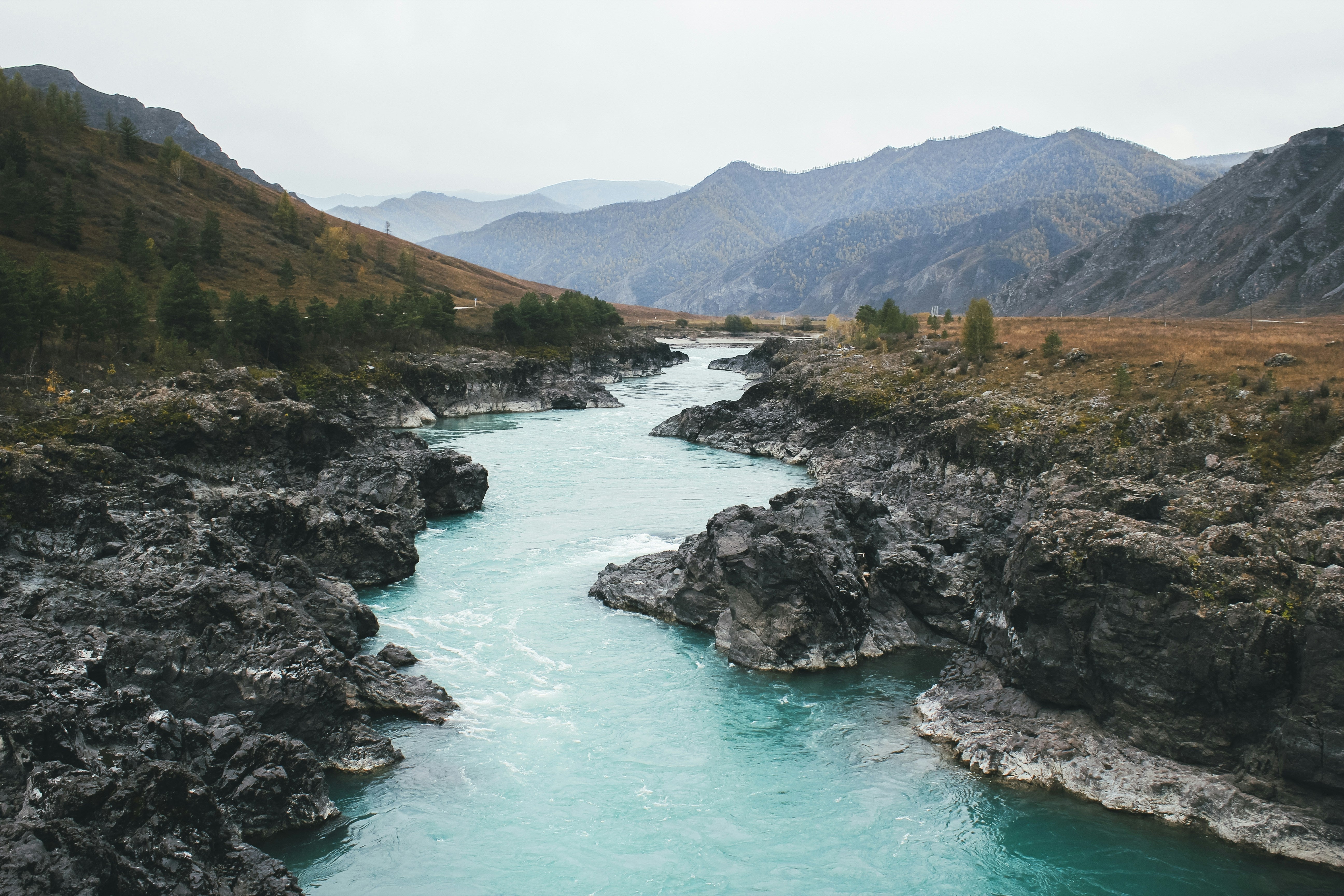
The Siberian Altai does not have the softness of a wellness brochure.
It's cold, vast and old-feeling. Forested slopes rise into alpine zones. Rivers cut through hard country. Granite, fault lines, high plateaus and winter weather shape a landscape where resilience is not a slogan. It's a basic requirement.
This is the world of Siberian Altai Shilajit, or more culturally, Mumiyo.
If Kashmiri Shilajit belongs most naturally to the Ayurvedic conversation, Siberian Altai Shilajit belongs to the Russian and Central Asian tradition of Mumiyo: a dark mountain substance surrounded by folk use, dramatic claims, practical preparation and striking mythology.
This article looks at the place, the stone, the names, the traditional beliefs and the modern standards that matter today.
In brief
Siberian Altai Shilajit is best understood through the Mumiyo tradition: the Russian and Central Asian language around dark mountain resins used historically in folk medicine.
Its story is shaped by cold alpine landscapes, forested mountain systems, hard stone, long winters and a tradition that is culturally distinct from the Ayurvedic framing usually attached to Shilajit.
That origin gives it character. It does not, by itself, prove quality.
As with any Shilajit, what matters today is purification, composition, contaminant testing and batch consistency.
The Siberian Altai Landscape
The Altai Mountains form a major mountain system in southern Siberia and Central Asia. The UNESCO-listed Golden Mountains of Altai include the Altai and Katun reserves, Lake Teletskoye, Mount Belukha and the Ukok Plateau. UNESCO and related World Heritage sources describe this region as containing an exceptional sequence of vegetation zones, from steppe and forest-steppe through mixed forest, subalpine and alpine environments.
That range of environments is part of what makes the Siberian Altai so compelling. It is not just rock and snow. It is steppe, forest, river, high mountain and plateau.
The geology is equally complex. Research on the Siberian Altai describes fault-controlled basins, Jurassic sedimentation events, tectonic reactivation and plutonic activity. Wider Great Altai studies describe fault-bounded zones, metallogenic history and granite-related mineral deposits in parts of the broader region.
In simpler terms, this is a landscape built by movement, collision, intrusion, fracture and time.
A fitting place, then, for a substance believed to emerge from the hidden work of mountains.
The Stones of the Siberian Altai
The Siberian Altai feels different from the Mongolian Altai, even though they share the wider Altai identity.
Here, it's about granite, faulted mountains, cold valleys, alpine environments, forests and exposed rock. The visual world is less dry-steppe frontier and more northern mountain severity.
This is a landscape where stone and climate feel equally important. Freeze and thaw. Snow and meltwater. Forest and exposed ridge. Long winters. Short growing seasons. Remote collection sites.
Again, we should avoid pretending that geology alone guarantees supplement quality. It doesn't.
But geology gives the story its setting. It tells the reader that Siberian Altai Shilajit is not generic black resin. It comes from a particular world of cold mountains, hard stone and old folk tradition.
Shilajit or Mumiyo?
For Siberian Altai, “Mumiyo” is the key word.
“Shilajit” is the name most UK customers recognise, largely because of Ayurveda and modern supplement language. But in Russia, Siberia and Central Asia, similar mountain substances are more commonly associated with the name Mumiyo, also written Mumijo or Mumie.
A review on Mumijo describes it as a traditional medicine especially used in Russia and Altai, while other sources note its use across Kazakhstan and Central Asia as a folk remedy and historically recognised substance.
That distinction is useful because it gives this Siberian article its own identity.
We're not simply saying:
“Here is another Shilajit resin from another mountain.”
We're saying:
“Here is the Russian and Central Asian Mumiyo tradition, understood through the modern Shilajit category.”
That is much richer.
Traditional Beliefs Around Mumiyo
The following are traditional beliefs and historical uses, not modern claims made by One Life Foods.
Siberian and Central Asian Mumiyo has a particularly colourful history.
In folk traditions across Central Asia, Russia and the former Soviet Union, Mumiyo was associated with repair, recovery, physical restoration, vitality and general resilience. Scientific literature discussing Mumiyo also notes its historical use around wounds, fractures, ulcers and broader panacea-like claims.
That doesn't mean those claims should be treated as proven clinical effects.
The bone fracture association is especially interesting from a folklore perspective. Across Mumiyo traditions, it repeatedly appears as a substance linked with rebuilding and restoration.
By the mid-20th century, Mumiyo had moved beyond folklore and into formal Soviet-era research, particularly around recovery, repair and regenerative processes.
That history is interesting, but it should not be overstated.
We're not saying it proves modern performance benefits, and it doesn't turn Mumiyo into an Olympic secret weapon.
It simply shows that this was a substance serious researchers in the region considered worth studying.
Whether every claim stands up clinically is not the point here.
The point is that local traditions saw it as a material of repair.
That's powerful storytelling, provided we label it properly.
We're exploring the folklore without trying to sell you medieval bone glue...
Myths: Mountain Tears, Rock Blood and Hidden Balm
Mumiyo folklore is wonderfully dramatic.
Across Central Asian and Eurasian traditions, similar substances have been called things like mountain wax, rock juice, rock sap, mountain blood and tears of the rocks. Some stories describe it as a kind of balm hidden in the mountains, formed in secret places and discovered only by those who know where to look.
Are these stories exaggerated? Of course.
But they are also useful.
They show that Mumiyo was not viewed as an ordinary mineral deposit. It was imagined as something the mountain produced almost biologically, as if the stone itself had a living quality.
That image, stone giving up a dark restorative resin, is exactly why Shilajit and Mumiyo have always attracted myth.
Modern science doesn't need to believe the mountain is crying. But good writing can still admit that the image is rather good.
Purification: From Folk Remedy to Modern Standard
The Siberian Altai article should not lean too heavily on Ayurvedic Shodhana. That belongs more naturally to the Kashmiri piece.
Here, the purification story is about the evolution from folk preparation to modern quality control.
Traditionally, raw Mumiyo-like material would need to be collected, sorted, dissolved, filtered and dried. Practical cleaning would remove stones, grit and plant debris. Modern preparation should add far more rigorous standards: contaminant testing, microbial screening, heavy metal analysis and checks for adulteration.
This distinction is important because the mythology of Mumiyo can easily become too romantic.
A resin can have a fascinating history and still need modern shilajit testing.
In fact, that is precisely the point.
The older traditions explain why people valued it. Modern standards determine whether it belongs in a serious product.
Siberian Altai Shilajit Today
Siberian Altai Shilajit has a grounded, resilient character.
Where Hunza feels sharp and high-altitude, Kashmir feels traditional and classical, and Mongolian Altai feels wild and expansive, Siberian Altai feels cold, steady and dependable.
It's the origin that naturally connects to Mumiyo, Russian and Central Asian folk medicine, the Golden Mountains, harsh climates and the idea of mountain resilience.
For us, this makes it especially useful as a foundation origin. It carries enough mythology to be interesting, enough geography to be distinctive, and enough traditional use to be credible, provided the claims are handled responsibly.
Finally...
Siberian Altai Shilajit is not valuable because folklore says it can do everything. It is valuable because it sits at the meeting point of mountain tradition, careful purification and modern testing.
That is where the story becomes serious.

Share:
Refeeds vs Cheat Meals: One Supports Performance, One Just Has Better PR
Refueling After a Weight Cut: What Fighters Should Eat After Weigh-In