



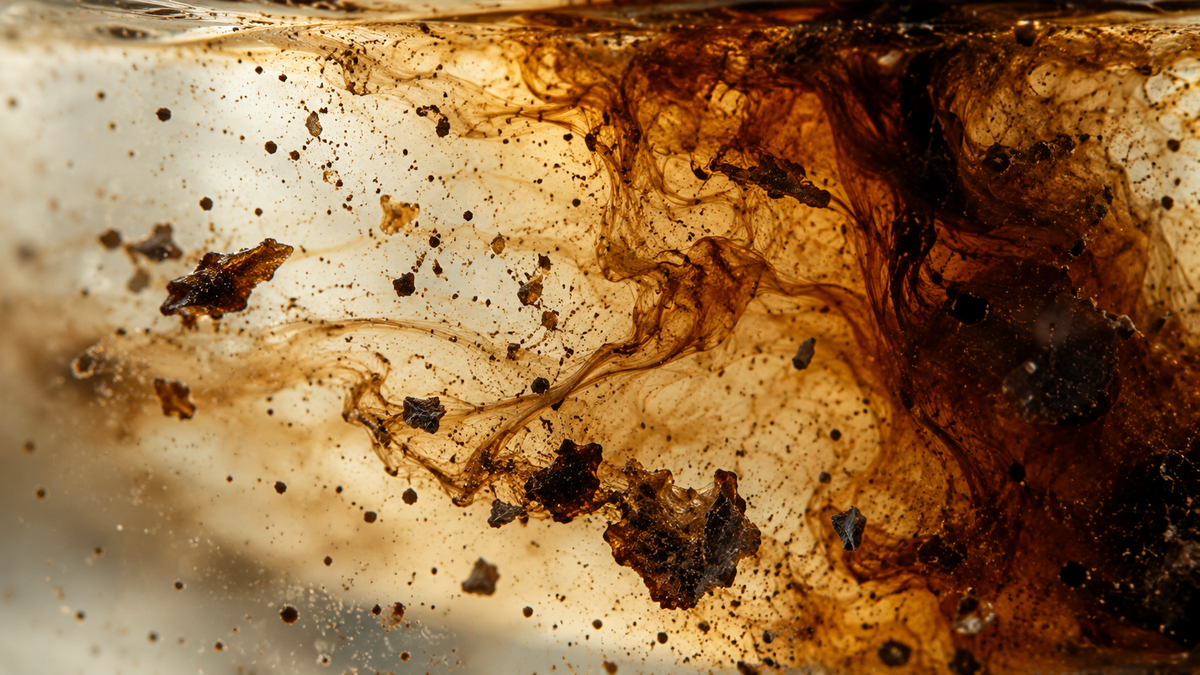
In the jagged folds of the Pir Panjal range, where rock faces split beneath the summer heat, a dark substance appears in the cracks.
Black. Sticky. Pungent. Revered.
It looks less like a supplement than something the mountain itself has exhaled.
For centuries, Shilajit has been gathered across the mountain ranges of Asia, purified, stored and passed through systems of traditional medicine that existed long before anyone understood cells, enzymes or mitochondria.
Modern accounts have sometimes tried to connect Shilajit with ancient mummification. The similarity between the regional term Mumijo and the historical word mumia has made that story especially tempting.
There is a problem with it.
The European Commission’s official Mumijo status document specifically warns that Mumijo or Shilajit shouldn’t be confused with mumia, a historical medicinal powder associated with decomposed mummified remains.
There is also no strong archaeological evidence showing that Shilajit was routinely used to preserve human bodies.
The more interesting connection isn’t between Shilajit and mummies.
It is between old ideas about preserving vitality and modern questions about how cells produce, protect and manage energy.
To understand that relationship, we need to move from mountain folklore to mitochondrial science.
Quick Answer: What Is the Connection Between Shilajit and Mitochondria?
Shilajit has a long traditional history as a substance associated with vitality, resilience and restoration.
Modern researchers have investigated whether compounds found in particular purified Shilajit preparations may interact with redox chemistry, fatigue, cellular energy systems or mitochondrial processes.
Laboratory and animal findings have generated plausible scientific questions. A small number of human studies have also reported measurable outcomes involving muscular fatigue and skeletal-muscle gene expression.
However, current research doesn’t prove that ordinary Shilajit resin repairs mitochondria, increases ATP in humans or reverses cellular ageing.
The accurate position is:
Shilajit is being investigated in relation to mitochondrial function and cellular energy. The evidence is interesting, but the mechanism and its relevance to everyday products remain uncertain.
For a broader introduction to its origin, formation and composition, read What Is Shilajit?
What Is Shilajit?
Shilajit is a naturally occurring organic-mineral material found within certain mountain environments.
It isn’t a single molecule and it doesn’t have one fixed chemical formula.
It is thought to develop over long periods as biological material is broken down, transformed and humified through interactions involving microorganisms, water and mineral-rich rock.
The resulting material can contain a variable mixture of:
- Fulvic substances
- Humic substances
- Minerals and trace elements
- Organic acids
- Phenolic compounds
- Dibenzo-alpha-pyrone-related compounds
- Other smaller organic fractions
- Partially insoluble material
Its precise composition can be influenced by:
- Geographic source
- Local geology
- Original biological material
- Microbial activity
- Climate
- Collection
- Purification
- Processing
- Storage
- Analytical method
This variability is one of the reasons Shilajit is difficult to study.
Two products can both be called Shilajit while differing significantly in their chemistry, concentration, processing history and contaminant profile.
Research involving one purified and standardised preparation therefore can’t automatically be applied to every resin, powder, capsule or liquid sold under the same name.
Shilajit in Traditional Medicine
Shilajit has a long history within Ayurvedic medicine and other traditional systems across Asia.
Within Ayurveda, it was commonly classified as a rasayana, a broad category associated historically with rejuvenation, resilience and the maintenance of vitality.
Traditional descriptions also associated Shilajit with physical strength, fertility, recovery and resistance to the wearing effects of time.
These systems didn’t describe Shilajit using concepts such as ATP production, electron transport, oxidative phosphorylation or pharmacokinetics.
They used the language and models available to them.
People observed patterns, constructed theories and developed practices around substances that appeared to influence how they felt or functioned.
Some traditional observations may eventually prove to have measurable biological explanations.
Others may remain cultural, symbolic, non-specific or unproven.
Traditional use isn’t the same as clinical evidence.
It is still part of the historical record explaining why Shilajit remained important enough to be collected, purified and used across generations.
Mumijo Isn’t Mumia: Correcting the Mummy Story
Several modern articles and research reviews have repeated the claim that Shilajit was used in ancient Egyptian mummification.
The claim appears convincing partly because Shilajit is known by regional names including Mumijo, Mumiyo, Mumie and Moomiyo.
Those words look similar to mumia, a historical term associated with substances taken from mummified remains and later sold as medicine.
Similar spelling isn’t proof of shared identity.
The European Commission’s official status document states that Mumijo shouldn’t be confused with mumia, described as a powder made from decomposed mummies and historically sold as a folk remedy.
There is no strong archaeological evidence establishing that conventional Shilajit was routinely used as an Egyptian embalming material.
Natural bitumen, plant resins, oils, waxes and aromatic substances were used in different preservation practices. Dark colour and resin-like texture may have encouraged later writers to merge several materials into one dramatic story.
That story shouldn’t be presented as established history.
The distinction matters scientifically too.
Mumijo or Shilajit is an organic-mineral mountain material.
Mumia belongs to a separate and considerably less appetising part of medical history.
You can read the official terminology note in the European Commission’s Mumijo status document.
From Preserving Vitality to Investigating Cellular Function
Removing the mummy claim doesn’t remove the underlying historical theme.
Traditional systems repeatedly associated Shilajit with preserving vitality in the living.
Modern research asks a narrower question:
Could parts of Shilajit’s chemistry interact with biological systems involved in fatigue, redox balance or cellular energy?
This is where mitochondria enter the discussion.
Mitochondria are structures within cells that play a central role in producing adenosine triphosphate, better known as ATP.
ATP provides usable energy for processes including:
- Muscle contraction
- Nerve activity
- Protein synthesis
- Cellular transport
- Tissue maintenance
- Repair and remodelling
Mitochondria aren’t simply biological batteries.
They form part of a changing network involving membranes, enzymes, nutrients, minerals, signalling molecules and redox-control systems.
Their function can be influenced by health, ageing, physical activity, nutrient status, metabolic conditions and many other factors.
This has led researchers to investigate whether Shilajit or compounds associated with it might influence mitochondrial processes or the body’s response to physical fatigue.
Does Shilajit Support Mitochondrial Function?
Some laboratory and animal experiments have explored whether characterised Shilajit preparations or compounds associated with them can influence:
- Mitochondrial enzymes
- Electron-transfer systems
- Oxidative balance
- Post-exercise ATP levels
- Cellular energy status
These findings provide possible mechanisms.
They don’t establish that the same effects occur in humans taking an ordinary commercial resin.
A controlled human study examined whether eight weeks of a purified and standardised Shilajit preparation affected fatigue-related declines in muscular force.
The higher-dose group showed a smaller decline in force in one subgroup of participants. The study didn’t prove that Shilajit increases fresh maximum strength, builds muscle, raises everyday energy or improves every form of exercise performance.
A separate human study reported changes in skeletal-muscle gene expression after supplementation with a specific purified preparation. The findings involved genes connected with extracellular-matrix organisation and muscle adaptation.
Gene-expression changes aren’t the same as demonstrated improvements in strength, recovery or mitochondrial function.
For a detailed examination of these studies, their outcomes and their limitations, read Shilajit for Exercise Performance: Strength, Fatigue and Recovery.
At present, we still don’t know:
- Which components of conventional resin are absorbed
- What concentrations reach the bloodstream
- Whether relevant compounds enter human muscle or other tissues
- Whether they interact directly with mitochondria
- Whether the whole matrix behaves differently from isolated fractions
- Whether different geographic sources produce comparable effects
- Whether preclinical ATP findings translate meaningfully to humans
It is therefore more accurate to say Shilajit is being investigated in relation to mitochondrial function than to claim that it repairs, restores or rebuilds mitochondria.
The chemistry gives us a plausible line of investigation.
It doesn’t give us a completed mechanism.
What Is Shilajit Made From?
Shilajit is sometimes marketed as though fulvic acid is its only meaningful component.
In reality, it is a multi-component matrix.
Depending on the material and testing method, it may contain varying proportions of:
- Fulvic compounds
- Humic substances
- Minerals and trace elements
- Organic acids
- Fatty acids
- Phenolic compounds
- Dibenzo-alpha-pyrone-related structures
- Other small organic molecules
- Partially insoluble fractions
Each category contains further complexity.
Fulvic and humic substances aren’t single molecules with one fixed structure. They are operationally defined fractions containing broad and overlapping groups of compounds.
The percentages reported by a laboratory can also change depending on how those fractions are extracted and measured.
This is why the largest number on a laboratory report isn’t automatically the most informative.
For a detailed comparison of the methods, read Fulvic Acid in Shilajit: Which Test Can You Trust?
Fulvic Acid and the Delivery-System Myth
Fulvic acid is often described as a microscopic delivery vehicle that carries minerals, herbs and nutrients directly through cell membranes.
It is an attractive explanation.
It is also much too simple.
Fulvic substances can interact with minerals and organic molecules. Depending on the substance and surrounding conditions, these interactions may alter:
- Solubility
- Stability
- Chemical form
- Digestive release
- Bioaccessibility
- Absorption
Binding doesn’t automatically improve absorption.
A substance might become more soluble but less able to cross the intestinal wall.
It might be protected temporarily and released later.
It might remain bound within the digestive system.
The interaction might have no meaningful biological consequence.
The result depends on the specific compound, type of binding, digestive conditions, dose and timing.
Fulvic acid shouldn’t be treated as a universal courier that knows where every nutrient needs to go.
A more credible question is whether a particular Shilajit preparation changes the behaviour of a particular compound under defined conditions.
That can be investigated through analytical chemistry, simulated digestion and human pharmacokinetic research.
Until then, the universal delivery-system claim remains a hypothesis rather than an established property.
Our guide to what the body actually absorbs from Shilajit explains the differences between dissolution, bioaccessibility, absorption and tissue delivery.
What Are Dibenzo-Alpha-Pyrones?
Dibenzo-alpha-pyrones, often shortened to DBPs, are a family of aromatic compounds discussed in parts of the Shilajit literature.
They have attracted attention because DBP-related compounds have been studied in connection with:
- Redox chemistry
- Electron transfer
- Coenzyme Q-related systems
- Mitochondrial processes
A compound doesn’t need to make up a large percentage of a substance to be biologically relevant.
Small amounts can sometimes matter when a molecule interacts with an enzyme, receptor, membrane or signalling pathway.
However, three separate questions need answers:
- Is the compound present?
- Is enough present to matter?
- Does it reach the relevant part of the human body?
The presence of an interesting chemical structure doesn’t prove that a normal serving supplies an effective dose.
It also doesn’t prove that every Shilajit product contains the same DBPs in the same amounts.
Many commercial products haven’t been tested specifically for these compounds.
For a closer look at the chemistry and the limits of the current evidence, read What Are Dibenzo-Alpha-Pyrones in Shilajit?
Can a Small Amount of Shilajit Really Do Anything?
Potentially, but the physical size of a serving can’t answer the question by itself.
Dose has to be understood in relation to chemistry.
We don’t require large quantities of every biologically active substance. Some compounds influence enzymes, receptors, redox systems or cellular signals at relatively low concentrations.
This doesn’t mean every small Shilajit serving works.
It means that a serving shouldn’t be dismissed solely because it weighs a few hundred milligrams.
The important questions are:
- Which compounds are present?
- How much of each compound is present?
- Which compounds survive digestion?
- Which compounds are absorbed?
- What concentrations reach the bloodstream?
- Are those levels high enough to influence human biology?
Some human studies have used daily quantities of a few hundred milligrams of specific purified preparations and reported measurable outcomes.
Those findings show that modest doses can be scientifically testable.
They don’t prove that every small serving of every resin will produce the same effects.
Read Why Small Doses of Shilajit Matter for a more detailed examination of the dose question.
Does Shilajit Work Because It Contains Minerals?
Minerals are part of Shilajit’s composition, but the usual mineral story is often exaggerated.
You will regularly see claims that Shilajit contains exactly 84, 85 or more minerals.
There is no universally agreed analytical list showing that every authentic sample contains a fixed number.
Elemental composition varies according to:
- Geographic source
- Local geology
- Water movement
- Purification
- Concentration
- Testing method
- Laboratory reporting limits
Detection also isn’t the same as nutritional significance.
A laboratory may identify an element at a very low concentration. That doesn’t mean a normal serving supplies a meaningful amount.
A few hundred milligrams of Shilajit shouldn’t be treated as a replacement for a mineral-rich diet or a properly formulated mineral supplement.
Its elemental profile can still be useful because it may help with:
- Comparing geographic and geological differences
- Assessing batch consistency
- Understanding the surrounding chemical matrix
- Identifying potential contaminants
- Challenging unsupported fixed-mineral claims
The accurate position isn’t that minerals are irrelevant.
It is that a long mineral list doesn’t explain Shilajit’s biological effects.
Read Does Shilajit Really Contain 85 Minerals? for the full analysis.
Complex Natural Matrices Versus Single Molecules
Modern supplement research often focuses on isolated compounds.
Creatine, caffeine and coenzyme Q10 can each be identified, quantified and studied at controlled doses.
Shilajit presents a different scientific problem.
It is chemically variable and difficult to reduce to one active ingredient or pathway.
Its constituents might:
- Act independently
- Interact with one another
- Change during digestion
- Be metabolised into different compounds
- Contribute little or nothing at normal serving levels
That complexity doesn’t make Shilajit superior to isolated compounds.
It doesn’t prove synergy.
It means the research questions are different.
Single-compound research can ask:
What happens when this defined molecule is given at this dose?
Research into Shilajit must also ask:
What is present in this preparation, what changes during digestion, what reaches the body, and which part of the mixture might explain the observed result?
The second question may reflect the complexity of natural materials more accurately.
It also creates more opportunities for speculation.
The phrases “natural matrix” and “synergy” shouldn’t be used as substitutes for evidence.
Shilajit Compared With NAD+, NMN and PQQ
NAD+, NMN and PQQ are often discussed in the same longevity conversations as Shilajit.
That doesn’t mean they work in the same way.
NAD+ is a defined molecule involved in cellular metabolism and numerous enzyme reactions.
NMN is a precursor involved in pathways that contribute to NAD+ production.
PQQ is a redox-active compound investigated for several possible biological effects.
Shilajit is a variable natural matrix rather than a single defined molecule.
It hasn’t been established that Shilajit:
- Prepares the body for NAD+
- Makes NMN work better
- Provides a required mineral foundation for PQQ
- Should be placed above these compounds in a universal hierarchy
The more useful comparison is conceptual.
Modern longevity research frequently isolates one molecule and investigates one pathway.
Shilajit raises the question of whether a chemically complex natural material can influence several systems through a mixture of constituents.
That possibility is scientifically interesting.
Complexity alone isn’t proof of superiority.
Folklore, Pharmacology and the Space Between Them
Shilajit occupies an unusual position.
It has:
- A deep traditional history
- A complex and variable composition
- A growing but limited body of modern research
- A large amount of exaggerated marketing surrounding it
Some traditional claims may eventually receive support from modern evidence.
Others may remain symbolic, cultural or unproven.
The goal shouldn’t be to strip away every story that can’t be recreated in a laboratory.
Folklore tells us how people understood a substance, why they valued it and why knowledge of it survived.
But folklore and pharmacology shouldn’t be presented as interchangeable.
A traditional belief can inspire a scientific question.
It can’t answer that question on its own.
The most interesting position is often between blind belief and automatic dismissal.
That is where mystery becomes investigation.
Why Purification and Testing Matter
A fascinating origin story doesn’t prove that a finished Shilajit product is safe, authentic or well made.
Because Shilajit forms in natural environments, raw material may contain:
- Soil and grit
- Plant debris
- Microorganisms
- Environmental contaminants
- Elevated levels of certain elements
- Variable moisture
Purification and finished-product testing are therefore essential.
A meaningful testing programme may examine:
- Humic and fulvic fractions
- Elemental composition
- Lead, cadmium, mercury and arsenic
- Microbiological contamination
- Polycyclic aromatic hydrocarbons
- Residual solvents
- Mycotoxins or pesticides where relevant
- Water content and water activity
- Other source-specific risks
The name of the laboratory isn’t enough on its own.
The analytical method, sample identity, accreditation scope, reporting limits and batch relevance also matter.
Our article on how Shilajit testing works explains what a broader testing programme may include and what brands often leave out.
You can also learn how to read a Shilajit laboratory report before relying on a certificate or headline percentage.
What Does the Evidence Actually Support?
The current evidence supports a measured conclusion.
Shilajit is:
- A genuine natural material with a long traditional history
- A chemically complex and variable organic-mineral matrix
- The subject of laboratory, animal and limited human research
- Scientifically interesting in relation to fatigue, redox chemistry and mitochondrial processes
- Highly dependent on source, purification, composition and testing
Shilajit is not yet proven to:
- Repair damaged mitochondria
- Reverse cellular ageing
- Increase ATP production in humans
- Transport every nutrient into cells
- Correct mineral deficiencies
- Make NAD+, NMN or PQQ work better
- Produce the same effects across every origin and product
- Validate every traditional claim attached to it
That doesn’t make the subject less interesting.
It makes honest investigation more important.
Before the Molecule, Remember the Mountain
Shilajit doesn’t need to replace modern longevity compounds.
It doesn’t need to be declared more foundational than NAD+, NMN or PQQ.
And it doesn’t need every ancient story surrounding it to be literally true.
Its importance lies partly in the questions it carries.
How can a small serving of a complex natural substance produce measurable outcomes in some studies?
Which parts of the matrix matter?
What does the body actually absorb?
Do the organic and mineral fractions behave differently together than they do in isolation?
How much of Shilajit’s reputation comes from pharmacology, how much from tradition and how much from the human tendency to find power in substances that emerge from wild and inaccessible places?
Thousands of years ago, people didn’t know the language of mitochondrial respiration.
They knew only that certain substances became associated with endurance, recovery and the preservation of vitality.
Today, we have better tools, more precise questions and fewer excuses for pretending that we already know all the answers.
Before we tried to preserve youth with molecules, we searched for vitality in mountains.
It might be time we looked again.
Explore the Full Shilajit Guide
This article is part of the One Life Foods Shilajit Guide, a growing knowledge centre covering Shilajit chemistry, human research, traditional history, safety, sourcing and laboratory testing.
Selected Research
- Wilson E, Rajamanickam GV, Dubey GP, et al. Review on Shilajit used in traditional Indian medicine.
- Carrasco-Gallardo C, Guzmán L, Maccioni RB. Shilajit: A Natural Phytocomplex with Potential Procognitive Activity.
- Keller JL, Housh TJ, Hill EC, et al. The effects of Shilajit supplementation on fatigue-induced decreases in muscular strength and serum hydroxyproline levels.
- Kamgar E, Kaykhaii M, Zembrzuska J. A Comprehensive Review on Shilajit: What We Know about Its Chemical Composition.
Written By
Written by Chris Simon, Founder of One Life Foods.
Chris has worked in the supplement industry since 2009 and is known for seeking out exceptional ingredients, products and formulations.

Share:
The Gut Check (Part 2): What Microbes, Genes, and Culture Can Teach Us About Real Wellness
FUEL – The Performance Booster That’s Not Just Another Pre-Workout