


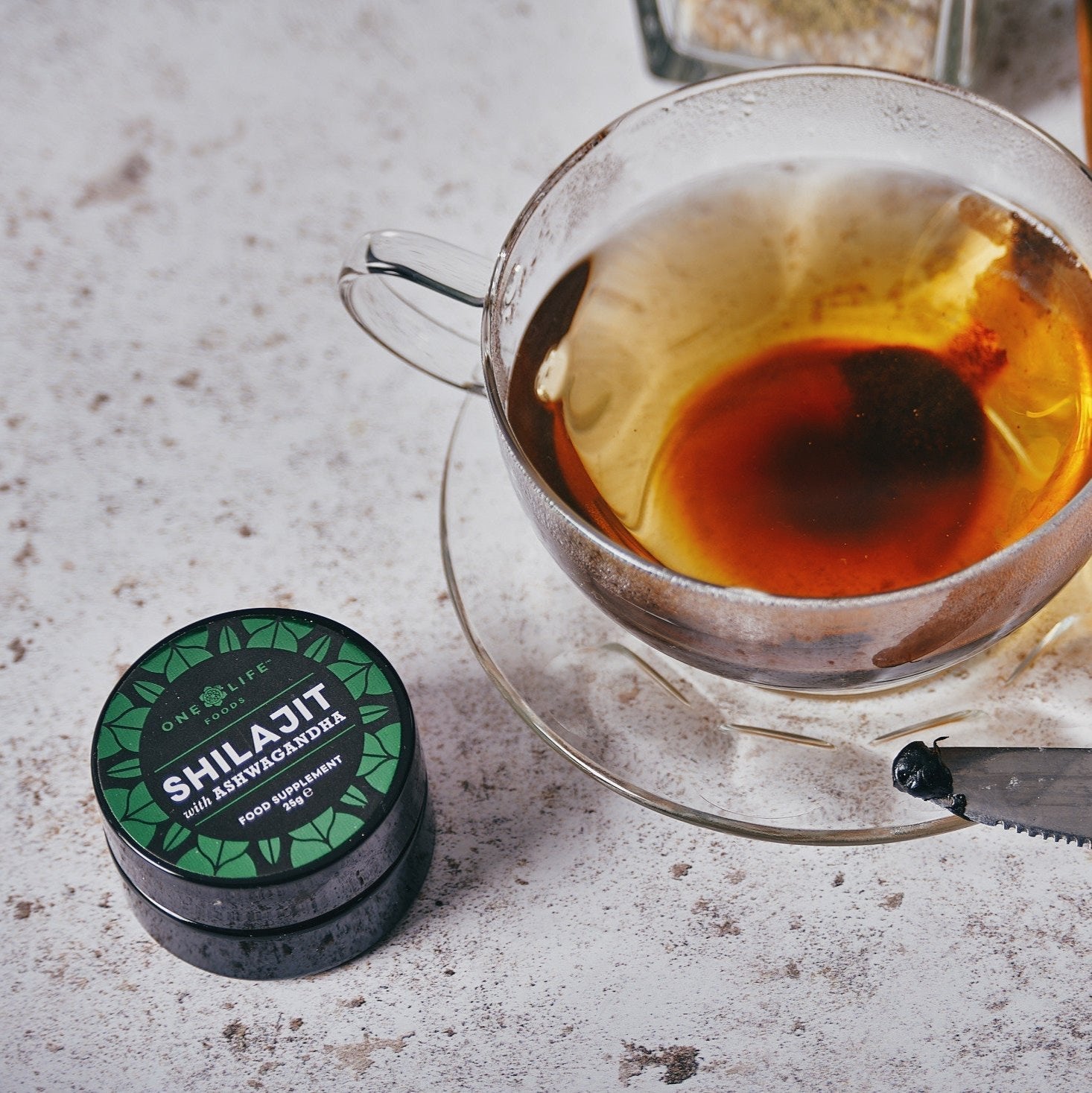
Some ingredient combinations make sense because they are fashionable.
Others make sense because they have survived centuries of use and continue to attract scientific interest today.
Shilajit and Ashwagandha fall firmly into the second category.
Both have long histories within Ayurvedic practice, yet they support health through remarkably different mechanisms. One is a complex mineral-rich substance formed over centuries within mountainous environments. The other is a botanical adaptogen traditionally used to help the body cope with physical and mental stress.
Together, they create a fascinating combination that continues to appeal to those seeking support for energy, resilience, recovery, and overall wellbeing.
What Is Shilajit?
Shilajit is a naturally occurring substance found in mountainous regions throughout Asia and parts of Siberia. It is formed through the gradual decomposition and transformation of plant material over long periods of time.
Authentic Shilajit contains a complex mixture of naturally occurring compounds, including:
-
Fulvic acids
-
Humic substances
-
Trace minerals
-
Dibenzo-α-pyrones (DBPs)
-
Phospholipids
-
Other bioactive constituents
Traditionally referred to as the "destroyer of weakness", Shilajit has been valued for its association with vitality, endurance, and healthy ageing.
Modern interest has focused on its potential role in supporting mitochondrial function, physical performance, and overall physiological resilience.
What Is Ashwagandha?
Ashwagandha (Withania somnifera) is one of the most extensively studied adaptogenic herbs available today.
Adaptogens are substances traditionally used to help the body adapt to physical, mental, and environmental stressors.
The key compounds found within Ashwagandha include:
-
Withanolides
-
Sitoindosides
-
Alkaloids
-
Various antioxidant compounds
Research has explored Ashwagandha's potential role in supporting stress management, exercise performance, recovery, sleep quality, cognitive function, and overall wellbeing.
Why Combine Shilajit and Ashwagandha?
Although they are often discussed together, Shilajit and Ashwagandha are fundamentally different substances.
Shilajit provides a complex spectrum of minerals, fulvic acids, humic substances, and unique bioactive compounds.
Ashwagandha contributes adaptogenic compounds that may help support the body's response to stress.
Rather than overlapping, their actions appear complementary.
This is one reason why the combination has remained popular for generations.
Potential Areas of Support
While no supplement should be viewed as a substitute for proper nutrition, sleep, exercise, and lifestyle habits, the combination of Shilajit and Ashwagandha may be of interest to individuals seeking support for:
Energy and Vitality
Both ingredients have traditionally been associated with supporting physical energy and reducing feelings of fatigue. Interestingly, when it comes to Shilajit, more is not always better. In a supplement industry that often equates bigger doses with better results, Shilajit presents an interesting exception. We explore this idea further in Why Small Doses of Shilajit Matter.
Stress and Resilience
Ashwagandha is particularly well known for its adaptogenic properties and its ability to help the body adapt to everyday stressors.
Recovery and Performance
Research into both ingredients has explored their potential role in exercise performance, recovery, and physical resilience.
General Wellbeing
By supporting multiple aspects of physiological function, the combination may contribute to a broader sense of balance and wellbeing.
The Importance of Quality
Not all Shilajit products are created equal, and laboratory testing can be surprisingly difficult to interpret.
Factors such as sourcing, purification, standardisation, laboratory testing, and formulation can have a significant impact on overall quality.
When evaluating products, it is worth looking beyond marketing claims and considering:
-
Independent testing
-
Ingredient standardisation
-
Transparent sourcing
-
Appropriate dosages
-
Overall formulation quality
Final Thoughts
Shilajit and Ashwagandha represent one of the most interesting pairings in traditional herbal and mineral supplementation.
One contributes a complex spectrum of minerals, fulvic acids, humic substances, and unique bioactive compounds. The other provides adaptogenic support that has attracted considerable scientific attention in recent decades.
While neither should be viewed as a magic solution, together they form a thoughtful combination that may help support energy, resilience, recovery, and overall wellbeing when combined with a healthy lifestyle.
As with all supplements, quality, consistency, and realistic expectations remain far more important than extravagant claims.
For those looking to explore this traditional combination further, our Shilajit & Ashwagandha formulation brings together purified Siberian Shilajit resin, Ashwagandha root extract and liquorice root extract in a carefully balanced blend designed to complement a healthy lifestyle.



Share:
What is Black Seed Oil?
Does Shilajit completely dissolve?