


Most people never see this part
When Shilajit is discussed, the focus is usually on:
- Fulvic acid
- Mineral content
- Origin
These are easy to market.
They are not the full picture.
What matters just as much, and is discussed far less, is what should not be there.
This is where proper testing becomes important.
What are PAHs and why are they relevant?
Polycyclic Aromatic Hydrocarbons, or PAHs, are a group of organic compounds formed when carbon-based material is exposed to heat or incomplete combustion.
They are commonly associated with:
- Fossil fuels
- Bitumen
- Burnt organic matter
Some PAHs are classified as carcinogenic or mutagenic.
For that reason, they are regulated in food and supplements across the UK and EU.
Why PAHs can appear in Shilajit
Shilajit forms from decomposed plant material over long periods.
That alone does not make it high in PAHs.
The issue comes from:
1. Source material
Low-quality or misrepresented Shilajit is sometimes collected from:
- Bituminous seams
- Tar-like deposits
- Carbon-rich sediment layers
These are naturally high in PAHs.
They are not the same as true mountain resin.
2. Processing methods
Even genuine Shilajit can be affected during handling.
For example:
- Drying over open flame
- Exposure to smoke
- Poorly controlled heating
These can increase PAH levels.
What should be tested
The standard reference is the PAH4 group:
- Benzo[a]pyrene (BaP)
- Benzo[a]anthracene (BaA)
- Benzo[b]fluoranthene (BbF)
- Chrysene (Chr)
These are used as marker compounds for contamination.
In the UK and EU, limits typically sit around:
- BaP < 10 µg/kg
- PAH4 < 50 µg/kg
Exact thresholds can vary slightly depending on classification.
What a clean result looks like
In properly sourced Shilajit, PAHs should be:
- Not detected within analytical limits
- or present only at trace levels well below regulatory thresholds
This is not just about safety.
It can also provide insight into origin.
What PAHs can tell you about authenticity
This is where it becomes more interesting.
PAH testing is not only about contamination.
It can also indicate:
- Geological origin
- Whether the material comes from true mountain exudate
- Whether it has been mixed with or replaced by bituminous material
For example, Shilajit formed in igneous and metamorphic environments tends to show very low PAH levels.
Material derived from carbon-rich sediment or fossil deposits does not.
So in practice:
PAH testing can provide useful signals about authenticity, as well as safety.
Residual solvents: the part no one talks about
Another overlooked area is solvent use during processing.
Shilajit is often described as “water purified”.
That does not always reflect the full process.
In many cases, early-stage extraction can involve solvents such as:
- Methanol
- Ethanol
- Hexane
- Isopropanol
- Acetone
These are used because they are efficient.
That doesn’t make them a problem in themselves. What matters is whether they have been properly removed.
Why solvent testing matters
Residual solvents are regulated under ICH Q3C guidelines.
They are grouped into:
- Class 1 solvents, which should not be present
- Class 2 solvents, which have strict limits
- Class 3 solvents, which are less toxic but still controlled
A proper analysis should confirm:
- Non-detectable Class 1 solvents
- Acceptable or non-detectable levels of others
Without this, you have no clear visibility of what remains from the extraction process.
Microbiological testing: the obvious risk
Shilajit is a natural material collected from open environments.
That brings a different set of risks.
It can carry:
- Bacteria
- Yeasts
- Moulds
Especially if:
- Collection is uncontrolled
- Filtration is poor
- Moisture levels are high
What should be tested microbiologically
A standard panel typically includes:
- Total Aerobic Plate Count
- Yeast and mould
- E. coli
- Salmonella
- Enterobacteriaceae
- Staphylococcus aureus (in some cases)
Low or non-detectable levels indicate:
- Proper purification
- Controlled handling
- Stable material
Where moisture fits into this
Microbial risk is closely linked to moisture.
Higher water content increases:
- microbial growth
- mould risk
- degradation over time
This is why:
- thick, stable resin matters
- and overly wet or runny material is a concern
For more on this, see:
Is Your Shilajit Safe – or a Biohazard in a Jar?
Why most brands don’t show this
There is a simple reason.
These tests are:
- more expensive
- less marketable
- harder to explain
It is easier to show:
- a fulvic acid percentage
- a mineral count
- a generic lab certificate
It is harder to show:
- what has been ruled out
- how the material has been controlled
- what was not detected
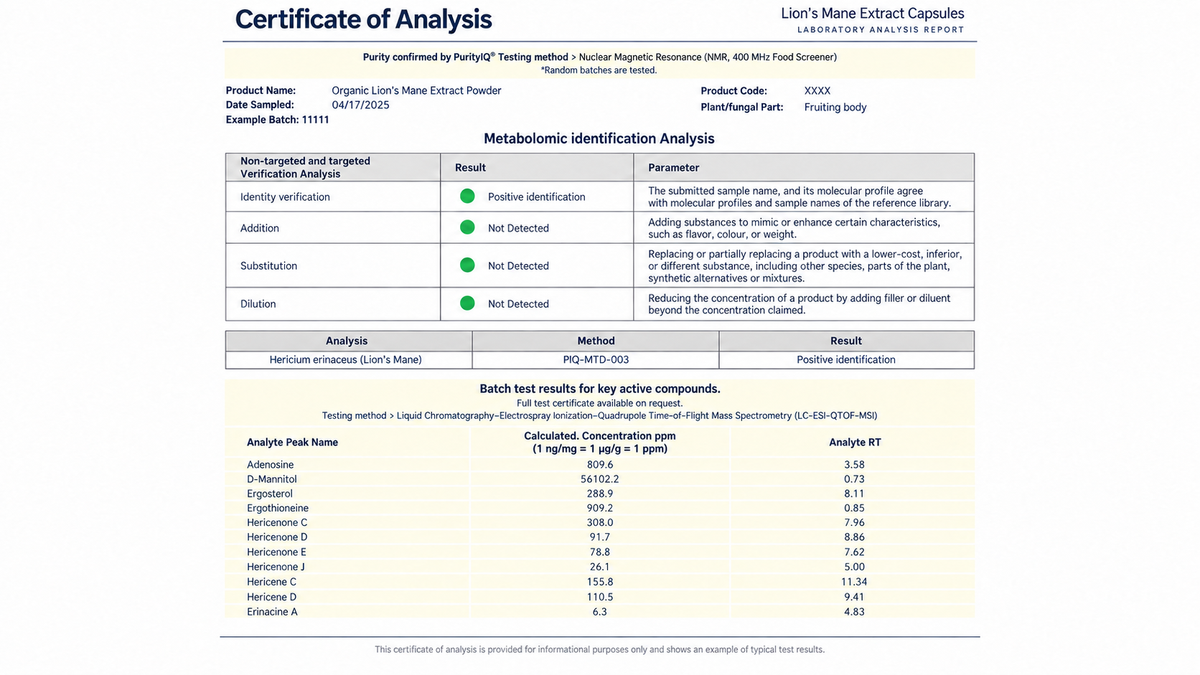
And even when test results are provided, they are not always easy to interpret. Understanding how to read a Shilajit lab report can help distinguish between meaningful analytical data and information that is presented without context.
What actually matters
If you step back, a few things become clear.
A meaningful product should be:
- Tested for contaminants, not just composition
- Screened using appropriate methods
- Low in unwanted compounds
- Consistent between batches
This is not always visible on a label.
It is also where most of the real information sits.
The bottom line
Shilajit is often presented in terms of what it contains.
What matters just as much is what it does not contain.
PAHs, residual solvents, and microbial contamination are not headline features.
They are part of the underlying quality.
Most products do not show this.
That does not mean it has been checked.
Where this fits
This is one part of a broader system.
To properly evaluate Shilajit, you also need to consider:
- Testing methods
- Mineral composition
- Sourcing
- Processing
For a wider view, see:
- How Shilajit Testing Actually Works
- What to Look for When Buying Shilajit
- Explore the Full Shilajit Guide
Written By
Written by Chris Simon, Founder of One Life Foods.
Chris has worked in the supplement industry since 2009 and is known for seeking out exceptional ingredients, products, and formulations. Read more about Chris and the story behind One Life Foods.
Share:
Shilajit Myths: What’s True, What Isn’t, and What The Evidence Shows
How Shilajit Testing Works (And What Most Brands Don’t Show)