


Electrolytes are not just a label feature
Electrolytes have become one of those words that appears everywhere.
Drinks. Powders. Tablets. Sachets. Gels. Daily hydration sticks. Gym tubs. Wellness products that look like they were designed by a fruit bowl with a marketing budget.
But electrolytes are not just a fashionable label term.
They are charged minerals that help the body manage fluid balance, nerve signalling, muscle contraction and other basic systems that become very relevant when you train, sweat or ask your body to do something more demanding than sit politely.
If hydration is the fluid side of the story, electrolytes are part of the control system.
They help decide where water goes, how electrical signals move and how muscles receive the messages needed to contract.
Not glamorous.
Quite important.
What are electrolytes?
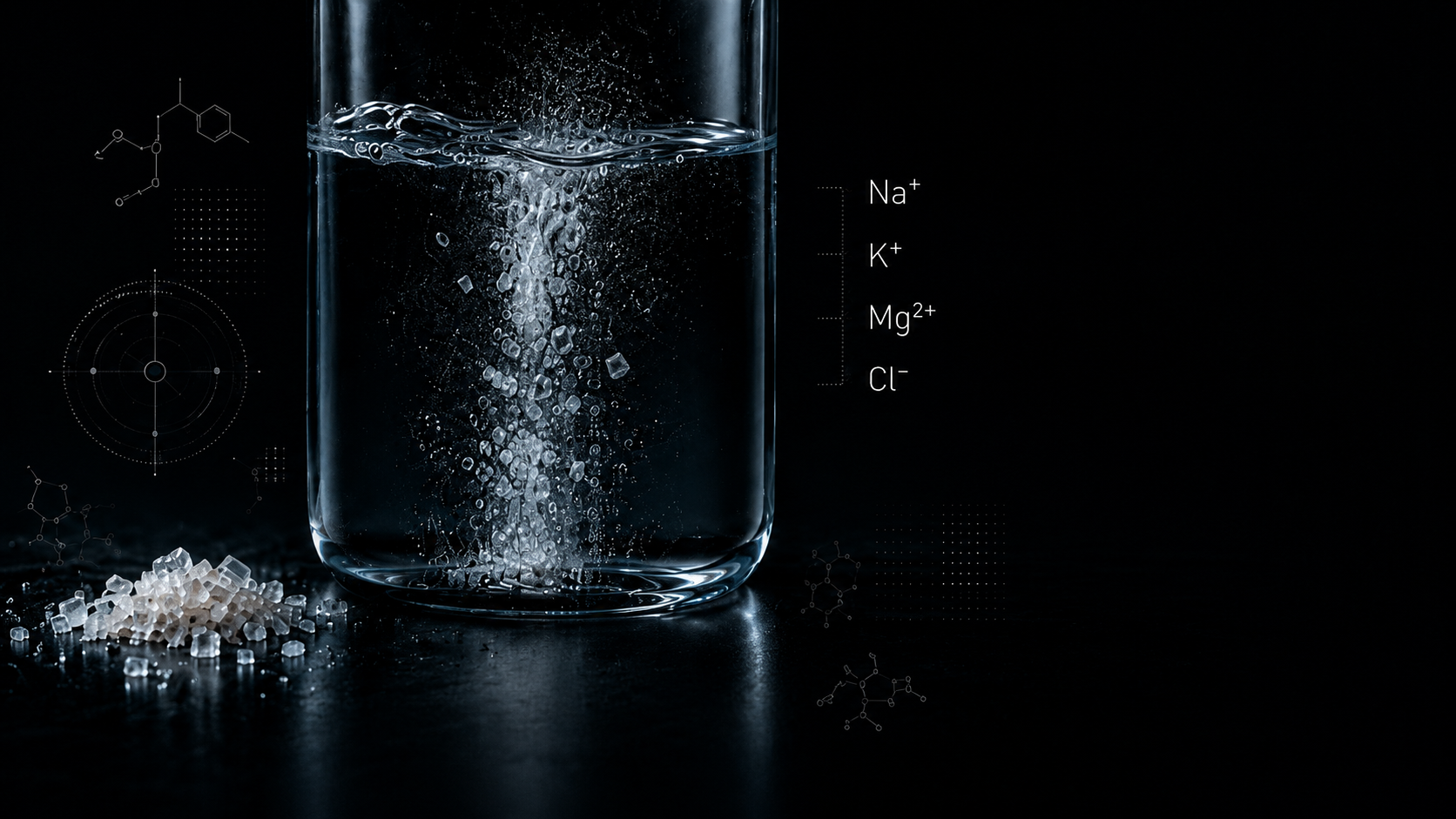
Electrolytes are minerals that carry an electrical charge when dissolved in fluid.
For training and hydration, the key electrolytes to understand are:
-
Sodium
-
Potassium
-
Chloride
-
Magnesium
-
Calcium
These minerals are found in body fluids, cells, blood plasma and sweat.
They help support:
-
Fluid balance
-
Blood volume
-
Nerve signalling
-
Muscle contraction
-
Acid-base balance
-
Normal cellular function
The word “electrolyte” comes from the fact that these minerals conduct electricity when dissolved in water.
That sounds dramatic, but it is simply how the body works.
Your nerves use electrical signals.
Your muscles respond to electrical signals.
Your cells rely on carefully managed mineral gradients.
So when people say electrolytes matter for performance, they are not saying minerals turn you into a superhero.
They are saying the body uses charged minerals to run properly.
Less exciting on a poster.
Much more useful in real life.
Why electrolytes matter for hydration
Hydration is not just drinking water.
Water has to be absorbed, distributed and retained in the right places.
Electrolytes help manage that process.
The body stores fluid in different compartments.
Some fluid sits inside your cells. This is called intracellular fluid.
Some fluid sits outside your cells. This is called extracellular fluid.
Sodium is the main electrolyte outside cells.
Potassium is the main electrolyte inside cells.
This difference helps create electrical and fluid gradients across cell membranes. Those gradients are essential for nerve impulses, muscle contraction and normal cell function.
In simple terms:
Water is the fluid.
Electrolytes help manage the system.
That is why hydration is not just a “drink more” conversation.
If you train hard, sweat heavily or spend time in heat, the electrolyte side becomes more relevant.
Sodium: the main extracellular electrolyte
Sodium is the main positively charged electrolyte in extracellular fluid.
That means it plays a central role in fluid balance outside your cells, including blood plasma.
Sodium helps support:
-
Extracellular fluid balance
-
Blood volume
-
Thirst regulation
-
Nerve signalling
-
Muscle function
-
Fluid retention after sweating
It is also the electrolyte most closely linked with sweat loss.
This is why sodium is so important in sports hydration.
Not because salt is fashionable.
Because sweat contains sodium, and sodium helps the body manage fluid.
For normal daily life, excessive sodium intake may be a concern for some people. That is a separate context.
For heavy sweating, long sessions, hot conditions or endurance work, sodium becomes a more practical performance consideration.
Context matters.
A desk lunch and a two-hour conditioning session are not the same sodium conversation.
Chloride: sodium’s quieter partner
Chloride is the main negatively charged electrolyte in extracellular fluid.
It often travels with sodium as sodium chloride, which is salt.
In hydration, chloride is often ignored because sodium gets the headlines.
Poor chloride. Always present. Rarely thanked.
But chloride matters.
It helps support:
-
Fluid balance
-
Acid-base balance
-
Electrical neutrality
-
Digestion, as part of stomach acid
In sweat, chloride is commonly lost alongside sodium.
That means sweat loss is not just a sodium story. Chloride is part of the picture too.
This is why a serious hydration formula should not ignore chloride completely, especially if it is built around sweat replacement.
It may not look exciting on the front of the label, but it has a job.
A useful habit for ingredients, really.
Potassium: the main intracellular electrolyte
Potassium is the main positively charged electrolyte inside cells.
It works closely with sodium to help maintain electrical gradients across cell membranes.
Those gradients are vital for nerve signalling and muscle function.
Potassium supports:
-
Intracellular fluid balance
-
Muscle function
-
Nerve signalling
-
Heart rhythm
-
Normal cellular function
Most people get potassium through food.
Good sources include potatoes, bananas, beans, lentils, yoghurt, leafy greens, tomatoes and fruit.
In sweat, potassium losses are usually lower than sodium losses, but potassium still has a role in a balanced electrolyte profile.
For sports hydration, potassium is usually a supporting mineral rather than the main sweat-loss priority.
That does not make it unimportant.
It just means it should not distract from sodium and chloride when sweat replacement is the main job.
Important does not always mean headline act.
Magnesium: energy metabolism, muscle and nerves
Magnesium is involved in hundreds of enzymatic reactions in the body.
It contributes to:
-
Energy metabolism
-
Muscle function
-
Nervous system function
-
Electrolyte balance
-
Protein synthesis
-
Normal psychological function
-
Reduction of tiredness and fatigue, where intake is inadequate
Magnesium is also closely tied to ATP biology. ATP is the body’s main energy currency, and magnesium is part of how ATP functions in the body.
In hydration formulas, magnesium is usually included at lower levels than sodium because sweat losses are much lower and higher doses can affect digestion.
This matters.
More magnesium is not automatically better in an intra-workout drink.
Nobody wants their hydration strategy to turn into a digestive emergency halfway through squats.
A sensible dose, in a suitable form, is the better approach.
Calcium: more than bones
Calcium is best known for bone health, but it also plays an important role in muscle contraction and nerve signalling.
When a muscle contracts, calcium ions help trigger the process that allows muscle fibres to generate force.
Calcium supports:
-
Muscle contraction
-
Nerve signalling
-
Bone maintenance
-
Cellular communication
In sports hydration, calcium is usually included in modest amounts as part of a broader electrolyte profile.
It is not usually the main electrolyte lost through sweat.
It is not usually the main reason a hydration product works.
But it does have a role.
A good formula understands that role and doses it accordingly.
A poor formula adds lots of calcium because people recognise the word and it makes the label feel healthy.
There is a difference.
The sodium-potassium relationship
Sodium and potassium are often discussed together because they sit on opposite sides of the cell membrane.
Sodium is mostly outside cells.
Potassium is mostly inside cells.
The body uses the sodium-potassium pump to help maintain this balance. This pump moves sodium out of cells and potassium into cells.
That gradient supports:
-
Nerve impulses
-
Muscle contraction
-
Cell volume
-
Electrical signalling
-
Normal cellular function
This is one of the reasons electrolyte balance matters during training.
Your muscles and nerves do not simply need water.
They need the right electrical environment.
That is less catchy than “hydration boost”, but it is more accurate.
Electrolytes and muscle function
Muscle contraction depends on electrical signalling.
Nerves send signals to muscles.
Electrolytes help create and transmit those signals.
Sodium and potassium are central to nerve impulse generation.
Calcium helps trigger contraction inside muscle cells.
Magnesium contributes to normal muscle function and energy metabolism.
This does not mean taking electrolytes automatically makes you stronger.
It means poor fluid and electrolyte balance can make it harder for the body to perform normally, especially during demanding training, heat or heavy sweat loss.
Electrolytes support function.
They do not replace training, food or recovery.
Shocking news for anyone hoping a sachet could replace sensible habits.
Electrolytes and cramps
Cramps are complicated.
They can be linked to fatigue, training load, heat, neuromuscular factors, hydration status and electrolyte changes.
Electrolytes may help some people, especially heavy sweaters or people training in hot conditions.
But they are not a guaranteed fix for every cramp.
That is important.
If a product claims to stop cramps as if the human body is a faulty lamp, be cautious.
A better approach is to look at the wider picture:
-
Training load
-
Conditioning
-
Heat exposure
-
Sweat rate
-
Sodium intake
-
Fluid intake
-
Recovery
-
Sleep
-
Carbohydrate intake
-
Overall diet
Electrolytes can be part of the answer.
They are rarely the whole answer.
The body does enjoy making things inconvenient.
Electrolytes and sweat
When you sweat, you lose both water and electrolytes.
The main sweat electrolytes are sodium and chloride.
Potassium, magnesium and calcium are also present, usually in smaller amounts.
This is where hydration needs become more individual.
Sweat rate varies widely.
Sweat sodium concentration varies widely too.
Two athletes can do the same session and lose very different amounts of fluid and sodium.
This is why generic hydration advice often falls short.
For a full breakdown of sweat composition, read What Electrolytes Do You Lose in Sweat? Sodium, Chloride, Potassium and Magnesium Explained.
The key point here is simple:
Electrolytes matter more when sweat loss matters more.
Elemental electrolytes: the label detail that matters
Electrolytes in supplements are usually delivered as compounds.
For example:
-
Sodium citrate
-
Sea salt
-
Potassium gluconate
-
Magnesium malate
-
Calcium citrate
The compound weight is not the same as the actual mineral amount.
That is why elemental values matter.
Elemental sodium means the actual sodium delivered.
Elemental potassium means the actual potassium delivered.
Elemental magnesium means the actual magnesium delivered.
A transparent electrolyte label should make this clear.
Otherwise, a product can look stronger than it really is by listing large compound weights.
This is one reason RE-UP uses fully disclosed elemental electrolyte values.
The point is not to make the label look busy.
The point is to show what the product actually delivers.
No hidden mineral maths.
No polite guessing.
Electrolytes in food vs supplements
You can get electrolytes from food.
And for normal daily life, you usually should.
Sodium comes from salt and salted foods.
Potassium comes from potatoes, fruit, vegetables, beans and dairy foods.
Magnesium comes from nuts, seeds, wholegrains, dark chocolate and leafy greens.
Calcium comes from dairy foods, fortified foods, tofu, fish with bones and certain greens.
Chloride usually comes from salt.
For normal daily hydration, food and water are usually enough.
Electrolyte supplements become more useful when demand increases.
That may include:
-
Heavy sweating
-
Long sessions
-
Hot conditions
-
Endurance training
-
Conditioning work
-
High-volume strength training
-
Repeated sessions
-
Sauna use
-
Late training where stimulants are not ideal
Supplements are tools.
Food is still the foundation.
Deeply inconvenient, but there we are.
What makes an electrolyte profile useful?
A useful electrolyte profile should match the intended use.
A casual daily hydration product does not need to look like an intra-workout formula for heavy sweaters.
An endurance fuel does not need to look like a gym hydration product.
A fasting electrolyte does not need to look like a Pink Lemonade intra-workout.
Different markets. Different formulas. Different jobs.
A good electrolyte profile should consider:
-
Sodium level
-
Chloride level
-
Potassium level
-
Magnesium dose
-
Calcium dose
-
Elemental mineral disclosure
-
Intended use
-
Water volume
-
Drinkability
-
Whether the formula includes other performance support
A product should make sense as a system.
Not just as a list of minerals arranged hopefully.
Where RE-UP fits
This article is about electrolyte chemistry, so the RE-UP point here is simple.
RE-UP uses fully disclosed elemental values for its electrolyte base.
That matters because electrolyte products should be judged by what they actually deliver, not by how impressive the compound names or raw weights appear on a label.
The broader formula architecture is covered in What Makes a Good Intra-Workout Hydration Formula?
For ingredient forms like sodium citrate, potassium gluconate and magnesium malate, see Electrolyte Forms Explained.
Here, the key point is transparency:
If a product is built around electrolytes, it should tell you the real electrolyte values.
The One Life Foods view
Electrolytes are not magic.
They are charged minerals with specific roles in fluid balance, nerve signalling and muscle function.
For people who train hard, sweat heavily or want better intra-workout consistency, electrolytes deserve proper attention.
That means meaningful dosing.
Clear labels.
Elemental values.
No proprietary blends.
No vague “mineral complex” pretending to be a strategy.
Hydration should be measured.
Performance should be structured.
Guesswork can stay in the bargain bin where it belongs.
The bottom line
Electrolytes are charged minerals that help the body manage fluid balance, electrical signalling and muscle contraction.
For hydration and training, the key electrolytes are sodium, potassium, chloride, magnesium and calcium.
Sodium and chloride are especially important in sweat loss.
Potassium supports intracellular balance.
Magnesium supports energy metabolism, muscle function and nervous system activity.
Calcium supports muscle contraction and nerve signalling.
A good electrolyte formula should disclose meaningful elemental values and match the demands of the session.
Because when it comes to hydration, what is actually delivered matters more than what looks impressive on a label.
Continue learning
Explore more from the One Life Foods hydration hub:
-
Hydration for Performance: Electrolytes, Sweat Loss and Intra-Workout Consistency Explained
-
What Electrolytes Do You Lose in Sweat? Sodium, Chloride, Potassium and Magnesium Explained
-
Why Sodium Helps Hydration: Fluid Balance, Nerve Signals and Performance
-
What Makes a Good Intra-Workout Hydration Formula? Electrolytes, Osmolytes and Label Transparency
-
Electrolyte Forms Explained: Mineral Salts, Bioavailability and Why Compound Weight Can Mislead
Written By
Written by Chris Simon, Founder of One Life Foods.
Chris has worked in the supplement industry since 2009 and is known for seeking out exceptional ingredients, products, and formulations. Read more about Chris and the story behind One Life Foods.



Share:
Hydration for Performance: Electrolytes, Sweat Loss and Intra-Workout Consistency Explained
Why Sodium Helps Hydration: Fluid Balance, Nerve Signals and Performance